
May 25, 2026
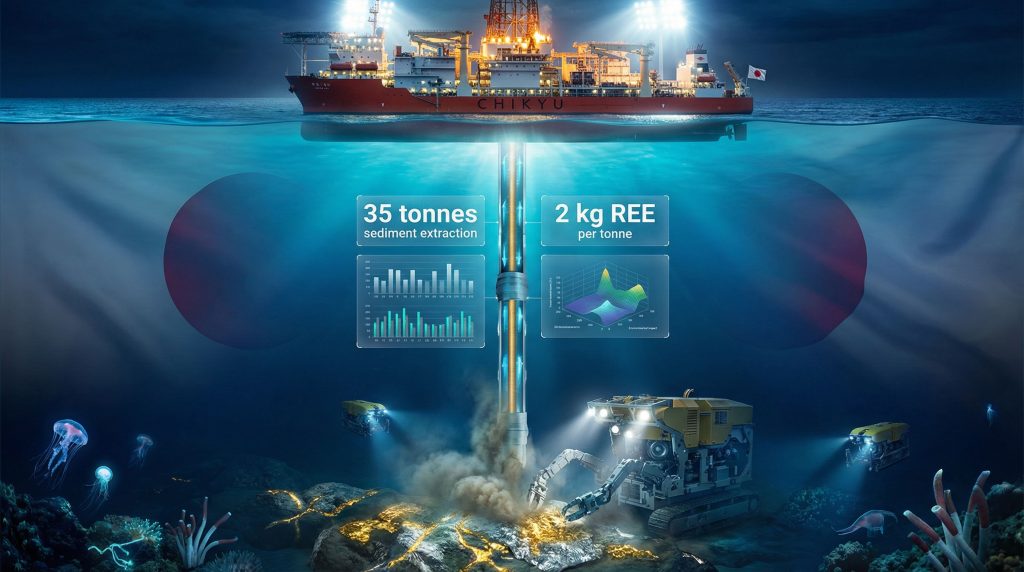
Japan's deep-sea mining trial stands at the forefront of addressing global supply chain vulnerabilities through innovative marine resource extraction. This groundbreaking operation represents one of the most technically challenging resource frontiers, requiring unprecedented coordination between technological innovation and environmental stewardship.
Current seabed governance structures face mounting pressure to balance competing interests: resource security for developed nations and environmental protection for fragile ecosystems. Furthermore, deep‑sea mining concerns have created regulatory gaps that individual nations are addressing through independent approaches within their territorial waters.
What Makes Japan's 6-Kilometre Deep Mining Operation a Regulatory Watershed?
Japan's pioneering approach to deep-sea mineral extraction establishes new precedents for how nations can pursue resource independence while navigating complex international frameworks. The country's strategy operates within established territorial boundaries while voluntarily adopting international standards, creating a hybrid governance model that could reshape global resource extraction protocols.
The Jurisdictional Framework Behind Japan's EEZ Strategy
Japan's deep-sea mining trial operates strategically within its Exclusive Economic Zone near Minamitorishima, approximately 1,900 kilometres southeast of Tokyo. This positioning allows the operation to proceed without direct International Seabed Authority oversight while maintaining voluntary compliance with ISA environmental guidelines.
The research vessel Chikyu, operated by the Japan Agency for Marine-Earth Science and Technology, departed Port of Shimizu on January 12, 2026, targeting extraction at approximately 6 kilometres depth. However, this operational framework demonstrates how nations with extensive territorial waters can pursue resource development independently while contributing to international best practices.
This dual-compliance approach represents a significant regulatory innovation. By operating within EEZ boundaries, Japan maintains sovereign authority over the operation whilst demonstrating commitment to environmental standards through voluntary ISA guideline adoption. Consequently, this model could establish precedent for other nations with deep-water territorial claims seeking resource extraction opportunities.
Technical Specifications of the Chikyu-Based Extraction System
The trial employs a direct pipe-lift methodology designed for extreme-depth operations. The system targets extraction of 35 tonnes of seabed sediment over a 3-4 week operational period, with processing occurring directly aboard the drilling vessel rather than requiring shore-based facilities.
Key operational parameters include:
- Extraction depth: 6,000 metres below sea level
- Target yield: 2 kilograms of rare earth elements per tonne of extracted material
- Processing methodology: Real-time onboard dewatering and sediment classification
- Operational timeline: Extended trial period for comprehensive data collection
The pipe-lift system represents a departure from traditional dredging operations, requiring specialised equipment capable of maintaining structural integrity under extreme pressure conditions. This technological approach minimises surface footprint whilst maximising extraction precision at unprecedented depths.
When big ASX news breaks, our subscribers know first
Why Is This Trial Critical for Global Rare Earth Supply Chain Security?
Current global rare earth element supply chains exhibit dangerous concentration risks that threaten technological infrastructure across multiple sectors. Japan's deep-sea mining trial directly addresses these vulnerabilities through domestic resource development, potentially reshaping international supply dynamics alongside broader industry evolution trends.
China's Market Dominance and Export Restriction Impact
China currently controls approximately 70% of global rare earth production, creating strategic vulnerabilities for nations dependent on these critical materials. Recent export restrictions amid escalating geopolitical tensions have highlighted the risks of single-source dependency for defence technologies, renewable energy systems, and advanced electronics manufacturing.
Supply chain concentration creates risks across multiple sectors:
- Defence technology manufacturing requiring specialised rare earth alloys
- Renewable energy infrastructure, particularly wind turbine permanent magnets
- Telecommunications and satellite systems dependent on rare earth components
- Electric vehicle battery technologies and charging infrastructure
The concentration of rare earth processing capabilities in China extends beyond raw material extraction. Moreover, processing facilities, refining technologies, and downstream manufacturing create additional chokepoints that amplify supply chain risks for consuming nations.
Japan's ¥40 Billion Investment Strategy Analysis
Japan's commitment of ¥40 billion (approximately $275-280 million USD) to deep-sea mining development since 2018 represents a national security investment rather than purely commercial venture. The programme targets demonstration-scale operations by 2027, with planned daily extraction capacity reaching 350 tonnes.
This investment timeline spans nearly a decade, indicating long-term strategic planning rather than opportunistic resource development. In addition, the funding encompasses research and development for specialised extraction equipment, environmental monitoring technologies, infrastructure development, and operational trials.
Cost-benefit analysis considerations include:
| Factor | Deep-Sea Extraction | Traditional Land-Based Mining |
|---|---|---|
| Initial Capital | Very High | Moderate to High |
| Environmental Impact | Ocean Ecosystem | Terrestrial Ecosystem |
| Geopolitical Risk | Low (Domestic EEZ) | Variable by Location |
| Supply Chain Control | Complete Domestic | Subject to Export Restrictions |
What Environmental Governance Challenges Does Deep-Sea Mining Present?
Deep-sea mining operations present unprecedented environmental governance challenges due to limited scientific understanding of abyssal ecosystems and the irreversible nature of potential damage. The international scientific community has expressed significant concerns about proceeding with commercial-scale extraction before comprehensive environmental impact assessments are completed.
International Scientific Community Response
Over 800 scientists have called for a moratorium on deep-sea mining operations, citing insufficient understanding of ecosystem impacts and inadequate regulatory frameworks. Additionally, more than 20 governments have advocated for development pauses until comprehensive environmental protections are established.
"The scientific consensus emphasises that deep-sea environments represent some of Earth's least understood ecosystems, with organisms exhibiting extremely slow reproduction cycles and limited recovery capacity from disturbance."
Key environmental concerns include:
- Sediment plume generation affecting water column organisms
- Benthic habitat destruction with century-scale recovery timelines
- Potential impacts on carbon sequestration processes
- Disruption of deep-sea food webs and biodiversity hotspots
The extreme conditions at 6-kilometre depths create unique ecological challenges. Furthermore, organisms adapted to high pressure, low temperature, and limited food sources exhibit metabolic rates and reproduction cycles that make ecosystem recovery extremely slow following disturbance.
Environmental Monitoring and Mitigation Protocols
Japan has developed proprietary monitoring technologies for real-time environmental assessment during extraction operations. These systems focus on sediment plume dispersion management, water quality monitoring, and baseline ecosystem documentation.
Monitoring framework components include:
- Pressure-resistant sensors capable of 6,000+ metre operation
- Particle size distribution analysis for sediment characterisation
- Chemical composition sensors for rare earth concentration measurement
- Baseline biodiversity surveys for impact comparison
Long-term fauna recovery assessment protocols build on previous small-scale testing, though comprehensive recovery data remains limited due to the novel nature of deep-sea sediment extraction at this scale. For instance, mining permitting processes in marine environments require entirely new frameworks compared to terrestrial operations.
How Could This Trial Influence International Seabed Authority Regulations?
Japan's regulatory approach could significantly influence International Seabed Authority framework development, particularly as the ISA works toward completing exploitation regulations initially targeted for 2025 completion. The voluntary compliance model demonstrates how national operations can meet international standards without direct ISA authorisation.
Current Regulatory Development Timeline
The ISA's regulatory development process has experienced multiple delays as member nations debate environmental protection standards, benefit-sharing mechanisms, and enforcement protocols. Consequently, Japan's trial provides real-world data that could inform these ongoing discussions.
Regulatory development challenges include:
- Establishing environmental impact thresholds for commercial operations
- Creating effective monitoring and enforcement mechanisms
- Balancing resource development with environmental stewardship mandates
- Ensuring equitable benefit distribution among member nations
Precedent Setting for Future Deep-Sea Operations
Japan's approach establishes several important precedents for future deep-sea mining governance. Resource security justifications versus environmental protection represent a fundamental tension in deep-sea mining regulation, whilst Japan's operation demonstrates how nations can prioritise resource security while maintaining environmental monitoring commitments.
Technology transfer implications for developing nations raise questions about intellectual property rights and benefit-sharing obligations. However, Japan's technological innovations could become subject to international sharing agreements under ISA frameworks.
National sovereignty arguments in EEZ mineral extraction challenge traditional interpretations of the "common heritage of mankind" principle that underlies ISA authority over seabed resources.
What Are the Geopolitical Implications of Successful Extraction?
Successful deep-sea rare earth extraction could fundamentally alter regional power dynamics in the Indo-Pacific whilst reducing global dependency on Chinese-controlled supply chains. The strategic implications extend beyond commercial considerations to encompass defence technology requirements and alliance cooperation frameworks.
Regional Security Considerations in the Indo-Pacific
Chinese naval activity monitoring near extraction sites suggests deep-sea resource extraction has transitioned from purely economic to strategic competition. Furthermore, Japan's technological demonstration affects regional military and technological capability assessments.
Strategic competition factors include:
- Technology demonstration for extreme-environment resource extraction
- Regional alliance implications for U.S.-Japan resource cooperation
- Impact on broader Indo-Pacific strategic positioning
- Potential influence on Taiwan's semiconductor supply chain security
Japan's defence technology sector requires substantial rare earth element volumes for advanced radar systems, telecommunications infrastructure, precision-guided munitions, and satellite technology. Consequently, domestic extraction capability reduces vulnerability to export restrictions during potential conflicts. This aligns with broader critical minerals strategy initiatives worldwide.
Global Supply Chain Diversification Potential
Geological surveys from 2018 indicate estimated reserves of 16 million metric tons of rare earth elements in Japanese territorial waters near Minamitorishima. At current global consumption rates of approximately 130,000-150,000 metric tons annually, these reserves could provide century-scale supply capacity.
Market impact projections include:
| Scenario | China's Market Share | Price Stability | Strategic Impact |
|---|---|---|---|
| Current State | 70% | Volatile | High Chinese Leverage |
| Successful Japanese Production | 50-60% | More Stable | Reduced Chinese Leverage |
| Multiple Deep-Sea Operations | 40-50% | Stable | Limited Chinese Leverage |
Supply chain diversification through deep-sea extraction could reduce China's ability to use rare earth export restrictions as geopolitical leverage. Additionally, it could create price stability for consuming industries whilst supporting energy transition security objectives globally.
What Technical Innovations Could Emerge from This Trial?
Japan's deep-sea mining trial represents a convergence of multiple advanced technologies, from extreme-depth materials engineering to real-time environmental monitoring systems. The technical innovations developed for this operation could have applications across marine research, offshore energy, and underwater construction sectors.
Deep-Sea Extraction Technology Development
The pipe-based lifting system operates at depths where pressure exceeds 600 atmospheres, requiring materials and engineering solutions that push the boundaries of current technology. System efficiency optimisation focuses on maximising extraction whilst minimising energy consumption and environmental impact.
Technical innovation areas include:
- Ultra-high-pressure pipe systems with integrated monitoring
- Onboard processing capabilities for immediate sediment classification
- Remote operation technologies for 6,000-metre depth control
- Real-time data transmission from extreme depth environments
Processing methodology development emphasises onboard dewatering and concentration systems that reduce the volume of material requiring transport whilst maximising rare earth recovery rates. These systems must operate reliably in marine environments with minimal maintenance requirements.
Data Collection and Analysis Frameworks
High-concentration rare earth deposits identified through geological surveys show concentrations up to 5,000 parts per million in target areas. Real-time monitoring systems must accurately measure these concentrations whilst tracking environmental parameters across the extraction zone.
Advanced monitoring capabilities include:
- Chemical composition sensors for continuous rare earth quantification
- Sediment plume tracking for environmental impact assessment
- Pressure and flow monitoring for extraction optimisation
- Integrated data systems for real-time decision making
Economic viability assessment metrics developed during the trial will establish benchmarks for commercial-scale operations, including extraction efficiency, processing costs, and environmental monitoring expenses.
The next major ASX story will hit our subscribers first
How Might Other Nations Respond to Japan's Deep-Sea Mining Success?
Successful Japanese deep-sea rare earth extraction would likely trigger competitive responses from other nations with deep-sea mineral potential in their territorial waters. The demonstration of technical feasibility and economic viability could accelerate global deep-sea mining development timelines.
Potential EEZ Claims and Exploration Programmes
Nations with extensive exclusive economic zones containing potential rare earth deposits may accelerate exploration and development programmes. For instance, the regulatory framework established by Japan provides a template for independent deep-sea mining operations.
Countries with significant deep-sea mineral potential include:
- Australia: Extensive southern ocean EEZ areas
- New Zealand: Pacific territorial waters with mineral deposits
- Canada: Atlantic and Pacific deep-sea territories
- Norway: North Sea and Arctic mineral resources
Technology licensing opportunities could emerge as Japan develops commercial-scale extraction capabilities. Nations lacking independent deep-sea mining technology may seek partnership agreements or licensing arrangements for Japanese innovations.
What Are the Long-Term Economic and Strategic Outcomes?
Japan's deep-sea mining initiative represents a fundamental shift toward resource independence through technological innovation rather than traditional diplomatic or commercial arrangements. The long-term success of this approach could reshape global resource extraction paradigms and strategic planning across multiple nations.
Resource Independence Achievement Timeline
Japan's pathway to reduced Chinese rare earth dependency extends beyond the current trial to encompass full-scale commercial operations and strategic stockpiling capabilities. The 2027 demonstration target of 350 tonnes daily extraction represents an intermediate milestone toward commercial viability.
Timeline projections include:
| Phase | Target Date | Capacity | Strategic Impact |
|---|---|---|---|
| Current Trial | 2026 | 35 tonnes total | Proof of concept |
| Demonstration | 2027 | 350 tonnes/day | Economic feasibility |
| Commercial Scale | 2030+ | Multiple operations | Supply chain impact |
Integration with existing rare earth processing infrastructure requires substantial additional investment in refining and manufacturing capabilities. Japan's approach emphasises complete domestic supply chain development rather than raw material extraction alone.
Commercial Viability Assessment Framework
Current operational focus prioritises national security objectives over immediate profitability, allowing for longer-term investment horizons and technology development without short-term return pressures. This approach contrasts with traditional mining ventures that require rapid return on investment.
Economic assessment factors include:
- Extraction costs versus traditional land-based alternatives
- Processing and refining expense integration
- Transportation and logistics optimisation
- Strategic value versus commercial market pricing
Scaling requirements for economically competitive operations will depend on continued technology development, regulatory stability, and market conditions for rare earth elements across multiple consuming industries.
According to ABC News Australia, Japan's ambitious timeline reflects the urgency of addressing supply chain vulnerabilities in critical technologies. Furthermore, detailed analysis from Mining Magazine highlights the technical complexities that make this operation a watershed moment for marine resource extraction.
Disclaimer: This analysis contains forward-looking statements regarding Japan's deep-sea mining trial programme, technological development timelines, and market impacts. Actual results may vary significantly based on technological challenges, regulatory changes, environmental considerations, and market conditions. Investment and policy decisions should consider multiple scenarios and expert consultation.
Japan's deep-sea mining trial establishes new paradigms for resource extraction that balance national security interests with environmental stewardship and international cooperation. The regulatory innovations developed through this approach could influence global frameworks for deep-sea resource development whilst demonstrating the feasibility of technologically advanced alternatives to traditional supply chain dependencies. Success in this endeavour would provide Japan with unprecedented resource security whilst contributing valuable data and methodologies to the international community's understanding of sustainable deep-sea mining practices.
Interested in Alternative Resource Investment Opportunities?
Japan's groundbreaking deep-sea mining trial demonstrates how innovative extraction technologies can reshape global supply chains and create new investment paradigms. Discovery Alert's proprietary Discovery IQ model delivers real-time notifications on significant ASX mineral discoveries, enabling subscribers to identify emerging opportunities in critical minerals and rare earth exploration before they capture broader market attention. Start your 30-day free trial today to position yourself ahead of evolving resource sector developments.