June 10, 2026
The Hidden Architecture of Asia's Energy Security Crisis
The global energy system has never operated in isolation from geopolitics, but the degree to which hydrocarbon supply chains are now weaponised instruments of statecraft marks a genuine structural shift. For heavily import-dependent economies, this is not a theoretical risk but a lived operational reality. Nowhere is this tension more acute than in East Asia, where industrialised nations with negligible domestic energy production must navigate a world of constrained corridors, hostile state actors, and commodity markets that reprice risk faster than diplomatic frameworks can respond.
Japan sits at the centre of this challenge. Its energy import dependency is near-total, its industrial economy is feedstock-intensive, and its peak electricity demand period coincides precisely with the months in which Middle Eastern geopolitical stress typically escalates. Understanding how Tokyo is responding to this structural exposure requires looking beyond individual bilateral agreements to the deeper architecture being constructed across multiple commodity domains simultaneously.
When big ASX news breaks, our subscribers know first
Why Japan's Hydrocarbon Dependency Creates a Compounding Vulnerability
Japan imports virtually all of the fossil fuels it consumes. LNG alone accounts for a dominant share of the country's electricity generation and industrial heat supply, with the fuel underpinning operations across steel, chemicals, ceramics, paper, and food processing sectors. Unlike crude oil, LNG cannot be stored at scale on land without specialised infrastructure, meaning supply continuity depends heavily on uninterrupted maritime delivery chains.
The Strait of Hormuz is the critical pressure point in this system. Approximately one-fifth of all global crude oil and LNG shipments pass through this narrow waterway, and conflict-linked disruptions affecting transit flows create cascading shortfalls across every East Asian economy that depends on Persian Gulf producers. Japan's exposure is compounded by the fact that Qatar, one of its significant LNG suppliers, is a Hormuz-dependent exporter.
The timing dimension makes this structurally dangerous. Japan's air-conditioning season peaks across July and August, placing maximum strain on gas-fired power generation precisely when geopolitical uncertainty in the Middle East corridor tends to be at its highest. The window available to reroute emergency supply, negotiate spot cargo diversions, or draw down strategic reserves is narrow, creating a risk concentration that no single bilateral agreement can fully neutralise.
Japan's LNG Import Mix: A Structural Overview
| Supplier Country | Estimated Share of Japan's LNG Imports | Key Risk Factor |
|---|---|---|
| Australia | ~40% | Largest supplier; separate energy MOU signed May 2026 |
| Malaysia | ~15% | Second-largest; Bintulu-anchored, Hormuz-independent |
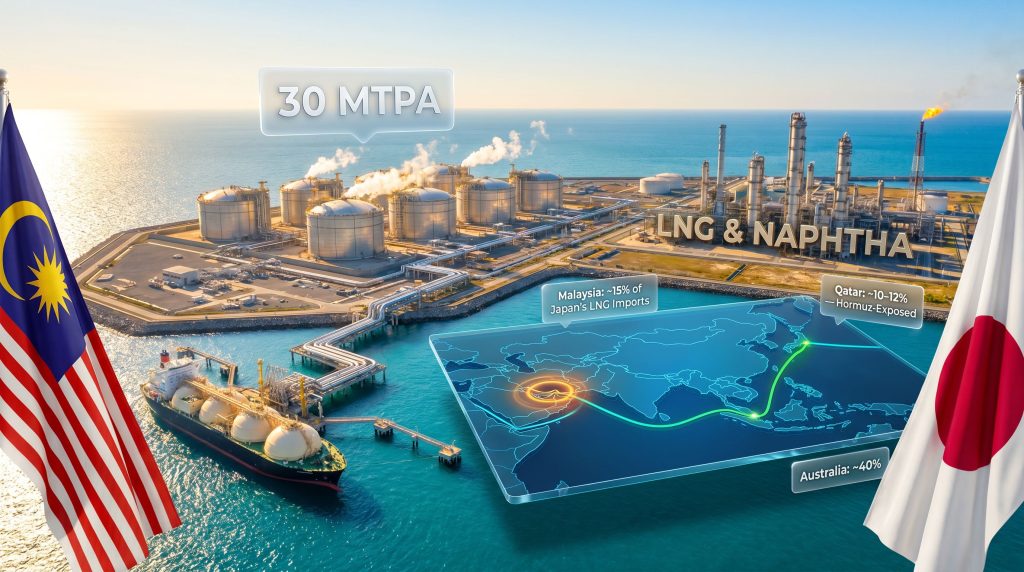
| Qatar | ~10-12% | Hormuz-exposed; primary vulnerability variable |
| United States | ~8-10% | Growing Pacific terminal capacity |
| Russia, PNG, Others | Remainder | Varied geopolitical and logistical risk profiles |
Key structural insight: Malaysia's geographic position outside the Strait of Hormuz corridor gives its LNG exports a risk profile fundamentally different from Middle Eastern suppliers. When Hormuz flows tighten, Malaysian cargo retains delivery reliability that Gulf-origin volumes cannot guarantee.
Malaysia's LNG Export Infrastructure: What PETRONAS Actually Controls
Malaysia's capacity to act as a reliable alternative supplier rests on one of the most significant single-site LNG production complexes in the world. The PETRONAS-operated Bintulu facility in Sarawak, Borneo, encompasses multiple production trains with a combined nameplate capacity of approximately 30 million tonnes per annum (MTPA), placing it among the largest integrated LNG export terminals globally.
What Makes Bintulu Strategically Distinctive
Several characteristics of the Bintulu complex give it operational advantages that matter specifically in supply stress scenarios:
-
Multi-train flexibility: The parallel production train configuration allows cargo scheduling to be adjusted in response to shifting demand priorities without shutting down entire production streams.
-
Condensate co-production: Malaysian LNG production generates condensate streams as a natural byproduct. These condensate flows are processed to yield naphtha-range hydrocarbons, meaning LNG supply agreements with Malaysia inherently carry a naphtha supply dimension.
-
Long-term contract relationships: PETRONAS has maintained supply relationships with Japanese utilities and trading houses for decades, creating operational familiarity and established cargo routing that reduces logistical friction during crisis periods.
-
Hormuz independence: Bintulu exports route through the South China Sea and into Pacific shipping lanes, entirely bypassing the Persian Gulf corridor.
Japan currently sources roughly 15% of its total LNG imports from Malaysia, making Kuala Lumpur its second-largest supplier after Australia. The Malaysian commitment to maximise available supply volumes to Japan — formalised in a bilateral summit pledge between Japanese Prime Minister Sanae Takaichi and Malaysian Prime Minister Anwar Ibrahim in June 2026 — represents a deliberate effort to convert this existing supply relationship into an explicit security guarantee. Furthermore, the LNG supply outlook heading into this period has added urgency to these negotiations, reinforcing why Tokyo is moving quickly to secure alternative corridors.
Naphtha: The Industrial Feedstock Dimension Most Analysts Overlook
When discussions of Malaysia Japan LNG and naphtha supplies focus exclusively on the power generation dimension, they systematically underestimate the industrial significance of the naphtha component. Naphtha is not a fuel in the conventional sense. It is the primary feedstock for steam crackers, the industrial facilities that convert light hydrocarbons into ethylene and propylene — the building blocks of virtually every petrochemical product in modern manufacturing.
The Two Distinct Naphtha Use Cases in Japan's Industrial Economy
Steam cracker naphtha feeds olefin production, supplying ethylene and propylene to manufacturers of plastics, synthetic fibres, packaging films, and specialty coatings. Japan's automotive, electronics, and consumer goods sectors all depend on this upstream feedstock chain.
Reformer naphtha feeds catalytic reforming units, producing high-octane gasoline blending components and aromatic hydrocarbons including benzene, toluene, and xylene, which feed downstream chemical synthesis.
Japan's domestic refining capacity has contracted structurally over the past decade as refiners consolidated operations and retired older units. Consequently, this has increased the country's dependency on imported naphtha and condensate-derived feedstocks. A supply disruption affecting naphtha availability does not merely raise input costs; it can force steam cracker curtailments that propagate disruption downstream across multiple industrial sectors simultaneously.
The operational logic of bundling naphtha within a bilateral LNG supply framework is therefore straightforward. Malaysian LNG production generates condensate that yields naphtha as a processing co-product. Offering both commodities under a coordinated bilateral commitment requires no fundamental restructuring of PETRONAS's production and export operations.
Industry context: The co-production relationship between LNG condensate and naphtha-range hydrocarbons means Malaysia can credibly commit to combined supply volumes in a way that pure LNG producers without condensate-rich reservoirs cannot easily replicate.
Japan's Multi-Vector Energy Diplomacy: Mapping the Broader Framework
The Malaysia summit pledge does not exist in isolation. Tokyo has been constructing a diversified bilateral energy security architecture across multiple partner nations over an accelerating timeline:
| Partner Nation | Agreement Type | Primary Commodity Focus | Timeline |
|---|---|---|---|
| Australia | Energy and Critical Minerals MOU | LNG, lithium, rare earths | May 2026 |
| Malaysia | Maximum supply commitment (summit) | LNG, naphtha | June 2026 |
| France | Rare earth supply chain MOU | Critical minerals | April 2026 |
| United States | Ongoing LNG purchase frameworks | LNG | Multi-year rolling |
The pattern reveals a deliberate strategy of geographic and commodity diversification. Australia anchors the Pacific LNG supply base. Malaysia provides the Southeast Asian Hormuz-independent pillar. France extends the diversification logic into rare earth processing capacity within Europe. The growing critical minerals demand across these economies, furthermore, is driving a convergence between energy security and industrial supply chain policy in ways that were not previously coordinated.
The Limits of Bilateral Pledges as a Security Instrument
A critical distinction separates a diplomatic supply commitment from a legally binding long-term offtake agreement. The Malaysian pledge to provide maximum possible volumes is a statement of intent and goodwill, not a contracted volume guarantee with penalty clauses and force majeure definitions. Several structural constraints apply:
-
Even at full Bintulu capacity utilisation, Malaysian supply covers approximately 15% of Japan's LNG import requirement. Offsetting a major Hormuz disruption affecting Qatar-origin volumes would require partial absorption across multiple alternative suppliers simultaneously.
-
Cargo diversion in a globally integrated LNG spot market is commercially driven. Third-party buyers offering premium spot prices can redirect Malaysian cargoes regardless of diplomatic commitments, unless underlying contracts specifically restrict diversion.
-
Strategic reserve drawdowns and demand-side industrial curtailments remain necessary complementary tools that bilateral supply pledges cannot replace.
The Rare Earth Dimension: When Energy Diplomacy Becomes Industrial Security Policy
China controls the dominant share of global rare earth production and, more critically, the overwhelming majority of refined rare earth processing capacity. The 17 elements classified as rare earths are essential inputs for permanent magnets used in EV motors and wind turbines, phosphors in display technologies, catalysts in petroleum refining, and precision guidance components in defence systems.
China rare earth restrictions on these materials have created acute supply anxiety across Japanese industrial sectors that depend on them for high-technology manufacturing. The response from Tokyo has been to embed rare earth supply diversification objectives within the same bilateral diplomatic frameworks being used to address hydrocarbon security.
Malaysia carries historical relevance in rare earth processing. The country hosted rare earth refining operations that generated significant domestic controversy over environmental and safety concerns, demonstrating both the technical capacity and the political sensitivity surrounding rare earth processing in Southeast Asian contexts. Any future cooperation in this domain would need to navigate that legacy carefully, and the broader challenges facing rare earth supply chains globally only reinforce the urgency of finding workable alternatives.
The bundling of rare earth cooperation with LNG and naphtha supply commitments within a single bilateral summit reflects a broader evolution in resource security diplomacy. Nations are increasingly treating energy commodities, petrochemical feedstocks, and critical minerals as interconnected strategic domains requiring unified negotiating frameworks rather than commodity-specific bilateral arrangements managed by separate ministries.
The next major ASX story will hit our subscribers first
Scenario Projections: Three Pathways for the Malaysia-Japan Supply Framework
Scenario 1: Sustained Hormuz Disruption
Malaysia redirects maximum available LNG cargo volume toward Japan. Bintulu operates at or near full capacity utilisation. Japan's Malaysian supply share increases at the margin but cannot fully offset Persian Gulf volume losses. Outcome: partial stabilisation requiring supplementary spot market procurement and strategic reserve activation.
Scenario 2: Moderate Supply Tightness (Most Probable Near-Term)
The Malaysian commitment provides a contractual floor for Japanese utilities during summer peak demand. Front-loaded cargo scheduling reduces spot market exposure. Naphtha co-deliveries stabilise petrochemical feedstock inventories ahead of the peak industrial production season. Outcome: effective near-term risk management without eliminating residual spot price volatility. According to reporting by Reuters, the summit commitment reflects precisely this kind of structured forward planning.
Scenario 3: Geopolitical De-escalation
Hormuz flows normalise and the maximum supply pledge transitions from a crisis management instrument to a long-term structural supply upgrade. The diplomatic relationship deepens into nuclear energy technology transfer and rare earth cooperation on an extended timeline. Outcome: durable bilateral architecture with multi-decade industrial and energy security implications extending well beyond any single supply disruption episode.
Beyond Commodities: Nuclear Technology and AI Cooperation as Strategic Anchors
The summit agenda between Prime Ministers Takaichi and Ibrahim extended beyond hydrocarbon supply to encompass cooperation in civil nuclear energy and artificial intelligence applications. Malaysia's interest in nuclear power as a long-term energy transition pathway creates an opening for Japan to leverage its nuclear technology expertise, reactor design experience, and safety framework development as diplomatic assets distinct from commodity supply relationships.
Nuclear cooperation deepens bilateral interdependence in ways that commodity agreements cannot. Technology transfer relationships create multi-year engagement architectures, training dependencies, and regulatory alignment processes that persist independently of spot market conditions or geopolitical fluctuations.
Joint AI policy development targeting applied use cases in agriculture, mobility, and education represents a further layer of partnership diversification that extends the bilateral relationship beyond commodity cycle volatility into domains with longer-term strategic durability.
What the Malaysia-Japan Framework Signals for Asian Energy Markets
Several structural conclusions emerge from this analysis that carry implications beyond the immediate bilateral relationship:
-
Geographic supply diversification is accelerating faster than market pricing reflects. The systematic construction of Hormuz-independent supply relationships by Japan suggests that Asian LNG importers are increasingly pricing geopolitical risk into their supply architecture decisions, not merely into spot cargo premiums.
-
Naphtha security is a systematically underappreciated industrial vulnerability. The inclusion of naphtha alongside LNG in the bilateral commitment reflects awareness that industrial feedstock disruption can propagate damage through manufacturing supply chains in ways that power generation disruptions, while more visible, do not.
-
Critical mineral and hydrocarbon diplomacy are converging into unified frameworks. The embedding of rare earth cooperation within an energy summit represents a model that other resource-importing nations are likely to replicate. In addition, critical raw materials transition pressures are accelerating the need for exactly these kinds of multilateral resource security agreements.
-
Bilateral pledges are necessary but structurally insufficient. Maximum supply commitments provide important diplomatic and operational floors but require reinforcement through long-term contracted volumes, strategic reserve capacity, and demand-side flexibility to constitute a complete supply security architecture. Analysis from Nikkei Asia highlights precisely why these commitments, while significant, represent a starting point rather than a final solution for Malaysia Japan LNG and naphtha supplies security.
Disclaimer: This article contains forward-looking analysis, scenario projections, and market commentary intended for informational purposes only. It does not constitute financial or investment advice. Readers should conduct independent research before making investment or commercial decisions related to energy markets or commodities.
Want To Stay Ahead of Major ASX Mineral Discoveries Tied to Asia's Energy Security Shift?
As geopolitical pressures reshape global energy and critical mineral supply chains, Discovery Alert's proprietary Discovery IQ model delivers real-time alerts on significant ASX mineral discoveries — instantly translating complex data into actionable opportunities for investors at every level. Explore historic discoveries and their exceptional returns to understand the scale of what's possible, then begin your 14-day free trial to position yourself ahead of the market.