June 10, 2026
When Geography Becomes Destiny: Japan's Relentless Energy Security Challenge
Few economic vulnerabilities rival the structural exposure that comes from importing nearly all of your primary energy from distant suppliers across contested maritime routes. For Japan, Malaysia to promise Japan maximum possible LNG and naphtha supplies is not a theoretical risk scenario but an embedded feature of its economic architecture. The country sources approximately 97% of its primary energy needs from overseas, a dependency so extreme that even minor disruptions along key shipping corridors can produce immediate and severe consequences for power generation, manufacturing, and household consumption alike.
What makes Japan's situation particularly precarious is not the scale of its imports alone, but the geography through which those imports must travel. Unlike continental economies that enjoy pipeline connectivity to major energy producers, Japan relies almost entirely on seaborne delivery systems. Every cubic meter of natural gas that fuels its power plants, and every kiloliter of naphtha that feeds its petrochemical factories, must arrive via tanker through a network of maritime corridors that are increasingly exposed to geopolitical disruption.
This is the structural reality driving Japan's diplomatic engagement with Malaysia, and it is why the pledge by Malaysian Prime Minister Anwar Ibrahim to supply Japan with the maximum possible volumes of LNG and naphtha carries significance well beyond routine bilateral trade discussions.
When big ASX news breaks, our subscribers know first
The Strait of Hormuz and the Hidden Fragility of Asian Energy Markets
To understand why Japan is moving urgently to secure Malaysian energy commitments, it is essential to grasp the mechanics of the global LNG supply outlook and where its critical vulnerabilities lie.
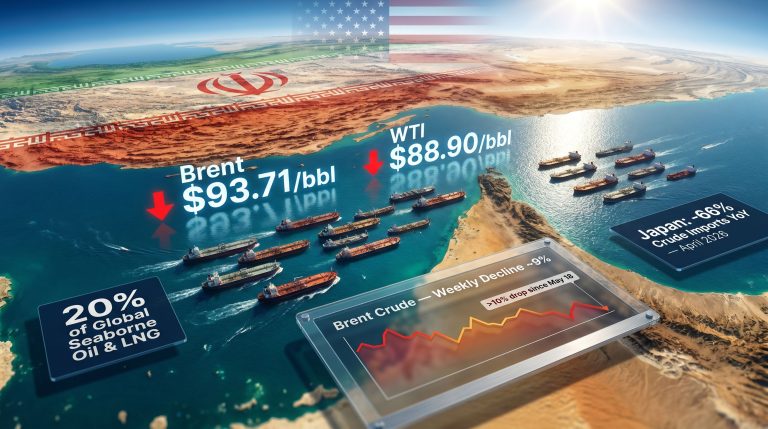
The Strait of Hormuz, the narrow waterway separating Iran from the Arabian Peninsula, handles an estimated one-fifth of all global crude oil and LNG shipments annually. This single maritime chokepoint represents one of the most consequential geographic features in the global energy system. A partial or complete disruption to Hormuz transit would not merely create inconvenience for energy traders. It would immediately sever a significant share of supply to some of the world's largest energy-importing economies, including Japan, South Korea, and China.
Escalating tensions connected to the Iran conflict have reintroduced meaningful uncertainty about the reliability of Hormuz passage for LNG tankers. The compounding factor for Japan is timing. As summer air-conditioning demand builds across the country between June and September, electricity consumption rises sharply, placing intense pressure on gas-fired generation capacity. A supply constraint during this peak window would force Japanese utilities into expensive spot market procurement at precisely the moment when global LNG spot prices historically spike due to seasonal demand convergence across multiple Asian markets simultaneously.
This convergence of geopolitical risk and seasonal demand creates what might be described as a diplomatic urgency window, where governments have strong incentives to lock in supply assurances before physical market tightness materialises.
LNG and Naphtha: Two Commodities, One Strategic Problem
LNG: The Backbone of Japan's Post-Nuclear Power System
Liquefied Natural Gas is produced by cooling natural gas to approximately −162°C, a process that reduces its volume by roughly 600 times, making it economically viable for ocean transport in specialised cryogenic tankers. For Japan, LNG is not merely a fuel source. It is the primary pillar of its electricity generation system, particularly following the Fukushima disaster which led to the suspension of nuclear generating capacity that once supplied approximately 30% of Japan's electricity.
Japan consistently ranks among the world's top three LNG importers by volume alongside China and South Korea. Its regasification infrastructure spans dozens of import terminals designed to reconvert LNG back into gaseous form for distribution into the power grid and industrial users. The technical specificity of this infrastructure, combined with the limited global fleet of LNG-capable tankers, means that supply disruptions cannot be remedied quickly through alternative transport arrangements.
A key detail that is rarely discussed in mainstream coverage is that Japan's LNG storage capacity at import terminals provides only approximately 10 to 12 days of average consumption cover. This is a remarkably thin buffer compared to the 90-day strategic petroleum reserve standard maintained for crude oil. This asymmetry in reserve coverage creates a situation where LNG supply interruptions translate into operational crises far more rapidly than equivalent crude oil disruptions.
Naphtha: The Less-Discussed but Equally Critical Commodity
While LNG captures most of the attention in energy security discussions, the inclusion of naphtha in Malaysia's supply pledge reveals a broader and more sophisticated understanding of Japan's industrial vulnerability.
Naphtha is a light hydrocarbon fraction derived from crude oil refining, and it serves as the primary feedstock for steam crackers that produce ethylene, propylene, and other base petrochemicals. These chemicals are the building blocks of plastics, synthetic fibres, industrial solvents, and countless materials that underpin Japan's automotive, electronics, and packaging industries.
| Commodity | Primary Function in Japan | Key Industries at Risk |
|---|---|---|
| LNG | Power generation and industrial fuel | Electricity, heating, heavy industry |
| Naphtha | Petrochemical feedstock | Automotive, electronics, packaging, textiles |
A technical distinction worth noting is that Japan's petrochemical sector relies predominantly on naphtha-based steam crackers rather than the ethane-based systems common in North America and the Middle East. This means Japanese producers cannot easily substitute alternative feedstocks during naphtha supply disruptions without significant capital expenditure on process modifications, creating an inelastic short-term demand profile that amplifies supply shock impacts.
Japan's downstream chemical manufacturing sector contributes meaningfully to national GDP and employs over a million workers directly. A sustained naphtha supply constraint would not merely increase input costs. It would generate cascading production slowdowns across multiple export-oriented industries with globally significant supply chain implications.
Malaysia's Strategic Position in Japan's Energy Import Architecture
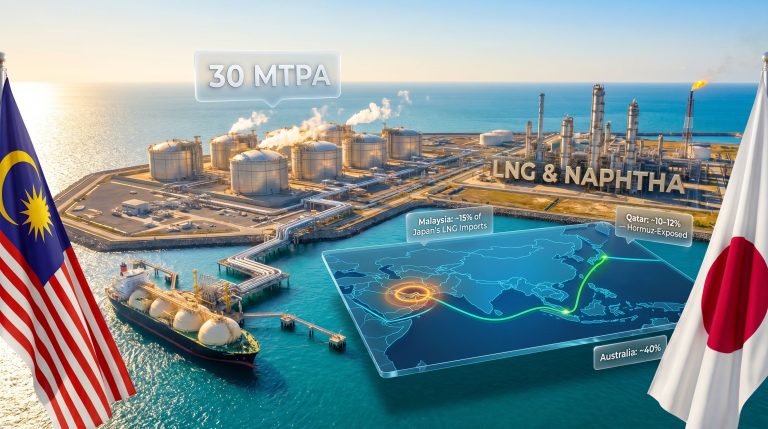
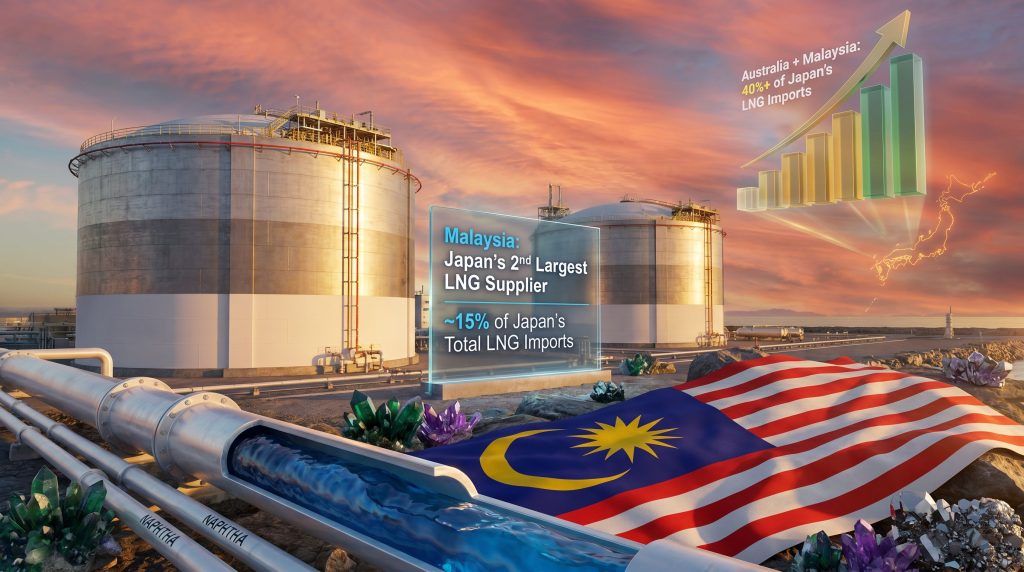
Malaysia currently supplies approximately 15% of Japan's total LNG imports, positioning it as Japan's second-largest LNG supplier after Australia. This is not a marginal trade relationship. Malaysian LNG exports are anchored by PETRONAS, one of Asia's most sophisticated state-owned energy enterprises with significant upstream and liquefaction capacity, particularly through the Bintulu LNG complex in Sarawak, which represents one of the largest LNG export facilities globally.
Critically, Malaysian LNG exports to Japan transit primarily through the South China Sea and the Strait of Malacca rather than the Strait of Hormuz. This distinct routing corridor provides a meaningful, though not absolute, geographic buffer against the Hormuz-linked disruption risks that currently threaten Japan's Middle Eastern supply relationships. From a supply chain resilience perspective, Malaysia and Australia together form a complementary non-Middle Eastern supply base that, combined, accounts for an estimated 40% or more of Japan's total LNG import volume.
The Anatomy of a Diplomatic Supply Pledge
The pledge by Prime Minister Anwar Ibrahim to supply Japan with the largest possible volumes of LNG and naphtha, formalised through a joint summit statement with Japanese Prime Minister Sanae Takaichi, represents a specific type of diplomatic instrument worth understanding carefully. According to reporting by Nikkei Asia, this commitment signals a significant elevation of the bilateral energy relationship.
This is a best-efforts diplomatic commitment embedded within a broader bilateral framework rather than a legally binding contractual guarantee. Such pledges create political accountability and signal supply prioritisation intent, but formal long-term supply contracts would require separate commercial negotiations between energy entities, including PETRONAS and Japanese utility companies. The distinction matters for investors and market analysts assessing the tangible near-term impact on LNG availability.
What the formalisation of this commitment through a joint summit statement does accomplish is elevating the bilateral energy relationship into the domain of strategic partnership. This creates a diplomatic architecture that makes future supply disruptions politically costly for both parties and signals to global LNG markets that Japan is actively building resilience through governmental engagement rather than relying solely on commercial contract mechanisms.
Japan's Multi-Vector Diversification Strategy: A Systematic De-Risking Framework
The Malaysia summit does not occur in isolation. It is one component of a systematically constructed diversification strategy that Japan has been accelerating across multiple fronts simultaneously. Furthermore, the interconnected nature of these efforts reflects a maturation in Japan's approach to critical minerals and energy security that goes well beyond traditional commodity procurement.
- Geographic diversification reducing over-reliance on Middle Eastern suppliers through expanded engagement with Southeast Asian, Australian, and potentially African LNG producers.
- Commodity diversification pursuing hydrogen, ammonia, and renewable energy import arrangements to reduce long-term LNG dependency.
- Bilateral agreement architecture formalising supply commitments through government-to-government frameworks that create political accountability beyond commercial contracts.
- Nuclear capacity restoration gradually reactivating domestic nuclear assets to reduce structural import dependency over the medium term.
In May 2026, Japan signed a cooperation agreement with Australia covering both energy and critical minerals, establishing a precedent for the type of comprehensive bilateral framework now being replicated with Malaysia. The sequencing is deliberate. Australia anchors the primary non-Middle Eastern supply base, while Malaysia provides critical secondary coverage that fills gaps in the diversification architecture.
The pattern also extended to rare earth supply chains, with Japan and France agreeing in April 2026 to strengthen REE cooperation, followed by the Australia agreement in May, and now the Malaysia engagement encompassing both energy and economic security dimensions.
The Rare Earth Dimension: Why This Summit Is About More Than LNG
One of the most strategically significant and least widely discussed aspects of the Japan-Malaysia summit is its economic security dimension, specifically the discussions around rare earth supply chains in the context of China's export restrictions.
China controls a dominant share of global rare earth element (REE) processing capacity, giving it substantial leverage over downstream technology and defence supply chains globally. China's rare earth restrictions on rare earth elements have materially accelerated Japan's push to build alternative supply partnerships. Japan's electronics, automotive, and defence industries depend critically on rare earth elements for applications ranging from electric vehicle motors and consumer electronics to precision-guided systems.
Malaysia hosts rare earth processing infrastructure and has been identified as a potential node in diversified REE supply chain architecture. The combination of energy supply and rare earth cooperation in a single bilateral framework reflects Japan's emerging economic security doctrine, which treats supply chain resilience across energy, petrochemicals, and critical minerals as a unified strategic priority rather than separate sectoral concerns.
Japan's integrated approach to supply chain security represents a significant evolution from post-World War II trade policy frameworks that prioritised commercial efficiency above strategic resilience. The country is increasingly willing to accept higher supply costs in exchange for reduced concentration risk across critical input categories.
The next major ASX story will hit our subscribers first
Nuclear and Digital Cooperation: The Expanding Partnership Scope
Technology Transfer as a Diplomatic Currency
The summit agenda reportedly includes discussions on nuclear energy cooperation, with Japan offering to share its expertise in power plant design, safety systems, and site selection methodology with Malaysia, which is evaluating nuclear energy as part of its long-term electricity mix transition.
This dimension of the partnership reflects a sophisticated diplomatic dynamic. Japan possesses world-class nuclear engineering capabilities developed over decades, and leveraging this expertise to deepen relationships with energy-supplying partners represents an elegant exchange mechanism. Technology knowledge transfer creates sustained interdependency and political goodwill that reinforces the durability of supply commitments beyond the immediate term.
AI Policy Cooperation: Signalling a Structural Relationship Shift
The inclusion of artificial intelligence policy cooperation in the summit agenda, targeting joint applications across agriculture, mobility, and education sectors, is perhaps the clearest signal that the Japan-Malaysia relationship is evolving from a transactional commodity arrangement into a comprehensive strategic partnership. In addition, similar frameworks involving strategic minerals partnerships in other regions demonstrate how multi-domain cooperation increasingly underpins modern economic alliances.
AI cooperation in agriculture carries particularly interesting downstream implications. Improvements in agricultural productivity through AI-assisted precision farming could affect agri-commodity trade dynamics between the two nations. This could potentially create new complementary trade flows that further deepen economic interdependency beyond the energy sector.
Key Takeaways for Market Observers and Strategic Analysts
- Malaysia to promise Japan maximum possible LNG and naphtha supplies represents a meaningful diplomatic elevation of bilateral energy ties, though the commercial implications depend on subsequent contract-level negotiations between energy entities.
- Japan's thin LNG storage buffer of approximately 10 to 12 days means that the urgency of securing supply assurances is not merely diplomatic theatre. It reflects genuine operational vulnerability during peak demand periods.
- The inclusion of naphtha alongside LNG signals that Japan's energy security framework has expanded to encompass industrial feedstock resilience, recognising that petrochemical supply disruptions carry economic consequences comparable in severity to power generation shortfalls. Furthermore, Reuters energy coverage consistently highlights how such feedstock vulnerabilities are becoming central to national energy policy discussions across Asia.
- The Australia-Malaysia complementarity model provides Japan with a non-Middle Eastern supply base covering an estimated 40%+ of total LNG needs, forming the structural cornerstone of its diversification strategy.
- The summit's multi-domain scope covering energy, rare earths, nuclear technology, and AI cooperation signals the emergence of a comprehensive strategic partnership that extends well beyond commodity trading relationships.
- Readers should treat Malaysia's supply pledge as a diplomatic best-efforts commitment pending formal joint statement release, rather than a confirmed long-term contractual arrangement. Formal supply contracts would require separate commercial negotiations between relevant energy entities.
This article is intended for informational purposes only and does not constitute investment advice. Readers should conduct independent research before making any financial or investment decisions. Forecasts, diplomatic commitments, and supply projections referenced in this analysis are subject to change based on evolving geopolitical, commercial, and regulatory conditions.
Want to Stay Ahead of Major ASX Mineral Discoveries Linked to Energy and Critical Minerals Themes?
Discovery Alert's proprietary Discovery IQ model delivers real-time alerts on significant ASX mineral discoveries — instantly translating complex geological data into actionable insights for investors across energy, rare earths, and resource sectors. Explore how historic mineral discoveries have generated extraordinary returns and begin your 14-day free trial at Discovery Alert to position yourself ahead of the broader market.