May 23, 2026
The Quiet Revolution Happening at the Intersection of Environmental Consulting and Resource Extraction
For decades, the global mining sector operated under an implicit assumption: that environmental responsibility and commercial productivity existed in permanent tension with one another. Sustainability was treated as a cost centre, a regulatory obligation to be managed rather than a strategic lever to be pulled. That assumption is now being systematically dismantled, not through government mandates or investor ultimatums alone, but through the practical, measurable work of sustainability practitioners embedding environmental thinking into the operational core of businesses across multiple industries.
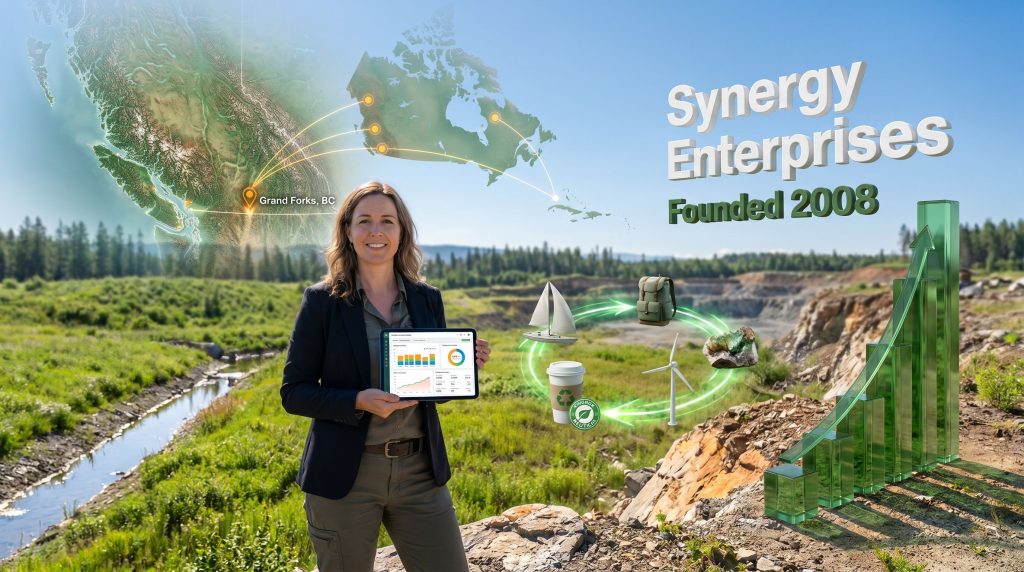
Among the professionals reshaping this landscape, Jill Doucette making an impact has become a phrase that carries genuine weight across sectors as different as hospitality, tourism, and hard-rock mineral exploration. As founder and CEO of Synergy Enterprises, a sustainability consultancy headquartered in Grand Forks, British Columbia, Doucette has spent more than seventeen years building what is arguably one of the more structurally interesting models in the sustainability consulting space: a for-profit consultancy operating in parallel with a non-profit foundation, each reinforcing the other's mandate.
Understanding why this model works, and why it is now extending into the critical minerals and energy security space, requires looking at both the mechanics of how Synergy Enterprises operates and the broader market conditions creating demand for exactly this kind of integrated environmental expertise.
When big ASX news breaks, our subscribers know first
From Biology to Business: The Professional Architecture Behind Synergy Enterprises
Doucette's academic grounding in biology at the University of Victoria gave her a systems-level understanding of ecological processes that most business consultants simply do not carry into client engagements. Rather than approaching sustainability as a reporting exercise, her methodology treats environmental performance as a function of interconnected systems, where changes to one variable — whether energy use, procurement, staffing culture, or waste management — produce measurable effects across the entire operation.
This perspective directly influenced the founding philosophy of Synergy Enterprises in 2008. The consultancy was built around the idea that environmental outcomes and commercial outcomes are not opposing forces but deeply correlated variables. A business that reduces waste, lowers its energy consumption, and redesigns its supply chain does not simply perform better on an ESG scorecard. It also typically reduces operating costs, strengthens staff retention, and builds brand differentiation in markets where consumer preferences are shifting toward verified environmental performance.
The intellectual influences behind this approach include environmental systems thinkers whose work emphasises circular design and the elimination of waste as a structural failure rather than an inevitable byproduct of production. Synergy Enterprises has operationalised these ideas through a proprietary methodology known internally as SPINS, which stands for Spontaneous Productive Innovation and Networking Sessions. This framework is designed to unlock creative problem-solving within client engagements by deliberately disrupting linear thinking patterns — an approach that has proven particularly effective when addressing complex, multi-stakeholder sustainability challenges.
The consultancy's current scope spans tourism, clean technology, aviation, maritime, mining, and critical minerals, with active operations across Canada, the Caribbean, and broader North American markets. Doucette also serves as Executive Director of the Synergy Foundation, the non-profit arm of this dual-entity model, which operates community programmes focused on circular economy innovation and food security.
The Business Transformation Methodology: Measuring Before Managing
One of the most instructive examples of Synergy Enterprises' operational approach is the Black Stilt Coffeehouse project, which has been cited as a pilot case demonstrating that carbon neutrality is achievable at the small business scale without imposing prohibitive financial burdens.
The project followed a methodology built around three sequential principles:
- Accurate baseline measurement first — Before any intervention, Synergy Enterprises conducts rigorous carbon accounting to establish the precise emissions footprint of the business across relevant operational scopes.
- Staff engagement as a performance multiplier — Environmental outcomes consistently improve when workforce culture aligns with organisational sustainability goals. Doucette's approach treats employee engagement not as a communications exercise but as a measurable driver of environmental performance.
- Cost-benefit integration from day one — Sustainability programmes that cannot demonstrate financial returns within a reasonable timeframe rarely achieve long-term adoption. Every intervention is designed to be commercially self-funding over its lifecycle.
The Black Stilt case produced three simultaneous outcomes that are rarely achieved together in conventional sustainability programmes: full carbon neutrality, measurable improvements in staff retention, and net cost reductions. The replicability of this model across other businesses has become central to Synergy Enterprises' commercial proposition.
The significance of demonstrating carbon neutrality at the small business scale should not be underestimated. Small and medium enterprises account for the majority of economic activity in most developed economies, yet they remain chronically underserved by sustainability frameworks designed primarily for large corporations.
The Non-Profit Dimension: Community Programmes With Commercial Logic
The Synergy Foundation operates several programmes that reflect the same design philosophy applied in commercial consulting: waste is a design failure, not an inevitability, and community wellbeing is a legitimate performance metric alongside financial returns.
The three most significant programmes currently operating under the Foundation's mandate are outlined below:
| Programme | Core Focus | Practical Mechanism |
|---|---|---|
| Project Zero | Circular Economy Entrepreneurship | Converts discarded materials such as reclaimed sailcloth into commercially viable products including backpacks, mentoring startups through the process |
| Community Garden Initiative | Food Security and Mental Wellbeing | Distributed thousands of garden kits and planters during the COVID-19 pandemic to address food insecurity and support community mental health |
| Green Business Certification | SME Sustainability Transition | Provides structured certification pathways for small-to-medium enterprises entering low-carbon operational programmes |
The COVID-19 pandemic became an inadvertent test of the Foundation's organisational agility. Rather than maintaining pre-existing programme structures as community needs shifted dramatically, Synergy Foundation rapidly redirected resources toward food security and mental health support, distributing garden kits and planters to households experiencing both economic stress and social isolation. This pivot demonstrates that a sustainability-focused organisation can respond to acute community crises without abandoning its core environmental mandate.
Research published in journals including Environmental Research and Public Health has consistently linked community gardening programmes to measurable improvements in mental health outcomes, reduced social isolation, and improved nutritional security. The Foundation's garden initiative drew on this evidence base while deploying resources at speed in response to real-time community need.
Project Zero's waste-to-product model reflects a growing body of circular economy theory advanced by institutions including the Ellen MacArthur Foundation, which argues that the linear take-make-dispose model of production is both environmentally unsustainable and economically inefficient. By mentoring entrepreneurs who convert waste streams into saleable products, Synergy Foundation is creating commercially viable circular economy pathways rather than simply advocating for their adoption.
The Critical Minerals Connection: Where Legacy Sites Meet Modern Supply Chains
Perhaps the most strategically significant evolution in Jill Doucette making an impact is the extension of Synergy Enterprises' methodology into the mining sector, specifically through engagement with legacy mine sites and their intersection with critical minerals demand across global supply chains.
The appointment of Doucette as Board Advisor to Sasquatch Resources Corp. in February 2026, with Synergy Enterprises simultaneously engaged as the project's environmental consultant, signals a meaningful shift in how resource companies are beginning to think about ESG expertise at the governance level. Rather than treating environmental consultancy as a compliance function, the appointment positions sustainability thinking within the board advisory structure, where it can influence strategic decisions from the outset rather than retroactively.
The focus of this engagement is the Mount Sicker project in British Columbia, Canada — a site that challenges one of the most persistent assumptions in the mining industry: that environmental remediation and active mineral extraction are fundamentally incompatible activities.
What Makes Legacy Mine Remediation Strategically Important Right Now?
The global critical minerals landscape is undergoing a structural transformation. Governments across North America and allied economies have identified critical minerals — ranging from lithium and cobalt to copper and rare earth elements — as essential inputs for clean energy technologies, defence applications, and digital infrastructure. Canada's Critical Minerals Strategy and analogous frameworks in the United States reflect an urgent policy priority to develop domestic supply chains that reduce strategic dependence on geopolitically uncertain import sources.
Legacy mine sites occupy a unique position within this strategic context. Furthermore, they represent:
- Pre-disturbed land, meaning new greenfield environmental disturbance is avoided entirely
- Existing waste-rock and tailings that may contain residual critical mineral concentrations worth recovering with modern extraction techniques
- Environmental liabilities that can be converted into environmental assets through carefully designed mine reclamation programmes
- Community relationships already established, which reduces the social licence challenges that commonly delay new greenfield mining projects by years
The five-step methodology Synergy Enterprises is applying at Mount Sicker moves sequentially through environmental assessment, carbon accounting and impact modelling, strategic alignment with national critical mineral priorities, stakeholder communication frameworks, and integration into ESG reporting and supply chain disclosure. This structured approach addresses not only the technical dimensions of legacy site remediation but also the regulatory, community, and investor communication challenges that have historically created friction between mining companies and their operating environments.
Regenerative Thinking as a Cross-Sector Framework
Doucette's published work and speaking engagements have increasingly focused on regenerative approaches to business and land use — a concept that is meaningfully different from conventional sustainability. Where sustainability asks how much harm can be avoided, regenerative frameworks ask how ecological and community systems can be actively restored. This distinction matters practically, not just philosophically.
In the context of tourism, which represents one of Synergy Enterprises' core sectors, regenerative destination planning requires operators to design experiences that leave ecological systems healthier than they found them. Research published through institutions including the Global Sustainable Tourism Council has identified regenerative tourism as one of the fastest-growing segments of the global travel industry, driven by traveller demand for experiences that carry verified positive environmental credentials rather than simply minimised negative ones.
Applied to mining, the regenerative framework reframes legacy site remediation as an opportunity to create net ecological benefit, not merely to restore a site to a pre-disturbance baseline. This conceptual shift has practical implications for how remediation programmes are designed, funded, and communicated to regulators, investors, and communities. In addition, considering natural capital in mining operations adds further depth to how companies account for environmental value throughout the project lifecycle.
The next major ASX story will hit our subscribers first
How the Synergy Model Scales Across Sectors
The structural elegance of Synergy Enterprises' dual-entity model lies in its replicability across very different contexts. The same core methodology — measure accurately, plan strategically, implement operationally, and communicate transparently — has been applied at the scale of a single coffeehouse and is now being deployed at a mining project with critical mineral supply chain implications.
The following table illustrates how the methodology translates across the sectors where Synergy Enterprises currently operates:
| Sector | Primary Application | Key Environmental Outcome | Commercial Benefit |
|---|---|---|---|
| Mining and Critical Minerals | Legacy site remediation and mineral recovery | Waste-rock reclassification, ecological restoration | Supply chain contribution without new greenfield disturbance |
| Tourism | Regenerative destination planning | Active ecological restoration, biodiversity improvement | Differentiation in high-value sustainability travel markets |
| Food and Hospitality | Carbon neutrality programmes | Emissions reduction, waste minimisation | Operating cost reduction, staff retention, brand value |
| Maritime and Aviation | Operational emissions reduction | Fuel consumption and carbon intensity reduction | Regulatory compliance, fuel cost savings |
| SME Retail and Services | Green business certification | Verified carbon reduction and waste programmes | Market differentiation, customer loyalty, certification value |
Recognition, Credibility, and the Evolving Role of ESG Expertise in Mining
A 2022 Chamber Award nomination recognising Doucette's community leadership in sustainability reflects a broader pattern of recognition that has accumulated across her career. Three published books on regenerative business and green economy innovation establish intellectual authority in a field where practical track records remain relatively rare. The board-level advisory appointment at Sasquatch Resources Corp. in 2026 represents perhaps the most significant signal of all: that the resource sector is beginning to seek sustainability expertise not as an afterthought but as a core governance capability.
This trend is consistent with broader patterns documented in ESG governance research. Mining Magazine's coverage of Doucette's industry impact highlights how the ESG Index 2025 benchmarks performance across more than sixty of the world's largest mining companies across ten weighted indicators and six ESG pillars, reflecting an industry in the early stages of integrating sustainability thinking into strategic decision-making at the highest levels.
The integration of environmental consulting expertise into board-level advisory roles within resource companies represents a structural maturation of ESG governance, moving the function from compliance reporting toward genuine strategic influence.
For smaller resource companies like Sasquatch Resources Corp., this shift carries particular significance. Unlike large mining majors with dedicated internal ESG teams and established stakeholder communication infrastructure, junior explorers and developers often lack the internal capacity to design and communicate environmental programmes credibly. Bringing external sustainability expertise to the board advisory level addresses this capability gap while simultaneously signalling to investors, regulators, and communities that environmental performance is being taken seriously from the earliest stages of project development.
The Broader Lesson: Sustainability as Operational Strategy, Not Compliance Exercise
The through-line connecting Jill Doucette making an impact across sectors — from the Black Stilt Coffeehouse to the Mount Sicker project — is a consistent rejection of the idea that sustainability is something that happens alongside a business rather than within it. Every programme Synergy Enterprises has designed, every certification framework the Foundation has deployed, and every board advisory role Doucette has accepted reflects the same underlying argument: that environmental performance and commercial performance are not competing priorities but deeply correlated variables that reinforce each other when properly integrated.
For the mining sector specifically, this argument is arriving at a moment of acute relevance. As legacy site liabilities attract increasing regulatory scrutiny, as mining sustainability transformation continues to reshape investor expectations, and as ESG disclosure requirements continue to tighten across North American and international markets, the ability to demonstrate net-positive environmental outcomes is transitioning from a reputational luxury to a commercial necessity.
The Synergy Enterprises model suggests that this transition need not be painful. When sustainability thinking is embedded at the operational level, grounded in accurate measurement, and communicated transparently to all stakeholders, it consistently generates returns — environmental, social, and financial — that justify the investment. That is the case Jill Doucette has been making for nearly two decades. It is increasingly difficult to argue with the evidence she has assembled in support of it.
This article draws on publicly available information about Synergy Enterprises, Synergy Foundation, and the broader sustainability consulting and critical minerals sectors. Forward-looking statements regarding project outcomes, market trends, and strategic positioning involve inherent uncertainty and should not be construed as investment advice. Independent verification of specific project claims and financial outcomes is recommended before making any investment or commercial decisions.
Want to Track the Next Major ASX Mineral Discovery Before the Broader Market Does?
Discovery Alert's proprietary Discovery IQ model delivers real-time alerts on significant ASX mineral discoveries — cutting through complex data across more than 30 commodities to surface actionable opportunities the moment they are announced, precisely the kind of early intelligence that separates informed investors from the crowd. Explore historic examples of major mineral discoveries and their market returns to understand the scale of opportunity, then begin a 14-day free trial of Discovery Alert to position yourself ahead of the market.