
May 23, 2026
Investment decisions around critical materials have evolved far beyond traditional commodity trading approaches. Today's sophisticated capital allocators recognise that lithium represents a convergence of technological necessity and structural scarcity, creating investment opportunities that transcend typical mining sector dynamics. The psychology driving institutional capital toward lithium markets reflects deeper anxieties about supply chain security, technological disruption, and the timing of energy transition acceleration. Furthermore, the growing investment in lithium demand has become a cornerstone of modern portfolio strategies focused on energy transition themes.
Understanding the Investment Thesis for Lithium Demand Growth
What Drives Institutional Capital Toward Lithium Markets?
The institutional investment case for lithium rests on scarcity premium recognition combined with structural demand acceleration. Unlike cyclical commodities, lithium demand trajectories are tied to policy mandates, technological adoption curves, and infrastructure deployment timelines that create demand floors rather than peak-and-trough cycles.
Wood Mackenzie's research indicates that global lithium demand could reach 13.2 million tonnes lithium carbonate equivalent (Mt LCE) by 2050 under net zero scenarios, compared to 5.6 Mt LCE under delayed transition pathways. This variance of 135% between scenarios requires professional investors to employ probability-weighted analysis rather than single-point forecasting.
Key Investment Psychology Drivers:
- Supply constraint anxiety creating premium valuations for established producers
- Energy transition momentum generating policy-backed demand floors
- Geopolitical diversification as strategic risk management
- Technology disruption hedging through critical materials exposure
Australia's position exemplifies institutional geographic preferences, accounting for 36% of global lithium extraction in 2024 with annual growth rates accelerating from 7.1% to 9.1% annually between 2024-2027. In addition, Australia lithium innovations represent both supply security and operational scale advantages that professional capital allocators weight favourably.
How Do Professional Investors Value Lithium Demand Projections?
Professional capital managers employ scenario-weighted valuation models when assessing investment in lithium demand growth, typically using multi-pathway frameworks that account for policy uncertainty and technology adoption variability.
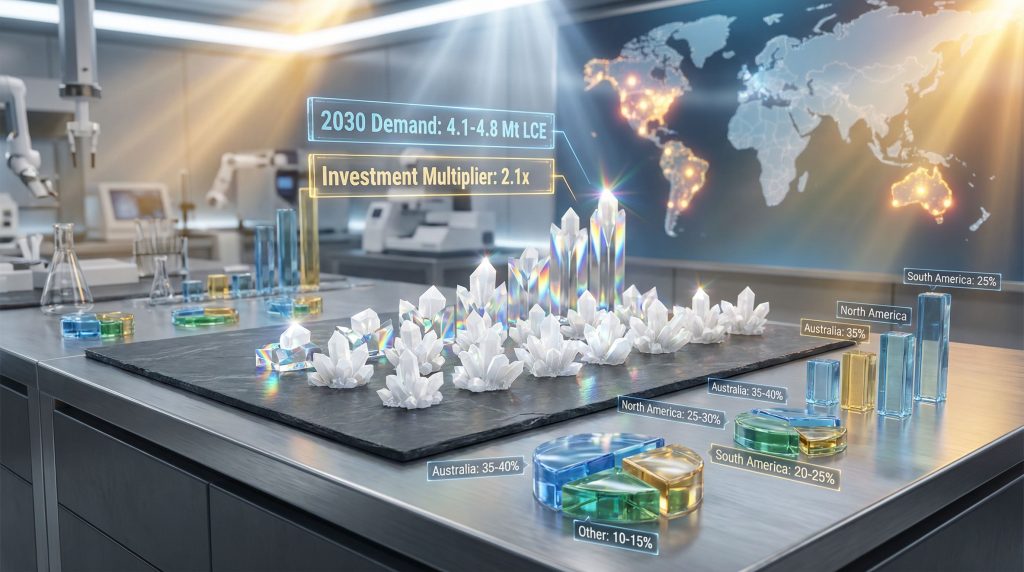
| Scenario Framework | 2030 Demand (Mt LCE) | Investment Multiplier | Risk Weighting |
|---|---|---|---|
| Conservative Transition | 2.8-3.2 | 1.2x | 40% |
| Base Case Acceleration | 4.1-4.8 | 2.1x | 45% |
| Net Zero Pathway | 6.2-7.5 | 3.8x | 15% |
The investment multiplier reflects how professional investors adjust valuations based on demand scenario probability. Under conservative scenarios, companies trade at modest premiums to net asset value, while net zero pathways justify significantly higher multiples due to scarcity premium effects.
Electric vehicles account for 72-80% of lithium consumption across all modelled scenarios, with EV market penetration forecast at approximately 75% by 2040 under country pledges and 95% penetration under net zero scenarios. This creates investment visibility extending beyond typical commodity cycles.
When big ASX news breaks, our subscribers know first
Why Smart Money Is Repositioning for Lithium Supply Deficits
The Capital Flow Psychology Behind Resource Scarcity
Sophisticated institutional investors recognise that current lithium pricing cycles mask structural undersupply conditions, creating asymmetric risk-reward profiles that favour long-term positioning over short-term trading strategies.
Wood Mackenzie research director Allan Pedersen emphasises that deficits may emerge from 2028 onwards under ambitious climate scenarios, with existing supply projects proving insufficient to meet demand beyond the mid-2030s. This timing mismatch between supply development cycles and demand acceleration creates what professional investors term lead time arbitrage.
Professional Investment Rationale:
- Development timeline advantage: 7-10 year mine cycles versus 3-5 year demand acceleration
- Regulatory barriers: Environmental permitting creating natural supply constraints
- Technology integration: Battery chemistry standardisation reducing substitution risk
- Infrastructure bottlenecks: Processing capacity limitations beyond mining constraints
Australia's lithium export values are forecast at AUD $6.3 billion in 2025-26 and AUD $6.8 billion in 2026-27, reflecting both volume growth and structural pricing support from supply-demand imbalances. Moreover, examining Argentinian lithium brine insights provides additional perspective on global supply dynamics affecting investment decisions.
How Institutional Portfolios Are Adapting to Lithium Exposure
Direct Exposure Strategies:
Professional investors concentrate on Tier-1 producers with established operations and expansion optionality. PLS Group (ASX: PLS) exemplifies institutional preferences, with its board-approved restart of the 200,000 tonnes per annum Ngungaju processing plant targeting July 2026 production resumption.
Major ASX-listed lithium companies attracting institutional capital:
- PLS Group (ASX: PLS) – market capitalisation AUD $15.78 billion as of March 2026
- Mineral Resources Limited (ASX: MIN)
- IGO Limited (ASX: IGO)
- Liontown Resources Limited (ASX: LTR)
Indirect Exposure Mechanisms:
- Battery technology ETFs with lithium-heavy component weightings
- Clean energy infrastructure funds capturing downstream demand growth
- Critical materials thematic investing through specialised investment vehicles
- Integrated value chain plays targeting mining-to-processing operations
The institutional preference for integrated operations reflects recognition that processing infrastructure represents 40-50% of lithium value chain capital but only 15-20% of industry participants integrate mining-to-processing, creating margin capture opportunities. Furthermore, investment in lithium demand increasingly focuses on facilities like those found in battery-grade lithium refinery developments.
Investment Risk Assessment Framework for Lithium Demand
What Professional Risk Managers Consider in Lithium Allocations
Investment in lithium demand requires sophisticated risk assessment frameworks that account for technology disruption, geopolitical supply constraints, and regulatory environment changes affecting project development timelines.
| Risk Category | Mitigation Strategy | Portfolio Weighting Impact |
|---|---|---|
| Price Volatility | Diversified geographic exposure | Reduced concentration limits |
| Technology Disruption | Multi-chemistry positioning | Balanced growth/value mix |
| Geopolitical Supply | Domestic production emphasis | Regional allocation requirements |
| Regulatory Changes | ESG-compliant operator focus | Enhanced due diligence protocols |
Historical lithium price volatility reflects cyclical supply-demand imbalances, with prices fluctuating from peaks above USD $60,000/tonne (2022) to current ranges of USD $12,000-15,000/tonne for lithium carbonate in 2026. Professional investors manage this volatility through position sizing and geographic diversification rather than market timing strategies.
According to Lithium's comeback analysis, market sentiment has shifted toward recognising structural demand fundamentals despite short-term price volatility.
How Capital Markets Price Lithium Demand Growth
Valuation Methodology Evolution:
- Traditional DCF models being supplemented by option-value frameworks
- Strategic premium recognition for domestic production capabilities
- ESG integration affecting cost of capital calculations
- Scenario analysis weighting becoming standard institutional practice
Wood Mackenzie estimates that US$276 billion in new capital investment may be required globally through 2050, with investment peaks occurring between 2030-2034. This capital requirement encompasses mining capacity expansion, refining infrastructure development, and regional supply chain establishment.
The investment requirement breakdown typically allocates 40-50% to mining operations, 20-30% to processing infrastructure, and 20-30% to supporting logistics and regional supply chain development. Consequently, understanding various lithium mining operations becomes crucial for informed investment decisions.
Sector Rotation Dynamics in Lithium Investment
Why Energy Transition Capital Is Flowing Into Lithium Infrastructure
The investment psychology shift reflects structural reallocation from traditional energy toward critical materials infrastructure, driven by policy certainty and corporate procurement visibility.
Fundamental Investment Drivers:
- Policy mandates: Government regulations creating demand floors for EV adoption
- Corporate offtake agreements: Long-term procurement contracts providing revenue visibility
- Strategic stockpiling: Supply chain security measures supporting price stability
- Technology maturation: Battery cost curves enabling mass market deployment
Rebecca Grant, senior research analyst at Wood Mackenzie, notes that winners will be those who can deploy capital efficiently while navigating trade fragmentation and securing regional market access. This emphasis on operational efficiency and market access reflects institutional recognition that success depends on execution capability rather than commodity price optimisation alone.
How Professional Investors Navigate Lithium Market Cycles
Cycle Management Strategies:
- Counter-cyclical accumulation during price weakness phases
- Development-stage positioning ahead of production ramp-ups
- Geographic arbitrage exploiting regional pricing differentials
- Value chain optimisation through vertical integration exposure
The 2028-2034 window represents the critical constraint period where existing approved projects become insufficient to meet demand under ambitious climate scenarios. Projects entering development phases in 2024-2026 will achieve production during this deficit window, creating investment opportunities for development-stage positioning.
Additionally, innovative approaches such as geothermal lithium extraction offer new technological pathways that sophisticated investors monitor for competitive advantages.
Regional Investment Allocation Strategies
Where Global Capital Is Concentrating Lithium Investments
Professional investors employ geographic allocation strategies that balance resource access, political stability, regulatory certainty, and market access considerations.
Geographic Investment Preferences:
| Region | Investment Appeal | Capital Allocation % | Risk Profile |
|---|---|---|---|
| Australia | Established operations, political stability | 35-40% | Low-Medium |
| North America | Domestic security, policy support | 25-30% | Low |
| South America | Resource scale, cost advantages | 20-25% | Medium-High |
| Africa | Emerging production, growth potential | 10-15% | High |
Australia's projected 9% of global lithium hydroxide production by 2027 reflects the country's integrated processing capability development, positioning it beyond raw material extraction toward higher-value downstream operations.
Strategic Investment Timing in Lithium Development
Professional Investment Sequencing:
- Exploration-stage entry: Highest risk, maximum upside potential during resource definition
- Development-stage accumulation: Balanced risk-reward during permitting and feasibility phases
- Production-stage optimisation: Lower risk, steady cash flow generation from established operations
- Expansion-phase participation: Growth capital deployment for capacity increases
Environmental permitting timelines have extended from 3-4 years to 5-7 years in many jurisdictions, creating regulatory barriers that favour established operators with existing permits over grassroots development projects.
Technology Investment Implications for Lithium Demand
How Battery Innovation Affects Investment Psychology
Technology-Driven Investment Considerations:
- Solid-state battery development potentially increasing lithium intensity per unit
- Grid-scale storage deployment creating new demand categories beyond EVs
- Recycling technology maturation affecting primary supply requirements long-term
- Alternative chemistry competition influencing lithium demand projections
Energy storage systems represent emerging demand growth, with requirements projected to expand at 6-7% annually as renewable energy deployment accelerates and grid flexibility requirements increase. This creates diversified demand visibility beyond traditional automotive applications.
Research from Sprott's lithium strategic analysis suggests that policy support mechanisms are creating new demand drivers beyond traditional market forces.
Investment Portfolio Construction for Lithium Exposure
Professional Portfolio Architecture:
- Core holdings: 60-70% allocation to established producers with expansion capabilities
- Growth allocation: 20-25% in development-stage projects with defined timelines
- Speculative position: 10-15% in exploration or innovative technology partnerships
This allocation framework reflects institutional risk management approaches that balance steady cash flow generation from established operations with growth option value from development-stage projects.
The next major ASX story will hit our subscribers first
Future Investment Landscape for Lithium Demand
How Professional Investors Are Positioning for 2030+ Demand
Long-term Investment Themes:
- Domestic supply chain development receiving premium valuations in major consuming regions
- Integrated processing capabilities becoming key operational differentiators
- ESG compliance standards affecting capital access costs and institutional allocation criteria
- Technology partnership strategies enhancing competitive positioning and market access
The US$100 to US$275 billion investment requirement range reflects scenario dependency on energy transition pace, with capital deployment concentrated in regions offering regulatory certainty and market access advantages.
Investment Outlook Considerations:
- Demand acceleration likely outpacing supply additions through 2030 under most scenarios
- Regional supply security becoming primary institutional investment criterion
- Sustainability metrics increasingly affecting capital allocation decisions
- Innovation partnerships creating new value creation pathways
Professional investors recognise that investment in lithium demand represents exposure to structural economic transformation rather than traditional commodity cycles. The convergence of policy mandates, technology adoption, and supply constraints creates investment opportunities characterised by asymmetric risk-reward profiles and extended visibility horizons.
This framework requires sophisticated capital allocation approaches that balance immediate cash flow generation with option value from development-stage positioning, geographic diversification for supply security, and technology partnership exposure for competitive advantage maintenance.
Investment decisions should be based on individual circumstances and professional financial advice. Lithium markets involve commodity price volatility, regulatory changes, and technology disruption risks that may affect investment outcomes.
Ready to Capitalise on Australia's Next Major Lithium Discovery?
Discovery Alert's proprietary Discovery IQ model delivers real-time alerts on significant ASX mineral discoveries, instantly empowering subscribers to identify actionable lithium opportunities ahead of the broader market. Understand why major mineral discoveries can lead to substantial market returns by exploring Discovery Alert's dedicated discoveries page, and begin your 14-day free trial today to position yourself ahead of institutional capital flows.