May 24, 2026
Lithium Market Evolution Through African Resource Strategies
The global battery metals landscape continues reshaping as diversified supply chains become critical for technological advancement. Traditional lithium-producing regions face increasing demand pressures while new geological provinces emerge as strategic alternatives. The Bougouni lithium project has positioned itself as a significant development in Mali's evolving resource sector. Furthermore, understanding these supply dynamics requires examining operational frameworks, processing methodologies, and regional development models that influence long-term market positioning.
Dense media separation technologies represent established processing approaches for coarse-grained spodumene recovery, offering lower capital requirements compared to flotation circuits. Additionally, Australian lithium innovations provide valuable insights for global processing advancements. These operational considerations become particularly relevant when evaluating staged development strategies across different geological settings and resource characteristics.
When big ASX news breaks, our subscribers know first
Strategic Resource Development Through Phased Implementation
Geographic Positioning Within West African Mining Infrastructure
The Bougouni lithium project in Mali operates within Mali's established mining corridor, situated approximately 180km south of Bamako in the Birimian greenstone belt. This geological formation extends across multiple West African countries and hosts various mineral deposits. Moreover, the project benefits from proximity to existing road networks and regional mining expertise developed through decades of gold and other mineral operations.
Regional Infrastructure Advantages:
• Established transport routes connecting interior regions to coastal ports
• Existing regulatory frameworks for mineral development
• Available skilled workforce from regional mining operations
• Proximity to engineering and logistics support services
The location provides strategic access to both African and international markets through established transport corridors. In addition, road connections to Port of San Pedro in Côte d'Ivoire enable efficient concentrate shipments to global processing facilities.
Resource Base Characteristics and Processing Suitability
The project encompasses three distinct deposits with varying mineralogical characteristics requiring different processing approaches. Furthermore, comprehensive lithium brine market insights reveal processing methodologies applicable across diverse geological settings. According to Mining Weekly's December 2025 report, the Ngoualana deposit contains coarse-grained spodumene material particularly suited for dense media separation, while Sogola-Baoulé and Boumou deposits contain finer-grained material requiring flotation processing.
Resource Processing Framework:
| Deposit | Processing Method | Annual Ore Feed | Recovery Technology |
|---|---|---|---|
| Ngoualana | Dense Media Separation | 1 million tonnes | Conventional gravity circuits |
| Sogola-Baoulé | Flotation | 2 million tonnes | Advanced flotation chemistry |
| Boumou | Flotation | 2 million tonnes | Fine particle recovery |
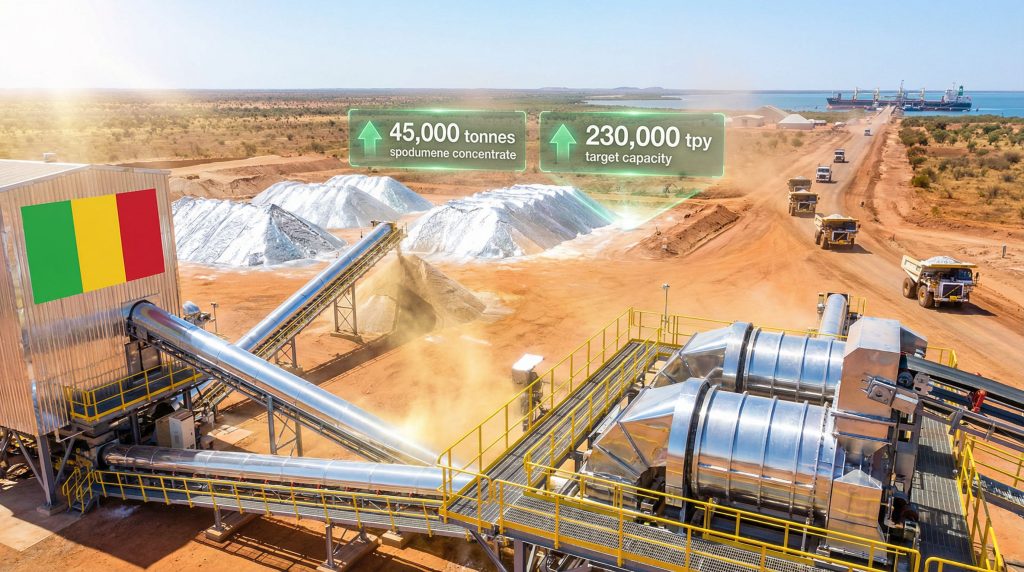
The Stage 1 operations achieved production of over 45,000 tonnes of spodumene concentrate by late 2025, with average lithium oxide content of 5.39% (Mining Weekly, December 5, 2025). Consequently, this demonstrates successful processing of coarse-grained material through dense media separation circuits.
Capital Allocation Strategy Through Sequential Development
Stage 1 Dense Media Separation Implementation
The initial development phase required capital expenditure of $60-70 million, establishing processing capacity of 125,000 tonnes annually of spodumene concentrate (Mining Weekly, December 5, 2025). This approach prioritises immediate cash flow generation whilst proving operational concepts before major expansion investments.
Dense media separation processing offers several advantages for initial operations:
• Lower capital intensity compared to flotation plants
• Simpler processing chemistry and operational requirements
• Higher recovery rates for coarse-grained spodumene
• Reduced technical risk during commissioning phases
The four-year mine life for Stage 1 operations provides sufficient time for cash flow generation to fund subsequent expansion phases. Construction commenced in mid-2024, with first concentrate production achieved by February 2025 (Mining Weekly, December 5, 2025).
Stage 2 Flotation Plant Expansion Framework
Stage 2 development involves approximately $175 million capital investment for a 350,000 tonnes-per-year flotation plant, processing finer-grained material from Sogola-Baoulé and Boumou deposits (Mining Weekly, December 5, 2025). However, this expansion targets 230,000 tonnes annually of concentrate production over a 12-year mine life.
Strategic Insight: The self-funding model eliminates external financing requirements for expansion, reducing financial risk whilst maintaining operational control through proven cash flow generation.
Flotation Processing Advantages:
• Recovery of fine-grained spodumene unsuitable for gravity separation
• Access to additional reserve base extending operational life
• Enhanced overall resource utilisation across deposit portfolio
• Technology scalability for potential future expansions
The staged approach allows operational teams to develop processing expertise through Stage 1 operations before implementing more complex flotation circuits. Consequently, this reduces technical execution risk whilst building organisational capabilities.
Government Partnership Structure and Local Development
Equity Participation Model
Mali's government holds a 35% shareholding in Les Mines de Lithium de Bougouni (LMLB), the project operating company, whilst Kodal Minerals maintains 49% ownership through its subsidiary Kodal Mining UK (Mining Weekly, December 5, 2025). This structure provides direct government revenue participation beyond traditional royalty mechanisms.
Ownership Structure Benefits:
• Government participation in project profitability through equity returns
• Alignment of national development objectives with project success
• Enhanced regulatory certainty through stakeholder partnership
• Local investor participation within government shareholding framework
The 650 total positions include 95% Malian workforce composition, representing approximately 618 local employment opportunities (Mining Weekly, December 5, 2025). Furthermore, this employment structure supports regional economic development whilst building local technical capabilities.
Revenue Distribution and Community Development
Direct equity participation creates revenue streams tied to operational performance rather than fixed royalty percentages. The November 2025 maiden shipment valued at $24 million demonstrates immediate government revenue generation through equity participation (Mining Weekly, December 5, 2025).
Local Content Implementation:
• Skills transfer programmes developing technical expertise
• Community development investments supporting regional infrastructure
• Supplier development initiatives creating local business opportunities
• Capacity building programmes enhancing educational and healthcare services
Production Timeline and Operational Achievement
Rapid Development Execution
The project timeline from construction commencement (mid-2024) to initial shipment (November 2025) represents approximately 18 months of development execution. First concentrate production occurred in February 2025, followed by the maiden shipment of 28,950 tonnes nine months later (Mining Weekly, December 5, 2025).
Development Milestones:
- Construction start: Mid-2024
- First production: February 2025
- Initial shipment: November 2025
- Total concentrate produced: 45,000+ tonnes by late 2025
This timeline demonstrates efficient project execution from construction through commissioning to commercial production. Moreover, the ability to achieve over 45,000 tonnes of production within the first operational year indicates successful processing circuit optimisation.
Transport and Logistics Validation
The maiden shipment involved transporting over 30,000 tonnes of concentrate across 880km to Port of San Pedro in Côte d'Ivoire (Mining Weekly, December 5, 2025). The official project opening marked a significant milestone for Mali's mining sector. The vessel arrived November 9 and departed November 30, bound for Hainan province, China, validating the complete logistics chain from mine to market.
Logistics Infrastructure:
• Dedicated stockpile facility at Port of San Pedro
• Proven road transport capacity for bulk concentrate movements
• Vessel loading and departure procedures successfully implemented
• Direct shipping access to Chinese processing facilities
Partnership Dynamics and Market Access
Kodal Minerals' Operational Leadership
Kodal Minerals provides technical expertise and project management capabilities through its 49% shareholding in LMLB. The company's experience in African mining environments contributes operational knowledge whilst maintaining local partnership structures required for regulatory compliance.
Operational Contributions:
• Project development and construction management
• Processing plant design and commissioning oversight
• International market access and commercial relationships
• Technical expertise in lithium processing operations
Hainan Mining Offtake Partnership
The offtake agreement with Hainan Mining provides guaranteed market access for concentrate production. The November 2025 shipment to Hainan province demonstrates operational implementation of this commercial relationship (Mining Weekly, December 5, 2025).
Following completion of vessel loading, LMLB submitted an invoice for 95% of cargo value, with first payment expectations totalling approximately $24 million (Mining Weekly, December 5, 2025). Consequently, this payment structure provides immediate cash flow whilst securing long-term market access.
Commercial Benefits:
• Guaranteed offtake commitment reducing marketing risk
• Integration with Chinese lithium processing supply chains
• Stable pricing mechanisms through partnership structure
• Direct access to battery manufacturing demand centres
The next major ASX story will hit our subscribers first
West African Lithium Sector Positioning
Regional Supply Chain Development
Mali's entry into commercial lithium production contributes to supply chain diversification beyond traditional Australian and South American dominance. The successful production and shipment operations establish operational precedents for similar projects across West Africa's geological formations. However, developing lithium mining insights across different geological settings requires careful evaluation of technical approaches.
Strategic Supply Advantages:
• Alternative sourcing for European and Asian battery manufacturers
• Reduced geographic concentration risk in global supply chains
• Regional expertise development supporting additional discoveries
• Infrastructure investments benefiting future projects
Technical Processing Innovation
The successful implementation of dense media separation processing for coarse-grained spodumene provides technical validation for similar deposits throughout the region. Processing knowledge developed at the Bougouni lithium project in Mali supports regional capacity building for lithium extraction operations.
Technology Transfer Impacts:
• Processing expertise applicable to similar geological settings
• Equipment and engineering capabilities established in region
• Local workforce trained in modern lithium processing techniques
• Regulatory frameworks developed for lithium project oversight
Investment Framework and Financial Performance
Capital Efficiency Benchmarking
Stage 1 capital expenditure of $60-70 million for 125,000 tonnes annual capacity represents approximately $560-600 per annual tonne of processing capacity (calculated from Mining Weekly data). This metric provides benchmarking opportunities against other spodumene processing developments. Additionally, battery-grade lithium refinery developments offer comparative capital intensity insights.
Financial Performance Indicators:
• Rapid payback period through immediate production capability
• Self-funding model eliminating external financing requirements
• Operational leverage through government partnership structure
• Revenue generation within 10 months of first production
The maiden shipment value of $24 million for 28,950 tonnes equates to approximately $829 per tonne of concentrate (calculated from Mining Weekly figures). This pricing validates market positioning for spodumene concentrate at 5.39% lithium oxide grade.
Production Cost Competitiveness
Dense media separation processing typically offers lower operating costs compared to flotation circuits due to reduced chemical requirements and simplified processing flows. The successful achievement of design production rates supports cost-competitive operations relative to alternative lithium sources.
Cost Structure Advantages:
• Lower chemical consumption in gravity-based separation
• Simplified maintenance requirements for DMS circuits
• Economies of scale through staged expansion approach
• Local workforce reducing labour cost pressures
Future Development Scenarios and Expansion Potential
Resource Base Growth Opportunities
The project area contains exploration upside beyond current defined resources. Regional geological formations suggest potential for additional spodumene discoveries within existing tenement holdings. Furthermore, advanced exploration techniques could expand the resource base supporting extended mine life scenarios.
Exploration Expansion Framework:
• Additional deposit discoveries within geological corridor
• Resource definition drilling extending known mineralisation
• Regional exploration programmes targeting similar formations
• Technology advancement improving resource recovery rates
Processing Technology Evolution
Stage 2 flotation plant implementation represents current processing technology applications. Future technological developments in fine particle recovery and concentrate upgrading could enhance production efficiency and product quality specifications.
Technology Enhancement Opportunities:
• Advanced flotation chemistry improving recovery rates
• Downstream processing capabilities for value-added products
• Integration with battery precursor manufacturing operations
• Automation systems optimising operational efficiency
Global Battery Supply Security Implications
Supply Chain Diversification Impact
The successful production and shipment operations at the Bougouni lithium project in Mali demonstrate viable alternative sourcing for global lithium requirements. Geographic diversification reduces supply chain vulnerability whilst supporting growing battery manufacturing capacity worldwide. However, securing lithium supply remains a critical strategic priority for battery manufacturing nations.
Strategic Supply Considerations:
• Reduced dependence on concentrated supply regions
• Enhanced supply security for European battery manufacturers
• Alternative transport routes avoiding geopolitical constraints
• Regional supply networks supporting multiple demand centres
Market Timing and Demand Alignment
Production commencement aligns with accelerating global demand for battery materials driven by electric vehicle adoption and energy storage requirements. The proven operational capability positions the project to capitalise on sustained lithium demand growth.
Demand Growth Factors:
• Electric vehicle manufacturing expansion globally
• Grid-scale energy storage system deployments
• Consumer electronics requiring advanced battery technologies
• Government policies supporting energy transition initiatives
The project's achievement of commercial production and successful international shipments validates Mali's emergence as a lithium-producing jurisdiction whilst demonstrating operational frameworks applicable across West African geological settings. The combination of strategic government partnership, proven processing technology, and established market access creates foundations for sustained production growth supporting global battery supply security objectives.
Want to Capitalise on the Next Major Lithium Discovery?
Discovery Alert provides instant notifications on significant ASX mineral discoveries, including battery metals opportunities, powered by its proprietary Discovery IQ model. Subscribers receive real-time insights into actionable trading opportunities before the broader market reacts, ensuring rapid positioning around emerging lithium and battery metals discoveries. Begin your 30-day free trial today and secure your competitive advantage in the evolving battery metals sector.