June 9, 2026
Why Australia's Battery Circular Economy Is Reaching a Structural Turning Point
The global battery industry has quietly crossed a threshold that few anticipated arriving this soon. For decades, the dominant narrative around lithium-ion batteries focused almost entirely on the upstream end of the supply chain: mining, refining, and manufacturing. The downstream question of what happens when those batteries reach end-of-life was largely treated as a future problem. That future has now arrived, and the commercial infrastructure being built to manage it is evolving rapidly from informal, transactional arrangements into formalised, multi-year frameworks built around compliance, traceability, and scalable material recovery.
Australia sits at an unusual intersection within this shift. As one of the world's primary producers of lithium, cobalt, nickel, and manganese, the country supplies the critical minerals that flow into battery manufacturing globally. Yet until recently, relatively little attention was paid to the question of recovering those same materials at the end of a battery's useful life and reintegrating them into the production cycle domestically. That calculus is changing, and the formalisation of the Livium CATL recycling pact offers a precise illustration of why.
When big ASX news breaks, our subscribers know first
Understanding Framework Contracts and Why They Matter More Than Volume Commitments
A common misconception when evaluating commercial agreements in early-stage or growth industries is that value is synonymous with volume obligations. In battery recycling, the current stage of market development makes that assumption problematic. Australia's end-of-life battery volumes are growing but have not yet reached the scale that would justify rigid offtake commitments with fixed pricing structures. What the industry requires at this point is operational architecture: governance frameworks, compliance pathways, certified service definitions, and relational infrastructure that can absorb increasing volumes as they materialise.
This is precisely what distinguishes a framework contract from a transactional purchase order arrangement. Rather than locking parties into specific quantities, a framework contract establishes:
- A defined scope of services with agreed quality and compliance standards
- Regulatory alignment between the contracting parties
- Operational certainty for logistics and capacity planning
- A credentialed relationship that can be referenced by both parties in subsequent commercial conversations
The Livium CATL recycling pact operates on exactly this logic. It is non-exclusive, carries no minimum volume commitments, and retains case-by-case pricing flexibility through individual purchase orders, consistent with the parties' prior working arrangement. What it adds is the governance layer that transforms a functional but informal relationship into a documented, structured partnership with a defined operating horizon extending to mid-2029.
The distinction matters for investors and industry observers alike: the value of this agreement is not measured in tonnes per annum, but in the institutional credibility and scalability it creates for both parties as Australian battery volumes accelerate through the second half of this decade.
The Livium CATL Recycling Pact: What It Covers and How It Works
The agreement connects ASX-listed Livium, operating through its battery recycling facility subsidiary Envirostream Australia, with the Hong Kong business unit of Contemporary Amperex Technology Co. Limited (CATL), one of the world's most vertically integrated lithium-ion battery manufacturers. The framework contract runs to mid-2029 and covers the full suite of end-of-life battery management services:
- Battery collection and logistics coordination across Australia
- Mechanical dismantling and processing to black mass
- Certification of recycling outcomes
- Destruction reporting aligned with Australian regulatory and customer chain-of-custody requirements
Livium's CEO Simon Linge has characterised the formalisation of the CATL relationship as a platform for deepening collaboration as battery volumes increase across the country, rather than a static commercial arrangement. That framing is significant. It positions the pact not as a ceiling on the relationship but as a foundation that scales with market conditions.
What the Agreement Deliberately Does Not Include
The structure's flexibility is as deliberate as its scope. Several features of the Livium CATL recycling pact are intentionally absent:
- No minimum volume commitments from either party
- No exclusivity provisions locking either party to a sole-provider arrangement
- No fixed pricing schedules, with commercial terms determined per purchase order
This design mirrors the realities of a market in its growth phase. Battery recycling volumes in Australia are driven by EV adoption curves, industrial equipment replacement cycles, and the ageing of early-generation stationary storage systems, all of which are accelerating but remain below the threshold where fixed-commitment structures would reflect commercial rationality for either party.
Envirostream Australia: The Operational Engine of the Partnership
Envirostream Australia functions as Livium's primary processing and logistics arm within the battery circular economy. Its capabilities span the complete end-of-life battery service chain, from initial collection through mechanical processing to the production of black mass and the generation of compliance documentation required by commercial and regulatory stakeholders.
The formalisation of the CATL agreement has been described by Livium as a validation of Envirostream's operational standards and recycling capabilities. That framing reflects a broader dynamic in the battery recycling industry: tier-one battery manufacturers are increasingly selective about which recycling partners they formalise relationships with, given the compliance and reputational dimensions of end-of-life material management. Furthermore, this selectivity is only set to intensify as regulatory scrutiny increases across the sector.
Black Mass: The Critical Intermediate Product
Black mass is the output that makes battery recycling economically meaningful. When lithium-ion batteries are mechanically shredded and processed, the resulting material contains a concentrated mixture of recoverable critical minerals. Understanding its composition helps clarify why the Livium CATL recycling pact carries strategic weight beyond its immediate commercial scope:
| Component | Source Battery Chemistry | Downstream Application |
|---|---|---|
| Lithium | LFP, NMC, NCA | Battery precursor materials, new cell production |
| Cobalt | NMC, NCA | Cathode active material synthesis |
| Nickel | NMC, NCA | High-energy-density cathode production |
| Manganese | NMC | Cathode structural stabilisation |
| Graphite | All Li-ion (anode) | Anode re-manufacturing |
Black mass quality varies significantly depending on the input battery chemistry and the mechanical processing method used. Higher-quality black mass commands better pricing from downstream hydrometallurgical and pyrometallurgical processors, and the consistency of that quality depends on the sophistication of the dismantling and shredding operation. This is where Envirostream's operational capabilities become directly relevant to CATL's material recovery economics.
Australia's Battery Recycling Market: From Nascent to Strategically Significant
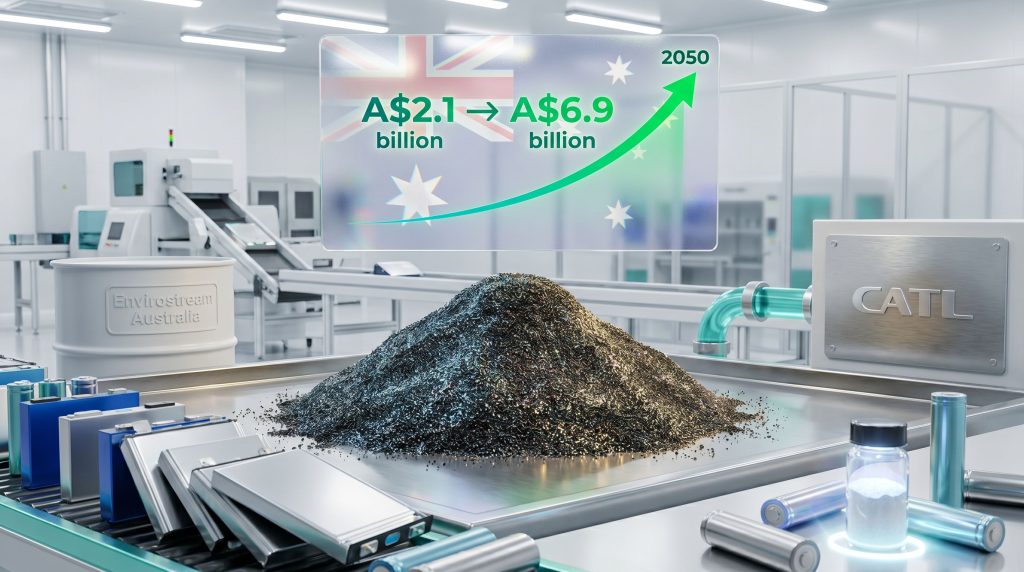
The scale of the commercial opportunity underpinning the Livium CATL recycling pact is substantial and growing. According to an economic assessment commissioned by the Association for the Battery Recycling Industry (ABRI) and prepared by Positive Economics Advisory, the value of annual battery materials recovery in Australia currently stands at approximately A$2.1 billion, with projections indicating growth to A$6.9 billion by 2050, representing a more than three-fold increase. In addition, recent developments in the battery raw materials market suggest that domestic recovery of these materials will only grow in strategic importance.
| Metric | Current Estimate | Projected (2050) |
|---|---|---|
| Annual battery materials recovery value | A$2.1 billion | A$6.9 billion |
| Growth multiple | Baseline | ~3.3x |
The ABRI assessment, which represents the first comprehensive baseline analysis of Australia's battery circular economy, identifies three primary demand drivers:
- Electric vehicle adoption, which is accelerating the volume of end-of-life battery packs entering the waste stream
- Industrial and manufacturing equipment, where battery-powered machinery generates significant commercial waste streams as replacement cycles shorten
- Stationary energy storage systems, including grid-scale installations and behind-the-meter storage units that are approaching end-of-life as early deployments age out
ABRI CEO Katharine Hole has emphasised that the growth of battery use across these three sectors creates a genuine opportunity to build a domestic industry capable of keeping valuable materials in circulation while supporting regional employment and reinforcing Australia's broader position within global critical minerals supply chains.
Why Domestic Processing Matters Beyond the Commercial Case
There is a supply chain security argument embedded within the growth of Australia's battery recycling capacity that goes beyond revenue projections. Australia currently exports a significant proportion of its primary critical mineral production for overseas refining and processing, including lithium and nickel. A parallel dynamic risks emerging in battery recycling, where black mass produced domestically is shipped offshore for hydrometallurgical processing rather than refined within Australia.
Retaining more of the processing value chain domestically would reduce Australia's exposure to offshore refining bottlenecks, particularly in cobalt and lithium precursor production. Furthermore, the critical minerals energy transition objectives underpinning Australia's industrial strategy make this domestic retention argument even more compelling. The Livium CATL recycling pact contributes to this objective by establishing a certified domestic processing pathway for CATL's Australian battery deployments.
CATL's Global Recycling Strategy and Where Australia Fits
CATL is not a passive participant in the battery end-of-life space. Through its Brunp Recycling subsidiary, CATL operates one of the most vertically integrated closed-loop battery material systems in the world, spanning production, deployment, collection, black mass processing, precursor material regeneration, and re-entry into cell manufacturing. This closed-loop model is central to CATL's manufacturing cost economics, as recycled precursor materials can be significantly cheaper than newly mined equivalents when supply chain disruptions or commodity price spikes occur. Consequently, their interest in formalising Australian recycling partnerships aligns with this broader global strategy.
CATL's international recycling strategy, however, is characterised by an asset-light approach. Rather than building wholly owned processing infrastructure in each growth market, the company has pursued market-specific operational partnerships with credentialed local operators. This is evident in its approach to Australia:
| Partnership Type | Geography | Primary Focus |
|---|---|---|
| Brunp Recycling (subsidiary) | China (domestic) | Closed-loop black mass to precursor processing |
| Rio Tinto cooperation agreement | Global/Australia | Lithium supply, mining electrification, battery material sourcing |
| Envirostream (Livium) framework | Australia | Collection, logistics, black mass processing, compliance reporting |
The Envirostream relationship fits CATL's established pattern of leveraging credentialed local operators as recycling nodes within its broader material recovery network. This structure scales with CATL's battery deployment volumes in Australia rather than requiring upfront capital investment in Australian processing infrastructure.
The next major ASX story will hit our subscribers first
Regulatory Dimensions: Certification, Destruction Reporting, and Product Stewardship
One of the less-discussed but commercially important aspects of the Livium CATL recycling pact is its explicit inclusion of certification of recycling and destruction reporting within the scope of services. These compliance functions are gaining significant regulatory weight in Australia as product stewardship obligations for batteries evolve.
Under Australia's product stewardship framework, battery importers, manufacturers, and end-of-life processors carry chain-of-custody obligations that require documented evidence that batteries have been processed by a certified operator in a compliant manner. For commercial and industrial battery operators, including EV manufacturers and fleet operators, destruction reporting is not a bureaucratic formality but a material compliance requirement with potential liability implications.
By embedding these functions within the framework contract, the agreement addresses CATL's compliance obligations for its Australian battery deployments while simultaneously positioning Envirostream as a preferred certified processor for other manufacturers and operators seeking documented recycling pathways.
The regulatory dimension of this agreement may ultimately prove as commercially significant as the processing economics. As product stewardship obligations tighten and chain-of-custody requirements extend further up the supply chain, the ability to provide certified destruction documentation will become a competitive differentiator in the Australian battery recycling market.
What the Pact Signals for Livium's Competitive Positioning
For Livium as an ASX-listed company, the Livium CATL recycling pact carries several layers of strategic significance that extend beyond the immediate commercial relationship.
Tier-one reference client effect: A formalised framework contract with one of the world's largest battery manufacturers provides Envirostream with a credentialed relationship that strengthens its commercial positioning with other potential OEM and battery manufacturer partners. In the battery recycling market, demonstrated capability with a sophisticated global client carries disproportionate weight in subsequent commercial negotiations.
Mid-2029 alignment with EV adoption acceleration: The agreement's duration is not arbitrary. Australia's EV adoption trajectory suggests that the period from now through the late 2020s will see a significant step-up in end-of-life battery volumes, as vehicles sold during the current adoption wave begin reaching battery replacement thresholds. An established operational framework with a major battery manufacturer positions Envirostream to capture that volume within a pre-existing compliance structure rather than negotiating access from scratch.
Platform logic over transactional logic: The agreement is best understood as a platform investment rather than a revenue contract. Its value compounds as battery volumes increase, as the compliance architecture it establishes becomes more deeply embedded in both parties' operational workflows, and as the credentialing effect supports Livium's ability to attract additional partnerships. Indeed, broader battery recycling consolidation trends globally suggest that early movers in establishing these frameworks will hold a structural advantage. A recent battery recycling breakthrough in processing technology further underlines why securing certified processing relationships now is a strategically forward-looking move.
Frequently Asked Questions
What is the Livium CATL recycling pact?
A framework contract between ASX-listed Livium, operating through Envirostream Australia, and CATL's Hong Kong business unit. The agreement covers battery collection, logistics, black mass processing, and compliance reporting services in Australia, running to mid-2029.
Does the agreement include volume commitments?
No. The framework is non-exclusive and contains no minimum volume obligations. Pricing and scope are determined on a case-by-case basis through individual purchase orders, consistent with the parties' prior arrangement.
What is black mass and why is it commercially important?
Black mass is the intermediate material produced when lithium-ion batteries are mechanically processed. It contains recoverable lithium, cobalt, nickel, manganese, and graphite, the critical minerals required for new battery cell manufacturing. Its quality and composition determine its value to downstream refiners and precursor material producers.
How large is the Australian battery recycling market?
According to an ABRI-commissioned assessment prepared by Positive Economics Advisory, Australia's annual battery materials recovery is currently valued at approximately A$2.1 billion, with projections indicating growth to A$6.9 billion by 2050.
Why does CATL partner with an Australian recycler rather than processing batteries in-house?
CATL's international recycling strategy favours asset-light partnerships with credentialed local operators over direct capital investment in offshore processing infrastructure. Partnering with an established domestic operator like Envirostream provides a certified recycling pathway aligned with Australian regulatory requirements without requiring CATL to build or operate Australian facilities.
What is Envirostream Australia?
Envirostream Australia is Livium's battery recycling subsidiary, providing end-of-life battery collection, mechanical processing, black mass production, and compliance documentation services to commercial and industrial clients across Australia.
Disclaimer: This article is for informational purposes only and does not constitute financial advice. Projections regarding market size and growth, including the ABRI-commissioned figures cited, represent forward-looking estimates subject to assumptions that may not be realised. Past commercial relationships and framework agreements do not guarantee future revenues or volumes. Readers should conduct their own due diligence before making investment decisions.
Want to Stay Ahead of ASX Opportunities in the Critical Minerals and Battery Sector?
Discovery Alert's proprietary Discovery IQ model delivers real-time alerts on significant ASX mineral discoveries — instantly translating complex data into actionable insights for traders and investors at every experience level. Explore historic discoveries and the returns they generated, then begin your 14-day free trial at Discovery Alert to position yourself ahead of the market.