June 9, 2026
The Hidden Architecture of Asia's Energy Vulnerability
Commodity markets rarely move in straight lines, and nowhere is that reality more sharply felt than in the intersection of geopolitics and energy infrastructure. The assumption that liquefied natural gas would serve as a reliable, long-term bridge fuel across Asia-Pacific power systems was always contingent on one uncomfortable variable: the concentration of supply in politically sensitive geographies. When that concentration becomes a liability, the fallback position is not renewable energy or battery storage. It is coal.
That is precisely the dynamic now unfolding across Asia, where an LNG shortfall pushes Asia back to coal in ways that are measurable, significant, and instructive for anyone seeking to understand how energy systems actually behave under stress.
When big ASX news breaks, our subscribers know first
Understanding the LNG Dependency That Made Asia Vulnerable
Over the past two decades, gas-fired generation became deeply embedded in the power systems of Northeast and Southeast Asia. Japan, South Korea, Taiwan, Vietnam, Thailand, and the Philippines all expanded gas-to-power capacity as a cleaner alternative to coal and a more flexible complement to baseload nuclear. LNG imports became the fuel source of choice precisely because domestic gas reserves were limited and pipeline infrastructure was either unavailable or geopolitically complicated.
The structural problem embedded in this trajectory was never well-publicised: a disproportionate share of Asia's contracted LNG supply originates from a narrow cluster of Gulf-region export facilities. That geographic concentration creates a single-point-of-failure risk that is difficult to hedge in the short term. Unlike oil, which can be rerouted through alternative suppliers with relative speed, LNG requires specialised liquefaction trains, purpose-built tankers, and receiving terminals calibrated to specific supply agreements.
When Qatar's Ras Laffan facility sustained damage as a consequence of Middle East conflict, the downstream consequences moved quickly. Force majeure provisions were triggered, removing approximately 10.2 million tonnes per annum of contracted LNG supply from Asian markets. For gas-dependent power systems with limited short-run substitution flexibility, that kind of removal does not produce a gradual adjustment. It produces an immediate dispatch crisis.
What a 35 Million Tonne LNG Shortfall Actually Does to Power Grids
The scale of the supply gap is worth translating into operational terms. Rystad Energy projects a 35 million tonne LNG shortfall for 2026, a volume that corresponds to roughly 90 terawatt-hours of displaced gas-fired electricity generation across the region. That is not a marginal rounding error in energy balances. It is a structural hole in generation capacity that utilities must fill using whatever dispatchable resource is available.
The economic logic of coal switching is straightforward. Coal-fired capacity across Asia is, in most cases, already built and largely depreciated. It does not require new capital approval, new environmental permits for incremental output, or new supply chain construction. When gas becomes scarce or prohibitively expensive, the least-cost alternative for a utility operator running a mixed fleet is to increase the dispatch rate of existing coal units. Regulatory cap removals across Northeast Asia have further enabled this response by allowing higher coal burn without requiring new capacity authorisations.
Country-by-Country Breakdown of the Coal Burn Response
The demand response is not evenly distributed. Economies with the deepest gas-to-power exposure are absorbing the sharpest adjustment pressure, as reported by outlets covering the crisis.
| Economy | Primary Exposure Driver | Observable Response |
|---|---|---|
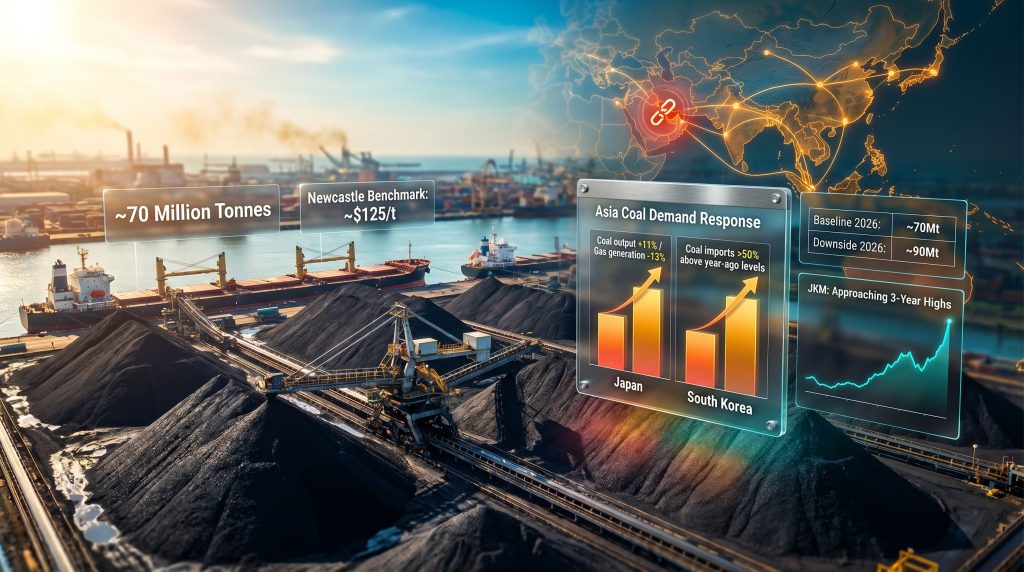
| Japan | High LNG import dependency + gas generation share | Coal-fired output up ~11%; gas generation down ~13% |
| South Korea | LNG reliance + reduced nuclear availability | Coal imports tracking >50% above year-ago levels (May 2026) |
| Taiwan | LNG supply disruption + nuclear phase-down | Elevated coal burn as LNG substitute |
| Vietnam | Tight domestic gas + LNG import reliance | Coal fleet running at higher utilisation rates |
| Thailand | Gas-heavy generation mix | Coal dispatch increased to offset gas shortfall |
| Philippines | LNG import dependency | Existing coal capacity operating harder |
| China | Low gas penetration in power sector | Comparatively insulated from immediate shock |
Japan's situation is particularly instructive. A country that has spent years repositioning its energy mix away from coal following Fukushima found its coal-fired generation rising 11 per cent even as gas output fell 13 per cent, simply because the system had no other lever to pull at speed. South Korean coal imports tracking more than 50 per cent above year-ago levels for May is not a policy choice. It is a procurement necessity.
The coal demand response is not driven by new capacity construction. It is driven by existing fleets operating at higher utilisation rates. This distinction is critical for interpreting both the nature and the expected duration of the current demand shift.
The Japan Korea Marker as a Real-Time Stress Barometer
One of the less-discussed dynamics in energy market analysis is the role that benchmark pricing plays in accelerating fuel switching decisions. The Japan Korea Marker, or JKM, is the primary spot price reference for LNG delivered into Northeast Asia. When JKM moves sharply higher, it does not simply increase input costs for gas-fired generators. It directly widens the economic gap between gas and coal dispatch, making coal switching financially rational for an expanding range of utility operators.
Furthermore, with JKM approaching three-year highs in response to the current supply disruption, the incentive to dispatch coal ahead of gas is now operating across a broader threshold than at any point since the immediate aftermath of the 2022 Russia-Ukraine crisis. This is a self-reinforcing mechanism: tighter LNG availability lifts JKM, which improves coal's dispatch economics, which increases coal burn, which generates upward pressure on thermal coal benchmark pricing. The LNG supply outlook for the remainder of 2026 suggests this dynamic is unlikely to ease quickly.
How 2026 Compares to the Post-2022 Coal Demand Surge
The 2022 response to Russia's invasion of Ukraine provides the most relevant historical parallel, but the comparison reveals important differences that matter for both demand duration and price sustainability.
Similarities between the two events:
- Both disruptions removed substantial gas volumes from global markets within compressed timeframes
- Both triggered immediate coal switching responses across major importing economies
- Both elevated thermal coal benchmark pricing and pulled forward near-term demand projections
Why the 2026 response is more contained:
- Thermal coal inventories across major Asian markets were significantly depleted in 2022, amplifying the procurement scramble
- Renewable energy capacity was considerably more limited in 2022, leaving fewer substitution pathways
- China and India now carry record alternative energy availability, providing meaningful demand buffering at the system level
- The 2022 event triggered a global round of new coal supply contracting; no comparable capital commitment wave has yet emerged in 2026
The practical consequence of these differences is that the current shock, while material, has not yet produced the same degree of global supply-chain stress. Healthy coal inventories have absorbed some of the immediate pressure, and strong renewable output across China and India has prevented the kind of cascading demand surge that characterised 2022. However, the energy market volatility stemming from geopolitical conflict continues to complicate medium-term planning for utility operators.
Quantifying the Near-Term Demand Outlook: Two Scenarios
Rystad Energy has modelled the incremental coal demand response under two scenarios that bracket the range of plausible outcomes through 2030.
| Scenario | 2026 Incremental Demand | Cumulative Demand to 2030 |
|---|---|---|
| Baseline (sustained gas market tightness) | ~70 million tonnes | ~150 million tonnes |
| Downside (renewed conflict escalation) | ~90 million tonnes | ~190 million tonnes |
Under the baseline assumption of a sustained but gradually resolving LNG supply gap, cumulative additional thermal coal consumption across Asia-Pacific is projected at approximately 150 million tonnes through 2030. Critically, roughly half of that volume, around 75 million tonnes, is expected to concentrate within 2026 alone. This front-loading reflects the immediacy of the current supply gap and the speed with which coal dispatch responds to gas availability.
A downside scenario, involving resumed hostilities and extended infrastructure damage, would push 2026 incremental demand toward 90 million tonnes and cumulative near-term demand toward 190 million tonnes. This would approach the scale of the post-2022 surge, though the structural drivers would be meaningfully different. The coal supply challenges already present before this crisis add further complexity to how quickly supply can respond.
The next major ASX story will hit our subscribers first
Newcastle Benchmark Pricing: What the Forecast Implies for Producers
The Newcastle 6,000 kcal benchmark, the primary seaborne thermal coal pricing reference, is expected to average approximately $125 per tonne across 2026 before moderating toward $115 per tonne in 2027 as supply conditions gradually normalise.
Several variables could either sustain elevated pricing beyond this baseline or accelerate its return toward equilibrium.
Factors that would sustain elevated prices:
- Prolonged disruption to Gulf LNG infrastructure without rapid repair or alternative supply mobilisation
- Further regulatory cap removals enabling higher coal burn across Northeast Asian markets
- Failure of new LNG project timelines to compensate adequately for lost contracted volumes
- Delayed nuclear restart schedules in Japan or South Korea extending simultaneous gas and coal demand
Factors that would accelerate price normalisation:
- Faster-than-expected recommissioning of damaged Ras Laffan infrastructure
- Accelerated LNG supply additions from projects under construction in the United States, Australia, and East Africa
- Stronger-than-forecast renewable output reducing residual thermal generation requirements across major markets
The partial shutdown of the Ras Laffan facility is currently expected to extend through late summer 2026. The pace of recovery will set the trajectory for both LNG and thermal coal markets through the remainder of the year, according to energy policy analysts who have modelled several recovery timelines.
Capital Allocation: The Signal That Separates Cycles From Trends
Perhaps the most analytically important question surrounding the LNG shortfall pushing Asia back to coal is whether producers interpret the demand increase as cyclical or structural. History suggests the answer to that question lies not in analyst forecasts but in actual capital deployment.
Following Russia's 2022 invasion of Ukraine, several major coal producers moved to extend mine lives and sanction new capacity, a signal that the industry was pricing in durable demand. As of mid-2026, that response has not yet repeated itself. No major producer has moved to commission large-scale new mining projects or materially extend mine lives in response to current conditions.
Any meaningful move by producers such as Glencore, BHP, Adaro, or Bumi toward new mine commissioning or significant life extensions would represent a genuine shift in how the industry is pricing long-run coal demand. Current signals remain firmly in the cyclical camp.
This restraint reflects a rational assessment of the risks. The LNG disruption could resolve within months if infrastructure repair proceeds as expected. Renewable and nuclear capacity continues to grow across the region, compressing the long-run window for new coal investment to recover capital. In addition, major importing governments have been consistent in characterising recent coal demand increases as emergency responses rather than permanent policy revisions, a framing that matters enormously for investment horizon calculations.
The Policy Dilemma: Energy Security Versus Decarbonisation
The current crisis has surfaced a tension that energy planners have long acknowledged but rarely confronted at this scale. Consequently, energy security trade-offs and decarbonisation are now in direct competition for near-term policy priority.
Governments across Asia-Pacific have been careful to frame increased coal burn as a temporary, emergency-driven measure rather than a strategic reversal of climate commitments. That framing serves an important function in preserving long-term policy credibility, but it does not change the physical reality that greater coal dispatch means higher carbon emissions and worsened air quality across urban and industrial regions.
The structural lesson embedded in the current crisis is one that China and India have, somewhat inadvertently, demonstrated more effectively than gas-dependent economies. A power system with lower gas penetration, stronger domestic coal inventories, and higher renewable installed capacity carries significantly lower exposure to LNG supply shocks. Nuclear restarts in Japan and South Korea represent one of the clearest near-term pathways to reducing simultaneous gas and coal demand.
However, the energy transition pressures facing grid operators mean that grid-scale storage and firm renewable capacity remain the longer-horizon solutions to the underlying vulnerability. Until those solutions are sufficiently scaled, coal will continue to perform the same function it has always performed in moments of energy system stress: providing dispatchable, fuel-secure generation at a cost that no other technology can match on short notice.
The LNG shortfall that pushes Asia back to coal is not a failure of energy transition ambition. It is an exposure of the gap between that ambition and the current state of grid infrastructure.
This article incorporates analysis and projections from Rystad Energy. Forecasts, scenario modelling, and price projections represent forward-looking estimates subject to change based on geopolitical developments, infrastructure repair timelines, and energy market conditions. This content does not constitute financial or investment advice.
Want To Capitalise On The Commodities Driving Asia's Energy Crisis?
Discovery Alert's proprietary Discovery IQ model delivers real-time alerts on significant ASX mineral discoveries — including thermal coal and energy commodities at the centre of today's supply disruptions — instantly empowering subscribers to identify actionable opportunities ahead of the broader market. Explore how historic mineral discoveries have generated substantial returns and begin your 14-day free trial at Discovery Alert to position yourself ahead of the next major market move.