May 24, 2026
When the Lights Go Out on the World's Most Critical Shipping Lane
Global energy markets are built on assumptions of continuity. Long-term LNG contracts are priced on the premise that cargoes will flow predictably, insurance premiums will remain manageable, and the logistical infrastructure connecting producers to consumers will function without interruption. The Strait of Hormuz has always represented the single greatest stress test of that assumption, and right now, that test is actively failing in ways the market has never encountered at this scale.
The emergence of a confirmed LNG tanker exit from the Strait of Hormuz for India in May 2026 is not simply a shipping story. It is a signal that the architecture of global energy trade is being quietly, systematically rebuilt under wartime conditions, using methods that most market participants cannot even see in real time.
When big ASX news breaks, our subscribers know first
The Strait of Hormuz and the Scale of What Is Actually at Stake
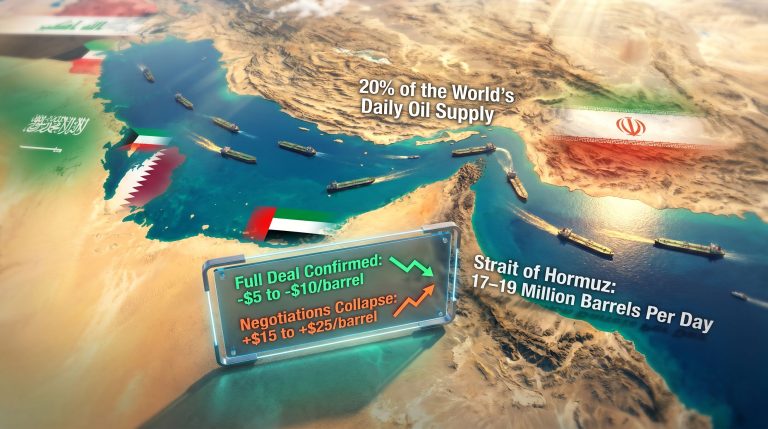
To understand why a single tanker movement commands global attention, it is necessary to first appreciate the true concentration of energy transit that flows through this 33-kilometre-wide passage at its narrowest point. Under normal operating conditions, roughly one-fifth of the world's entire LNG supply transits the Strait daily. Before the Iran conflict disrupted trade flows, approximately three LNG tankers were exiting Hormuz every day, servicing long-term supply contracts across Asia, South Asia, and increasingly Europe.
That baseline has effectively collapsed. The Strait has not been physically closed, but it has become operationally hostile in a manner that amounts to the same outcome for commercial shipping. A combination of active security threats, a US-Iran standoff producing a de facto mutual blockade, and sharply elevated war risk insurance premiums has made routine commercial transit functionally impractical.
The waterway remains technically open; it is simply too dangerous, too expensive, and too uncertain to use in the conventional sense. Furthermore, understanding the global LNG supply outlook makes clear just how concentrated this vulnerability really is across interconnected global markets.
What this means for the global LNG market is not an academic concern. It means that a corridor responsible for one-fifth of global supply has been reduced to a trickle of covert, satellite-tracked movements conducted under signal blackout. The informational vacuum this creates ripples through spot pricing, contract reliability calculations, and national energy security planning simultaneously.
India's Supply Architecture and Why Its Exposure Is Severe
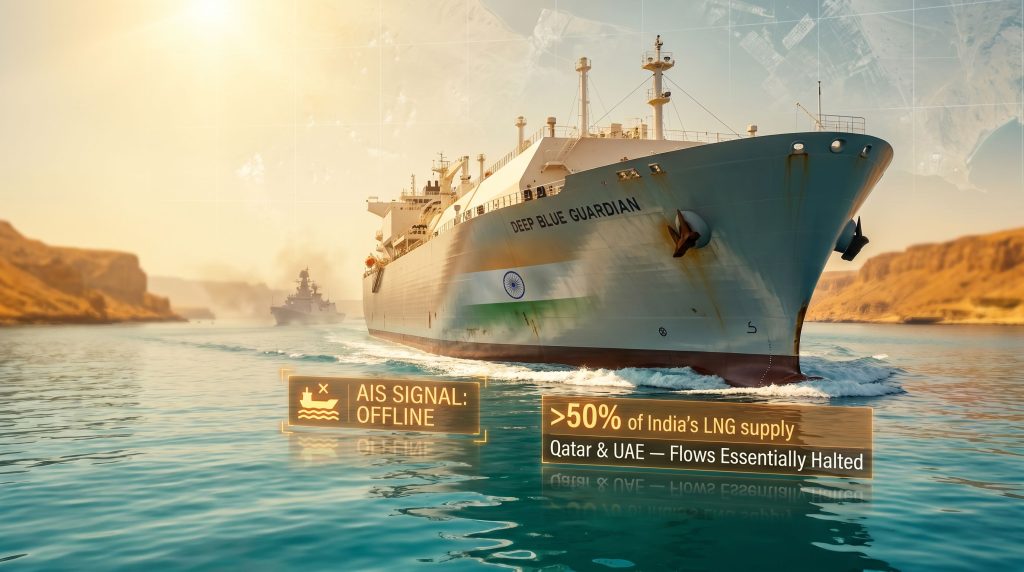
Before the conflict began, India had constructed its LNG import infrastructure heavily around Persian Gulf exporters. Ship-tracking data compiled by Bloomberg confirms that more than 50% of India's LNG imports in the year prior to the conflict originated from Qatar and the UAE, both of which export through the Strait of Hormuz. That concentration was not an oversight.
Persian Gulf LNG offered competitive long-term contract pricing, short shipping distances relative to alternatives, and reliable volumes from well-capitalised state-linked exporters. The vulnerability embedded in that dependency has now been exposed with full force.
| LNG Source Region | Pre-Conflict Share of India's Supply | Current Supply Status |
|---|---|---|
| Qatar | Combined >50% with UAE | Flows essentially halted |
| United Arab Emirates | Combined >50% with Qatar | Flows essentially halted |
| Spot Market (Global) | Supplementary buffer | Active procurement at premium pricing |
| US LNG (long-haul) | Minimal | Under accelerated evaluation |
| Australian LNG | Minimal | Under accelerated evaluation |
| African LNG (Mozambique/Tanzania) | Minimal | Under evaluation for future diversification |
The practical consequences have moved beyond supply chain statistics into the operational reality of Indian industry. With spot market procurement carrying significant premiums over contracted volumes, gas-intensive sectors including fertiliser production, power generation, and petrochemical manufacturing have faced active supply curtailments. These are not sectors that can simply switch fuels on short notice.
Fertiliser plants running below capacity have downstream effects on agricultural input availability. Power generation shortfalls affect industrial output and household supply. The cascade from a shipping disruption in the Persian Gulf to factory curtailments in Gujarat or Andhra Pradesh is both direct and rapid.
India's structural over-reliance on a single geographic corridor for more than half of its LNG supply has been converted from a theoretical risk into a lived operational crisis. The cost of that dependency is now being paid in real time through spot market premiums, industrial curtailments, and sovereign resource deployment.
How a Dark Transit Actually Works: The Operational Mechanics
The confirmed movement of a cargo from Abu Dhabi National Oil Company's Das Island export terminal in the Persian Gulf to western India represents the first documented instance of an LNG tanker exits Strait of Hormuz for India since the Iran conflict began. The operational sequence that made this movement possible has now become the standard template for any Persian Gulf LNG export attempting to reach key buyers.
What Does Signal Blackout Actually Involve?
Under normal conditions, commercial vessels broadcast their position, speed, heading, and identity continuously via Automatic Identification System (AIS) transponders. This data feeds into commercial tracking platforms and is used by analysts, traders, and port authorities to monitor cargo movements globally. AIS is not a surveillance system imposed from outside; it is a mandated safety protocol designed to prevent collisions and coordinate maritime traffic.
When vessels operating in the current Hormuz environment deactivate their AIS transponders, they do so primarily as a crew and vessel safety measure, making themselves less visible to potential threats in an active security environment. The consequence, however, is a systemic blind spot in global LNG supply intelligence.
The reconstructed sequence for a dark transit operation follows a consistent pattern:
- A vessel approaches the eastern entrance of the Strait of Hormuz and deactivates its AIS transponder, disappearing from commercial tracking systems.
- The vessel transits through the Strait and proceeds to a Persian Gulf export terminal, in this case Das Island, during the blackout window.
- Loading operations occur at the terminal. Satellite imagery, sourced independently of AIS data, confirms vessel presence and loading activity even when no transponder signal is being broadcast.
- The vessel departs and eventually reactivates its AIS signal after clearing the Strait, reappearing in tracking data as it heads toward its destination port.
- Analysts using platforms that cross-reference satellite imagery with AIS data can reconstruct the cargo movement retrospectively, though with inherent time delays relative to real-time market intelligence.
This methodology is not unique to India-bound cargoes. ADNOC Logistics and Services has exported at least two other shipments from the Persian Gulf using the same dark transit protocol, with one cargo confirmed destined for Japan and another for China. The pattern strongly suggests that Persian Gulf exporters are systematically prioritising their most strategically significant long-term buyers.
The Role of Naval Escorts: When Energy Security Becomes a Military Function
Beyond the AIS blackout strategy employed by commercial operators, reporting indicates that Indian state-linked shipping has pursued a parallel and more direct approach: direct naval escort through contested waters. Indian Navy assets have reportedly accompanied tankers through the Strait, reflecting a significant escalation in how New Delhi is approaching energy supply security.
This development carries strategic implications that extend well beyond the current supply disruption. The deployment of naval assets to protect commercial energy cargoes represents a formal blurring of the line between commercial logistics and national security operations. It signals that India's government has assessed the supply risk as sufficiently severe to justify sovereign military resource allocation for energy protection purposes.
When a nation begins using its naval fleet to escort fuel tankers through a contested maritime chokepoint, it has effectively classified energy supply continuity as a national security function equivalent in priority to conventional defence operations. This is a significant doctrinal shift with long-term implications for how India structures both its energy procurement and its defence posture.
What AIS Blackouts Mean for LNG Market Intelligence
The widespread adoption of dark transit practices has created a structural gap in the quality of global LNG supply data that market participants are only beginning to fully reckon with. In addition, the consequences extend across all major importing regions — including European gas price pressures that have intensified as buyers compete for the same limited spot volumes.
| Tracking Method | Capability During AIS Blackout |
|---|---|
| AIS (Automatic Identification System) | Non-functional during blackout. Vessel invisible to all commercial trackers. |
| Satellite Imagery | Operational. Can confirm vessel presence and loading activity at terminals. |
| Commercial Vessel Tracking Platforms | Partial. Can reconstruct movements using satellite cross-referencing with time delays. |
| Port Authority Arrival Records | Delayed confirmation of delivery post-transit only. |
| Insurance and Brokerage Networks | Anecdotal and fragmented. Useful for broad pattern identification. |
When AIS data disappears, satellite imagery becomes the primary verification methodology. This introduces analytical delays that have direct consequences for spot market pricing. Traders and buyers who cannot determine in real time how much Persian Gulf LNG is actually clearing Hormuz must make procurement decisions under conditions of elevated informational uncertainty.
That uncertainty systematically supports higher spot prices, as buyers cannot confidently discount a supply shortage that may or may not be as severe as it appears from incomplete tracking data. This dynamic represents one of the less-discussed but genuinely significant market distortions created by the current conflict.
The next major ASX story will hit our subscribers first
India's Strategic Response: Building Beyond Persian Gulf Dependency
The structural exposure revealed by the Hormuz disruption has accelerated India's evaluation of long-term supply diversification across multiple dimensions. The shift is no longer theoretical. The cost premium India is currently absorbing through forced spot market procurement is itself generating the economic pressure to accelerate contract restructuring.
What Alternative Supply Routes Are Being Evaluated?
Alternative supply corridors under active evaluation include:
- United States LNG routed via the Cape of Good Hope or through the Suez Canal, leveraging expanding US export capacity from facilities along the Gulf Coast. Consequently, Asian demand for US LNG has intensified sharply as buyers seek geopolitically safer alternatives.
- Australian LNG from the North West Shelf, Ichthys, and Prelude projects, offering Pacific Basin routing that bypasses the Persian Gulf entirely.
- East African LNG from emerging export infrastructure in Mozambique and Tanzania, though development timelines for these projects remain extended.
- Long-term contract renegotiation with existing Gulf suppliers to incorporate force majeure provisions, alternative delivery point mechanisms, and flexible routing clauses that did not feature prominently in pre-conflict agreements.
The cost arithmetic of this transition is not straightforward. Australian and US LNG carries longer shipping distances to Indian ports, increasing freight costs relative to Persian Gulf supply. East African projects remain years from meaningful export volumes. Spot market procurement, while available, comes at pricing that makes sustained large-scale spot dependency economically damaging for Indian industry.
War Risk Insurance and the Hidden Cost of Every Cargo That Gets Through
One dimension of the Hormuz disruption that receives insufficient analytical attention is the effect of war risk insurance premium escalation on the delivered cost of LNG that does successfully transit the Strait. Every cargo that clears Hormuz under current conditions does so at a dramatically elevated insurance cost, which is passed through to the buyer.
War risk premiums for Persian Gulf transit have surged since the conflict began, adding a cost layer on top of the already elevated spot market pricing that India and other buyers are absorbing. This means that even the trickle of supply that is getting through is arriving more expensively than any pre-conflict modelling would have projected.
The insurance market is effectively applying a conflict surcharge to every unit of LNG that transits the Strait, compressing the economic case for attempted transit while simultaneously adding to buyer costs. This premium structure also creates a reflexive dynamic: higher war risk costs reduce the number of operators willing to attempt transit, which reduces supply, which pushes spot prices higher.
Five Structural Shifts the Hormuz Crisis Is Permanently Accelerating
The covert LNG transit to India is not simply a temporary workaround. It is a data point in a larger reconfiguration of how energy trade is organised, monitored, and protected globally. Moreover, the trade war impact on energy markets has compounded these disruptions, creating a uniquely complex operating environment for buyers and exporters alike. Five structural shifts are now clearly in motion:
- Geographic supply diversification is moving from preference to imperative. Major Asian LNG importers are treating single-corridor dependency as an unacceptable risk, accelerating contract diversification timelines that may otherwise have unfolded over a decade.
- Satellite tracking is replacing AIS as the primary supply intelligence standard in conflict-adjacent regions. Market intelligence infrastructure is being upgraded to account for systematic AIS suppression, but this transition introduces analytical costs and time delays.
- Sovereign involvement in commercial energy logistics is intensifying. Naval escorts, state-directed spot procurement, and national strategic reserve activation represent a fundamentally different relationship between governments and energy supply chains than existed five years ago.
- War risk insurance is being repriced as a structural LNG cost variable. Persian Gulf supply will carry a conflict risk premium in buyer cost models for years beyond any eventual de-escalation, reshaping the relative competitiveness of different supply sources.
- Spot market pricing is being permanently recalibrated to incorporate geopolitical risk. The Hormuz disruption is demonstrating that low-probability, high-impact supply shocks are more frequent than pre-conflict modelling assumed, which will be reflected in long-term contract pricing and spot market risk premiums going forward.
Furthermore, the pressures around geopolitics and oil prices are intensifying in parallel, reinforcing the case that energy buyers must fundamentally rethink supply chain resilience as a strategic priority rather than an operational afterthought.
The resilience displayed by Persian Gulf exporters and major Asian buyers in maintaining supply flows through covert operational mechanisms is genuinely impressive. But resilience achieved through this level of operational complexity and cost is not a substitute for structural diversification. The Hormuz crisis may ultimately compress a decade of LNG trade architecture evolution into two or three years of forced restructuring.
Frequently Asked Questions
Why are LNG tankers turning off their tracking signals near the Strait of Hormuz?
Vessels transiting Hormuz during the current Iran conflict are deactivating their AIS transponders as a direct safety response to the active security environment in the waterway. Making the vessel invisible to commercial tracking systems reduces its visibility to potential threats. This practice is being characterised by operators as a crew protection measure, though it creates significant blind spots in global supply intelligence.
How much of India's LNG supply was dependent on the Persian Gulf before the conflict?
Vessel tracking data confirms that more than half of India's LNG imports in the year prior to the conflict originated from Qatar and the UAE, both of which export through the Strait of Hormuz. Those flows have been largely suspended since hostilities began, forcing India into elevated spot market procurement and industrial supply curtailments.
Does one LNG tanker exiting Hormuz for India mean the Strait is reopening?
Not in any normalised sense. Before the conflict, approximately three LNG tankers exited Hormuz daily. The confirmed movement of a single cargo through a covert dark transit operation represents a fraction of that baseline and reflects an operationally complex workaround rather than a resumption of standard commercial shipping.
Which other countries are receiving LNG through dark transit operations from the Persian Gulf?
Vessel tracking and satellite analysis indicate that similar dark transit operations have delivered cargoes to both Japan and China from UAE export infrastructure, suggesting that Persian Gulf exporters are selectively maintaining supply relationships with their most strategically significant long-term buyers.
What are the long-term implications for global LNG trade architecture?
If the Hormuz disruption persists beyond 12 to 18 months, the probability increases significantly that major Asian importers, including India, will fundamentally restructure their LNG supply portfolios away from Persian Gulf concentration toward geographically diversified sources. This would represent one of the most significant reconfigurations of Asian LNG trade flows in two decades, driven not by policy planning but by the sustained operational consequences of conflict-induced supply disruption.
Want to Stay Ahead of the Resource Opportunities Emerging From This Energy Disruption?
As global LNG trade routes are being fundamentally redrawn and supply diversification accelerates across Asia, the downstream pressure on commodity markets — including critical minerals and energy-linked resources listed on the ASX — is intensifying rapidly. Discovery Alert's proprietary Discovery IQ model delivers real-time alerts the moment significant ASX mineral discoveries are announced, ensuring subscribers can act on actionable opportunities before the broader market catches on — start your 14-day free trial today, or explore how historic discoveries have delivered exceptional returns to those positioned early.