May 24, 2026
Strategic Assessment of Mexico's Energy Security Transition
The global energy landscape has experienced unprecedented volatility in recent years, driven by geopolitical tensions, supply chain disruptions, and rapidly evolving technological capabilities. Within this context, nations worldwide are reassessing their energy independence strategies, weighing domestic production potential against import dependencies that once seemed strategically acceptable. Mexico's Sheinbaum weighs fracking return to cut U.S. gas dependence as part of a broader evaluation of unconventional gas development that represents a critical juncture in North American energy dynamics, where technological advancement, environmental stewardship, and economic sovereignty converge.
This strategic pivot emerges at a moment when energy security considerations extend far beyond traditional supply-demand calculations. The interconnected nature of modern energy infrastructure means that single points of failure can cascade across entire economic systems, making diversified supply portfolios essential for national resilience.
When big ASX news breaks, our subscribers know first
Strategic Energy Security Assessment
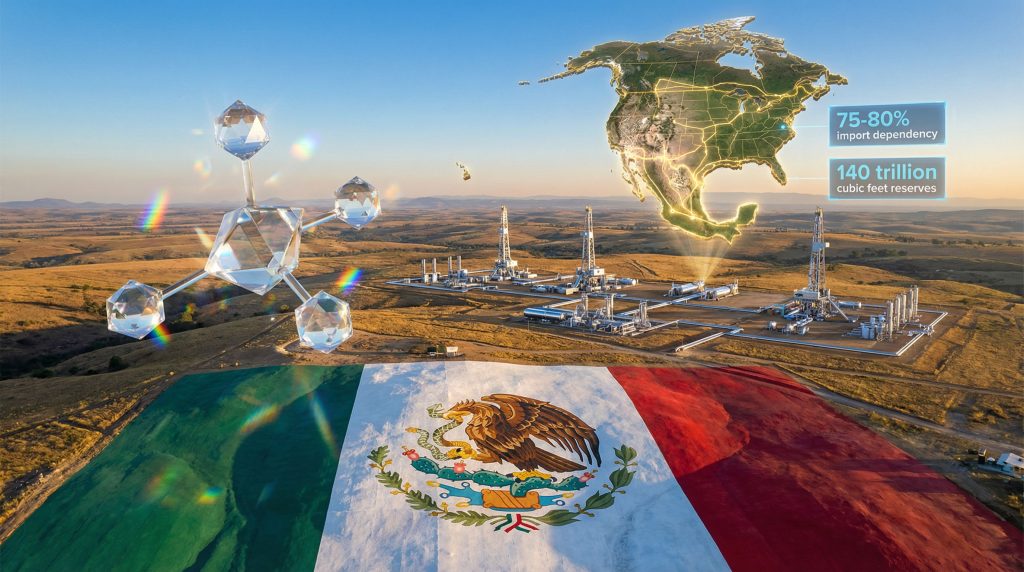
Mexico's natural gas consumption patterns reveal a fundamental vulnerability that extends beyond simple economic considerations. The nation consumes approximately 9 billion cubic feet daily while producing only 2.3 billion cubic feet domestically, creating a 6.7 billion cubic feet deficit that must be filled through imports. This translates to 75-80% import dependency, primarily from Texas-based pipeline infrastructure.
The scale of this dependency becomes particularly concerning when viewed through the lens of reserve potential. Furthermore, Pemex estimates indicate that Mexico possesses 83 trillion cubic feet in proven conventional reserves, yet 140+ trillion cubic feet in non-conventional formations remain largely untapped. This disparity highlights the strategic opportunity that unconventional development could provide for long-term energy autonomy.
Current Supply-Demand Metrics:
- Daily consumption: 9 bcf/d
- Domestic production: 2.3 bcf/d
- Import requirements: 6.7 bcf/d
- Dependency ratio: 75-80%
- Conventional reserves: 83 tcf
- Unconventional potential: 140+ tcf
The concentration risk inherent in this supply structure cannot be understated. Single-source dependencies create cascading vulnerabilities that extend beyond energy markets into industrial competitiveness, fiscal planning, and geopolitical positioning. Historical precedents demonstrate how supply disruptions, whether from natural disasters, infrastructure failures, or policy changes, can rapidly transform energy security into economic crisis.
What Are the Geopolitical Implications of Reduced U.S. Gas Dependence?
Regional Power Balance Shifts
Mexico's potential transition toward energy self-sufficiency would fundamentally alter bilateral trade dynamics and regional influence patterns. Current import relationships create asymmetrical leverage structures that constrain policy autonomy and expose the nation to external supply manipulation.
The strategic implications extend beyond energy markets into broader economic positioning. Consequently, reduced dependency could enable Mexico to negotiate from positions of strength in bilateral trade discussions, develop industrial sectors without external energy price volatility, create potential export capabilities for regional markets, and reduce foreign currency outflows currently devoted to energy imports.
Economic Sovereignty Indicators:
| Metric | Current State | Potential Future |
|---|---|---|
| Import dependency | 75-80% | 25-40% |
| Policy autonomy | Constrained | Enhanced |
| Regional positioning | Energy importer | Potential exporter |
| Currency exposure | High | Reduced |
Technology Transfer and Environmental Innovation
The formation of scientific committees involving Pemex and the Mexican Oil Institute signals an approach that prioritises technological advancement over rapid development. This strategy acknowledges that modern unconventional gas extraction technologies offer substantially improved environmental profiles compared to early U.S. shale operations.
Advanced Technology Applications Under Evaluation:
- Waterless fracturing systems utilising CO2 or nitrogen
- Biodegradable chemical additives with reduced environmental persistence
- Closed-loop water recycling infrastructure
- Real-time environmental monitoring networks
- Precision drilling techniques minimising surface disruption
The two-month evaluation timeline suggests urgency while maintaining scientific rigour. This compressed schedule indicates that preliminary assessments have likely been conducted, with the committee focused on final technology selection and implementation frameworks.
Why Is Timing Critical for Mexico's Energy Transition Strategy?
Industrial Demand Acceleration
Mexico's power sector expansion creates a narrow window for establishing domestic supply chains before long-term import commitments become entrenched. In addition, seven combined-cycle plants are entering operation with five additional facilities planned, representing substantial increases in baseline gas consumption. This development parallels renewable energy transformations occurring across the energy sector.
Infrastructure Development Timeline:
| Phase | Facilities | Operational Period | Demand Impact |
|---|---|---|---|
| Current deployment | 7 plants | 2026-2027 | +15% consumption |
| Planned construction | 5 plants | 2028-2030 | +25% total demand |
| Industrial expansion | Multiple sectors | 2030+ | +40% baseline growth |
This infrastructure buildout creates urgency around supply source decisions. Combined-cycle facilities typically operate under 15-25 year fuel supply contracts, making switching costs prohibitive once agreements are executed. Establishing domestic production capabilities before these contracts are finalised could fundamentally alter Mexico's energy trajectory.
Global Energy Market Volatility
Recent Middle East conflicts and supply chain disruptions have highlighted the risks of import dependency across global energy markets. For instance, LNG market tightening and increased competition for North American gas exports create additional pressure on traditional supply arrangements. These dynamics reflect broader patterns seen in Canada energy transition challenges and US natural gas forecast scenarios.
The confluence of these factors generates political will for domestic production initiatives that might not exist during stable market conditions. Energy price volatility directly impacts industrial competitiveness, making supply security a national economic priority rather than merely an energy policy consideration.
What Environmental and Social Frameworks Could Enable Sustainable Development?
Technology Innovation Pathways
Mexico's approach emphasises learning from early U.S. shale development experiences while implementing advanced technologies that weren't commercially available during initial unconventional gas expansion. This technological leapfrogging strategy could establish new environmental standards for Latin American unconventional development.
Environmental Technology Categories:
"Waterless Fracturing Systems: Advanced CO2 and nitrogen-based fracturing techniques eliminate groundwater contamination risks while maintaining formation stimulation effectiveness."
"Chemical Innovation: Biodegradable additive formulations reduce long-term environmental persistence while maintaining operational performance requirements."
"Water Management: Closed-loop recycling systems minimise freshwater consumption and eliminate wastewater disposal challenges."
"Monitoring Integration: Real-time sensor networks enable immediate response to environmental anomalies and continuous compliance verification."
Community Engagement and Benefit Sharing
Unlike early U.S. shale development, Mexico has the opportunity to implement comprehensive community consultation and revenue-sharing frameworks from project inception. This proactive approach could establish new standards for social licence maintenance and local economic development.
However, the scientific committee's mandate to evaluate environmental technologies suggests that community impact assessment will be integrated into technology selection processes rather than treated as a separate consideration. This approach recognises the importance of critical minerals & energy security considerations in sustainable development frameworks.
How Do Production Targets Align with Long-term Energy Security Goals?
Pemex Production Scenarios
Current production targets suggest a phased approach that maintains import relationships while building domestic capacity. Furthermore, Pemex aims to increase domestic production to 4 billion cubic feet daily by 2030, with longer-term targets of 8.6 billion cubic feet over the following decade.
Production Pathway Analysis:
- 2026-2028: Technology validation and pilot project implementation
- 2028-2030: Initial commercial production scaling (1.7 bcf/d increase)
- 2030-2035: Accelerated development targeting self-sufficiency
- 2035+: Potential export capacity development for regional markets
Import Transition Strategy
Even under optimistic production scenarios, Mexico will require substantial U.S. imports through the early 2030s, creating opportunities for managed transition rather than abrupt supply shifts. This gradual approach reduces disruption risks while building operational expertise.
The production timeline alignment with power sector expansion suggests strategic coordination between energy supply development and industrial demand growth, optimising infrastructure utilisation while minimising dependency periods.
The next major ASX story will hit our subscribers first
What Are the Investment and Economic Implications?
Capital Requirements and Financing
Developing 140 trillion cubic feet of unconventional reserves requires substantial capital investment, potentially exceeding $100 billion over two decades. This scale necessitates international partnerships and technology transfer agreements that could reshape Mexico's energy sector relationships.
Investment Framework Considerations:
- Joint venture structures with international operators
- Technology licensing agreements for advanced extraction methods
- Infrastructure development for processing and transportation
- Workforce development and training programmes
- Environmental monitoring and compliance systems
Economic Multiplier Effects
Domestic gas production creates upstream and downstream economic benefits that extend far beyond energy sector revenues. Consequently, reduced import costs improve industrial competitiveness while creating employment opportunities in technical sectors.
Economic Impact Categories:
- Foreign exchange savings: Reduced outflows for energy imports
- Industrial development: Lower input costs for manufacturing sectors
- Employment generation: Technical jobs in drilling, completion, and processing
- Technology advancement: Local expertise development in advanced extraction methods
- Regional development: Infrastructure investment in producing areas
How Does This Strategy Compare to Alternative Energy Pathways?
Renewable Energy Integration
Mexico's unconventional gas strategy appears designed to complement rather than compete with renewable energy development. Natural gas serves as bridge fuel technology, providing reliable baseload power while solar and wind capacity scales up to meet growing demand.
This integrated approach recognises that renewable intermittency requires flexible backup generation, with natural gas offering superior environmental profiles compared to coal or oil-based alternatives.
Regional Energy Hub Potential
Successful unconventional gas development could position Mexico as a regional energy supplier to Central America, creating new export revenue streams and geopolitical influence. This transformation from energy importer to potential exporter would fundamentally alter Mexico's regional positioning.
Regional Market Opportunities:
- Guatemala and Honduras gas demand growth
- Industrial development in Central American manufacturing
- LNG export infrastructure development
- Regional energy security cooperation frameworks
What Risk Mitigation Strategies Are Essential for Success?
Environmental Protection Frameworks
Implementing comprehensive environmental monitoring and protection measures before development begins could avoid the regulatory backlash experienced in other regions. Proactive environmental stewardship establishes social licence while preventing costly remediation requirements.
Critical Risk Mitigation Elements:
- Baseline environmental assessment: Comprehensive pre-development monitoring
- Technology validation: Rigorous testing of environmental protection systems
- Community engagement: Ongoing consultation and benefit-sharing programmes
- Regulatory compliance: Exceeding minimum environmental standards
- Adaptive management: Continuous improvement based on monitoring results
Political Continuity Mechanisms
Establishing bipartisan support and institutional frameworks that survive political transitions will be crucial for long-term project success. Energy infrastructure requires decades to reach full potential, making political stability essential for investor confidence and operational continuity. These considerations parallel concerns seen in US-China trade war impacts on long-term strategic planning.
Technology Validation Processes
Rigorous testing of environmental technologies and community impact assessment will be essential for maintaining social licence to operate. The scientific committee's evaluation provides opportunity to establish technology standards that could influence industry practices across Latin America.
Mexico's Sheinbaum weighs fracking return to cut U.S. gas dependence as part of a comprehensive strategy for economic sovereignty and regional influence enhancement. Success depends on balancing immediate energy security requirements with environmental protection and social acceptance, while positioning for long-term competitiveness in evolving global energy markets.
The two-month scientific committee timeline suggests decisions will be made rapidly, creating urgency around technology selection, regulatory frameworks, and community engagement strategies that will define Mexico's energy future for decades. This compressed evaluation period indicates that preliminary assessments have likely been conducted, with final recommendations focused on implementation pathways rather than fundamental feasibility questions. According to official reports, the administration's approach emphasises technological innovation while addressing environmental concerns through advanced monitoring systems.
Disclaimer: This analysis involves forecasts and speculative assessments of Mexico's Sheinbaum weighs fracking return to cut U.S. gas dependence policy decisions. Future developments may differ significantly from projected scenarios. Readers should consult official government sources and qualified energy analysts for investment or policy decisions.
Ready to Invest in Energy Transition Opportunities?
Whilst Mexico reassesses its energy independence strategy, Discovery Alert's proprietary Discovery IQ model delivers real-time alerts on significant ASX mineral discoveries, helping investors identify actionable opportunities in critical minerals and energy transition sectors ahead of the broader market. Begin your 14-day free trial today and secure your market-leading advantage in this rapidly evolving landscape.