May 24, 2026
Understanding Mexico's Environmental Governance Crisis Through the Gulf Spill
Modern offshore hydrocarbon extraction operates within complex regulatory ecosystems where multiple government agencies, environmental protocols, and monitoring systems must coordinate seamlessly to prevent ecological disasters. Furthermore, the mining sector faces similar challenges with permitting regulatory insights playing a crucial role in operational success. When these systems fail, the consequences extend far beyond immediate environmental damage to reveal fundamental weaknesses in institutional design, transparency mechanisms, and accountability frameworks that govern critical infrastructure operations.
The recent contamination event affecting Mexico's Gulf coastline demonstrates how regulatory gaps, information asymmetries, and coordination breakdowns can transform what should have been a contained incident into a crisis spanning multiple states and threatening internationally recognised marine ecosystems. This analysis examines the systemic governance failures that enabled a 630-kilometre contamination zone to develop and persist, highlighting critical lessons for environmental regulatory reform.
When big ASX news breaks, our subscribers know first
Timeline Discrepancies Reveal Transparency Deficits in Environmental Oversight
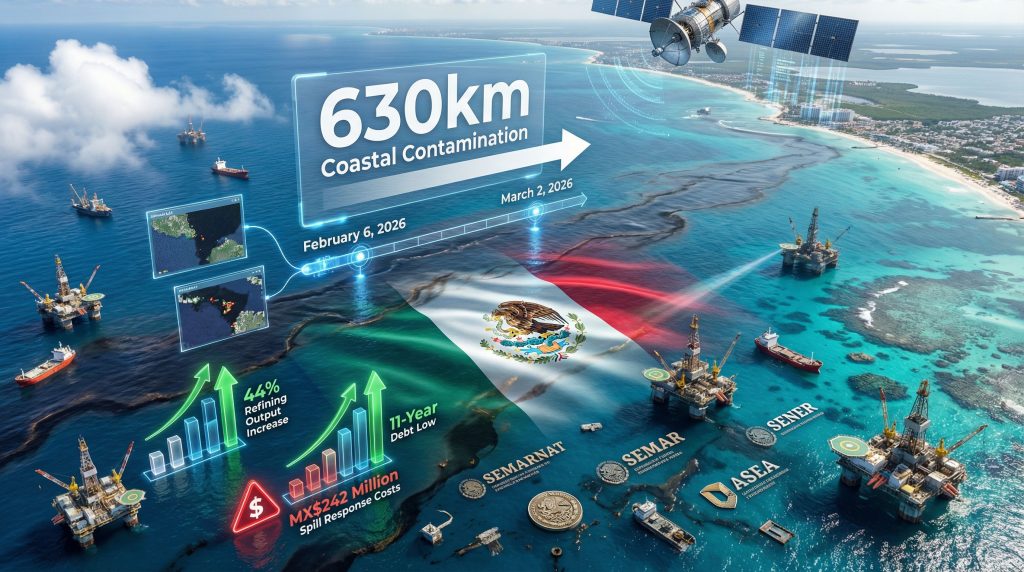
The chronology of Mexico's recent Gulf of Mexico oil spill PEMEX incident exposes critical gaps between detection capabilities and official disclosure protocols that undermine public trust in environmental governance. Advanced satellite monitoring technologies detected hydrocarbon contamination signatures on February 6, 2026, yet government acknowledgment only occurred on March 2, 2026, creating a 24-day information gap that raises fundamental questions about regulatory transparency.
Satellite Evidence Versus Official Narratives
A coalition of 17 civil society organisations conducted an independent investigation using over 70 satellite images from synthetic aperture radar and multispectral platforms, documenting the progressive development of hydrocarbon slicks weeks before coastal impacts were reported. This sophisticated monitoring approach identified the alleged source as pipeline OLD AK C, a 36-inch active crude line connecting the AKAL-C platform to the Dos Bocas Maritime Terminal.
The technical precision of satellite detection capabilities demonstrates that real-time environmental monitoring infrastructure exists but remains disconnected from official notification protocols. Synthetic aperture radar technology can detect hydrocarbon slicks under various weather and lighting conditions, providing temporal documentation that should trigger immediate regulatory response mechanisms.
Operational Activity Documentation
Particularly concerning is the documented presence of the Árbol Grande, a pipeline repair vessel operated by Constructora Subacuática Diavaz under PEMEX contract, which remained anchored at the alleged spill site for over eight days beginning February 7, 2026. Support vessels conducted water cannon dispersal operations during this period, indicating operational awareness of the contamination event well before public disclosure.
| Timeline Comparison | Date | Source |
|---|---|---|
| Satellite detection of hydrocarbon slicks | February 6, 2026 | Civil society coalition investigation |
| Vessel deployment to spill site | February 7, 2026 | Satellite imagery documentation |
| Official government acknowledgment | March 2, 2026 | Government press conference |
| Public announcement | March 26, 2026 | Joint agency press conference |
This timeline discrepancy represents more than administrative delay; it indicates systematic information management failures within Mexico's environmental governance framework that prioritise institutional protection over public transparency.
Multi-Agency Coordination Breakdown Exposes Institutional Design Flaws
The Gulf of Mexico oil spill PEMEX response involved five primary agencies – SEMARNAT, SEMAR, SENER, ASEA, and PEMEX – yet coordination failures necessitated direct presidential intervention to establish emergency oversight mechanisms. This breakdown reveals fundamental structural problems in Mexico's environmental regulatory architecture.
Resource Mobilisation Versus Information Integration
Despite deploying substantial resources including:
• 3,000 total personnel (2,200 from SEMAR; 700 from PEMEX)
• 47 vessels for containment and cleanup operations
• 48 vehicles for coastal response activities
• 7 aircraft for aerial monitoring and coordination
• 2 aerial drones and 2 submarine drones for specialised operations
• 1,000 metres of containment barriers
The response demonstrated Mexico's capacity for resource mobilisation while simultaneously exposing critical information sharing gaps between regulatory bodies. The fact that operational knowledge existed within contractor circles but failed to propagate through inter-agency channels indicates systematic communication protocol failures.
Legal Trigger Mechanisms and Enforcement Gaps
Under Article 11 of Mexico's hydrocarbons sector environmental protection law, ASEA must notify the Attorney General's Office when evidence indicates potential environmental crimes. This legal mechanism was activated following the spill discovery, but the 24-day delay in recognition suggests that existing trigger protocols are inadequately integrated with real-time monitoring capabilities.
President Sheinbaum's instruction to establish a Permanent Environmental Observatory in the Gulf of Mexico represents acknowledgment that existing coordination mechanisms proved insufficient for managing complex offshore incidents.
The need for executive-level intervention to create new oversight structures demonstrates that Mexico's current regulatory framework lacks the institutional integration necessary for effective environmental governance in offshore operations.
Environmental Monitoring System Deficiencies Require Structural Reform
Mexico's environmental monitoring infrastructure combines sophisticated detection capabilities with outdated integration protocols, creating dangerous gaps between what can be observed and what triggers official response mechanisms. The Gulf of Mexico oil spill PEMEX case demonstrates that technological solutions exist but remain disconnected from regulatory action frameworks. Additionally, modern industries are increasingly adopting data-driven operations to enhance monitoring capabilities and response times.
Current Regulatory Framework Limitations
ASEA functions as Mexico's sole industrial safety and environmental regulator for the hydrocarbon sector, overseeing operations across a vast offshore infrastructure network. However, the agency's oversight capacity appears mismatched to PEMEX's operational scale, particularly regarding real-time monitoring and incident detection protocols.
The involvement of five separate agencies with overlapping jurisdictions creates coordination complexity that hinders rapid response capabilities. Each agency operates within distinct mandate boundaries:
• SEMARNAT: Environmental policy oversight and ecosystem protection
• SEMAR: Maritime response coordination and naval operations
• SENER: Energy sector policy and strategic planning
• ASEA: Industrial safety and environmental compliance enforcement
• PEMEX: Operational entity with direct infrastructure responsibility
International Best Practices Comparison
Norway's offshore monitoring model integrates the Petroleum Safety Authority with automated leak detection systems, acoustic monitoring, and satellite surveillance, creating seamless real-time awareness capabilities. Brazil's regulatory framework through ANP and IBAMA includes mandatory incident reporting timelines and automated environmental data integration.
These international examples demonstrate that effective offshore environmental governance requires:
- Automated detection systems at critical pipeline nodes
- Real-time pressure and flow monitoring integration
- Automated satellite data ingestion and alert protocols
- Cross-agency data sharing infrastructure
Mexico's current system lacks these integrated capabilities, relying instead on manual coordination processes that introduce dangerous delays in incident recognition and response.
Economic Implications Threaten PEMEX's Financial Recovery Trajectory
The timing of this environmental crisis poses significant risks to PEMEX's recent financial improvements, potentially undermining investor confidence and credit rating stability. The company achieved its lowest debt level in 11 years during 2025, accompanied by a 44% increase in refining output and credit rating upgrades from both Fitch and Moody's.
Immediate Response Costs and Financial Impact
PEMEX's documented spill response investments include:
| Cost Category | Amount (MX$) | Description |
|---|---|---|
| Beach cleanup operations | 217 million | Coastal contamination removal |
| Specialised containment vessels | 8 million | Maritime response equipment |
| Community support programmes | 15 million | Fishing cooperative assistance |
| Total documented costs | 240 million | Immediate response investment |
These immediate costs represent only the beginning of potential financial exposure. The contamination event affects 630 kilometres of coastline across three states, with cleanup operations reaching 39 beaches and removing over 740 tons of pollutants from maritime and coastal areas.
Credit Rating Vulnerability
The Fitch and Moody's upgrades that accompanied PEMEX's 2025 financial recovery were explicitly conditioned on continued progress in operational and safety governance. This environmental incident directly challenges the operational reliability improvements that justified those credit enhancements. In addition to understanding spill impacts, companies must consider a recent oil spill in the Gulf of Mexico that has raised further questions about regional environmental management.
PEMEX's own ESG reporting has identified pipeline leaks and ecological contamination as material business risks, indicating internal acknowledgment of governance deficiencies that the recent spill has now materialised into public crisis.
Sectoral Impact Assessment
The contamination affects critical economic sectors across the Gulf region:
Fishing Industry Disruption:
• 11 fishing cooperatives representing approximately 300 direct members
• Emergency support allocation of MX$15 million through PEMEX's Community and Environmental Support Programme
• Environmental impact indicators including dead turtles and dolphins washing ashore
Marine Ecosystem Service Losses:
• Veracruz Reef System contamination affecting UNESCO-recognised protected areas
• National Commission of Protected Natural Areas deployment for specialised reef zone cleanup
• Long-term biodiversity impact in one of the western Atlantic's most diverse marine ecosystems
Aging Pipeline Infrastructure Creates Systemic Environmental Risk
Mexico's offshore pipeline network represents a critical vulnerability in the country's energy infrastructure, with much of the system dating from the 1970s and 1980s and experiencing years of underinvestment in maintenance protocols. The Gulf of Mexico oil spill PEMEX incident highlights how infrastructure aging intersects with regulatory oversight gaps to create systemic environmental risks.
Technical Infrastructure Analysis
The alleged source pipeline, OLD AK C, represents typical infrastructure within PEMEX's offshore network – a 36-inch active crude line connecting production platforms to mainland terminals. This infrastructure configuration requires continuous integrity monitoring, particularly given the marine environment's corrosive effects on pipeline materials.
Pipeline integrity management in offshore environments demands:
- Regular internal inspection using intelligent pipeline inspection tools
- Cathodic protection system monitoring for corrosion prevention
- Pressure testing protocols to identify structural weaknesses
- External coating assessment for environmental protection integrity
Maintenance Investment Gaps
PEMEX's financial constraints during previous years resulted in deferred maintenance across its infrastructure portfolio, creating accumulated risk within the pipeline network. While the company achieved significant financial recovery in 2025, the legacy effects of underinvestment continue to manifest as operational vulnerabilities.
The contrast between PEMEX's recent financial improvements and this infrastructure failure illustrates a fundamental challenge: financial metrics can improve rapidly, but infrastructure integrity requires sustained investment over extended periods to address accumulated maintenance deficits.
The next major ASX story will hit our subscribers first
Legal Precedents and Corporate Environmental Accountability
The Gulf of Mexico oil spill PEMEX incident will likely establish important legal precedents for corporate environmental accountability in Mexico, particularly regarding the relationship between operational knowledge, regulatory disclosure, and criminal liability under environmental protection laws.
Criminal Liability Framework Development
The Attorney General's Office investigation, triggered by ASEA's formal complaint under Article 11 requirements, will determine whether the timeline discrepancies constitute environmental crimes under Mexican law. Key legal questions include:
• Corporate knowledge standards: Whether documented vessel deployment constitutes acknowledgment of spill occurrence
• Disclosure obligation timing: Legal requirements for incident reporting relative to operational awareness
• Individual versus institutional responsibility: Liability distribution between corporate entities and government agencies
Civil Society Oversight Role
The coalition's investigation methodology demonstrates how citizen monitoring can provide legal evidence for environmental enforcement. Their use of over 70 satellite images from multiple sensors creates a documentation standard that may influence future environmental litigation approaches.
This precedent suggests that satellite imagery analysis by civil society organisations can function as an independent verification mechanism for corporate and government environmental claims, potentially establishing new accountability standards in environmental governance.
Regulatory Architecture Reform Requirements
Mexico's response to this crisis requires fundamental restructuring of its offshore environmental regulatory framework to address the institutional design flaws that enabled a 24-day disclosure delay despite technological detection capabilities. Furthermore, lessons from this incident relate to broader industry evolution trends affecting multiple sectors.
Institutional Integration Recommendations
Effective reform must address the coordination failures between Mexico's five overlapping agencies through:
Single Environmental Authority Integration:
• Consolidated monitoring systems across all offshore operations
• Unified incident response protocols eliminating inter-agency coordination delays
• Real-time data sharing infrastructure connecting satellite monitoring, operational systems, and regulatory oversight
Mandatory Real-Time Reporting Requirements:
• Automated alert systems triggered by satellite detection or operational indicators
• 24-hour maximum disclosure timelines for potential environmental incidents
• Public transparency protocols eliminating discretionary disclosure decisions
International Cooperation Mechanisms
Mexico's Gulf of Mexico operations require regional coordination frameworks that extend beyond national boundaries, particularly for:
- Cross-border spill response protocols with the United States
- Technology transfer agreements for advanced monitoring systems
- Regional environmental governance frameworks for shared marine ecosystems
These cooperation mechanisms should establish standardised monitoring protocols, joint incident response capabilities, and shared environmental data systems that prevent information gaps from creating regional environmental risks.
Energy Transition Strategy Implications
This environmental crisis occurs at a critical moment in Mexico's energy sector development, potentially accelerating policy discussions about offshore hydrocarbon operations versus renewable energy investment priorities. The Gulf of Mexico oil spill PEMEX incident raises fundamental questions about risk management in traditional energy infrastructure versus emerging clean energy alternatives. Moreover, this event coincides with global renewable energy transformations that are reshaping energy sector priorities worldwide.
ESG Investment Considerations
International investor confidence in Mexico's energy sector may be affected by this demonstration of environmental governance gaps, particularly given PEMEX's recent credit rating improvements. The incident highlights how operational failures can rapidly undermine financial progress, creating uncertainty for ESG-focused investment strategies. Additionally, historical precedents such as the Ixtoc I oil spill demonstrate the long-term environmental and economic consequences of offshore incidents.
The contamination of UNESCO-recognised marine ecosystems adds international dimension to Mexico's environmental governance reputation, potentially affecting access to green bond markets and sustainable finance mechanisms.
Veracruz Reef System Recovery Protocols
The impact on one of the western Atlantic's most biodiverse marine ecosystems requires specialised restoration approaches that extend beyond immediate contamination cleanup. Recovery protocols must address:
• Marine biodiversity restoration timelines for affected coral reef communities
• Ecosystem service compensation frameworks for long-term environmental damage
• UNESCO World Heritage site protection measures ensuring international conservation standards
These restoration requirements create additional financial obligations for PEMEX while establishing precedents for environmental damage compensation that may influence future offshore operation risk assessments.
Transforming Crisis into Regulatory Innovation
Mexico's response to this environmental crisis provides an opportunity to establish world-class offshore environmental governance standards that could serve as a regional model for effective regulatory integration and transparency. This transformation must consider broader energy transition strategy considerations to ensure regulatory frameworks support sustainable development objectives.
Policy Reform Implementation Roadmap
Effective transformation requires structured reform implementation:
90-Day Emergency Review Timeline:
• Comprehensive assessment of existing regulatory coordination mechanisms
• Technology integration evaluation for real-time monitoring capabilities
• International best practice analysis for regulatory framework redesign
Permanent Environmental Observatory Implementation:
• Integrated satellite monitoring systems with automated alert capabilities
• Cross-agency data sharing protocols eliminating information silos
• Public transparency requirements for environmental monitoring data
Monitoring and Evaluation Framework
Sustained regulatory improvement requires systematic assessment mechanisms:
- Annual offshore infrastructure integrity assessments with public reporting requirements
- Public transparency standards for environmental monitoring data and incident reporting
- International peer review mechanisms ensuring continuous improvement in governance standards
The Gulf of Mexico oil spill PEMEX incident demonstrates that effective environmental governance requires more than technological capabilities or financial resources – it demands institutional integration, transparency commitment, and accountability frameworks that prioritise environmental protection over institutional convenience. Mexico's response to this crisis will determine whether the country can transform environmental governance failure into regulatory innovation that serves as a model for effective offshore environmental management.
This analysis is based on publicly available information and regulatory documents. Environmental regulatory frameworks continue to evolve, and investors should conduct independent due diligence when evaluating energy sector investments. The long-term environmental and financial implications of offshore incidents may take years to fully materialise and quantify.
Want to Stay Ahead of Major Market-Moving Events?
Discovery Alert delivers instant notifications on significant ASX mineral discoveries using its proprietary Discovery IQ model, helping investors identify actionable opportunities before they become widely recognised. Don't miss the next major discovery that could generate substantial returns – begin your 14-day free trial today and gain the market edge you need to make informed investment decisions.