
May 22, 2026
Strategic resource allocation decisions increasingly determine whether mining developments become community assets or economic extractors. Regional Australia faces a fundamental challenge where industrial growth potential meets infrastructure constraints, creating complex scenarios that demand sophisticated planning frameworks. Furthermore, the intersection of mining industry trends with local housing markets represents a critical case study in sustainable development economics.
Understanding these dynamics requires examining how resource towns navigate the tension between immediate economic opportunity and long-term community viability. When major projects announce workforce requirements equivalent to significant percentages of existing populations, the resulting pressures extend far beyond simple supply-demand calculations.
Understanding the Pre-Development Housing Baseline
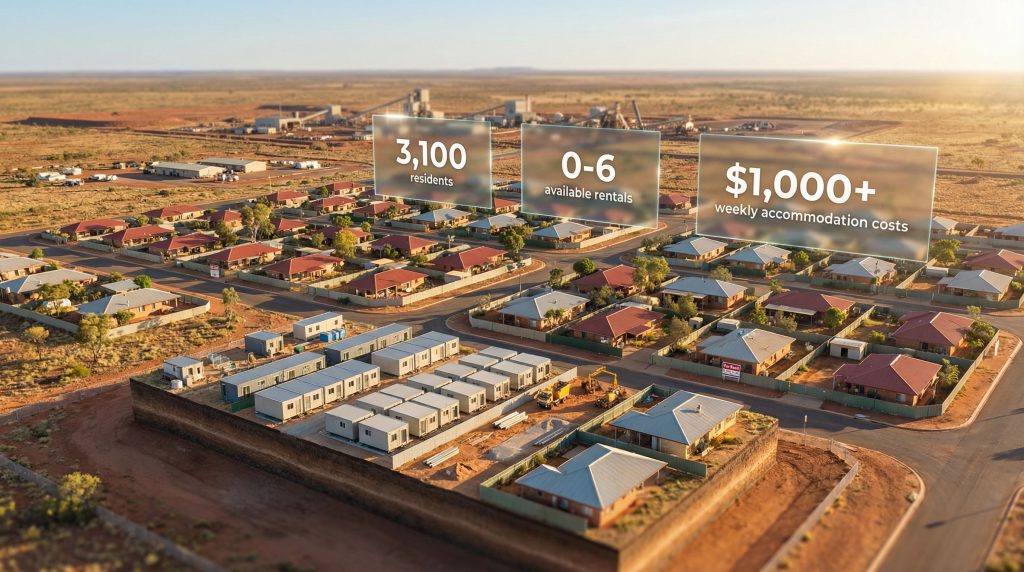
Regional housing markets operate under fundamentally different constraints than metropolitan areas, with Cloncurry's situation exemplifying these unique dynamics. The town's 3,100 residents compete for accommodation within a finite stock of 859 total private dwellings, creating a market density of approximately 3.6 persons per dwelling unit.
Current Market Dynamics Analysis:
• Rental availability fluctuates between zero and six properties at any given time
• Historical baseline suggested 10-15 rental properties typically available
• Market contraction represents approximately 50-85% decline from previous availability levels
• One local motel maintains 50% or higher occupancy with permanent residents
The financial burden on families seeking accommodation has reached critical thresholds. Households report spending $1,000 weekly for two motel rooms, creating an annual accommodation cost of $52,000 for temporary housing arrangements. This represents a significant premium over typical rental markets and demonstrates the severity of supply constraints.
Population Pressure Indicators:
Real estate professionals describe a transformed competitive landscape where transient mining contractors consistently outbid local families for available properties. The market transformation reflects broader structural changes in regional employment patterns, with resource sector wages creating pricing pressures that permanent residents struggle to match.
Local families with stable employment and community ties find themselves displaced into temporary accommodation despite meeting traditional rental criteria. The Cloncurry housing crisis illustrates how pre-development shortages compound when major industrial announcements occur without corresponding accommodation planning.
When big ASX news breaks, our subscribers know first
What Are the Economic Drivers Behind Housing Scarcity?
Construction economics in remote locations operate under significantly different parameters than urban markets. Material transport costs, labour availability, and infrastructure dependencies create cumulative barriers that traditional development financing models struggle to address effectively. Moreover, project financing challenges compound these difficulties in regional areas.
Construction Cost Barriers:
Building costs in outback locations carry substantial premiums due to distance from supply chains and limited contractor availability. The economic viability threshold appears to require minimum project scales of approximately 20 residential units to achieve cost efficiencies that make rental property investment attractive.
• Material transport adds significant cost premiums to base construction prices
• Skilled construction workforce availability remains constrained in remote Queensland locations
• Infrastructure dependencies tie housing development to broader utility and service capacity expansion
• Project financing becomes challenging when traditional return-on-investment calculations don't account for regional market dynamics
Investment Risk Assessment Framework:
Developers face unique challenges when evaluating remote area residential projects. Small population bases create uncertainty for large-scale developments, whilst higher construction costs reduce potential rental yields compared to urban alternatives.
Banking institutions demonstrate reluctance to finance remote area developments due to perceived risks around market absorption, resale potential, and ongoing maintenance considerations. These financing constraints create a cycle where housing shortages persist despite clear demand evidence.
Market Size Limitations:
With Cloncurry's population base supporting approximately 17-20 sustainable new dwelling units annually at standard growth rates, the scale required for cost-effective development creates absorption challenges. Developers must balance economies of scale requirements against market capacity to support bulk residential construction.
How Do Mining Boom Cycles Affect Local Housing Dynamics?
The Eva Copper Project represents a significant case study in how mining developments impact regional accommodation patterns. With construction phase employment reaching 1,000 workers and operational jobs exceeding 450 positions, the project workforce equals approximately 32% and 15% of current town population respectively.
Project Scale and Employment Impact:
| Phase | Employment | Population Impact | Duration |
|---|---|---|---|
| Construction | Up to 1,000 workers | +32% of current population | Temporary |
| Operations | 450+ ongoing roles | +15% sustained growth | 15 years |
| Production Target | 60,000 tonnes copper annually | Revenue generation | Mine life cycle |
FIFO vs. Local Employment Decision Matrix:
Municipal leadership advocates for meaningful percentages of operational employment to be locally based rather than fly-in, fly-out arrangements. The distinction carries significant implications for community economic development and social cohesion.
FIFO operations extract economic value whilst providing limited community development benefits. Conversely, local employment creates sustained population growth, supports service sectors, and generates ongoing municipal revenue through rates and local spending patterns.
Corporate Housing Investment Expectations:
Local government has proposed that mining companies invest approximately 1% of total project capital value into staff accommodation infrastructure. For multi-billion-dollar projects, this represents potential housing investment in the $10-50+ million range, though specific commitments remain unconfirmed.
The mining company's approach emphasises comprehensive livability assessments covering schools, healthcare, and community services alongside accommodation considerations. This holistic framework suggests recognition of interdependent factors affecting workforce localisation decisions.
Revenue Generation Implications:
Mining operations contribute significant rates revenue to council budgets whilst creating proportional demands for infrastructure investment. The balance between revenue generation and service delivery requirements determines long-term community benefit outcomes.
What Strategic Housing Solutions Emerge From Resource Boom Scenarios?
Effective housing solutions require coordinated approaches that address both immediate accommodation needs and sustainable community development objectives. The scale and urgency of resource project timelines demand innovative construction and financing models. Additionally, sustainable development approaches provide frameworks for long-term planning.
Corporate-Led Housing Development Models:
Direct company investment in employee accommodation represents one pathway for addressing workforce housing needs. Mining corporations increasingly recognise that accommodation availability directly impacts recruitment success and operational efficiency.
• Purpose-built employee housing reduces FIFO costs and supports community integration
• Public-private partnership structures can leverage corporate capital with government planning expertise
• Bulk construction projects achieve economies of scale whilst addressing immediate capacity requirements
• Modular construction approaches enable rapid deployment for urgent accommodation needs
Government Intervention Frameworks:
State housing programmes targeting regional areas provide additional capacity for addressing accommodation shortages. Queensland's social housing initiatives specifically recognise the challenges facing resource communities during development phases.
Development Economics and Scale Requirements:
Real estate professionals identify 20-unit minimum thresholds for achieving cost efficiencies that make private rental investment viable. This scale requirement necessitates coordinated development approaches rather than individual property construction.
Regulatory incentives including fast-tracked approvals and reduced barriers for residential development can improve project feasibility timelines. Local government planning processes that anticipate mining development cycles enable proactive rather than reactive accommodation solutions.
How Do Regional Housing Crises Ripple Through Broader Economic Systems?
Housing availability constraints extend beyond individual hardship to affect entire regional economic ecosystems. When essential workers cannot secure accommodation, service sectors experience cascading impacts that undermine overall community viability.
Labour Market Implications:
Professional workforce recruitment becomes severely compromised when accommodation availability cannot support incoming employees. Healthcare workers, teachers, and other essential service providers face barriers to establishing permanent practice in communities experiencing housing shortages.
• Skills retention challenges as existing residents relocate due to accommodation pressures
• Service sector impacts when hospitality and retail workers cannot secure housing
• Educational continuity concerns when families face displacement from housing instability
• Healthcare service delivery disruption when medical professionals cannot establish permanent residence
Social Cohesion and Community Stability:
Multi-generational residents forced into temporary accommodation experience disruption to established community networks. The social fabric of small towns depends on stable housing arrangements that support long-term relationship building and civic participation.
Children's educational stability becomes compromised when families cycle through temporary accommodation arrangements. Furthermore, community organisations and volunteer networks face disruption when active participants relocate due to housing unavailability.
Economic Multiplier Effects:
Local spending patterns change significantly when residents allocate substantial income portions to temporary accommodation costs. Families spending $52,000 annually on motel accommodation redirect resources from discretionary local spending that typically supports regional business networks.
What Investment Opportunities Emerge From Housing Supply Gaps?
Significant housing shortages create investment opportunities for developers and investors willing to navigate remote area construction challenges. Understanding the specific parameters that enable successful projects requires analysis of regional market dynamics and construction economics. However, investment strategy insights suggest careful evaluation of these opportunities.
Private Sector Development Scenarios:
Bulk construction projects targeting 20+ unit developments can achieve economies of scale necessary for viable remote area construction. Build-to-rent investment models specifically targeting mining workforce accommodation provide focused market positioning with defined tenant demographics.
• Manufactured housing solutions offer cost-effective alternatives to traditional construction methods
• Purpose-built rental accommodation designed for mining workforce requirements
• Investment partnerships between developers and mining companies to ensure tenant security
• Regional construction capacity development to support ongoing accommodation needs
Infrastructure Investment Requirements:
Housing development success depends on coordinated infrastructure capacity expansion. Utility systems including water, sewerage, and power require upgrading to support increased population density and residential development.
Transportation network improvements and telecommunications infrastructure become essential for supporting both construction activities and ongoing community livability. Digital connectivity particularly affects remote work capabilities and modern lifestyle expectations.
Return on Investment Calculations:
Remote area residential investment requires adjusted financial models that account for higher construction costs, limited resale markets, and specialised tenant demographics. However, constrained supply and strong rental demand can support premium pricing that improves investment returns.
Long-term mining project commitments provide tenant stability that reduces vacancy risks compared to urban rental markets. Fifteen-year mine life cycles offer extended investment horizons that can support development financing and return expectations.
The next major ASX story will hit our subscribers first
How Can Resource Towns Achieve Sustainable Growth Models?
Sustainable resource town development requires planning frameworks that extend beyond individual mining project lifecycles. Communities must balance immediate economic opportunities with long-term viability strategies that support continued prosperity after resource extraction concludes.
Diversification Beyond Single-Industry Dependence:
Economic base broadening reduces vulnerability to mining boom-bust cycles whilst creating multiple revenue streams for community sustainability. Tourism development, service sector expansion, and agricultural integration provide economic foundation that supports continued population growth.
Regional positioning strategies that leverage natural attractions, transportation networks, and established infrastructure can attract investment beyond mining sector dependence. Community assets developed during resource boom periods become foundations for subsequent economic development phases.
Long-term Planning Frameworks:
Mine life cycle consideration ensures that community development investments provide value beyond individual project durations. Environmental impact mitigation and post-mining economic transition planning require proactive rather than reactive approaches.
• Community consultation processes that ensure local input in major development decisions
• Regional collaboration models for sharing resources and planning expertise across multiple communities
• Industry partnership models that engage mining companies as long-term community stakeholders
• Infrastructure investment designed to support multiple economic activities rather than single-sector focus
Policy Innovation Requirements:
Flexible zoning regulations enable adaptive responses to rapid population changes whilst maintaining development standards appropriate for community character and environmental protection.
Incentive structure design that encourages private investment in regional housing whilst ensuring community benefit outcomes requires sophisticated policy frameworks. Cross-government coordination between state, federal, and local housing initiatives maximises resource efficiency and programme effectiveness.
What Lessons Apply to Other Resource-Dependent Communities?
The Cloncurry housing crisis provides insights applicable to resource communities throughout regional Australia. Proactive planning strategies, industry engagement models, and policy innovation approaches offer frameworks for addressing accommodation challenges before they reach crisis levels.
Proactive Planning Strategies:
Early intervention housing policies that address accommodation needs during project planning phases prevent crisis-level shortages that disrupt community stability. Regional collaboration models enable resource sharing and coordinated planning approaches across multiple affected communities.
• Housing impact assessments integrated into mining project approval processes
• Pre-development accommodation capacity analysis and expansion planning
• Industry partnership frameworks established before project commencement
• Regional development authority coordination for multi-community planning approaches
Policy Innovation Frameworks:
Successful resource town development requires adaptive policy frameworks that balance rapid growth accommodation with sustainable community development objectives. Regulatory approaches must enable responsive development whilst maintaining appropriate planning standards.
Cross-government coordination ensures that state housing initiatives, federal regional development programmes, and local planning processes work synergistically rather than creating regulatory conflicts or resource duplication.
Industry Engagement Models:
Mining companies increasingly recognise that community accommodation capacity directly affects project success and operational efficiency. Engagement frameworks that establish clear expectations and partnership opportunities improve outcomes for both companies and communities.
The most successful approaches involve mining companies as community development partners rather than external resource extractors. This partnership model creates alignment between corporate objectives and community sustainability goals.
Sustainable Development Outcomes:
Resource communities that successfully navigate boom periods whilst maintaining long-term viability demonstrate specific characteristics: diversified economic bases, proactive infrastructure investment, strong community engagement processes, and adaptive governance structures.
These communities leverage mining development as a foundation for broader economic growth rather than accepting resource dependence as a permanent condition. The housing accommodation challenge becomes an opportunity for infrastructure development that supports multiple economic activities and long-term population growth.
"The housing crisis represents both a significant challenge and a potential catalyst for broader economic development. Communities that address accommodation needs proactively whilst building diverse economic foundations position themselves for sustained prosperity beyond individual mining project lifecycles."
Investment and Planning Disclaimer: This analysis discusses mining development impacts, housing market dynamics, and investment opportunities for educational and informational purposes. Housing markets, mining projects, and regional development involve significant risks including market volatility, regulatory changes, and economic uncertainties. Readers should conduct independent research and consult qualified professionals before making investment or development decisions. Future outcomes may differ substantially from current projections or historical trends discussed in this analysis.
Ready to Capitalise on Resource Sector Developments?
Discovery Alert's proprietary Discovery IQ model delivers real-time alerts on significant ASX mineral discoveries, instantly empowering subscribers to identify actionable opportunities ahead of the broader market. Begin your 30-day free trial today and secure your market-leading advantage whilst positioning yourself at the forefront of Australia's evolving resource sector.