May 21, 2026
The Minnesota mining ban overturn represents a watershed moment in American industrial policy, fundamentally reshaping the relationship between environmental protection and strategic mineral development. This legislative victory through congressional mechanisms has eliminated decades of regulatory uncertainty, creating unprecedented opportunities for domestic critical minerals energy transition initiatives.
Understanding the Congressional Override of Environmental Protections
The Congressional Review Act of 1996 has emerged as a powerful tool for reversing federal agency regulations, allowing legislators to nullify administrative rules through simple majority votes. This mechanism operates outside traditional regulatory frameworks, creating permanent barriers against future administrations reinstating similar restrictions.
Recent Senate action demonstrates the potency of this approach, with a 51-49 vote successfully overturning mining restrictions across 225,504 acres in Minnesota's Superior National Forest. The reversal eliminates a 20-year prohibition established under previous federal leadership, fundamentally altering land use priorities in one of America's most ecologically significant regions.
Furthermore, the legislative pathway employed here bypasses standard administrative procedures, requiring that regulations be submitted to Congress before implementation. Once lawmakers file a resolution of disapproval within 60 legislative days, agencies lose authority to issue substantially similar rules without new statutory authorization from Congress.
What Legal Mechanism Enabled This Environmental Policy Reversal?
Congressional Review Act procedures differ markedly from conventional rule-making processes under the Administrative Procedure Act. The mechanism allows permanent nullification of federal agency decisions, creating lasting policy constraints that transcend typical election cycles and administrative transitions.
Congressman Pete Stauber, representing northern Minnesota, characterised the Senate action as returning decision-making authority to established permitting processes where scientific analysis guides outcomes rather than political considerations. This framing positions the reversal as a restoration of regulatory normalcy rather than environmental deregulation.
Consequently, the procedural victory enables mining companies to pursue federal lease reissuance and Environmental Impact Assessments under National Environmental Policy Act compliance, reversing decades of regulatory uncertainty for mineral extraction projects in the region.
Which Federal Agencies Must Now Redesign Their Permitting Frameworks?
Multiple federal and state agencies hold overlapping jurisdictional authority over Minnesota mining operations, creating complex regulatory pathways for project developers. The Bureau of Land Management manages federal mineral leases and conducts reissuance processes, while the U.S. Forest Service oversees Environmental Impact Statements under federal environmental review requirements.
Federal Regulatory Timeline Requirements:
• Bureau of Land Management: Lease reissuance and land management (6-12 months)
• Forest Service: Environmental impact assessments (12-18 months)
• EPA: Water quality and pollution controls (18-24 months)
• Army Corps of Engineers: Wetland and waterway permits (12-18 months)
• Minnesota Department of Natural Resources: State mining permit authority
• Minnesota Pollution Control Agency: Water quality certification oversight
The Environmental Protection Agency maintains authority over Clean Water Act provisions regarding water quality standards and pollution controls, while the U.S. Army Corps of Engineers issues permits for wetland disturbance and waterway modifications. State-level oversight adds additional regulatory layers through Minnesota's environmental review processes.
However, industry estimates suggest 3-5 years minimum for comprehensive permitting completion, with potential extensions to 7-10 years if significant litigation emerges. The Twin Metals project, operated by Antofagasta subsidiary, must navigate all six regulatory pathways before commencing copper, cobalt, and nickel extraction operations.
When big ASX news breaks, our subscribers know first
Economic Implications for America's Critical Minerals Independence
Domestic mineral production represents a cornerstone of national security strategy, particularly given America's overwhelming dependence on foreign sources for essential materials. Current import dependencies create strategic vulnerabilities across defence technologies, renewable energy infrastructure, and advanced manufacturing sectors.
The Minnesota mining ban overturn directly addresses supply chain risks associated with geopolitically unstable regions. Copper, nickel, and cobalt extraction from domestic sources offers reduced transportation costs, regulatory predictability, and supply security guarantees compared to international alternatives.
How Does This Decision Address National Security Vulnerabilities?
Critical mineral imports expose American manufacturing to supply disruptions, price volatility, and geopolitical manipulation. The reversal of Minnesota's mining restrictions enables domestic access to copper deposits essential for electrical conductivity applications in defence systems, renewable energy infrastructure, and telecommunications networks.
Cobalt applications span battery technology for electric vehicles and defence systems, alongside high-temperature industrial processes. Nickel serves crucial functions in stainless steel alloys, battery chemistry formulations, and aerospace applications requiring corrosion resistance and strength characteristics.
Antofagasta's Twin Metals subsidiary characterised the legislative victory as reflecting a critical moment for strengthening America's mineral supply chains. However, the company indicated extracted minerals would likely require processing overseas, highlighting gaps in domestic mineral processing infrastructure that persist despite mining authorisation.
In addition, the Superior National Forest region contains mineral deposits with established geological characteristics suitable for large-scale extraction operations. Decades of exploration by Antofagasta demonstrate substantial upfront capital investment readiness, suggesting economic viability under favourable regulatory conditions.
What Economic Multiplier Effects Could Emerge from Northeastern Minnesota?
Regional economic transformation typically accompanies major mining developments, generating direct employment opportunities and broader economic multiplier effects. Mining operations require specialised workforce categories including extraction workers, equipment operators, environmental monitoring specialists, infrastructure engineers, and comprehensive support services.
Projected Regional Economic Impacts:
| Economic Metric | Estimated Range | Timeline |
|---|---|---|
| Direct Mining Employment | 1,200-1,500 positions | 3-5 years post-approval |
| Indirect Service Employment | 3,000-4,000 positions | Gradual build-up |
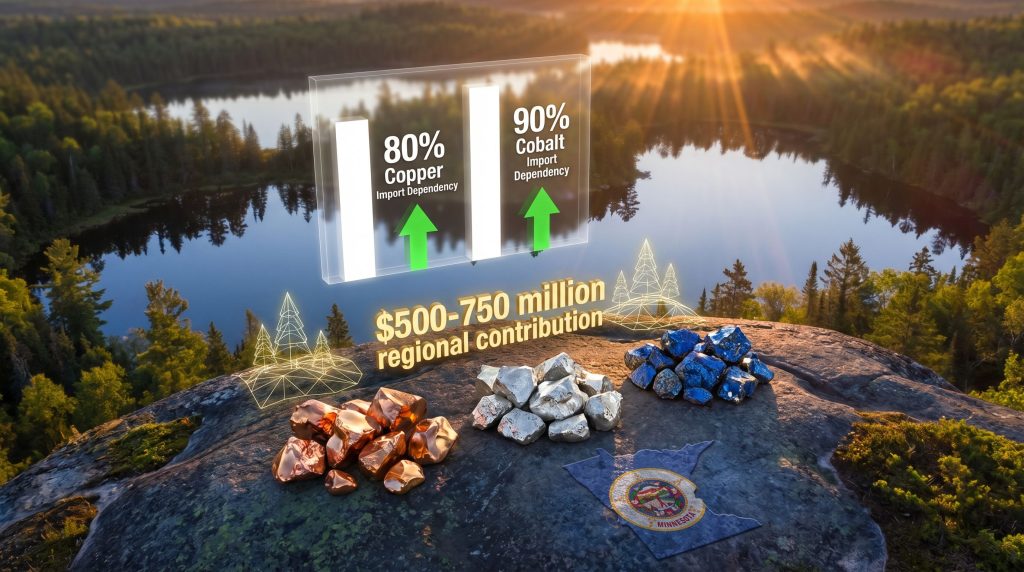
| Annual Regional Economic Output | $500-750 million | Full operational capacity |
| Local Government Tax Revenue | $25-40 million annually | Steady-state operations |
| Infrastructure Capital Investment | $2-3 billion | Initial development phase |
Economic multiplier effects extend beyond direct mining employment to include increased demand for construction services, transportation infrastructure, equipment suppliers, and local business services. The region currently attracts over 200,000 annual visitors for recreational activities, indicating existing infrastructure that mining operations could leverage while potentially creating land use conflicts.
For instance, tax revenue streams include mining royalties paid to federal and state governments, property taxes on mineral resources and facilities, payroll taxes from employment, and business income taxes from operations. These revenue sources provide sustained funding for local government services and infrastructure maintenance.
Environmental Risk Assessment and Mitigation Strategies
Sulphide mining operations in water-rich environments present documented environmental challenges requiring comprehensive risk assessment and technological mitigation strategies. The Boundary Waters region's interconnected lake system amplifies potential contamination pathways, creating cascading environmental vulnerabilities across extensive geographical areas.
What Scientific Evidence Supports Concerns About Watershed Contamination?
Acid mine drainage represents the primary environmental concern associated with sulphide mineral extraction in high-precipitation regions. When sulphide minerals encounter water and oxygen during mining operations, oxidation processes generate sulphuric acid and mobilise heavy metals including iron, copper, zinc, and manganese into water systems.
Environmental Risk Factors:
• Acid Mine Drainage: Sulphide oxidation producing acidic conditions and metal mobilisation
• Heavy Metal Leaching: Contamination of groundwater and surface water resources
• Aquatic Ecosystem Disruption: Bioaccumulation in fish populations and food chain impacts
• Watershed Connectivity: Contaminant transport through interconnected lake systems
Conservation organisations including Save the Boundary Waters, Earthjustice, The Wilderness Society, Center for Western Priorities, and Friends of the Boundary Waters Wilderness have expressed formal opposition. According to Reuters reports, environmental groups characterise the Senate vote as "a threat to America's most beloved wilderness area". Environmental groups emphasise that Minnesotans and the broader American public have consistently supported protection of this iconic landscape.
The Superior National Forest's high precipitation levels and complex hydrology increase water infiltration through mining waste materials, potentially accelerating acid generation and metal leaching pathways. Bioaccumulation risks affect fish populations consumed by both wildlife and human visitors to the region.
How Do Modern Mining Technologies Address Historical Environmental Failures?
Contemporary mining operations employ sophisticated environmental protection technologies designed to prevent contamination and enable post-mining site restoration. These systems represent significant advances over historical practices that created long-term environmental damage.
Advanced Environmental Protection Measures:
• Closed-loop water systems: Prevent discharge into natural waterways through water recirculation
• Real-time monitoring networks: Automated sensors detecting pH, dissolved metals, and contamination
• Engineered containment barriers: Impermeable membranes and clay liners isolating waste materials
• Biodegradable processing chemicals: Naturally degradable alternatives to persistent synthetic compounds
• Automated restoration protocols: Equipment-driven revegetation and erosion control systems
Closed-loop water systems require zero-discharge certification and continuous monitoring to detect system failures before environmental release occurs. Real-time monitoring networks typically include sensors measuring pH levels, dissolved metal concentrations, turbidity, and water flow rates throughout mining operations.
Furthermore, engineered containment barriers utilise impermeable geomembranes and compacted cohesive soil layers to physically isolate waste materials from environmental pathways. These systems require long-term monitoring and maintenance to ensure containment integrity over decades following mining completion.
Mining companies assert confidence in technological solutions, with operators stating they believe minerals can be extracted safely using modern environmental protection measures. However, environmental groups maintain that no technology can eliminate risks associated with sulphide mining in water-rich wilderness areas, complementing broader discussions about mine reclamation innovations.
Stakeholder Analysis: Competing Interests and Political Dynamics
The Minnesota mining debate reveals fundamental tensions between economic development priorities and environmental conservation values, with clearly defined stakeholder coalitions advancing competing visions for land use and resource management.
Which Interest Groups Mobilised Most Effectively During This Legislative Battle?
Pro-mining coalitions emphasised national security imperatives and economic development opportunities, highlighting job creation potential and strategic mineral independence benefits. Manufacturing associations stressed supply chain security concerns, while labour unions promoted employment opportunities in economically challenged regions.
Pro-Mining Coalition Priorities:
• Manufacturing associations: Supply chain security and domestic sourcing
• Labour unions: High-wage employment opportunities in mining sector
• National security organisations: Strategic mineral independence from foreign sources
• Regional development councils: Economic diversification and investment attraction
Environmental opposition mobilised around wilderness protection and ecological preservation themes, emphasising irreversible damage risks to pristine natural areas. Conservation organisations, Indigenous communities, tourism industry representatives, and scientific institutions formed a broad coalition opposing mining expansion.
Environmental Opposition Concerns:
• Conservation organisations: Wilderness area integrity and ecosystem protection
• Tourism industry: Recreation-based economy preservation
• Scientific institutions: Long-term ecological research and monitoring
• Indigenous communities: Traditional territory and cultural preservation
The 200,000+ annual visitors to the region represent a substantial constituency supporting conservation priorities, generating tourism-related economic activity that could compete with mining development. Recreation-based businesses depend on water quality and wilderness character maintenance for long-term viability.
How Did Partisan Political Calculations Influence Senate Voting Patterns?
The 51-49 Senate vote breakdown reflected broader Republican priorities emphasising domestic resource development versus Democratic emphasis on environmental protection and climate considerations. The largely party-line voting pattern demonstrated limited bipartisan consensus on balancing economic and environmental priorities.
Congressional Review Act utilisation represents a strategic legislative approach enabling permanent policy changes that transcend typical election cycles. This mechanism creates lasting constraints on future administrations attempting to restore environmental protections, regardless of shifting political leadership.
Consequently, regional considerations influenced some senators representing mining-dependent constituencies, highlighting tensions between national party positions and local economic interests. Northern Minnesota's representation through Congressman Pete Stauber provided crucial legislative leadership for mining authorisation efforts.
International Market Context and Strategic Positioning
Global critical minerals markets exhibit significant geographical concentration and geopolitical risk factors that influence American strategic planning and supply chain security assessments. Minnesota's mineral potential must be evaluated within broader international supply and demand dynamics.
How Does Minnesota's Mineral Potential Compare to Global Competitors?
Global Critical Minerals Landscape Analysis:
| Region | Copper Reserves | Nickel Reserves | Cobalt Reserves | Geopolitical Risk Level |
|---|---|---|---|---|
| Democratic Republic of Congo | Low | Medium | Extremely High | Very High |
| Indonesia | Medium | Very High | Low | Medium |
| Chile | Very High | Low | Medium | Low |
| Minnesota (Projected) | High | High | Medium | Very Low |
The Democratic Republic of Congo controls approximately 70% of global cobalt production but faces persistent political instability, infrastructure limitations, and labour practice concerns. Indonesian nickel production dominates global markets but involves environmental controversies and export policy uncertainty.
Chilean copper operations, including those managed by Antofagasta, represent established mining expertise and stable political conditions. However, distance from American manufacturing centres creates transportation costs and supply chain vulnerabilities during global disruptions.
Minnesota's geological formations offer domestic alternatives with significantly reduced geopolitical risks, regulatory predictability, and proximity to American industrial centres. The Superior National Forest region contains sulphide mineral deposits suitable for large-scale extraction operations using established mining technologies.
What Supply Chain Vulnerabilities Does This Development Address?
Current American manufacturing dependencies create strategic vulnerabilities during international trade disputes, transportation disruptions, and geopolitical conflicts. Mineral imports from politically unstable regions expose critical industries to supply interruptions and price manipulation.
Transportation infrastructure limitations affect global mineral supply chains, particularly during shipping disruptions, port congestion, and international sanctions. Domestic mining operations eliminate these transportation vulnerabilities while reducing carbon footprints associated with long-distance mineral transport.
However, Antofagasta indicated extracted minerals would likely require processing overseas due to limited domestic processing capacity. This limitation preserves some supply chain dependencies even with domestic mineral extraction authorisation, highlighting needs for comprehensive mineral processing infrastructure development.
Processing infrastructure gaps represent a critical weakness in American mineral independence strategies. Raw material extraction without corresponding processing capabilities creates partial supply chain solutions that maintain foreign dependencies for value-added manufacturing inputs.
Regulatory Pathway Forward: Permitting and Implementation Challenges
Federal and state regulatory frameworks create complex approval pathways that mining companies must navigate before operations commence. Multiple agencies hold overlapping jurisdictional authority, requiring comprehensive permit coordination and environmental compliance demonstration.
What Specific Approvals Must Mining Companies Secure Before Operations Begin?
Sequential Regulatory Requirements for Mining Authorisation:
- Federal lease reissuance through Bureau of Land Management oversight and approval
- Environmental impact statements demonstrating National Environmental Policy Act compliance
- State mining permits from Minnesota Department of Natural Resources authorisation
- Water quality certifications through Minnesota Pollution Control Agency review processes
- Wetland disturbance permits requiring Army Corps of Engineers authorisation
- Air quality compliance verification meeting EPA emissions standards and monitoring
Each regulatory pathway involves distinct procedural requirements, technical standards, and public participation opportunities. Environmental impact statements require comprehensive ecological assessments, alternative analysis, and mitigation planning for unavoidable environmental effects.
Water quality certifications examine potential impacts on surface water and groundwater resources, including acid mine drainage prevention and long-term monitoring protocols. Wetland disturbance permits assess impacts on aquatic ecosystems and require compensatory mitigation for unavoidable habitat losses.
Furthermore, air quality compliance addresses particulate emissions, dust control, and potential atmospheric contamination from mining operations and mineral processing activities. These requirements involve continuous monitoring systems and emission control technologies.
How Long Could Full Regulatory Approval Realistically Take?
Comprehensive permitting timelines depend on regulatory complexity, environmental impact scope, and potential legal challenges from opposition groups. Industry experience suggests 3-5 years minimum for complete approval processes, assuming cooperative regulatory environments and limited litigation.
Factors Influencing Regulatory Timeline Extensions:
• Environmental impact complexity: Extensive ecological assessments and mitigation planning
• Public participation requirements: Community engagement and stakeholder consultation processes
• Legal challenges: Opposition litigation and administrative appeals
• Agency coordination: Multi-jurisdictional approval synchronisation requirements
• Technical standard compliance: Engineering design and environmental protection system validation
Historical precedents indicate potential timeline extensions to 7-10 years if significant opposition litigation emerges or environmental impact discoveries require additional assessment. Legal challenges from conservation organisations could create procedural delays and require additional environmental analysis, drawing parallels with broader mining permitting guides that outline similar complexities.
Antofagasta Twin Metals subsidiary spokesperson Kathy Graul emphasised commitment to robust discussion and engagement with communities through future regulatory processes, suggesting proactive stakeholder consultation strategies to minimise opposition and expedite approvals.
The next major ASX story will hit our subscribers first
Long-term Strategic Implications for American Industrial Policy
The successful application of Congressional Review Act procedures against environmental protections establishes precedent that could influence federal land use policies across multiple states and resource categories. This legislative approach creates permanent policy frameworks resistant to future administrative reversals.
Will This Decision Establish Precedent for Other Protected Federal Lands?
Alaska, Nevada, and Wyoming contain substantial mineral deposits currently subject to various federal protections that could face comparable legislative challenges. The Minnesota mining ban overturn precedent demonstrates effective mobilisation strategies for resource development interests seeking access to restricted federal lands.
Congressional Review Act mechanisms enable permanent nullification of environmental protections without requiring conventional legislative majorities needed for statute modification. This procedural advantage allows resource development advocates to achieve lasting policy changes through strategic timing and political coordination.
States with Potential Federal Land Use Conflicts:
• Alaska: Arctic National Wildlife Refuge oil and gas restrictions
• Nevada: Greater sage-grouse habitat protections affecting mineral exploration
• Wyoming: National monument designations limiting energy development
• Utah: Bears Ears and Grand Staircase monument restrictions
• Colorado: Oil shale development limitations on federal lands
The precedent establishes that environmental protections implemented through federal agency action remain vulnerable to Congressional Review Act challenges, creating incentives for resource development industries to pursue similar legislative strategies across multiple jurisdictions.
How Might Future Administrations Respond to This Regulatory Framework Change?
Congressional Review Act provisions prevent future presidents from reinstating substantially similar mining restrictions without new legislative authorisation from Congress. This constraint limits executive branch environmental protection authorities and requires Congressional cooperation for restoration of comparable protections.
Alternative regulatory approaches could include different legal frameworks, modified geographical boundaries, or alternative environmental protection mechanisms that avoid Congressional Review Act constraints. However, these approaches require careful legal analysis to prevent similar legislative challenges.
For instance, future environmental protection strategies may emphasise voluntary agreements, state-level regulations, or market-based incentives rather than federal administrative restrictions vulnerable to Congressional nullification. This shift could fundamentally alter how environmental conservation policies are implemented and sustained, reflecting broader trends in mining industry evolution.
Investment and Market Response Analysis
Financial markets respond rapidly to regulatory certainty changes, particularly for capital-intensive industries like mining that require long-term investment planning and regulatory stability. The Minnesota mining ban overturn creates new investment opportunities while signalling broader policy direction changes.
What Financial Markets Are Responding to This Regulatory Shift?
Market Sector Impact Assessment:
• Mining equipment manufacturers: Stock price increases reflecting increased demand expectations
• Critical minerals ETFs: Enhanced investor interest in domestic mining exposure
• Regional real estate markets: Development pressure and land value appreciation
• Environmental services companies: Monitoring and compliance contract opportunities
• Transportation infrastructure: Capacity expansion planning for mineral transport
Mining equipment manufacturers benefit from anticipated infrastructure investment and operational equipment needs for new mining projects. Critical minerals exchange-traded funds offer investor exposure to domestic mining development trends and strategic mineral independence themes.
Regional real estate markets anticipate development pressure as mining operations require substantial support infrastructure including worker housing, equipment storage, transportation facilities, and service businesses. Land values near potential mining sites may experience appreciation reflecting development potential.
Environmental services companies prepare for extensive monitoring contracts, environmental compliance consulting, and restoration services required throughout mining project lifecycles. These services represent substantial long-term revenue opportunities spanning decades of operations and post-mining monitoring.
How Are International Competitors Adjusting Their Strategic Positioning?
Global mining corporations reassess North American investment priorities given reduced regulatory uncertainty in previously restricted areas. Capital allocation decisions may redirect investment flows from higher-risk international projects toward domestic American operations with enhanced regulatory clarity.
According to CNBC coverage, Antofagasta's existing investment in Twin Metals development represents substantial capital commitment to Minnesota mining potential, demonstrating confidence in long-term project viability. The company's Chilean operations provide established mining expertise applicable to Minnesota geological conditions.
International Strategic Adjustments:
• Capital reallocation: Shifting investment focus toward domestic American projects
• Risk assessment updates: Reduced regulatory uncertainty in North American operations
• Market positioning: Competitive advantages for companies with existing American assets
• Supply chain integration: Opportunities for vertically integrated mining and processing
However, processing infrastructure limitations noted by Antofagasta indicate that extracted minerals would require overseas processing, maintaining some international dependencies and limiting complete supply chain independence benefits.
The regulatory reversal signals broader American industrial policy emphasis on domestic resource development, potentially attracting additional international mining investment and technological expertise to American projects previously constrained by regulatory uncertainty. This development aligns with recent trends in executive mining permits that streamline approval processes for strategic mineral extraction projects.
Ready to Capitalise on America's Mining Renaissance?
The Minnesota mining ban overturn signals unprecedented opportunities in domestic critical minerals development, creating substantial market advantages for investors positioned ahead of this regulatory shift. Discovery Alert's proprietary Discovery IQ model delivers real-time notifications on significant ASX mineral discoveries, transforming complex geological data into actionable investment insights that keep you ahead of emerging market trends.