Kuniko Ltd
Kuniko Limited has released results from its MobileMT airborne electromagnetic survey at the Commonwealth Gold-Silver Project in New South Wales, revealing a coherent 4km-long prospective corridor that upgrades the exploration potential of this district-scale system in the renowned Lachlan Fold Belt.
The comprehensive 3D resistivity modelling provides the first district-scale view of the subsurface architecture to depths exceeding 1km, imaging continuous structural controls and revealing large, depth-extensive resistive bodies interpreted as silica-altered rhyolitic hosts and potential concealed intrusives linked to mineralisation.
Furthermore, the Kuniko Ltd MobileMT survey results demonstrate significant advancement in understanding the Commonwealth-Silica Hill system's geometry and structure. The survey data indicates potential for substantial resource expansion across multiple target zones.
MD Maja McGuire commented: "The MobileMT results are extremely encouraging and provide the first district-scale view of the Commonwealth–Silica Hill system. For the first time, 3D resistivity modelling has defined a coherent ~4km-long prospective corridor, imaging continuous structural and stratigraphic controls to depths exceeding 1km."
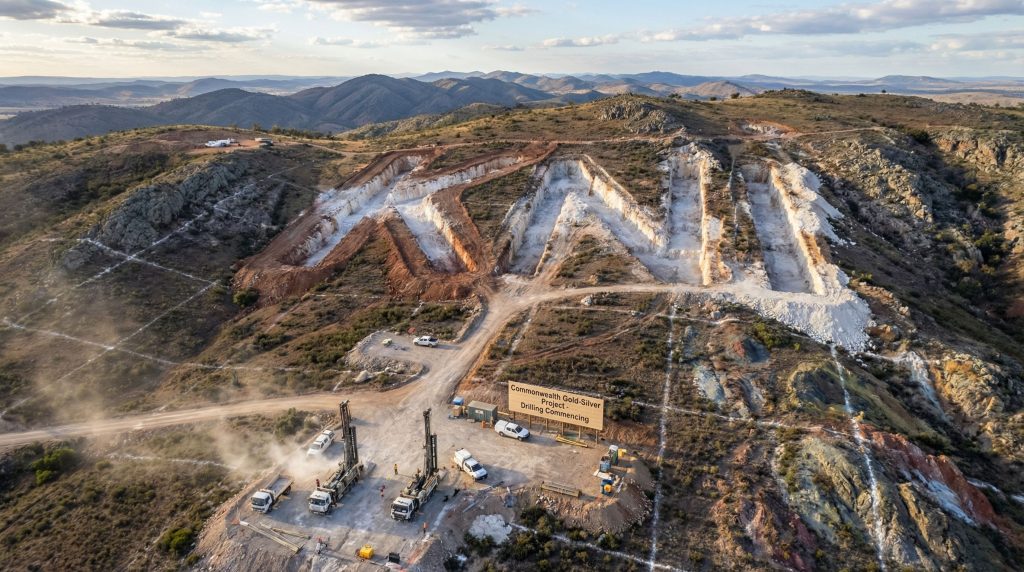
With drilling scheduled to commence this week, investors are positioned to monitor a company testing high-priority targets in one of Australia's premier gold regions.
Advanced Geophysical Mapping Reveals District-Scale System
The 328 line-kilometres of airborne electromagnetic data collected between October and November 2025 has delivered clarity on the Commonwealth-Silica Hill system's architecture. The survey was strategically aligned with the Nindethana Fault, a first-order structural suture zone that provides the regional framework for volcanogenic massive sulphide (VMS) and epithermal-style mineralisation in the district.
Moreover, the Kuniko Ltd MobileMT survey results have validated previous geological interpretations whilst revealing new exploration opportunities. The systematic coverage has provided unprecedented insight into deep structural controls on mineralisation.
Key Survey Findings:
• 4km NNW-SSE trending corridor linking Commonwealth Mine, Silica Hill, Coronation Mine and Collings Prospect
• Multiple high-priority targets identified along major thrust faults and splays
• Large resistive bodies interpreted as potential concealed intrusive complexes
• Strong correlation between elevated silver-in-soil anomalies and resistivity features
The 3D modelling has revealed broad high-resistivity domains correlating with silica-altered rhyolitic volcanic units, the principal host to gold-silver mineralisation at Silica Hill. Discrete conductive features occur along major thrust faults, highlighting zones of enhanced structural permeability favourable for sulphide accumulation.
| Survey Specifications | Details |
|---|---|
| Total Coverage | 328 line-kilometres |
| Survey Area | 19 km² |
| Line Spacing | 100m (ENE-WSW orientation) |
| Tie Line Spacing | 1,000m (ESE-WNW orientation) |
| Penetration Depth | Exceeding 1km |
| Data Resolution | ~11m intervals for EM data |
When big ASX news breaks, our subscribers know first
Understanding Resistivity in Mineral Exploration
Resistivity measures how strongly a material opposes electrical current flow. In mineral exploration, this property is crucial because different rock types and alteration zones exhibit distinct resistivity signatures.
High-resistivity zones typically indicate:
• Silica-altered volcanic rocks (quartz-rich zones)
• Fresh, unweathered intrusive rocks
• Competent host rocks suitable for mineralisation
Low-resistivity zones often represent:
• Clay-altered or weathered rocks
• Sulphide-bearing horizons
• Fault zones with enhanced fluid flow
For investors, resistivity contrasts are key exploration vectors as mineralisation often occurs at the interface between high and low resistivity zones where structural and chemical conditions favour ore deposition. The MobileMT survey has mapped these critical boundaries across the entire 4km corridor, providing systematic targeting for future drilling.
Consequently, the interpretation of these geophysical signatures enables more precise targeting of high-grade mineralisation zones within the broader system.
Multiple Priority Targets Ready for Testing
The geophysical interpretation has identified several high-confidence targets that warrant immediate follow-up. The Kuniko Ltd MobileMT survey results have systematically prioritised these targets based on multiple geological and geophysical criteria.
Priority Target Areas:
- Commonwealth-Silica Hill Interface – Known mineralisation occurs along pronounced resistivity gradients
- Welcome Jack Corridor – Historic drilling returned 2m @ 5.7 g/t Au, reinforcing corridor prospectivity
- Stringers Target – Large coherent conductive feature near interpreted Devonian intrusion
- Thrust Fault Splays – Discrete conductive features associated with structural permeability
The spatial coincidence between elevated silver-in-soil anomalies and near-surface resistivity highs provides independent geochemical validation of the geophysical targets. This multi-disciplinary approach increases confidence in target selection.
| Target Priority | Location | Key Features |
|---|---|---|
| Tier 1 | Commonwealth-Silica Hill | Known resources + resistivity gradients |
| Tier 1 | Welcome Jack trend | Historic high-grade intercepts |
| Tier 2 | Stringers intrusive margin | Large conductive anomaly |
| Tier 2 | Fault splay zones | Structural permeability indicators |
What Makes This Drilling Program Significant?
With site preparations now complete, Kuniko's maiden diamond drilling program (~1,200m) is scheduled to commence imminently. The company has worked with landholders and contractors to ensure access, infrastructure and drill pad readiness, including water and pipeline installation.
Immediate Next Steps:
• Phase 1 drilling (~1,200m) targeting extensions to known mineralisation
• Ground truthing of MobileMT-identified targets
• Final soil assay results from Gladstone West Project integration
• Ongoing interpretation of 3D resistivity models for additional target generation
The timing enables drilling to test multiple target concepts along the newly-defined corridor, potentially delivering results across several prospects. In addition, the systematic approach ensures maximum value extraction from the available drilling metres.
Investment Thesis: District-Scale Discovery Potential in Tier-1 Location
The Commonwealth Gold-Silver Project represents an investment opportunity for several reasons. The Kuniko Ltd MobileMT survey results have substantially enhanced the project's appeal by defining clear drilling targets within a coherent geological framework.
Strategic Location Advantages:
• Located 100km north of Orange, NSW in the prolific Lachlan Fold Belt
• Same geological province as Cadia-Ridgeway, North Parkes and Cowal operations
• Established mining infrastructure and skilled workforce availability
• Existing permits and landholder agreements enable rapid program advancement
Geological Upside Potential:
• VMS-epithermal hybrid systems similar to globally recognised high-grade deposits
• 4km strike length with systematic targeting now available for first time
• Depth extensions remain largely untested below historical shallow drilling
• Multiple prospect types within single corridor (VMS, epithermal, structural)
The combination of proven mineralisation, systematic geophysical targeting, and immediate drilling catalyst creates a risk-reward profile for growth-focused investors.
| Investment Metrics | Details |
|---|---|
| Strike Length | 4km prospective corridor |
| Depth Potential | >1km demonstrated by geophysics |
| Drilling Catalyst | Commencing this week |
| Historical Performance | Multiple gold-silver intercepts |
| Regional Context | Tier-1 Lachlan Fold Belt location |
VMS-Epithermal Hybrid Systems: Understanding the Geology
Volcanogenic Massive Sulphide (VMS) deposits form when hot, metal-rich fluids are expelled onto the seafloor during underwater volcanic activity. These systems create concentrated accumulations of base and precious metals.
Epithermal deposits develop when heated groundwater carries dissolved metals through fractures in volcanic rocks, depositing gold and silver as the fluid cools. When VMS and epithermal processes occur together, they can create particularly high-grade precious metal zones.
The Commonwealth-Silica Hill system demonstrates characteristics of both deposit types, suggesting multiple episodes of mineralisation may have concentrated metals across the 4km corridor. This geological setting has produced several world-class deposits, including Eskay Creek in Canada, which achieved grades exceeding 40 g/t gold.
However, the unique aspect of the Kuniko project lies in the systematic mapping of these complex geological relationships through advanced geophysical techniques.
The next major ASX story will hit our subscribers first
Why Should Investors Monitor Kuniko Limited?
Kuniko Limited presents an opportunity to gain exposure to systematic exploration of a district-scale gold-silver system using advanced geophysical technology. The company's methodical approach to target generation, combined with immediate drilling catalysts, positions it for potential exploration success.
Key Investment Differentiators:
• Diversified portfolio spanning battery metals in Norway and precious metals in Australia
• Technical approach demonstrated through advanced geophysical interpretation
• Strategic partnerships including earn-in agreement with Impact Minerals
• Experienced management with proven track record in mineral exploration
The 4km gold-silver corridor represents one component of Kuniko's broader strategy to develop strategic and critical mineral projects aligned with global energy transition themes. With drilling commencing this week and multiple high-priority targets defined, the company offers near-term catalysts alongside longer-term portfolio optionality.
Furthermore, the successful application of MobileMT technology demonstrates the company's commitment to utilising cutting-edge exploration methods to maximise discovery potential.
Investment Tracking Points:
• Drilling results from Phase 1 program expected in coming weeks
• 3D model refinement potentially identifying additional targets
• Resource extension potential along 4km corridor strike length
• Strategic partnership developments building on technical success
Key Takeaway:
Kuniko Limited has positioned itself as a systematic explorer of district-scale mineral systems, with the Commonwealth Gold-Silver Project representing potential upside in Australia's premier Lachlan Fold Belt. With drilling commencing imminently and a 4km prospective corridor now defined through advanced geophysics, investors should monitor developments for potential exploration success.
Could Kuniko's District-Scale Discovery Potential Transform Your Portfolio?
With Kuniko Limited's maiden diamond drilling program commencing imminently across a newly-defined 4km gold-silver corridor in the renowned Lachlan Fold Belt, this presents a compelling opportunity for investors seeking exposure to systematic exploration of a district-scale mineral system. The company's successful application of advanced MobileMT geophysical technology has identified multiple high-priority targets with immediate drilling catalysts ahead. To explore Kuniko's diversified portfolio spanning battery metals in Norway and precious metals in Australia, and to stay informed on upcoming drilling results from this significant exploration program, visit Kuniko's official website for comprehensive company information and the latest project developments.