
May 23, 2026
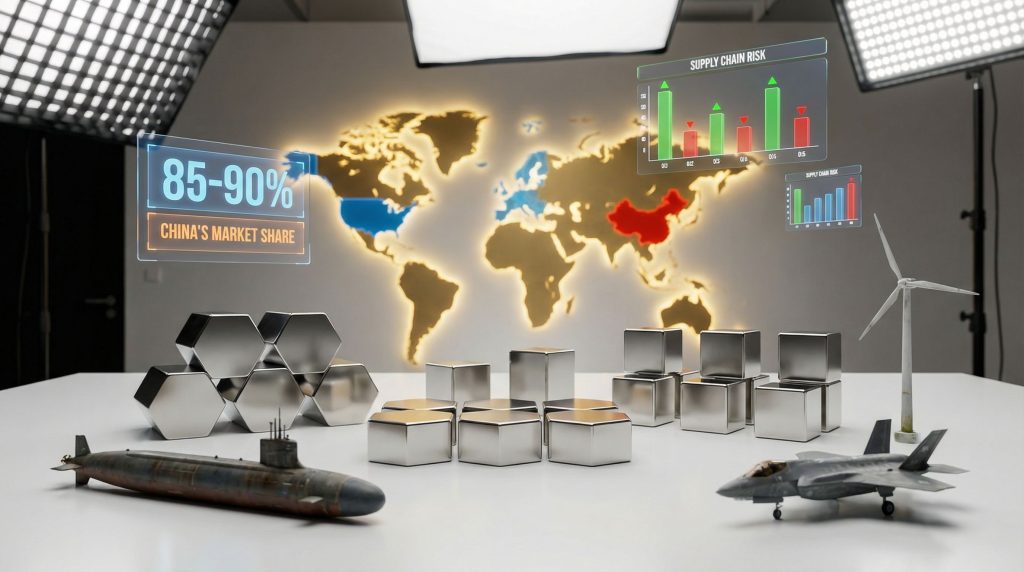
The strategic evolution of industrial dependencies has fundamentally altered global economic warfare dynamics. Modern conflicts increasingly focus on controlling the granular components that enable technology to function, rather than traditional finished products or market access disputes. This shift represents a calculated move toward dominating foundational materials that underpin everything from smartphone production to military defense systems.
Furthermore, this transformation reflects a deeper understanding of where true leverage resides in interconnected economies. Rather than competing solely through innovation or manufacturing efficiency, nations now recognise that controlling production inputs creates more immediate and powerful forms of economic pressure. The magnet-led tech war exemplifies this strategic pivot, where rare earth elements and their processed derivatives have become tools of geopolitical influence.
What Makes the Modern Tech War Different From Previous Trade Conflicts?
The Shift From High-Tech to Foundation Materials
Traditional trade wars operated through tariffs, quotas, and market access restrictions that primarily affected end products. The current conflict operates at a more fundamental level, targeting the raw materials and processed inputs that make production possible in the first place. China's export controls demonstrate dominance in rare earth separation capacity, controlling approximately 85-90% of global processing, creating leverage that extends far beyond any single industry or product category.
This strategic positioning allows for what researchers term "calibrated coercion" where export restrictions can be precisely tuned to create supply pressure without triggering complete supply chain collapse. The approach maintains dependency whilst demonstrating control, a more sophisticated form of economic leverage than traditional trade barriers.
The evolution from semiconductor-focused competition to critical mineral dependencies represents a fundamental shift in the nature of technological rivalry. However, whilst chip controls constrain long-term technological development, mineral controls can halt immediate production across multiple sectors simultaneously. This distinction highlights why critical minerals energy security has become a primary concern for Western policymakers.
| Conflict Type | Target | Time to Impact | Strategic Goal |
|---|---|---|---|
| Traditional Trade War | End products, market access | 6-12 months | Market share protection |
| Chip War (2018-2023) | Advanced semiconductors, manufacturing tools | 12-24+ months | Technological advancement control |
| Magnet-Led Tech War (2020-Present) | Critical minerals, processed materials | Weeks to months | Production capability control |
Understanding Calibrated Coercion as Economic Strategy
Export licensing mechanisms operate as precision instruments of economic pressure. Rather than implementing complete embargos that would force rapid supply chain diversification, China has developed a system of controlled scarcity that maintains dependency whilst demonstrating leverage. This approach keeps supply levels below crisis thresholds, creating enough disruption to influence behaviour without triggering emergency industrial reconstruction.
The gallium and germanium restrictions implemented through China's export licensing system demonstrate this calibrated approach. These materials, essential for semiconductor production and defence applications, face selective availability based on licensing decisions rather than complete supply cutoffs. The strategy maximises geopolitical influence whilst minimising the risk of buyer revolt that could accelerate Western supply chain independence efforts.
Revenue considerations take secondary priority in this framework. Chinese policymakers appear willing to sacrifice short-term export earnings from critical minerals to maintain long-term strategic leverage over global industrial capacity. This calculation reflects an understanding that control over foundational inputs provides more valuable influence than maximising commodity sales revenue.
When big ASX news breaks, our subscribers know first
Why Are Permanent Magnets the New Battleground for Technological Supremacy?
The Hidden Infrastructure Behind Modern Defence Systems
Neodymium-iron-boron (NdFeB) magnets form the invisible backbone of contemporary military technology. These permanent magnets, incorporating rare earth elements like neodymium, dysprosium, and terbium, enable the precision and reliability required for defence applications. Without them, modern warfare capabilities would face immediate operational degradation.
Virginia-class submarines depend on rare earth magnets for propulsion systems, sonar arrays, and sensor networks. The F-35 Lightning II fighter aircraft incorporates an estimated 50-100+ kilograms of rare earth magnets across actuators, targeting systems, and electronic warfare equipment. Precision-guided munitions rely on permanent magnets for guidance systems, navigation components, and electromagnetic fuzing mechanisms.
The technical specifications required for military applications exceed commercial standards. Defence platforms require magnets with coercivity levels of 12-14 kOe (kiloersteds) minimum to resist demagnetisation under extreme conditions. Operating temperature ranges must extend to +200°C or higher for aerospace applications, demanding specialised dysprosium and terbium additives that further concentrate supply dependencies.
Defence contractors face qualification timelines of 18-36 months for new magnet suppliers, creating additional barriers to rapid supply chain diversification. This extended qualification process means that current supplier relationships effectively lock in dependencies that cannot be quickly altered in response to supply disruptions.
Commercial Technology Vulnerabilities Beyond Defence
Electric vehicle production represents perhaps the largest commercial vulnerability to magnet supply disruptions. Each EV motor requires approximately 1-3 kilograms of NdFeB magnets, with global EV production reaching 13-14 million units annually as of 2025. This translates to 27,000+ metric tons of rare earth magnets consumed by the automotive sector annually, creating massive exposure to supply interruptions.
Wind energy generation faces similar dependencies through direct-drive permanent magnet generators, which represent 50-60% of new turbine installations globally. A typical 10 MW wind turbine requires 600-800 kilograms of NdFeB magnets, contributing to annual global demand of 30,000-40,000 metric tons from the renewable energy sector alone.
Consumer electronics manufacturing depends on smaller quantities of magnets per device but operates at massive scale. Smartphone production, hard drive manufacturing, and refrigeration systems all incorporate rare earth magnets as essential components. Supply disruptions lasting 60-90 days would create cascading production halts across multiple consumer technology categories.
The concentration of magnet production in China, controlling 85-90% of global manufacturing capacity, creates systemic vulnerability across these interconnected commercial sectors. Unlike defence applications with strategic stockpiles, commercial industries typically maintain 2-4 months of magnet inventory, providing limited buffer against extended supply disruptions. This situation has prompted discussions about establishing a critical minerals reserve in key Western nations.
How Does China's Export Control Strategy Actually Work?
Decoding Announcement No. 61 of 2025
China's export control framework operates through a sophisticated licensing system that provides maximum flexibility whilst maintaining the appearance of administrative rather than punitive measures. The European Union Institute for Security Studies analysis reveals how Beijing has positioned export licensing as a geopolitical control mechanism that can be adjusted incrementally based on broader strategic objectives.
The licensing requirements specifically target dual-use materials with military applications whilst maintaining commercial availability for approved buyers. This selective approach allows China to reward allied nations with predictable supply whilst creating uncertainty for competitors. The system operates below crisis thresholds that would trigger emergency supply chain reconstruction whilst maintaining sufficient pressure to influence policy decisions.
Implementation timing demonstrates sophisticated calibration. Rather than imposing immediate restrictions, China announces licensing requirements with extended implementation periods, allowing markets to adjust whilst demonstrating the scope of potential control. This approach maximises the demonstration effect whilst minimising the risk of triggering rapid diversification efforts.
The Economics of Strategic Material Leverage
China's dominance extends across multiple stages of critical mineral processing, creating layered dependencies that compound supply chain vulnerabilities:
| Processing Stage | Chinese Market Share | Strategic Significance |
|---|---|---|
| Rare Earth Separation | 85-90% | Converts raw ore to usable oxides |
| Rare Earth Metals | 70%+ | Metallic reduction for alloy production |
| Rare Earth Alloys | 70-80% | Specialised compositions for magnets |
| NdFeB Magnet Production | 85-90% | Finished products for end applications |
| Gallium Processing | 95%+ | Critical for semiconductors and defence |
| Germanium Processing | 90%+ | Essential for fibre optics and electronics |
This vertical integration creates multiple points of potential control within individual supply chains. Even if alternative sources emerge for raw materials, the concentration of processing capacity means that Chinese facilities remain essential for converting minerals into usable forms. The "boring middle" of separation, refining, and alloy production represents the true bottleneck rather than mining operations.
Economic calculations favour strategic leverage over immediate revenue maximisation. Critical mineral exports represent relatively modest profit margins compared to finished goods manufacturing. Chinese policymakers appear willing to sacrifice commodity export revenue to maintain influence over global industrial capacity, recognising that control provides more valuable long-term benefits than short-term sales optimisation.
What Are the Real Costs of Western Supply Chain Vulnerabilities?
Quantifying Industrial Dependencies
European and United States industrial sectors face unprecedented levels of import reliance for critical materials processing. Current dependency ratios reveal the scope of vulnerability across essential mineral categories:
- Rare earth elements: 95%+ import dependency for processed oxides and metals
- Gallium: 85%+ reliance on Chinese processing capacity
- Germanium: 90%+ dependency for refined materials
- Neodymium magnets: 80-85%+ import reliance for high-performance grades
The concentration of these dependencies in a single supplier nation creates systemic risk that extends beyond normal market volatility. Unlike diversified supply chains where individual supplier disruptions can be managed through alternative sources, the current structure provides limited options for rapid substitution during supply interruptions. This has contributed to broader concerns about US-China trade war impacts across strategic industries.
Production capacity gaps between current Western capabilities and required domestic processing infrastructure span multiple orders of magnitude. Building equivalent separation capacity to reduce Chinese dependency would require $10-15 billion in capital investment across the United States and European Union, with construction timelines extending 3-5+ years from project initiation to commercial operation.
The "Boring Middle" Infrastructure Gap
Mining operations alone cannot address supply chain vulnerabilities without corresponding investments in processing infrastructure. The separation of rare earth elements from mined concentrates requires specialised facilities with complex chemical processes, environmental controls, and technical expertise that cannot be quickly replicated.
Current Western separation capacity operates at approximately 5-10% of Chinese levels, creating a fundamental bottleneck even when domestic mining operations expand. Mountain Pass mine in California, for example, ships concentrates to China for separation processing before reimporting refined materials for domestic use. This circular dependency illustrates the inadequacy of mining-focused solutions without processing infrastructure development.
Alloy production and magnet manufacturing face similar capacity deficits. Converting separated rare earth oxides into specialised alloys requires additional processing steps with distinct technical requirements and capital investments. Magnet production demands precise compositional control, manufacturing equipment, and quality certification processes that currently exist at commercial scale only in Chinese facilities.
Investment requirements for building complete mine-to-magnet domestic supply chains exceed $20-25 billion across major Western economies. Timeline projections for achieving meaningful supply chain independence extend 5-7 years from initial investment through commercial qualification, assuming consistent political support and streamlined permitting processes.
How Are Western Nations Responding to Mineral-Based Coercion?
U.S. Defence Department's Strategic Investments
The United States Department of Defence has initiated targeted funding programmes designed to accelerate domestic critical mineral processing capacity. Recent contract awards demonstrate the scale of investment deemed necessary to address supply chain vulnerabilities in strategic materials.
Vulcan Elements and ReElement Technologies received combined funding of $700 million through Defence Production Act authorities, specifically targeting rare earth separation and processing capabilities. These investments aim to establish domestic alternatives to Chinese processing facilities whilst maintaining compatibility with existing defence contractor specifications and qualification requirements.
A separate $620 million defence contract allocation focuses specifically on domestic magnet production capacity. MP Materials and E-VAC Magnetics have received funding to expand manufacturing capabilities for defence-grade permanent magnets, with production targets designed to reduce import dependency for critical military applications.
The investment strategy prioritises dual-use applications that can serve both commercial and defence markets. By supporting facilities capable of producing magnets for electric vehicles and wind turbines alongside military applications, the Defence Department aims to create economically sustainable domestic capacity that does not rely solely on government procurement for viability.
European Union's Critical Raw Materials Act Implementation
The European Union's Critical Raw Materials Act establishes a comprehensive framework for reducing dependency on single-source suppliers whilst building domestic and allied processing capacity. The legislation sets specific targets for supply chain diversification and domestic capability development.
Strategic project designation criteria prioritise investments in separation, refining, and manufacturing infrastructure rather than purely extractive operations. The framework recognises that mining alone cannot address supply chain vulnerabilities without corresponding downstream processing capabilities.
Bilateral partnerships with mineral-rich nations outside China form a central component of the EU strategy. Agreements with countries like Australia, Canada, and certain African nations aim to establish integrated supply chains that bypass Chinese processing bottlenecks whilst providing development opportunities for partner countries.
The anti-coercion instrument development represents a deterrence-focused approach to supply chain security. Economic response mechanisms allow the EU to impose countermeasures against nations that use export restrictions for political leverage, creating potential costs for calibrated coercion strategies.
What Alternative Strategies Could Reduce Magnetic Material Dependencies?
Rare-Earth-Free Magnet Technologies
Research and development efforts in rare-earth-free permanent magnet technologies offer potential long-term alternatives to current NdFeB magnet dependencies. Companies like Niron Magnetics have developed alternative magnetic materials based on iron-nitrogen compounds that eliminate rare earth element requirements entirely.
Performance characteristics of rare-earth-free magnets currently lag traditional NdFeB specifications but continue improving through ongoing research. Energy product levels reach 20-25 MGOe compared to 30-52+ MGOe for high-performance neodymium magnets, creating limitations for applications requiring maximum magnetic field strength in minimum volume.
The mining industry evolution includes significant investment in alternative material research, with defence qualification processes for alternative magnetic materials typically requiring 2-3 years of testing and validation before approval for military applications. Commercial qualification timelines operate more rapidly but still demand 12-18 months of performance verification under operational conditions.
Cost competitiveness remains challenging for rare-earth-free alternatives, particularly when competing against established Chinese magnet production with optimised supply chains and economies of scale. Manufacturing scaling and process optimisation could potentially achieve cost parity with traditional magnets over 5-7 year development timeframes.
Recycling and Urban Mining Potential
End-of-life magnet recovery from electronic devices, vehicles, and industrial equipment represents a significant potential secondary supply source for rare earth materials. Current recycling rates for rare earth elements remain below 5% globally, indicating substantial room for improvement through enhanced collection and processing systems.
Processing capacity requirements for meaningful secondary supply far exceed current recycling infrastructure. Extracting rare earth elements from complex electronic assemblies requires specialised facilities capable of handling diverse material streams whilst maintaining economic viability and environmental compliance.
Economic analysis of magnet recycling operations reveals breakeven requirements of 10,000+ metric tons of processed material annually to justify facility investments. Current collection systems struggle to achieve these volumes due to distributed sources and limited consumer participation in electronic waste recovery programmes.
Technological advances in rare earth extraction from recycled materials continue improving efficiency and cost-effectiveness. Rare Earth Exchanges notes that hydrometallurgical processes and advanced separation techniques show promise for increasing recovery rates whilst reducing environmental impacts compared to primary mining and processing operations.
The next major ASX story will hit our subscribers first
How Might This Competition Evolve Through 2030?
Scenario Planning for Escalation and De-escalation
Best-case scenario analysis suggests continued predictable licensing with gradual Western capacity development. In this pathway, China maintains export controls at manageable levels whilst Western nations steadily build domestic processing infrastructure. Supply chain tensions remain manageable through diplomatic coordination and commercial arrangements that provide sufficient material flows for essential applications.
Worst-case scenario modelling examines complete export cutoffs and immediate supply chain crisis. This pathway would trigger emergency industrial mobilisation in Western nations, with government intervention to accelerate domestic capacity development through expedited permitting, direct funding, and strategic material stockpiling. Economic disruption would be severe but potentially catalyse rapid supply chain independence.
Most likely scenario projection anticipates continued calibrated pressure with periodic relief based on broader geopolitical considerations. China would maintain export licensing as a flexible policy tool, adjusting restrictions in response to trade negotiations, technology transfer disputes, and military tensions whilst avoiding levels that trigger emergency response measures.
Market psychology during this evolution will likely emphasise security of supply over cost optimisation. Industrial buyers may accept higher prices for guaranteed availability from diversified sources, creating economic incentives for Western processing capacity development even when Chinese alternatives remain technically available.
Investment Implications for Critical Mineral Sectors
Risk assessment frameworks for rare earth and magnet company investments must incorporate geopolitical factors alongside traditional market fundamentals. Supply chain security considerations increasingly drive purchasing decisions across defence, automotive, and renewable energy sectors, creating premium valuations for companies offering diversified sourcing options.
Geographic diversification strategies for institutional investors focus on companies with processing capabilities outside Chinese control. Australian rare earth developers, U.S. separation facilities, and European magnet manufacturers represent strategic investment themes aligned with supply chain security priorities.
Policy support mechanisms likely to drive sector growth include direct government procurement commitments, loan guarantees for processing facility development, and preferential contracting for domestic suppliers. These interventions create investment opportunities whilst reducing commercial risks for companies building alternative supply chains.
Disclaimer: The investment implications discussed represent analytical scenarios based on current policy trends and market conditions. Actual investment outcomes may vary significantly based on technological developments, policy changes, and geopolitical events that cannot be predicted with certainty. Potential investors should conduct independent due diligence and consider their specific risk tolerance before making investment decisions.
What Should Policymakers and Investors Monitor Going Forward?
Key Performance Indicators for Supply Chain Independence
Tracking domestic processing capacity development requires monitoring multiple interconnected metrics across the entire supply chain. Raw material processing capabilities, measured in metric tons of annual separation capacity, provide fundamental indicators of progress toward supply chain independence.
Primary Metrics for Supply Chain Security:
- Domestic rare earth separation capacity: Target 25%+ of national consumption by 2030
- Magnet production capabilities: Achieve 40%+ domestic sourcing for critical applications
- Alternative supplier development: Establish supply relationships with 3+ non-Chinese processors
- Strategic material stockpiles: Maintain 6-12 months inventory for defence-critical materials
- Recycling infrastructure: Achieve 15%+ recovery rates for rare earth elements by 2030
Strategic Recommendations for Stakeholders
Government policy priorities should emphasise accelerating domestic capacity development through coordinated industrial policy rather than purely market-based approaches. Direct procurement commitments, loan guarantees, and expedited permitting can reduce commercial risks that currently limit private sector investment in processing infrastructure.
Corporate supply chain diversification strategies must balance cost optimisation with security of supply considerations. Companies should develop qualified supplier relationships across multiple geographic regions whilst maintaining strategic inventory levels that provide buffer against supply disruptions.
Investment Framework for Critical Mineral Exposure:
- Technology assessment: Evaluate companies developing rare-earth-free alternatives
- Processing capacity: Prioritise investments in separation and refining infrastructure
- Geographic distribution: Diversify across multiple supplier nations and regions
- Government support: Factor policy backing into investment risk assessments
- Timeline considerations: Account for 3-7 year development cycles for major projects
The transformation of global supply chain dependencies requires coordinated responses that address both immediate vulnerabilities and long-term strategic positioning. Until Western nations achieve meaningful domestic processing capacity across the complete spectrum from separation through magnet production, export licensing will continue operating as a geopolitical control mechanism that can be adjusted based on broader strategic objectives.
Monitoring frameworks must track not only capacity development but also the practical timeline for achieving supply chain independence. Current investment levels and construction schedules suggest that meaningful reduction in Chinese dependencies will require sustained political commitment and financial support extending through the remainder of this decade.
The magnet-led tech war represents a fundamental shift in how economic leverage operates in interconnected global markets. Success in navigating this transition will depend on understanding that control over foundational materials creates more immediate influence than control over finished products or even advanced technologies. Building resilient supply chains requires investments in the unglamorous but essential infrastructure of separation, refining, and processing that enables modern industrial civilisation to function.
Ready to Capitalise on the Critical Minerals Supply Chain Revolution?
Discovery Alert's proprietary Discovery IQ model delivers instant notifications on significant ASX mineral discoveries, including rare earth and critical mineral projects that could become essential to Western supply chain independence efforts. Understand why major mineral discoveries can generate substantial returns by exploring historic examples of exceptional market outcomes, then begin your 30-day free trial today to position yourself ahead of the evolving geopolitical landscape.