June 9, 2026
The Hidden Complexity Behind Africa's Battery Mineral Ambitions
The global race to secure battery-grade graphite has quietly exposed one of the most underappreciated tensions in critical mineral strategy: the gap between where raw materials exist and where the technical capability to transform them resides. Across Southern Africa, governments are increasingly unwilling to accept the role of passive commodity exporters in a supply chain whose most profitable stages happen thousands of kilometres away. The Mozambique graphite export ban is not an isolated policy move — it is the latest iteration of a continent-wide industrial ambition now colliding directly with Western supply chain strategies built around African ore and non-African processing.
Understanding what this means for investors, battery manufacturers, and the graphite market requires more than reading the legislative headline. It demands a careful look at graphite's unique processing chemistry, the commercial realities of building refining capacity in a developing economy, and the geopolitical forces pulling Mozambican ore toward Louisiana rather than Nampula. Furthermore, the broader critical minerals demand surge reshaping global supply chains adds another layer of urgency to these questions.
When big ASX news breaks, our subscribers know first
Why Graphite Is Uniquely Difficult to Process In-Country
Among the suite of battery-critical minerals, graphite presents a processing challenge that is often underestimated in policy discussions. Unlike some base metals where smelting infrastructure can be replicated with sufficient capital, transforming raw flake graphite into battery-grade anode material involves a technically precise, multi-stage sequence that has taken China decades to master at scale.
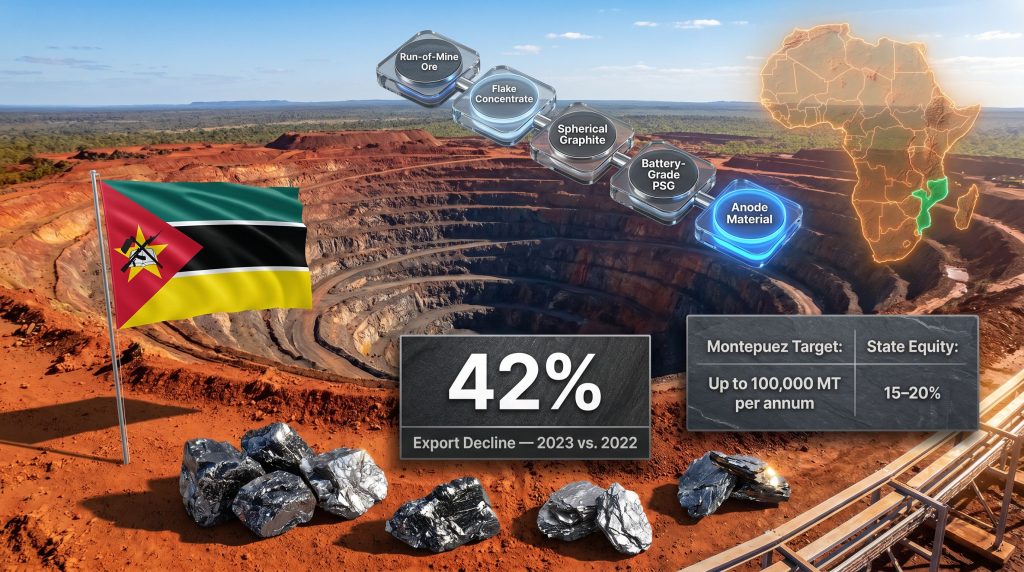
The transformation journey from run-of-mine ore to a functional lithium-ion anode component involves five distinct stages:
- Extraction and crushing of ore at the mine site
- Flotation concentration to produce flake graphite concentrate
- Micronisation and spheroidisation to produce spherical graphite particles
- High-temperature purification to achieve carbon purity levels typically exceeding 99.95%
- Surface coating and blending to meet battery manufacturer specifications
Most Mozambican exports currently exit at Stage 2. The country's operations are selling concentrate, not battery material. Each subsequent stage adds capital intensity, energy consumption, and technical precision. Spheroidisation alone involves milling graphite flakes into rounded particles of tightly controlled dimensions. Purification requires thermal treatment in furnaces operating above 2,500 degrees Celsius. These are not processes that scale up quickly in environments with unreliable power grids or underdeveloped industrial workforces.
What Makes China's Processing Advantage So Durable?
Critical Insight: China's dominance in graphite processing is not simply a function of raw material access. It reflects decades of accumulated process engineering, energy infrastructure investment, and supply chain integration. Estimates suggest China controls between 60% and 70% of global natural graphite processing capacity — a structural advantage that cannot be replicated through legislation alone.
However, as the global graphite shortage intensifies, Western nations are under increasing pressure to develop alternative processing pathways outside of Chinese control. This dynamic is reshaping investment priorities across the entire battery materials sector.
Mozambique's Legislative Architecture: What the New Law Actually Does
Mozambique's parliament passed revised mining legislation on 7 May 2026, introducing a prohibition on the export of unprocessed and semi-processed minerals. The law is not expected to enter force before 2027, pending presidential assent and the development of supporting regulatory instruments. A presidential decree announced in June 2026 reinforced the direction of the legislation by requiring companies seeking export authorisation to commit to a credible local refining plan.
The structural provisions of the new framework extend beyond the export ban itself:
| Policy Provision | Requirement | Applies To |
|---|---|---|
| Raw mineral export ban | Domestic processing required before export | All unprocessed minerals |
| State equity participation | Minimum 15% government stake | General mining projects |
| Strategic project equity | Minimum 20% government stake | Strategic mineral projects |
| Refinery obligation | Companies must develop or commit to local refining | Export-seeking operators |
Where the Legal Ambiguity Lies
A critical ambiguity runs through the entire framework: the law does not define with precision what level of processing satisfies the export threshold. The difference between flake concentrate, purified spherical graphite, and fully coated anode material represents an enormous spread in capital requirements and technical complexity. Whether a company that builds a spheroidisation plant but conducts final purification offshore satisfies the domestic processing requirement remains legally undefined.
This definitional gap is not a minor administrative oversight — it is a source of material investment risk. Operators cannot size capital commitments, negotiate offtake contracts, or finalise financing without knowing precisely what processing standard the government will enforce. The June 2026 decree also fails to clarify whether currently producing operations are subject to immediate compliance requirements or benefit from transitional protections. For context on Mozambique's mining policy shifts, including the 15% state stake rule, the implications for existing operators are significant.
The Balama-to-Vidalia Blueprint and Its Regulatory Exposure
The Mozambique graphite export ban arrives at a moment when the most visible supply chain model linking Mozambican ore to Western battery markets is explicitly designed around offshore processing. Syrah Resources' Balama operation in Cabo Delgado province is the largest graphite mine in Mozambique and one of the largest flake graphite operations anywhere in the world. Its associated anode material facility in Vidalia, Louisiana was constructed with financial support from Washington and represents the most advanced proof-of-concept for a Mozambique-origin graphite supply chain serving the U.S. battery sector.
The Balama-Vidalia model involves exporting graphite concentrate from Mozambique and processing it into battery-grade anode material in the United States. This architecture was designed specifically to bypass China's processing dominance by relocating the value-adding stages to a jurisdiction where U.S. battery manufacturers can source material without triggering critical mineral sourcing restrictions embedded in legislation such as the Inflation Reduction Act.
The fundamental tension introduced by the Mozambique graphite export ban is now apparent: a policy framework that incentivises domestic Mozambican processing is structurally incompatible with a supply chain model that deliberately locates processing in the United States. Whether the authorisation pathway in the new law can accommodate offshore processing commitments in lieu of domestic refining investment is the central unresolved question for every operator with Mozambican graphite assets.
Total Graphite's Montepuez Project and the Vertical Integration Thesis
Against this regulatory backdrop, British company Total Graphite (formerly Tirupati Graphite) released an updated Definitive Feasibility Study for its Montepuez graphite project in Mozambique on 8 June 2026. The project sits at an advanced permitting stage and carries an estimated production capacity of up to 100,000 metric tonnes of graphite per annum, positioning it as a potentially significant second node in a Mozambique-U.S. supply chain alongside Balama.
Total Graphite's stated strategic objective is to build a vertically integrated business spanning the full graphite value chain, from Mozambican ore extraction through to a purified spherical graphite facility in the United States. The company's leadership has described the combination of the Montepuez asset with a U.S. downstream processing facility as a response to continued strong growth in demand for anode materials driven by battery storage expansion and the broader energy transition.
How Does Montepuez Fit the Downstream Plant's Requirements?
The updated DFS is specifically aimed at optimising Montepuez's production parameters to align with the input specifications of the planned U.S. processing plant. This is technically significant: PSG facilities are designed around specific flake size distributions, carbon grades, and moisture characteristics. Montepuez's ore profile needs to match the downstream plant's requirements with enough consistency to support long-term offtake commitments.
The company is concurrently evaluating multiple financing pathways and reviewing its broader asset portfolio, which includes the Vatomina graphite project in Madagascar. The Madagascar asset represents a form of strategic optionality, offering an alternative supply node if Mozambique's regulatory environment deteriorates or if the authorisation pathway for offshore processing proves unworkable.
Market Headwinds: The Oversupply Problem That Complicates Everything
Any analysis of the Mozambique graphite export ban must account for the market conditions into which it lands. The global graphite market has been under sustained pressure from Chinese production volumes that have remained elevated despite weak pricing. This persistent oversupply has contributed to a significant contraction in Mozambican export volumes, which declined by approximately 42% in 2023 compared to 2022.
The economics of domestic processing investment become considerably less attractive in a low-price environment. Building a spheroidisation and purification facility capable of handling 100,000 tonnes of concentrate annually requires hundreds of millions of dollars in capital expenditure. The return on that investment depends on a spread between concentrate input costs and battery-grade output prices that has been compressed by Chinese competition at both ends of the value chain.
| Market Factor | Current Condition | Impact on Processing Investment |
|---|---|---|
| Global graphite price trend | Depressed by Chinese oversupply | Reduces margin available to justify domestic refinery capex |
| Mozambique export volumes | Down approximately 42% year-on-year (2022–2023) | Signals weak market absorption at current concentrate prices |
| China processing capacity | 60–70% of global natural graphite processing | Creates structural cost competition for new entrants |
| U.S. battery demand | Growing, legislatively supported | Provides premium pricing pathway for non-Chinese supply |
The price recovery prerequisite for commercially viable domestic African processing is not trivial. Long-term offtake agreements and concessional financing from development finance institutions or government-backed lenders may be necessary to de-risk processing investments in the current market. The Vidalia facility in Louisiana benefited from precisely this type of financial architecture — suggesting that replicating the model in Mozambique would require comparable institutional support. In addition, understanding the broader battery metals investment landscape is essential context for evaluating these financing dynamics.
The next major ASX story will hit our subscribers first
Lessons from Indonesia's Nickel Export Ban
Indonesia's decision to ban raw nickel ore exports in 2020 provides the most instructive recent precedent for assessing Mozambique's trajectory. Indonesia's ban triggered immediate trade disputes, including a World Trade Organization challenge, but ultimately accelerated the development of a substantial domestic nickel processing and battery materials industry. The country is now a major producer of nickel intermediate products and is attracting battery supply chain investment at scale.
The structural differences between nickel and graphite, however, are significant. Nickel smelting technology, while capital-intensive, is more widely distributed globally than graphite purification capability. Nickel's applications in stainless steel provided Indonesia's domestic industry with a commercial foundation independent of the battery sector. Graphite's primary end-use in battery anodes means Mozambique's processing ambitions are almost entirely dependent on the growth trajectory of the electric vehicle and energy storage markets.
What Indonesia demonstrated — and what Mozambique's policymakers are clearly watching — is that enforcement timelines matter enormously. Indonesia's initial announcement created several years of uncertainty before full implementation. That transition period allowed operators to begin investment planning. Whether Mozambique can replicate Indonesia's outcome depends significantly on whether the government can provide regulatory clarity on processing definitions, transitional provisions, and authorisation criteria before the 2027 implementation date.
Furthermore, the critical minerals transition underway globally means that the window for establishing viable non-Chinese processing capacity is narrowing. Regulatory delay carries its own strategic cost.
Scenario Analysis: Four Possible Regulatory Outcomes for Graphite Operators
| Scenario | Regulatory Outcome | Impact on Mozambique-U.S. Projects |
|---|---|---|
| Full enforcement, no exemptions | All raw exports halted without domestic refining | Significant project delays; U.S. supply chain disruption |
| Transitional exemptions for existing operations | Producing mines grandfathered; new projects face stricter rules | Balama continues; Montepuez faces compliance requirements before production |
| Authorisation pathway with offshore processing | Exports permitted with approved local or offshore processing commitments | Projects viable if companies demonstrate phased processing investment |
| Enforcement delayed beyond 2027 | Implementation lag preserves near-term supply continuity | Window for project advancement maintained; long-term uncertainty persists |
The authorisation pathway scenario is arguably the most commercially viable outcome for operators pursuing the Mozambique-U.S. integration model. The new law does include a mechanism for export authorisation accompanied by a credible refining plan, but the criteria for what constitutes a credible plan — and whether that plan must be located within Mozambique — remain undefined.
Resource Nationalism, Industrial Strategy, and the African Development Calculus
The theoretical foundation for Mozambique's export restriction draws on decades of development economics literature arguing that raw commodity exports generate limited long-term prosperity relative to processed mineral exports. The evidence for this argument is compelling in certain contexts. Botswana's diamond beneficiation programme, developed over multiple decades through carefully structured agreements with De Beers, transformed the country's diamond sector from a source of raw stones into a polished diamond manufacturing hub with measurable employment and fiscal multiplier effects.
The conditions that distinguished Botswana's success included:
- Regulatory clarity from the outset
- A structured transition period that allowed industry to adapt
- Sustained government investment in supporting infrastructure and skills development
- An industry partner motivated to cooperate rather than relocate
Whether Mozambique can replicate those conditions for graphite processing — against a backdrop of market oversupply, infrastructure constraints, and the concentration of processing expertise in China — represents the central question for the decade ahead. The risk of investment deterrence from poorly implemented resource nationalism is real and documented. If the regulatory uncertainty introduced by the Mozambique graphite export ban is not resolved with clarity and speed, capital may redirect to competing jurisdictions including Madagascar, Tanzania, or other emerging graphite provinces that offer clearer frameworks.
Frequently Asked Questions: Mozambique Graphite Export Ban
What minerals does Mozambique's export ban cover?
The legislation passed in May 2026 applies to all unprocessed and semi-processed mineral products. Graphite is not singled out but is directly affected given that most Mozambican graphite currently exports as concentrate at the flotation stage, well below any reasonable definition of processed battery material.
When does the ban take effect?
Parliamentary passage occurred on 7 May 2026. Full implementation is not expected before 2027, following presidential assent and the establishment of supporting regulations. A presidential decree issued in June 2026 signalled the direction of enforcement but did not establish the final regulatory detail.
Does the ban affect Balama and other existing operations?
The current legislative language does not explicitly clarify whether producing operations benefit from transitional exemptions. This ambiguity is a material risk factor for investors in active Mozambican graphite assets until formal guidance is published.
What is purified spherical graphite and why does it matter?
Purified spherical graphite is the battery-ready form of graphite used in lithium-ion anode manufacturing. Producing it requires spheroidisation to shape particles and high-temperature purification to reach carbon purity levels above 99.95%. The capital and technical intensity of this process is the core reason why domestic African processing at battery-grade specification remains a significant industrial challenge rather than a straightforward policy outcome.
How does this compare to Indonesia's nickel ban?
Indonesia banned raw nickel ore exports in 2020, initially triggering trade disputes before ultimately catalysing significant domestic nickel processing investment. The graphite equivalent faces different structural challenges due to China's concentration of processing technology, graphite's narrower end-use profile, and Mozambique's more constrained infrastructure base. The outcome will depend heavily on regulatory clarity and the willingness of international capital to fund domestic processing in a low-price environment.
This article contains forward-looking analysis and scenario projections. Regulatory outcomes, market conditions, and project timelines involve significant uncertainty. Nothing in this article constitutes financial or investment advice. Readers should conduct independent due diligence before making any investment decisions related to companies or projects mentioned.
Want to Stay Ahead of the Next Major Mineral Discovery on the ASX?
Discovery Alert's proprietary Discovery IQ model delivers real-time alerts on significant ASX mineral discoveries across graphite, battery metals, and over 30 other commodities — instantly translating complex mineral data into actionable investment insights for traders and long-term investors alike. Explore historic discoveries and their market-moving returns, then begin your 14-day free trial at Discovery Alert to position yourself ahead of the broader market.