
May 22, 2026
Multi-agency coordination challenges arise from different departmental priorities, procurement procedures, and operational requirements that must align for effective strategic mineral program implementation. The Department of Defense prioritizes military specifications and security protocols, while the Department of Energy focuses on civilian applications and commercial viability, creating potential conflicts in program execution.
Procurement system integration requires harmonising different federal contracting procedures, quality standards, and reporting requirements across agencies with distinct operational cultures. Private sector partners must navigate multiple bureaucratic processes while maintaining commercial efficiency and profitability objectives.
Communication protocols between federal agencies and private partners need establishment to ensure rapid information sharing during supply emergencies whilst protecting classified information and commercial sensitive data. These systems must function effectively during crisis situations when immediate coordination becomes critical for national security.
Performance measurement standardisation across agencies ensures consistent evaluation of program effectiveness and private partner performance. Different agencies may emphasise distinct success metrics, requiring unified frameworks that satisfy multiple stakeholder requirements while providing clear guidance for operational decisions.
Furthermore, the rapid evolution of global mineral markets requires adaptive policy frameworks that can respond to changing conditions without extensive bureaucratic delays. Current government procedures may prove inadequate for the dynamic decision-making needed in volatile commodity markets.
Private sector concerns about long-term policy stability affect investment decisions, as companies require confidence that strategic programs will continue through political transitions and budget cycles. Government commitment mechanisms must provide sufficient certainty to justify substantial capital investments whilst maintaining flexibility for program modifications.
Conclusion: Reshaping America's Mineral Future Through Strategic Planning
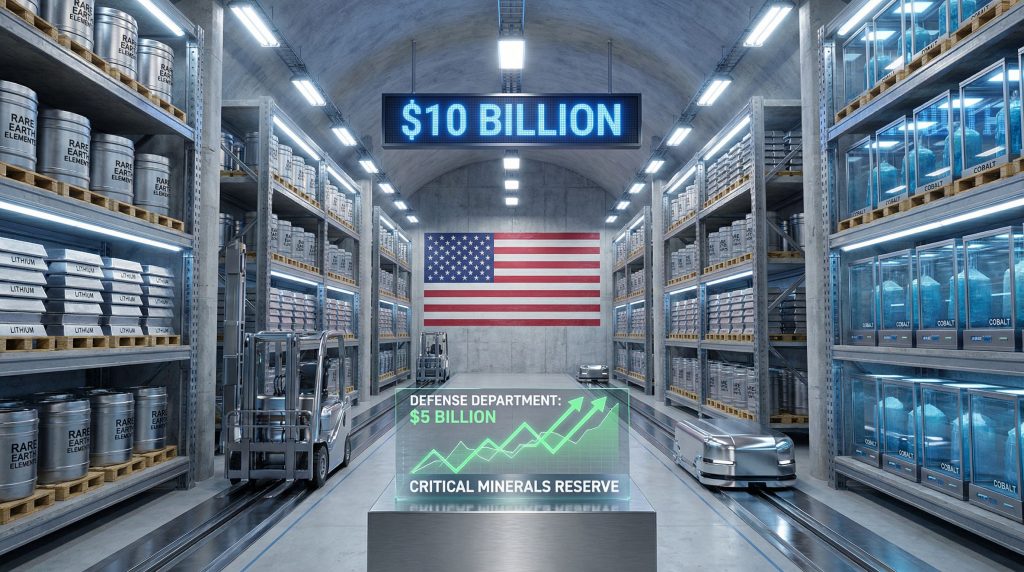
The US critical minerals stockpile plan represents a fundamental shift in American resource strategy, moving beyond traditional market-based approaches toward comprehensive supply chain security that integrates national security considerations with economic competitiveness objectives. Through initiatives encompassing the critical minerals strategy 2025, policymakers recognise that mineral independence requires coordinated action across government agencies, private sector partners, and international allies.
Strategic partnerships with companies like Clarios, GE Vernova, and Western Digital demonstrate private sector recognition that critical minerals & energy security cannot rely solely on traditional supply chains vulnerable to geopolitical manipulation and market distortion. These collaborations provide operational expertise whilst government participation ensures strategic objectives align with commercial incentives through risk-sharing mechanisms and long-term purchase commitments.
International implications extend beyond bilateral trade relationships toward comprehensive supply chain restructuring that influences global investment patterns, technological development, and geopolitical alliances. As innovations like the battery recycling breakthrough demonstrate, technological advancement combined with strategic planning can reduce import dependence whilst creating economic opportunities across multiple industries.
The success of America's strategic mineral initiative ultimately depends on sustained political commitment, adequate financial resources, and effective coordination between diverse stakeholders with different priorities and operational requirements. However, the scale of current challenges and the complexity of global mineral markets suggest that comprehensive solutions require years of consistent implementation rather than short-term policy interventions.
As evidenced by complementary policies like the US mineral production order and developments in Australia lithium industry innovations, international coordination remains essential for achieving meaningful supply chain diversification. The interconnected nature of global mineral markets means that American strategic objectives can only succeed through collaborative approaches that strengthen allied relationships whilst reducing collective dependence on concentrated supply sources.
According to Reuters reporting on Australia's Sunrise, international partnerships demonstrate growing momentum toward supply diversification, whilst the Australian Financial Review highlights the substantial financial commitments needed to achieve meaningful results. These developments suggest that strategic mineral planning has evolved from policy discussion toward operational implementation with measurable economic and security implications for participating nations and industries.
Seeking to capitalise on critical mineral market opportunities?
Discovery Alert's proprietary Discovery IQ model delivers real-time alerts on significant ASX mineral discoveries, instantly identifying actionable opportunities in lithium, rare earths, and other critical minerals ahead of broader market awareness. Begin your 14-day free trial today and position yourself to capitalise on the next major discovery in this rapidly evolving strategic sector.