May 24, 2026
Central Asia's Mining Sector Enters a New Phase of Private Capital Consolidation
The global scramble for critical mineral supply chains has fundamentally altered how private capital evaluates resource-sector assets. Across Central Asia, a region historically defined by state-dominated extraction industries and legacy Soviet-era infrastructure, a new generation of domestically rooted investors is moving aggressively to capture strategic positions in multi-commodity platforms. The transaction in which Nature Energy buys 39% stake in ERG is one of the most significant expressions of this trend to emerge in 2026, and it carries implications that stretch well beyond Kazakhstan's borders.
When big ASX news breaks, our subscribers know first
Understanding ERG: A Diversified Mining Platform With Critical Minerals at Its Core
Eurasian Resources Group occupies an unusual position in the global mining landscape. Unlike single-commodity producers that rise and fall with the fortunes of one market cycle, ERG operates across a sweeping range of industrial and critical metals. This gives it a commodity diversification profile that few privately held mining companies anywhere in the world can match.
The group's production portfolio spans:
| Commodity | Strategic Role Within ERG |
|---|---|
| Ferroalloys | Core earnings driver and primary revenue segment |
| Copper | Major industrial output with growing electrification demand |
| Cobalt | Critical minerals exposure linked to battery supply chains |
| Aluminium | Diversified base metals anchor |
| Iron Ore | Bulk materials stream supporting steelmaking demand |
| Thermal Coal | Energy commodity providing cash flow stability |
What makes this portfolio particularly compelling in 2026 is the intersection of two demand curves: traditional industrial metals consumed by construction and manufacturing, and the broader critical minerals demand surge increasingly sought by battery manufacturers, electric vehicle producers, and grid-scale energy storage developers. ERG sits across both of these trajectories simultaneously.
Kazakhstan itself holds some of the world's most significant mineral reserves, including the ninth-largest copper reserves globally and substantial cobalt resources. These are increasingly valued as Western supply chains seek alternatives to Democratic Republic of Congo-sourced material. ERG's position within this geological context gives it a strategic depth that pure financial metrics alone cannot fully capture.
How the Deal Was Structured: Two Sellers, One Strategic Buyer
The transaction through which Nature Energy Solutions acquired its 39.3% combined stake in ERG was not executed as a single block purchase. Instead, it was assembled through two distinct and legally separate transfers, each carrying its own valuation complexity and governance implications.
The Chodiev Tranche: 18.6% From a Living Co-Founder
The first tranche involved the acquisition of an 18.6% stake from Patokh Chodiev, one of ERG's original co-founders. Transactions involving living founders of major resource companies are relatively uncommon at this scale, as co-founders typically retain holdings as generational wealth vehicles or use them as leverage in ongoing governance arrangements. Chodiev's decision to exit represents a meaningful strategic choice, and the terms of his departure will likely shape his ongoing relationship with Kazakh resource sector politics for years to come.
The Machkevitch Estate Tranche: 20.7% From an Inherited Holding
The second and slightly larger tranche involved the purchase of a 20.7% stake from the estate of Alexander Machkevitch, a late co-founder whose holdings passed to his heirs. Acquiring assets from an estate introduces a layer of complexity that differs substantially from negotiating with a living counterparty. Estate-based asset sales often involve multiple beneficiaries with divergent interests, valuation disputes, and legal processes that can slow or complicate execution. The successful completion of this tranche signals that Nature Energy Solutions navigated these complexities effectively.
The dual-tranche structure is analytically significant. When a buyer assembles a near-controlling stake through two separate estate and founder transactions rather than a single block trade, it suggests negotiated pricing at each step rather than a single market-clearing price, raising questions about blended valuation assumptions.
What the $1.4 Billion Bid Implies About ERG's Total Worth
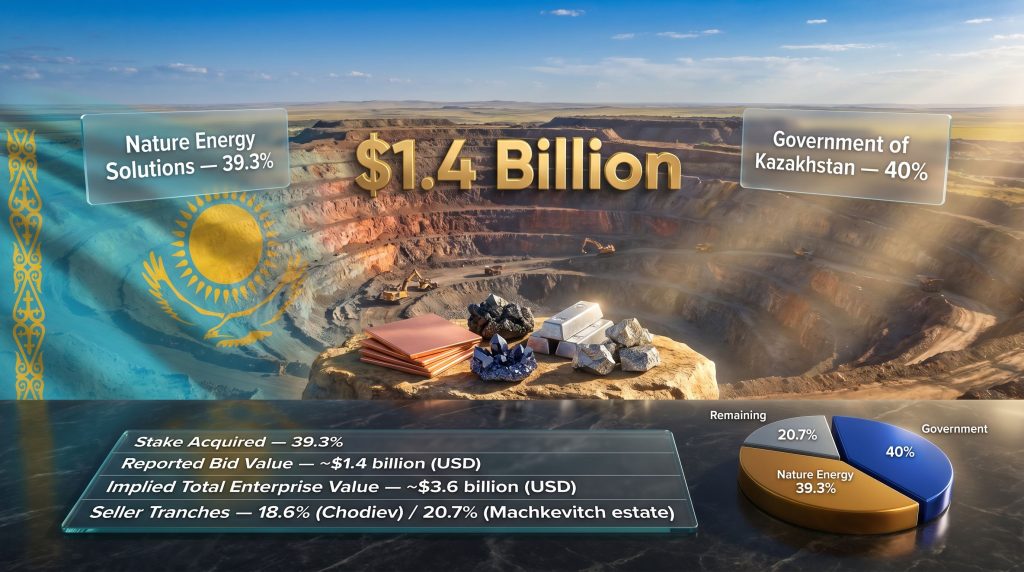
ERG declined to publicly disclose the transaction value. However, reporting from March 2026 indicated that Nature Energy Solutions had tabled a bid of approximately $1.4 billion for a stake of roughly 40%. If that figure is applied to the 39.3% ultimately acquired, the implied total enterprise valuation for ERG approaches $3.6 billion.
| Deal Parameter | Reported Figure |
|---|---|
| Stake Acquired | 39.3% |
| Reported Bid Value | ~$1.4 billion (USD) |
| Implied Total Enterprise Value | ~$3.6 billion (USD) |
| Seller 1 Stake | 18.6% (Chodiev) |
| Seller 2 Stake | 20.7% (Machkevitch estate) |
For a company producing ferroalloys, copper, cobalt, aluminium, iron ore, and thermal coal across one of the world's most mineral-rich jurisdictions, a $3.6 billion enterprise valuation represents a price point that many institutional analysts would consider conservative relative to replacement cost of the underlying asset base.
Glencore's Role: When a Trading House Backs an Equity Deal
The Financial Times reported in March 2026 that Glencore had proposed to support Mutalip's acquisition financially. The precise mechanics of this arrangement — whether structured as debt financing, equity co-participation, or off-take consideration tied to future production — have not been publicly confirmed.
What is notable is the identity of the reported backer. Glencore is not simply a financial institution seeking yield. It is the world's largest diversified commodity trading and mining company, with deep operational exposure to cobalt and copper across multiple continents.
When a global commodity trading house aligns behind a private buyer's acquisition of a near-controlling stake in a diversified miner, the motivation almost never stops at financial return. Off-take agreements, supply chain integration, and geopolitical positioning are typically embedded in such arrangements.
Furthermore, for Glencore specifically, ERG's cobalt output carries particular strategic interest. The DRC currently dominates global cobalt production, accounting for more than 70% of mined output. Any diversification of cobalt sourcing into Kazakhstan, a jurisdiction with more stable rule-of-law expectations for Western-aligned trading counterparties, represents genuine supply chain optionality. If Glencore secured preferential off-take rights as part of its reported backing arrangement, the financial cost of supporting the acquisition may be more than offset by long-term commodity flow economics.
Post-Transaction Ownership: A Balanced but Concentrated Structure
Following the completion of this transaction, ERG's ownership map has been materially simplified from a fragmented multi-party arrangement into a more concentrated, three-party structure.
| Shareholder | Approximate Stake |
|---|---|
| Government of Kazakhstan | 40% |
| Nature Energy Solutions (Mutalip) | 39.3% |
| Remaining Private Interests | ~20.7% |
The Kazakh government's fixed 40% anchor is a structural feature of ERG that predates this transaction and will persist regardless of private shareholder changes. This sovereign stake creates a governance dynamic that is quite different from a typical publicly listed miner. Any major strategic decision, including capital allocation, project development, or potential future divestments, will require accommodation of sovereign interests alongside commercial objectives.
Nature Energy's 39.3% position gives Mutalip significant blocking power and operational influence, but it does not constitute majority control in isolation. Consequently, the relationship between Kazakhstan's sovereign holding and Nature Energy's private stake will be the defining governance dynamic within ERG going forward. ERG confirmed that all of its operating entities continued normal business activities following the shareholder transition.
Who Is Shakhmurat Mutalip and Why Is This Move Significant?
Mutalip's background in Kazakhstan's construction sector represents a pattern that is becoming increasingly visible across Central Asian economies. Entrepreneurs who accumulated capital through real estate development and infrastructure contracting during Kazakhstan's post-Soviet economic expansion are now pivoting toward resource sector positions, using construction-derived capital as the foundation for upstream commodity plays.
This pivot is not accidental. It reflects a broader recognition within Kazakhstan's domestic business community that long-term wealth preservation is increasingly tied to resource ownership rather than service sector activity. Mining assets, particularly those with critical minerals exposure, offer inflation protection, dollar-denominated revenue streams, and strategic optionality that construction businesses simply cannot replicate.
The Nature Energy Solutions vehicle itself is positioned at the intersection of entrepreneurial ambition and Kazakhstan's evolving natural resource governance framework. The company's name, emphasising energy solutions, may also hint at longer-term positioning around the energy transition minerals within ERG's portfolio.
The next major ASX story will hit our subscribers first
Why Cobalt and Copper Make ERG Strategically Irreplaceable in 2026
The timing of this transaction is not incidental to the commodity cycle. Copper has been one of the strongest-performing major metals in recent years, and those exploring copper investment strategies will note that the metal increasingly trades with the volatility characteristics of technology stocks rather than traditional industrial commodities. ERG's copper production therefore carries both earnings significance and strategic optionality.
Cobalt's narrative is more nuanced. However, the structural demand case tied to lithium-ion battery manufacturing remains intact. Key factors reshaping cobalt's investment thesis include:
- Growing pressure from Western governments to reduce dependence on DRC-sourced cobalt
- The emergence of Kazakhstan as a more geopolitically accessible alternative supplier
- Battery chemistry evolution that, while reducing cobalt intensity per unit in some applications, has not eliminated cobalt demand entirely
- Long-term infrastructure electrification programmes in Asia and Europe requiring sustained battery-grade cobalt supply
ERG's cobalt output, produced as a co-product of copper refining in Kazakhstan, carries a different cost and geopolitical risk profile than DRC-sourced material — a meaningful differentiator for off-takers seeking supply chain resilience.
Kazakhstan's Hybrid Ownership Model and What It Means for Private Investors
Kazakhstan operates a distinctive resource sector governance framework in which the state retains equity stakes in strategic assets while private capital provides operational dynamism and commercial discipline. This is not a simple nationalisation model, nor is it a fully privatised market. It is a hybrid arrangement that creates specific constraints and specific protections for private co-investors.
For Nature Energy Solutions, operating alongside a 40% state stakeholder means that certain strategic decisions will always involve sovereign considerations. On the other hand, the state's ongoing financial interest in ERG's performance also provides a degree of institutional protection for the asset base. The Kazakh government has strong incentives to maintain the operational and financial health of a company in which it holds billions of dollars of equity value.
In addition, this structure shapes how external parties — including potential future buyers, off-take partners, and lenders — assess ERG's risk profile. Understanding the broader mining geopolitical landscape is essential here, as sovereign co-ownership effectively functions as a form of implicit country risk mitigation, even if it introduces governance complexity at the board level.
Frequently Asked Questions
What exactly did Nature Energy Solutions acquire?
Nature Energy Solutions, controlled by Kazakh entrepreneur Shakhmurat Mutalip, acquired a combined 39.3% stake in Eurasian Resources Group through two separate purchases: an 18.6% tranche from co-founder Patokh Chodiev and a 20.7% tranche from the estate of the late Alexander Machkevitch.
Is this the same company as ERG S.p.A. in Italy?
No. This transaction involves Eurasian Resources Group, a Kazakh mining conglomerate producing ferroalloys, copper, cobalt, aluminium, iron ore, and thermal coal. ERG S.p.A. is a separate Italian renewable energy company and is entirely unrelated to this transaction.
How much did Nature Energy Solutions pay?
ERG declined to confirm official deal terms. Earlier reporting indicated that a bid of approximately $1.4 billion was tabled for a roughly 40% stake, implying a total enterprise valuation approaching $3.6 billion. Furthermore, this figure should be treated as indicative rather than confirmed.
What was Glencore's involvement?
Reports from March 2026 indicated Glencore proposed to provide financial support for the acquisition. However, whether this took the form of debt, equity co-participation, or off-take arrangements has not been publicly confirmed.
Does Nature Energy now control ERG?
Not outright. The Kazakh government retains a 40% stake, creating a balanced ownership structure. Nature Energy buys 39% stake in ERG providing significant influence, but not unilateral majority control.
Key Takeaways
- Nature Energy buys 39% stake in ERG, assembled through two discrete founder and estate transfers totalling 39.3%
- The reported ~$1.4 billion bid implies a total enterprise value approaching $3.6 billion for the Kazakh mining group
- Glencore's reported financial backing adds a global commodity trading dimension suggesting potential off-take and supply chain integration objectives
- ERG's cobalt and copper exposure positions it as a strategically significant asset within global critical minerals supply chains
- Kazakhstan's 40% sovereign stake ensures state influence persists regardless of private shareholder restructuring
- A broader pattern of Kazakh construction-sector entrepreneurs pivoting to mining is becoming an identifiable trend across the region's resource economy
- All ERG operational entities confirmed continuity of normal business activities following the ownership transition
Readers seeking broader context on Central Asian mining markets and large-scale commodity sector transactions can find ongoing coverage at Mining.com, which tracks global resource industry developments across all major commodity classes.
Disclaimer: This article contains forward-looking analysis and references to reported transaction values that have not been officially confirmed by the parties involved. All financial figures referenced are based on prior media reporting and should not be interpreted as verified transaction data. This article does not constitute financial or investment advice.
Want To Stay Ahead of the Next Major Mineral Discovery?
Discovery Alert's proprietary Discovery IQ model scans ASX announcements in real time, transforming complex multi-commodity data into actionable insights for investors tracking critical minerals such as copper and cobalt — the very commodities driving transactions like this one. Explore how historic mineral discoveries have generated substantial returns and begin a 14-day free trial at Discovery Alert to position yourself ahead of the broader market.