May 24, 2026
The nuclear energy sector is experiencing unprecedented momentum as uranium market volatility and evolving geopolitical landscapes reshape global supply chains. The convergence of artificial intelligence infrastructure requirements, data centre proliferation, and geopolitical realignments has created a perfect storm driving nuclear renaissance investments worldwide.
Modern power grids face an existential challenge: how to deliver consistent, carbon-free electricity at unprecedented scales whilst maintaining grid stability. Nuclear power's ability to provide baseload electricity with 92-95% capacity factors positions it as the only scalable solution capable of meeting both climate commitments and reliability requirements that emerging technologies demand.
The Strategic Architecture of Energy Independence
Nuclear fuel supply chains represent one of the most complex geopolitical chess games in modern energy markets. Current global uranium enrichment capacity operates near maximum utilisation, with free-world enrichment capabilities estimated at approximately 52,000-55,000 separative work units (SWU) annually against total commercial demand approaching 60,000 SWU.
The elimination of Russian enrichment services from Western markets has created an 8,000-12,000 SWU annual supply gap that traditional suppliers cannot fill without significant capacity expansion. This shortage represents roughly 15-20% of global commercial reactor fuel requirements, highlighting the strategic vulnerability that decades of globalised nuclear fuel trade created.
Furthermore, us uranium market disruptions have compounded these supply challenges. The Department of Energy's efforts to rebuild domestic enrichment capabilities reflect the urgent need for energy independence in critical nuclear fuel technologies.
Quantifying the Data Centre Revolution's Impact
Electricity consumption patterns across major industrialised economies reveal an acceleration that few energy planners anticipated. US data centre electricity consumption has reached approximately 4% of total national electricity generation as of 2024, with projections indicating growth to 5.5-6.2% by 2026 according to regional transmission organisation analyses.
Hyperscale data centres require what the industry terms "Five Nines" reliability: 99.999% uptime availability. This translates to acceptable downtime of just 5.26 minutes annually. Traditional renewable energy sources, operating at capacity factors of 15-25% for solar and 25-35% for wind, cannot approach these reliability thresholds without massive battery storage investments that remain economically prohibitive at utility scale.
Nuclear facilities deliver electricity with zero operational carbon emissions whilst maintaining consistent output regardless of weather patterns, seasonal variations, or time-of-day fluctuations. These characteristics make nuclear power uniquely suited to support the next generation of computing infrastructure that artificial intelligence and cloud computing demand.
Historical Context: Learning from Supply Chain Disruptions
The uranium enrichment industry experienced similar supply shocks during the 1970s oil crises, when geopolitical tensions disrupted established trade relationships. However, the current situation differs fundamentally because:
- Technology advancement: Modern centrifuge technology allows faster capacity deployment than previous gas diffusion methods
- Regulatory experience: Nuclear licensing authorities possess decades of operational oversight experience
- Financial mechanisms: Government risk-sharing through grants and loan guarantees reduces private sector exposure
- Market demand certainty: Long-term power purchase agreements provide revenue visibility that earlier eras lacked
The precedent established by Centrus Energy's American Centrifuge Plant demonstrates that domestic enrichment capacity can be rebuilt successfully. Centrus received $150 million in federal support and achieved commercial operations within similar timeframes to those projected for newer facilities.
When big ASX news breaks, our subscribers know first
Capital Structure Innovation in Nuclear Infrastructure
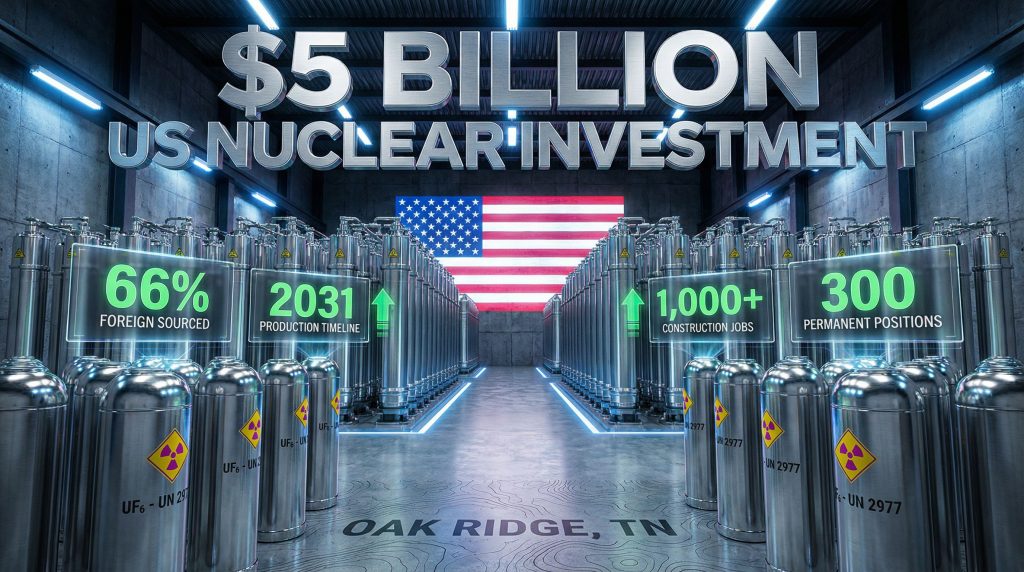
Orano nuclear fuel plant investment represents a fundamental shift in how nuclear infrastructure projects approach financing complexity. The $5 billion total project cost breaks down into a sophisticated capital structure that distributes risk across multiple stakeholder categories whilst ensuring adequate return profiles for private investors.
The Department of Energy's $900 million commitment represents approximately 33% of total project financing, establishing a risk-sharing model where government capital de-risks initial construction phases whilst private capital funds operational scaling and market penetration.
Multi-Layered Financing Architecture
Modern nuclear infrastructure projects employ what financial markets term "project finance" structures, where revenue streams from long-term contracts provide security for multiple layers of capital:
Senior Secured Debt (45-50% of capital stack):
- Backed by utility off-take agreements spanning 20-40 years
- Interest rates typically 200-300 basis points above treasury rates
- Security provided by physical assets and cash flow assignments
Mezzanine Financing (10-15% of capital stack):
- Higher-yield debt with equity conversion features
- Typical returns ranging from 12-18% annually
- Provides flexibility during construction and ramp-up phases
Equity and Co-Investment (35-40% of capital stack):
- Private equity, infrastructure funds, pension fund participation
- Target returns of 15-25% internal rate of return
- Long-term investment horizon matching facility operational life
The remaining $4.1 billion financing requirement likely follows this established infrastructure financing model, with Orano maintaining majority control whilst distributing minority stakes to strategic partners. Additionally, reports indicate that Orano may seek investors to complete the financing package for this ambitious project.
Strategic Partnership Dynamics
International nuclear projects increasingly attract diverse investor bases that bring both capital and strategic advantages:
- Pension funds seeking long-term, inflation-protected returns
- Infrastructure funds specialising in utility-scale projects
- Export credit agencies from allied nations supporting technology transfer
- Strategic industrial partners requiring secure fuel supply arrangements
This diversified approach reduces concentration risk whilst providing Orano access to different capital pools with varying risk tolerances and return requirements.
Regulatory Timeline Analysis and Market Entry Strategy
The pathway to commercial operations for new nuclear facilities involves a complex regulatory approval process that typically spans 24-30 months from application submission to licence issuance. Understanding this timeline provides critical insight into market dynamics and competitive positioning.
Nuclear Regulatory Commission Licensing Process
Phase 1 – Application Preparation (H1 2026):
The licence application submission represents culmination of extensive preparatory work including environmental impact assessments, safety analysis reports, quality assurance programme documentation, and cybersecurity protocols meeting post-Fukushima regulatory standards.
Phase 2 – Acceptance Review (H2 2026 – 2027):
The NRC conducts completeness determination within 30 days of submission, followed by potential requests for additional information. Complex facilities typically require 1-3 rounds of supplemental documentation before acceptance for substantive review.
Phase 3 – Substantive Review (2027-2029):
This phase encompasses environmental impact statement preparation, public hearings on safety and environmental aspects, and technical review by specialised NRC staff. The 24-30 month duration reflects thoroughness required for nuclear facility licensing.
Phase 4 – Licence Issuance and Construction Authorisation (2029):
Combined Construction and Operating Licence issuance enables simultaneous facility construction and operational preparation, streamlining the traditional two-phase approach.
Production Capacity Ramp and Market Penetration
2031 Initial Operations:
- Capacity utilisation: 70-80% during demonstration and compliance verification
- Expected output: 2,100-2,800 SWU annually
- Primary focus on regulatory compliance and operational optimisation
2032 Market Penetration:
- Capacity utilisation: 85-95% with established utility contracts
- Expected output: 3,400-4,750 SWU annually
- Market penetration across 8-12 US utilities
2033+ Full Operations:
- Nameplate capacity operations approaching 95%+ utilisation
- Annual output: 4,000-5,000 SWU
- Market contracts with 15+ utilities plus potential international sales
The Oak Ridge, Tennessee location provides strategic advantages including proximity to existing nuclear infrastructure, established regulatory relationships, and access to specialised workforce with security clearances required for enrichment operations.
Economic Multiplier Effects and Regional Development
Nuclear facility construction generates economic impacts extending far beyond direct employment creation. The $5 billion investment creates ripple effects throughout regional economies that persist for decades beyond initial construction phases.
Direct Employment Impact Analysis
Construction Phase Employment:
- 1,000+ construction workers during peak building activity
- Average construction wages: $65,000-$85,000 annually
- Specialised trades requiring nuclear facility experience command premium wages
- Construction duration: 24-36 months providing sustained employment
Permanent Operations Employment:
- 300+ permanent positions across operations, maintenance, security, and administration
- Average operational salaries: $85,000-$125,000 annually
- High-skilled positions requiring specialised training and security clearances
- Career advancement opportunities within nuclear industry
Economic Multiplier Calculations
Economic impact studies for similar nuclear facilities demonstrate multiplier effects where each direct job creates 1.5-2.0 additional indirect jobs in supporting industries:
- Supplier network development: Local procurement of non-nuclear components and services
- Service sector expansion: Housing, retail, professional services supporting increased population
- Tax base enhancement: Property taxes, income taxes, and business taxes supporting public services
The Tennessee location benefits from existing nuclear industry infrastructure, including Oak Ridge National Laboratory and the former K-25 gaseous diffusion plant site, providing institutional knowledge and specialised workforce availability.
Supply Chain Localisation Benefits
American Supplier Integration:
Modern nuclear facilities require extensive supplier networks spanning construction materials, specialised equipment, maintenance services, and operational supplies. Federal requirements for domestic content create opportunities for:
- Manufacturing capacity expansion in supporting industries
- Technology transfer from international nuclear suppliers to domestic partners
- Industrial base strengthening supporting both commercial and national security applications
Long-term Industrial Development:
The facility establishes Tennessee as a hub for nuclear fuel cycle activities, potentially attracting additional investments in:
- Advanced manufacturing for nuclear components
- Research and development collaboration with national laboratories
- Workforce development programmes supporting nuclear industry growth
Global Competitive Dynamics and Market Repositioning
The entry of new US enrichment capacity fundamentally alters competitive dynamics across global uranium fuel markets. Existing suppliers must reassess capacity utilisation, pricing strategies, and market positioning in response to shifting demand patterns.
Moreover, uranium investment strategies are increasingly focusing on domestic capacity development as investors recognise the strategic importance of supply security in nuclear fuel cycles.
International Competitor Response Analysis
European Enrichment Capacity:
- Urenco operations across Netherlands, Germany, and United Kingdom maintain approximately 18,000 SWU annual capacity
- Orano's French operations at Georges Besse 2 facility provide 7,500 SWU capacity
- Combined European capacity serves both domestic reactor fleets and export markets
Market Share Implications:
The new US facility capturing 30-40% of identified supply gap positions Orano to serve approximately 25-30% of total US commercial reactor fuel requirements. This market penetration level suggests:
- Reduced import dependency for US utilities
- Price stabilisation through domestic supply security
- Enhanced negotiating leverage for US utilities in international contracts
Technology Leadership and Innovation Acceleration
Advanced Centrifuge Technology:
Modern gas centrifuge technology employed in new facilities operates at significantly higher efficiency than previous generation equipment:
- Energy consumption: 50-60 kWh per SWU (compared to 2,500 kWh per SWU for gaseous diffusion)
- Modular design: Allows capacity expansion through additional centrifuge cascade installation
- Operational flexibility: Enables production adjustment based on market demand variations
Research and Development Collaboration:
Proximity to Oak Ridge National Laboratory creates opportunities for advanced nuclear fuel cycle research including:
- High-Assay Low-Enriched Uranium (HALEU) development for advanced reactor designs
- Recycling technologies for used nuclear fuel processing
- Next-generation reactor fuel development supporting small modular reactor deployment
Risk Assessment and Scenario Planning
Nuclear infrastructure investments operate within complex risk environments spanning regulatory, market, technological, and political dimensions. Understanding these risk factors enables informed investment decision-making and operational planning.
Consequently, uranium spot price dynamics continue to influence long-term planning decisions for major nuclear infrastructure projects like the Orano facility.
Regulatory and Political Risk Factors
Policy Continuity Risk:
Nuclear projects spanning multiple presidential administrations face potential policy shifts affecting:
- Federal funding commitments and appropriations continuity
- Regulatory approach changes impacting licensing timelines
- Trade policy modifications affecting international supplier relationships
State and Local Regulatory Environment:
Tennessee's supportive stance toward nuclear industry provides regulatory stability, though potential challenges include:
- Environmental permitting requirements and community engagement processes
- Transportation infrastructure development for uranium feedstock delivery
- Workforce development coordination with educational institutions
Market Demand Volatility Assessment
Nuclear Plant Operational Timeline:
Current US reactor fleet averaging 40+ years operational age faces retirement decisions over coming decades:
- Licence renewal applications extending operations to 60-80 years
- Economic competitiveness against natural gas and renewable generation
- Grid reliability requirements supporting baseload power retention
Small Modular Reactor Impact:
Emerging SMR technologies may require different enrichment specifications:
- HALEU requirements for advanced reactor designs
- Fuel fabrication differences compared to traditional reactor fuel
- Market timing uncertainty for SMR commercial deployment
Furthermore, us uranium production trends will play a crucial role in determining the domestic supply chain integration capabilities for facilities like Orano's proposed enrichment plant.
Competitive Response and Price Pressure Scenarios
International Supplier Capacity Expansion:
Existing enrichment providers may respond to US market opportunities through:
- Capacity debottlenecking at existing facilities
- Price competition to maintain market share
- Strategic partnerships with US utilities or investors
Technology Disruption Potential:
Advanced enrichment technologies under development could impact long-term market dynamics:
- Laser enrichment technologies promising higher efficiency
- Alternative fuel cycles reducing enrichment requirements
- Recycling advancement changing uranium demand patterns
The next major ASX story will hit our subscribers first
Investment Strategy Implications and Market Outlook
Orano nuclear fuel plant investment represents broader trends reshaping energy infrastructure investment strategies. Understanding these implications enables investors to position portfolios for the nuclear renaissance whilst managing associated risks.
Portfolio Positioning for Nuclear Renaissance
Direct Investment Opportunities:
- Uranium mining companies benefiting from sustained demand growth
- Nuclear technology providers supplying reactor components and services
- Utility companies with significant nuclear generation portfolios
Infrastructure Investment Themes:
- Grid modernisation supporting increased baseload generation
- Transmission capacity expansion connecting nuclear facilities to demand centres
- Energy storage complementarity balancing nuclear baseload with renewable intermittency
Risk Mitigation Strategies:
- Geographic diversification across multiple nuclear markets
- Technology diversification spanning uranium, enrichment, and reactor technologies
- Timeline diversification balancing near-term and long-term nuclear investments
Market Psychology and Sentiment Analysis
Nuclear investment sentiment reflects broader themes of:
- Energy security prioritisation following geopolitical disruptions
- Climate policy alignment supporting carbon-free electricity generation
- Technology advancement confidence in nuclear safety and economics
Investor psychology increasingly recognises nuclear power as essential infrastructure rather than speculative technology, supporting sustained capital allocation to nuclear projects over multi-decade investment horizons.
Investment Disclaimer: Nuclear infrastructure investments involve substantial capital requirements, regulatory risks, and long development timelines. Investors should conduct comprehensive due diligence and consider professional advice before making investment decisions in nuclear energy sectors.
What percentage of total US nuclear fuel requirements will this facility supply?
The facility's projected 4,000-5,000 SWU annual capacity would serve approximately 25-30% of current US commercial reactor fuel enrichment requirements, based on the 93 operating reactors consuming roughly 18,000-20,000 SWU annually in aggregate.
How does this investment compare to other recent nuclear infrastructure projects?
This $5 billion investment represents the largest single US enrichment capacity addition since the 1970s. By comparison, Centrus Energy's American Centrifuge Plant received $150 million in federal support for more limited capacity. International benchmarks include Urenco's expansions in Europe requiring $2-3 billion for comparable capacity levels.
What are the critical milestones investors should monitor?
Key timeline markers include licence application submission (H1 2026), NRC approval (estimated 2028-2029), final investment decision (pending regulatory approvals), construction commencement (2029-2030), and commercial operation start (2031). Any delays in regulatory approval could shift the entire timeline by 6-18 months.
The nuclear fuel cycle renaissance extends beyond individual facility investments to encompass comprehensive energy security strategy, technological leadership maintenance, and economic competitiveness in carbon-constrained energy markets. Understanding these broader implications enables stakeholders to navigate the complex intersection of energy policy, market dynamics, and investment opportunity that defines modern nuclear industry development.
Ready to Capitalise on Nuclear Renaissance Investment Opportunities?
Discovery Alert's proprietary Discovery IQ model delivers instant notifications on significant ASX mineral discoveries, including uranium and nuclear fuel cycle companies positioned to benefit from this historic infrastructure investment wave. Explore why major mineral discoveries can generate substantial returns by visiting Discovery Alert's dedicated discoveries page, showcasing historic examples of exceptional market outcomes.