May 23, 2026
When Industrial Legacies Collide With Modern Market Realities
Smelting has always been a capital-intensive, energy-hungry, and geopolitically sensitive industry. Long before critical minerals became a mainstream policy conversation, large-scale smelting complexes served as the backbone of industrial economies, processing raw concentrates into refined metals that flowed into everything from construction to electronics. Today, however, the economics that once justified these facilities have shifted dramatically.
The question is no longer just whether a smelter is profitable, but whether losing one is a strategic risk a nation can afford to take. That tension sits at the heart of the current situation surrounding the Nyrstar Australian lead zinc smelters future, as two of the Southern Hemisphere's most significant metals processing facilities face an uncertain path forward amid weak commodity markets, elevated energy costs, and a funding gap that has moved from theoretical to immediate.
When big ASX news breaks, our subscribers know first
Two Facilities, One Defining Moment
The Port Pirie lead smelter in South Australia and the Hobart zinc smelter in Tasmania are not recent industrial constructions. Both facilities have operated for well over a century, embedding themselves deeply into the economic fabric of their host regions. Port Pirie carries a rated lead processing capacity of 160,000 tonnes per year, placing it among the world's most significant multi-metal smelting complexes.
Hobart operates at 280,000 tonnes per year of zinc refining capacity, making it a cornerstone asset for the Southern Hemisphere's base metals supply chain. Together, the two sites directly employ more than 1,300 workers, with Port Pirie alone accounting for over 800 employees and approximately 250 contractors.
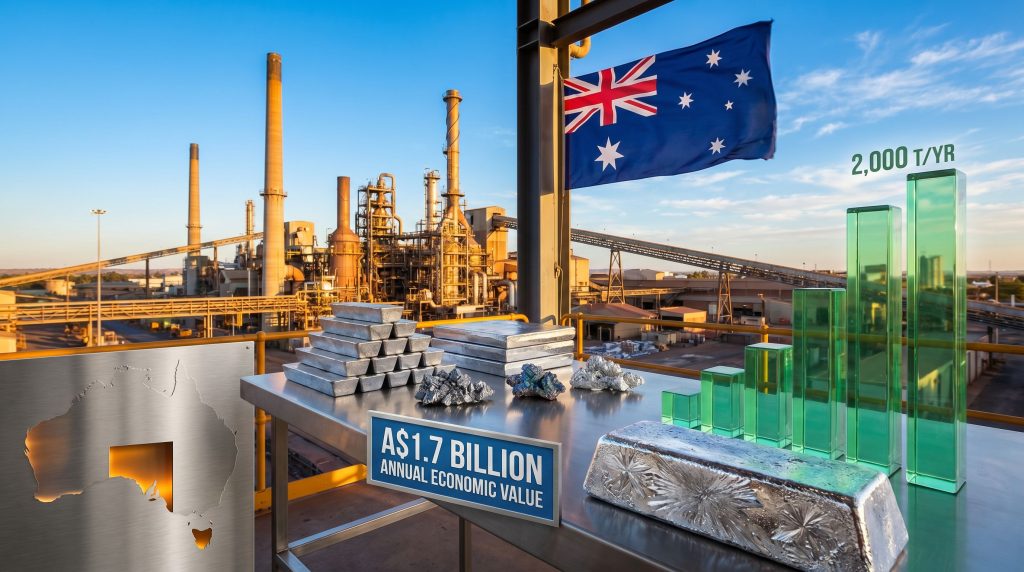
The economic reach extends well beyond the plant gates. Port Pirie's operations are estimated to generate roughly A$1.7 billion in annual economic value, and when broader employment multiplier effects are factored in, the two facilities collectively support an estimated 6,600 jobs across South Australia and Tasmania.
What makes these facilities particularly irreplaceable is not just their scale, but their metallurgical diversity. Both smelters process silver and a range of co-product metals alongside their primary output streams, including trace metals that are increasingly classified as critical inputs for clean energy, defence manufacturing, and advanced electronics.
The Structural Forces Compressing Smelter Economics
Understanding why the Nyrstar Australian lead zinc smelters future is under review requires stepping back from the immediate funding debate and examining the underlying market dynamics.
Zinc Market Weakness and Margin Compression
The Hobart facility implemented a 25% production curtailment in early 2025 in response to deteriorating zinc market conditions. This was not a routine seasonal adjustment. Commodity market analysts have characterised the situation as reflecting structural margin compression rather than a short-term cyclical dip, meaning the facility's cost structure cannot support full-capacity operations under prevailing pricing conditions.
Several intersecting forces are responsible:
- Chinese production dominance across key metals and concentrates creates persistent pricing pressure that undercuts the economics of Western smelting operations
- Australian energy costs place both facilities in a structurally disadvantaged position relative to Asian competitors, where electricity inputs are cheaper and often subsidised
- Currency dynamics and long-term treatment charge compression mean that smelters globally are receiving less revenue per tonne of concentrate processed than in previous decades
- Capital reinvestment cycles at ageing facilities require ongoing expenditure that is difficult to justify when operating margins are already negative
The Funding Gap That Changes Everything
In August 2025, the Australian federal government joined with the governments of South Australia and Tasmania to assemble a A$135 million (approximately US$97 million) transitional funding package to sustain operations at both sites. The funding was explicitly framed as interim support, designed to hold the facilities together while two-year feasibility studies into critical minerals diversification were completed.
That first phase expired on 30 April 2026. As of May 2026, no second-phase agreement has been confirmed.
| Funding Component | Contributor | Amount |
|---|---|---|
| State of South Australia | SA Government | A$55 million |
| State of Tasmania | Tasmanian Government | A$25 million |
| Federal Government | Canberra | Remaining majority share |
| Combined Total | Trilateral Agreement | A$135 million (~US$97mn) |
The expiry of this package has triggered a formal review of all options for both facilities. Nyrstar has stated that no final decision has been made regarding closures or production curtailment, but the review is now formally underway. Capital expenditure budgets and operational costs are understood to be primary candidates for reduction as part of that process.
Furthermore, the interval between the expiry of first-phase assistance and the confirmation of any second-phase arrangement represents the most financially precarious period both smelters have faced in their long operating histories. This situation is not unlike the Mount Isa smelter bailout debate, where government intervention was similarly framed around preserving strategic industrial capacity.
What the First Phase of Funding Actually Achieved
Despite the uncertainty now surrounding both facilities, the A$135 million first-phase package was not without tangible outcomes. Understanding what was accomplished during this transitional period matters because it provides the clearest evidence of what the facilities could become if permanent strategic funding is secured.
The Antimony Pilot: From Concept to Commercial Shipment
Perhaps the most significant milestone achieved under the first-phase agreement was the development and early commercialisation of an antimony processing pilot plant at Port Pirie. The facility produced its first commercial antimony shipment in February 2026, a development that moved the diversification strategy from theoretical planning to demonstrated operational reality.
Antimony is classified as a critical mineral by both Australia and the United States. The broader antimony shortage risks affecting defence and advanced industries make Port Pirie's pilot programme all the more significant. Its applications span:
- Flame retardants used across consumer and industrial products
- Ammunition and military hardware components
- Emerging energy storage technologies, including certain battery chemistries
- Semiconductor manufacturing as a dopant material
If permanent funding is confirmed, the Port Pirie antimony pilot is projected to scale to 2,000 tonnes per year by the end of 2026, a production rate that would position Australia as a meaningful non-Chinese source of this strategically sensitive metal.
The first-phase period also funded environmental improvement works at Port Pirie, including a product recycling facility designed to reduce lead emissions, and initiated the formal feasibility studies examining both smelters' potential as critical minerals processing hubs.
The Critical Minerals Pivot: What the Feasibility Studies Are Actually Examining
The feasibility studies currently underway are not simply exploring incremental product additions. They are examining whether both smelters can be fundamentally repositioned as multi-metal processing platforms serving clean energy, defence, and advanced manufacturing supply chains. Indeed, the surge in critical minerals demand globally makes this strategic pivot both timely and commercially compelling.
Target Minerals and Their Strategic Significance
The five principal critical minerals under investigation reflect the specific metallurgical capabilities of lead and zinc smelting infrastructure:
| Critical Mineral | Primary Applications | Why It Matters |
|---|---|---|
| Antimony | Flame retardants, ammunition, energy storage | Already in pilot production at Port Pirie |
| Bismuth | Pharmaceuticals, alloys, lead-free solders | Non-toxic lead substitute with growing demand |
| Tellurium | Cadmium telluride (CdTe) solar panels | Thin-film solar supply chain dependency |
| Germanium | Fibre optics, infrared systems, semiconductors | Export-restricted by China since 2023 |
| Indium | Transparent conductive films, solar cells, displays | No primary production currently in Australia |
A critical technical insight that is often overlooked in broader policy discussions is that these metals are not produced in dedicated mines. They exist as trace by-product elements within lead and zinc concentrates, and their recovery requires the specific pyrometallurgical and hydrometallurgical processing capabilities that large-scale smelters like Port Pirie and Hobart already possess. This is precisely why these facilities cannot simply be replaced by purpose-built critical minerals processing plants elsewhere.
The By-Product Metal Recovery Model Explained
In smelting terminology, by-product recovery refers to the extraction of commercially valuable trace metals that are present in concentrate feed material alongside the primary metal. In a lead smelter, for instance, the blast furnace and subsequent refining stages can be configured to recover silver, bismuth, antimony, and other metals that would otherwise remain locked in slag or dross streams.
This technical characteristic gives existing multi-metal smelters a structural advantage over greenfield processing proposals. The capital cost of adding by-product recovery circuits is a fraction of constructing an entirely new facility. However, it is also worth noting that bismuth export controls are already reshaping the global supply landscape, adding further urgency to unlocking domestic recovery capacity. The feasibility studies are examining whether this embedded technical optionality can be economically unlocked at commercial scale.
Trafigura's Role and the Global Portfolio Dynamic
Nyrstar is wholly owned by Trafigura, one of the world's largest commodity trading and logistics organisations. This ownership structure introduces a layer of strategic complexity that goes beyond simple government-industry negotiations.
Decisions about the Australian smelters are made within a global capital allocation framework, where the return profile of maintaining loss-making operations in Australia is weighed against alternative investment opportunities within Trafigura's broader commodity portfolio. The continued operation of both facilities therefore depends not only on government funding agreements but on Trafigura's assessment of the long-term strategic value of retaining a position in Australian critical minerals processing.
This dynamic also reflects a broader pattern emerging across Australia's metals processing sector. Deals providing transitional support to industrial processors have been structured for aluminium and copper facilities facing similar pressure from low commodity prices and elevated energy costs. The Australian government appears to be treating domestic metals processing capacity as a strategic national asset rather than evaluating each facility purely on commercial metrics.
Furthermore, global momentum around critical minerals supply chains underscores why Western governments are increasingly reluctant to allow strategic processing infrastructure to be lost to market forces alone. This policy context matters for understanding the Nyrstar situation, though it is important to note that strategic classifications at a national level do not automatically translate into guaranteed funding outcomes for individual facilities.
The next major ASX story will hit our subscribers first
The Irreversibility Problem: Why This Decision Cannot Be Undone
The most important dimension of the current funding impasse is one that rarely features prominently in commercial discussions: the near-irreversible nature of smelter closure.
Industry analysis consistently indicates that if either facility were to close permanently, reconstructing equivalent processing capability would require not only billions of dollars in capital expenditure but also a multi-year regulatory approvals process. Critically, it would require the reassembly of a specialised metallurgical workforce that takes decades to develop. Once that institutional knowledge base disperses, it cannot be rapidly reconstituted.
Three Scenarios for the Facilities' Future
| Scenario | Description | Key Dependency |
|---|---|---|
| Full Continuation | Second-phase funding confirmed; feasibility studies completed; critical minerals production scales | Federal-state alignment plus Trafigura commitment |
| Partial Curtailment | Output reduced at one or both sites; workforce contracted; some pilot programs paused | Near-term outcome if funding is delayed but not abandoned |
| Permanent Closure | One or both facilities decommissioned; workforce dispersed; processing capability lost | Triggered by prolonged funding failure and sustained market weakness |
The third scenario would carry consequences that extend well beyond the immediate communities of Port Pirie and Hobart. Without functioning large-scale smelting infrastructure capable of processing polymetallic concentrates, Australia's ability to produce refined critical minerals domestically rather than exporting raw ore for overseas processing would be severely constrained.
This directly conflicts with the objectives of the Future Made in Australia policy framework, which depends on domestic processing capability to capture economic value from the global energy transition.
Disclaimer: The scenario analysis presented here reflects publicly available information as of May 2026. Outcomes depend on ongoing negotiations between Nyrstar, its parent company Trafigura, and Australian federal and state governments. Nothing in this article constitutes financial advice or a forecast of commercial outcomes.
A Funding Decision With Consequences That Outlast the Budget Cycle
What makes the current impasse surrounding the Nyrstar Australian lead zinc smelters future genuinely consequential is the asymmetry between the cost of continued support and the cost of losing the facilities permanently.
A second phase of transitional funding, the scale of which has not yet been publicly confirmed, would be measured in hundreds of millions of dollars across a defined timeframe. The cost of rebuilding equivalent processing infrastructure from scratch, retraining a metallurgical workforce, obtaining environmental approvals, and re-establishing supply chain relationships would likely run into multiples of that figure over a decade or more.
The antimony pilot at Port Pirie has already demonstrated that the diversification pathway is not theoretical. It is operational, commercially proven at pilot scale, and aligned with genuine Western supply chain demand for non-Chinese sources of strategically sensitive metals. Whether that proof-of-concept is sufficient to unlock the next phase of commitment from all three levels of government, and from Trafigura as the facility's owner, remains the central question shaping the future of Australian lead and zinc refining.
For further market intelligence on base metals, smelting economics, and critical minerals developments, Argus Media publishes ongoing analysis tracking this evolving situation.
Want to Track the Next Major ASX Critical Minerals Discovery Before the Broader Market Does?
Discovery Alert's proprietary Discovery IQ model scans ASX announcements in real time, instantly identifying significant mineral discoveries across antimony, bismuth, germanium, and more than 30 other commodities — translating complex data into clear, actionable opportunities for investors at every experience level. Explore historic discoveries and their remarkable returns, then begin your 14-day free trial to position yourself ahead of the market.