June 9, 2026
The Hidden Mechanics of OPEC+ Supply Management: Why Pace Matters More Than Volume
Global crude oil markets are rarely moved by a single decision. More often, it is the pattern of decisions that shapes long-term price trajectories, trader positioning, and energy security calculations for import-dependent economies. When a major producer coalition adjusts not just the size of its output increase, but the deliberate rhythm at which those increases are delivered, the signal embedded in that tempo deserves careful examination.
Understanding OPEC oil production targets in July 2026 requires looking beyond the headline barrel figure. The real story is about institutional architecture, coalition discipline, and the calculated use of flexibility as a strategic tool in an era of compressed demand certainty. Furthermore, crude oil price trends throughout 2025 have laid important groundwork for how markets are now interpreting these supply signals.
When big ASX news breaks, our subscribers know first
Why the 188,000 b/d Figure Is More Nuanced Than It Appears
The Step-Down in Pace: What It Communicates to Markets
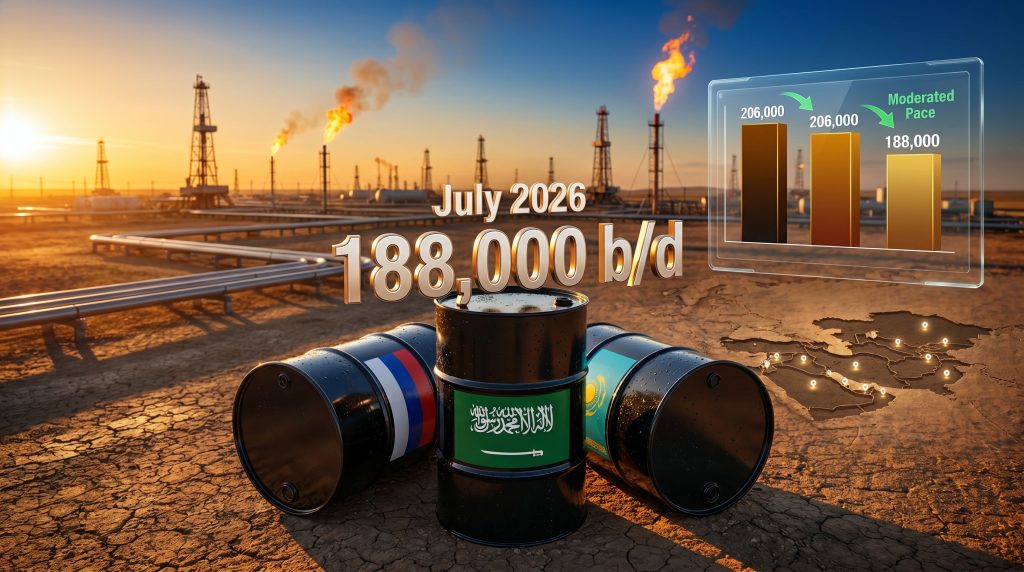
For two consecutive months earlier in 2026, the OPEC+ coalition approved monthly production target increases of 206,000 barrels per day. The subsequent moderation to 188,000 b/d for both June and July of 2026 is not a dramatic reversal, but it is a deliberate recalibration. In commodity markets where forward expectations drive physical positioning, even modest changes in the pace of supply additions carry outsized informational value.
The shift from 206,000 b/d to 188,000 b/d tells analysts and traders several things simultaneously:
- The coalition retains an unwinding bias but is not committed to a uniform acceleration
- Demand-side signals have introduced enough uncertainty to justify a measured slowdown
- Internal coalition dynamics, particularly among higher-producing members, remain manageable for now
- The group is preserving optionality for future meetings rather than front-loading volume into uncertain markets
The pace at which OPEC+ unwinds its supply curbs functions as a live indicator of the coalition's internal confidence in demand recovery. A deceleration is not a retreat; it is a diagnostic signal about where the alliance believes the demand cycle currently sits.
The Timeline of OPEC+ Supply Decisions Through Mid-2026
To properly contextualise the July decision, the progression of monthly output adjustments across 2026 is instructive:
| Period | Monthly Target Increase (b/d) | Directional Signal |
|---|---|---|
| Early 2026 (two consecutive months) | 206,000 | Accelerated unwinding |
| June 2026 | 188,000 | Moderated pace introduced |
| July 2026 | 188,000 | Moderation sustained |
The voluntary production cuts being unwound were originally introduced in April 2023 in response to demand fragility following the post-pandemic normalisation period. The fact that their reversal is being handled through a multi-year phased process, rather than a single large-scale announcement, reflects the coalition's awareness that abrupt supply additions have historically triggered price crashes that damage member revenue far more than modest quota restraint.
The Seven Nations Behind the July 2026 Production Decision
Who Is at the Table and Why It Matters
The July 2026 agreement involves seven specific OPEC+ member nations rather than the full coalition membership. This sub-group carries disproportionate influence over real-world supply outcomes. In addition, OPEC's market influence extends well beyond these seven nations, shaping pricing expectations across the entire global energy complex.
| Member Nation | Role Within the Framework |
|---|---|
| Saudi Arabia | Primary swing producer; sets the tone for coalition positioning |
| Russia | Second-largest contributor; subject to geopolitical supply uncertainty |
| Iraq | Historically inconsistent compliance; structural output limitations |
| Kuwait | Strong historical adherence to quota obligations |
| Kazakhstan | Active overproducer with accumulated compensation obligations |
| Algeria | Smaller volume contributor; high conformity track record |
| Oman | Non-OPEC participant with consistent alignment to coalition targets |
A critical and frequently overlooked distinction when evaluating these agreements is the gap between paper targets and actual physical barrels delivered to market. Production targets are administrative commitments; real output depends on infrastructure capacity, maintenance schedules, export terminal conditions, and geopolitical disruptions. For several member nations in this group, the delta between agreed quota and achieved output has been persistent enough to meaningfully deflate the real-world impact of any given target increase.
Kazakhstan's Overproduction Problem: A Structural Fault Line
Kazakhstan deserves specific attention as a recurring source of coalition friction. The country has accumulated excess production volumes beyond its agreed quota since January 2024. This sustained overproduction creates two compounding problems for OPEC+ price management efforts:
- It physically adds barrels to a market the coalition is trying to manage
- It erodes the credibility of the compliance framework, potentially encouraging other members to test their own quota limits
The formal compensation mechanism, under which overproducing nations agree to produce below their quota in future months to offset the excess, has now been extended through December 2026. This extension serves as a structural safeguard, giving Kazakhstan and any other overproducers a longer runway to correct their production profiles without fracturing coalition unity through punitive measures.
The Declaration of Cooperation: OPEC+'s Legal and Operational Backbone
How the Governance Architecture Actually Functions
Unlike a formal treaty organisation, OPEC+ operates under a framework known as the Declaration of Cooperation (DoC), a non-binding but politically significant agreement that governs collective production behaviour across member states. Several mechanics within this structure are not widely understood outside specialist circles:
- The Joint Ministerial Monitoring Committee (JMMC) functions as the operational oversight body, responsible for tracking individual member compliance and recommending policy adjustments
- Compliance is measured against a baseline production reference, not against absolute output ceilings, which introduces interpretive flexibility in how quota adherence is calculated
- Regular virtual ministerial meetings replace the traditional in-person sessions that historically characterised OPEC governance, allowing the coalition to respond to market developments within days rather than months
- The DoC explicitly permits voluntary additional cuts by individual members beyond the agreed collective target, providing a mechanism for stronger-performing members to compensate for weaker ones without requiring a formal coalition-wide resolution
This architecture explains why OPEC+ can simultaneously announce target increases while market observers note that actual supply growth remains subdued. The coalition manages perception and physical reality as two distinct but interconnected levers. According to the official OPEC communiqué, this flexibility framework remains central to the group's supply management philosophy going forward.
Geopolitical Pressure Points Complicating the July Supply Picture
Middle East Instability as a Price Variable
No analysis of OPEC oil production targets in July 2026 is complete without accounting for the geopolitical backdrop. Escalating conflict across the Middle East has introduced a persistent risk premium into crude pricing that operates independently of OPEC+ supply decisions. Consequently, the trade war oil impact has further complicated demand forecasting for the coalition's strategists.
Wood Mackenzie has assessed that conflict scenarios involving Iran carry the potential to remove approximately 20% of global LNG supply from accessible markets, a figure that underscores how interconnected oil and gas pricing dynamics have become under current geopolitical stress. While this is primarily a gas market risk assessment, the underlying supply chain disruption implications carry through into crude pricing psychology.
This creates a genuinely complicated environment for the coalition:
- Geopolitical risk supports higher prices, which might argue for faster unwinding
- But the same instability increases supply uncertainty from within member territories
- Demand destruction risk from a broader regional escalation argues for caution
- The coalition cannot easily distinguish between a geopolitically inflated price and a fundamentals-driven one when setting output targets
The Flexibility Doctrine in Practice
OPEC+ has been explicit that its operational posture for 2026 centres on maintaining maximum strategic flexibility. Rather than committing to a fixed unwinding schedule that would bind the coalition regardless of evolving conditions, the group has embedded optionality directly into its supply framework. This means every monthly meeting carries genuine decision-making weight, and market participants should not assume a linear continuation of the current unwinding trajectory.
What the July 5 Meeting Will Determine
Scenarios for August 2026 and the Signals to Watch
The OPEC+ ministerial review scheduled for July 5, 2026 will examine compliance data from all seven participating nations alongside early market response metrics from the July output adjustment. The outcome of that meeting will effectively set the tone for the second half of 2026 crude supply management. The OPEC meeting impact on pricing has historically been significant, and analysts are watching this forthcoming session closely.
| Scenario | Trigger | Probable Coalition Response |
|---|---|---|
| Demand recovery strengthens | Inventory drawdowns accelerate globally | Maintain or modestly increase the 188,000 b/d pace |
| Demand weakens further | Persistent inventory builds in OECD nations | Pause or reduce the monthly increment |
| Geopolitical supply shock | Major disruption in a key OPEC+ producer | Reverse recent increases; tighten quotas |
| Compliance breakdown | Widespread overproduction across multiple members | Further extend compensation window; apply diplomatic pressure |
The most underappreciated risk in the current setup is the compliance breakdown scenario. If Kazakhstan and other historically overproducing members continue to exceed quotas while the coalition simultaneously raises targets, the real-world supply addition to market could be materially larger than the headline 188,000 b/d figure implies. Investors and traders tracking OPEC oil production targets in July should monitor actual production data against agreed targets as the more reliable indicator of market impact. WTI and Brent futures remain the primary instruments through which these compliance gaps are priced into forward curves.
Furthermore, reporting from France 24 has highlighted how the July production announcement was received across international energy markets, noting the degree to which the decision surprised analysts expecting a more aggressive output increase.
The next major ASX story will hit our subscribers first
Frequently Asked Questions
What are OPEC's oil production targets in July 2026?
Seven core OPEC+ member nations agreed to raise collective output targets by 188,000 barrels per day effective July 2026, continuing the phased unwinding of voluntary cuts first introduced in April 2023.
Why is the July increase smaller than earlier 2026 increments?
The shift from 206,000 b/d in the two preceding months to 188,000 b/d reflects deliberate moderation in response to softening demand signals and the coalition's preference for preserving operational flexibility over committing to an accelerated unwinding pace.
Does a higher production target guarantee more oil reaching the market?
Not necessarily. Ongoing supply disruptions, infrastructure constraints, and compliance gaps mean that paper target increases do not always translate into equivalent physical supply additions. The actual market impact may be smaller than the announced volume suggests.
When does the overproduction compensation window close?
The compensation period covering excess volumes produced since January 2024 has been formally extended through December 2026.
Can OPEC+ reverse the July production increase?
Yes. The coalition has explicitly reserved the right to pause, reduce, or entirely reverse production increases at any point, and this flexibility is treated as a core feature of the current supply management framework rather than a contingency measure.
Key Takeaways at a Glance
- 188,000 b/d target increase agreed for July 2026 by seven OPEC+ core members, matching June but below earlier 206,000 b/d increments
- The pace moderation signals cautious demand reading, not an abandonment of the unwinding strategy
- Real-world supply additions may fall below the announced target due to infrastructure and compliance constraints
- Kazakhstan's accumulated overproduction remains a structural tension point within the coalition
- The compensation window has been extended to end of December 2026 as a coalition cohesion mechanism
- The July 5 ministerial meeting is the critical near-term event for determining August 2026 supply direction
- Geopolitical instability, particularly Middle East conflict risk, functions as an independent and unpredictable price variable operating alongside OPEC+ supply decisions
This article contains forward-looking assessments and scenario analysis based on publicly available data and reported coalition decisions. Energy market outcomes depend on a wide range of variables including geopolitical developments, macroeconomic conditions, and member compliance. Nothing in this article constitutes investment advice.
Readers seeking ongoing coverage of OPEC+ supply decisions and upstream energy developments across the Asia-Pacific region and global commodity markets can explore further reporting at Petroleum Australia.
Want to Stay Ahead of the Next Major Commodity Discovery?
While OPEC+ supply decisions shape the broader energy landscape, Discovery Alert's proprietary Discovery IQ model delivers real-time notifications on significant ASX mineral discoveries across oil, gas, and over 30 other commodities — turning complex market data into actionable investment insights the moment announcements hit the exchange. Explore Discovery Alert's dedicated discoveries page to understand how historic mineral discoveries have generated substantial market returns, and begin your 14-day free trial today to position yourself ahead of the broader market.