May 24, 2026
The Capital Architecture Reshaping Africa's Base Metals Frontier
Copper has a supply problem, and the world is only beginning to reckon with its full scale. The International Energy Agency projects that global copper demand could nearly double by 2040 as electrification accelerates across power grids, electric vehicles, and renewable energy infrastructure. Yet the pipeline of new mines capable of meeting that demand remains dangerously thin. The deposits that do exist are increasingly difficult to access, politically complex, or locked behind multi-billion-dollar development barriers. Against this backdrop, the reactivation of underdeveloped copper-zinc systems in southern Africa is not a peripheral story. It sits at the intersection of green metals scarcity, institutional capital reallocation, and a structural reshaping of how junior-to-mid-tier miners actually get built.
Orion Minerals South Africa funding has emerged as one of the more technically sophisticated examples of this reshaping. The company's approach to financing the Prieska Copper-Zinc Project and the Okiep Copper Project reveals as much about the evolution of mining finance as it does about the specific assets involved.
When big ASX news breaks, our subscribers know first
South Africa's Hidden Base Metals Opportunity
For most of the twentieth century, South Africa's mining identity was defined by gold and platinum. The Witwatersrand Basin produced more gold than any geological formation in history, and the Bushveld Igneous Complex gave the country a near-monopoly on platinum group elements. This precious metals dominance was so complete that it effectively obscured what lies beneath other parts of the country's geology.
The Northern Cape province tells a different story. The Namaqualand region and the broader Areachap Terrane host a series of volcanogenic massive sulphide deposits, a geological setting that produces the kind of polymetallic mineralisation where copper and zinc occur together in high-grade lenses. VMS systems are geologically significant because they form at ancient seafloor hydrothermal vents, concentrating metals into compact, high-tonnage bodies that are amenable to bulk underground mining. Prieska's deposit fits squarely within this geological category.
By contrast, the Democratic Republic of Congo and Zambia have long dominated African copper output through the Central African Copperbelt, a sediment-hosted stratabound copper system of entirely different geological character. South Africa's copper endowment is real but structurally distinct, and the absence of historical large-scale copper mining in the country reflects the dominance of precious metals investment rather than any deficiency in the underlying geology.
The Prieska and Okiep Assets: What the Geology Tells Investors
The Prieska Copper-Zinc Project sits in the Northern Cape, approximately 100 kilometres north of the town of Prieska. The deposit was previously mined between 1971 and 1991, producing over 430,000 tonnes of copper and 970,000 tonnes of zinc before being placed on care and maintenance. This historical production record is strategically valuable because it confirms the metallurgical processability of the ore, the infrastructure corridor, and the underground access geometry. Restarting a previously producing mine carries meaningfully lower technical risk than a greenfield development.
The current resource at Prieska is substantial. At steady-state production, the project is designed to yield 22,000 tonnes of copper concentrate and 65,000 tonnes of zinc concentrate annually, over a projected mine life exceeding 13 years. That kind of multi-decade production profile creates the long-term offtake certainty that major commodity traders require before committing construction-scale capital.
The Okiep Copper Project, located in the Namaqualand district, adds a second leg to Orion's portfolio. Okiep has its own deep historical production pedigree, having been mined for copper intermittently since the nineteenth century. Orion's current work at Okiep focuses on resource delineation drilling to define the scale of the remaining mineralised system, running in parallel with Prieska's development pathway.
How Is Orion Minerals Structuring Its Multi-Layered Financing Stack?
Understanding the Orion Minerals South Africa funding structure requires looking beyond individual deal announcements and examining the architecture as a whole. What Orion has assembled is a sequenced multi-tranche capital stack in which each instrument is calibrated to a specific phase of risk and a specific class of capital provider.
The Bridge Placement: A$15.4 Million From South African Institutions
The most recent component is an A$15.4 million share placement (approximately USD $10.9 million or ZAR 181 million) from South African institutional investors, with closing anticipated around 28 May 2026. The placement is structured as bridge financing, designed to fund early engineering works, surface infrastructure preparation, and exploration drilling at both Prieska and Okiep while the larger construction financing package is finalised.
The choice of South African institutional investors as the bridge equity provider is not incidental. These investors have direct familiarity with the project's jurisdiction, the regulatory environment, and the physical assets. Allocating to an ASX-listed vehicle gives them exposure to a domestic resource development story with the added benefit of Australian securities regulation, exchange liquidity, and international governance standards. This cross-border capital dynamic is becoming increasingly common as African institutional funds seek resource exposure that combines local knowledge with listed market transparency.
Bridge financing of this nature is milestone-linked capital, not speculative positioning. Its purpose is to compress the gap between feasibility completion and construction commencement, directly reducing the cost escalation risk that plagues projects during prolonged funding periods.
The IDC Convertible Loan: Development Finance With Equity Optionality
South Africa's Industrial Development Corporation has committed an A$21 million senior secured convertible loan facility to support pre-development activities at Prieska. The proceeds are earmarked for early mining work and dewatering operations, the latter being a critical prerequisite for underground access in a previously flooded mine.
Convertible loan structures are particularly favoured by development finance institutions because they provide debt-like downside protection while retaining equity upside if the project succeeds. For Orion, the IDC facility delivers capital without the immediate dilution of a pure equity raise, though the conversion feature means potential future dilution if the loan is converted rather than repaid in cash. Furthermore, this structure closely mirrors the kind of blended finance approach increasingly common in mining private equity circles.
Triple Flag Precious Metals: The Streaming Mechanism Explained
Triple Flag Precious Metals has committed a USD $87 million funding package structured as a USD $80 million precious metals stream plus an additional A$10 million component. Streaming is a financing instrument that deserves explanation for investors unfamiliar with the mechanics.
Under a streaming agreement, a specialist financier provides upfront capital to a mining company in exchange for the contractual right to purchase a fixed percentage of future metal production at a deeply discounted predetermined price. The streaming company profits from the spread between its contracted purchase price and the prevailing spot market price over the life of the mine.
For mine developers, streaming is attractive because it is non-dilutive to equity and does not carry the covenant burden of traditional project debt. The trade-off is a permanent reduction in long-term revenue per unit of metal produced. Streaming deals are typically structured around precious metals by-products (gold, silver) rather than the primary base metals, leaving the developer with full price exposure on its main revenue streams.
The Glencore Prepayment Facility: Commodity Capital at Construction Scale
The dominant financing instrument in Orion's capital stack is a USD $250 million prepayment facility being finalised with Glencore. This deal with Glencore operates differently from streaming: the offtake partner advances capital against the future delivery of physical metal. Repayment occurs through concentrate shipments rather than cash, directly aligning Glencore's commercial interest in receiving long-term copper and zinc supply with Orion's need for construction capital.
Glencore's strategic logic is transparent. As one of the world's largest commodity traders, securing a dedicated offtake position from a new southern African copper-zinc producer with a 13-plus year mine life addresses its own long-term supply positioning. The USD $250 million facility is projected to cover the substantial majority of the total Prieska construction cost of A$578 million (approximately A$412 million net of streaming proceeds).
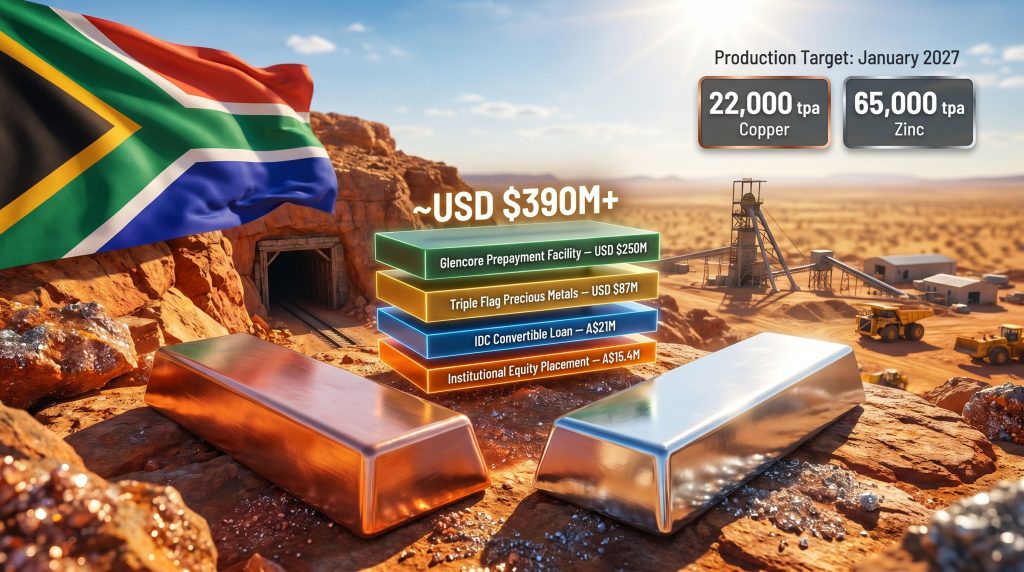
Orion Minerals Funding Stack: Comparative Overview
| Funding Source | Instrument Type | Scale | Primary Purpose |
|---|---|---|---|
| South African Institutional Investors | Equity Placement | A$15.4M (~USD $10.9M) | Bridge financing, early works |
| Industrial Development Corporation (IDC) | Senior Secured Convertible Loan | A$21M | Pre-development, dewatering |
| Triple Flag Precious Metals | Precious Metals Stream + Equity | USD $87M total | Construction de-risking |
| Glencore | Prepayment Facility | USD $250M | Primary construction capital |
| Total Capital Stack (Approximate) | Hybrid Multi-Tranche | ~USD $390M+ | Full mine development |
What This Financing Model Reveals About Modern Mine Development
Why Single-Source Funding No Longer Works for Large-Scale Projects
The post-2020 mining capital environment has fundamentally altered how large projects get financed. Traditional project finance, in which a single lead bank or consortium provides the bulk of debt against project cash flows, has become increasingly difficult to execute for African mining developments. ESG mandates, country risk premiums, and the capital intensity of modern mine builds have pushed commercial lenders toward more selective deployment.
The response from the sector has been the hybrid multi-tranche structure. By layering equity, convertible debt, streaming, and prepayment instruments, developers distribute risk across a diversified capital base and ensure that no single counterparty holds a blocking position. Each instrument class attracts a different type of investor with different risk tolerance and return expectations. Moreover, the global copper supply crunch is intensifying pressure on developers to close financing faster than in previous cycles:
- Equity placements absorb early-stage development risk and provide flexible working capital
- Convertible loans suit development finance institutions seeking blended return profiles
- Streaming deals attract specialist royalty companies with long-duration return models
- Prepayment facilities align commodity traders with construction outcomes through offtake linkage
The sequencing of these instruments is as important as the instruments themselves. Risk-absorbing equity and convertible debt must come first, establishing the feasibility foundation that allows streaming and prepayment counterparties to commit at scale. Orion's capital stack follows this logic with precision.
Comparing the Four Instruments: A Structural Framework
| Instrument | Dilution Risk | Revenue Impact | Repayment Mechanism | Best Use Phase |
|---|---|---|---|---|
| Equity Placement | High | None | N/A | Early-stage / bridge |
| Convertible Loan | Medium (conditional) | Interest cost | Cash or equity conversion | Pre-development |
| Precious Metals Stream | Low | Reduces long-term margin | Future metal delivery | Construction de-risking |
| Prepayment Facility | None | Reduces volume available to spot | Concentrate delivery | Primary construction |
Production Targets and the Road to First Concentrate
Dewatering as the Critical Path Item
One of the less discussed but technically critical aspects of reactivating Prieska is the dewatering requirement. When the mine was placed on care and maintenance in 1991, the underground workings gradually flooded. Accessing the existing development infrastructure and commencing new underground mining requires systematically pumping out significant volumes of water from depths that can exceed several hundred metres in VMS systems of this scale.
Dewatering is both time-consuming and capital-intensive, which is precisely why the IDC convertible loan is specifically allocated to this activity alongside other pre-development works. Successfully completing dewatering unlocks access to the existing decline infrastructure and ore body knowledge accumulated during the first mine's operational life, reducing the cost and time required to reach productive underground mining.
Construction Timeline and Production Commencement
Once full construction financing is formally closed, Orion has indicated a build timeline of approximately 13 months. The production commencement target, as cited in publicly available reporting, is January 2027, with steady-state output designed to reach 22,000 tonnes per annum of copper and 65,000 tonnes per annum of zinc in concentrate form.
The concentrate production model is worth understanding. Prieska will not produce refined copper cathode or zinc metal. It will produce sulphide concentrates containing copper and zinc respectively, which are then shipped to smelters for final processing. This is standard for VMS-type deposits and means that Orion's revenue model is based on payable metal in concentrate, with treatment charges and refining charges deducted by the smelter. The Glencore prepayment facility effectively pre-sells a portion of this concentrate stream.
Mine Life and Resource Extension Potential
The current projected mine life of over 13 years is based on defined resource estimates. A notable feature of VMS systems is that they often exhibit depth and strike continuity beyond initial resource boundaries. The Prieska deposit has been shown to continue at depth, and ongoing exploration drilling has the potential to extend the resource base and the mine's operating life beyond current projections. In addition, a completed definitive feasibility study provides the technical foundation upon which this optionality can ultimately be valued. This optionality is rarely priced into development-stage valuations but represents meaningful long-term value creation potential.
South Africa's Emerging Role in the Green Metals Supply Chain
The Northern Cape as a Base Metals Corridor
South Africa's copper production has historically been negligible compared to the DRC and Zambia, both of which produce copper measured in hundreds of thousands to millions of tonnes annually. Yet the Northern Cape region carries genuine geological endowment, and Prieska's scale, combined with Okiep's complementary copper resource, positions this corridor as a credible emerging base metals jurisdiction within southern Africa.
Unlike the DRC and parts of Zambia, South Africa offers significant infrastructure advantages: established road and rail networks, a functional domestic power grid (notwithstanding ongoing generation challenges), a deep pool of mining engineering expertise, and a legal framework that, while complex, is familiar to international investors and lenders. These structural factors create competitive conditions for new mine development that pure geology comparisons do not fully capture.
ESG Credentials as a Capital Access Prerequisite
The participation of the IDC and institutional investors in the Orion Minerals South Africa funding stack reflects a broader shift in how capital allocators evaluate mining projects. Environmental, social, and governance credentials are no longer a disclosure exercise. They are increasingly a hard prerequisite for accessing development finance and institutional equity. Projects that can demonstrate credible local procurement frameworks, community engagement plans, and environmental management systems are accessing capital at lower cost and on better terms than those that cannot.
Orion has articulated commitments to sustainable mining practices and local procurement at Prieska, recognising that the IDC's mandate explicitly includes social and developmental outcomes alongside commercial returns. This alignment between the capital provider's mandate and the project's operating framework is a structural advantage that is easy to overlook when focusing on headline funding numbers. Consequently, investors reviewing copper investment strategies should consider how ESG alignment increasingly functions as a financing accelerant rather than merely a reputational consideration.
The next major ASX story will hit our subscribers first
Frequently Asked Questions: Orion Minerals South Africa Funding
What is the total funding being assembled for the Prieska project?
Orion Minerals is assembling a multi-tranche financing package totalling approximately USD $390 million or more. This comprises a USD $250 million Glencore prepayment facility, a USD $87 million Triple Flag streaming and funding package, an A$21 million IDC convertible loan, and an A$15.4 million institutional equity placement. Each instrument serves a distinct phase of the development timeline.
Who are the South African investors backing Orion Minerals?
The A$15.4 million placement is supported by South African institutional investors. Separately, the Industrial Development Corporation, a state-owned development finance institution, is providing a convertible loan facility. This combination of private institutional and public development capital reflects domestic confidence in the Prieska project's commercial and strategic merits.
When is Orion Minerals expected to begin copper-zinc production?
Based on current project timelines and publicly available reporting, Orion is targeting the commencement of copper-zinc concentrate production at Prieska by January 2027, subject to full construction financing being finalised and the approximately 13-month construction schedule proceeding as planned.
How does a precious metals streaming deal work?
A streaming agreement involves an upfront capital payment to a mining company in exchange for the contractual right to purchase a fixed percentage of future metal production at a deeply discounted predetermined price. In Orion's case, Triple Flag Precious Metals has provided USD $80 million under such an arrangement, delivering non-dilutive capital to Orion while Triple Flag secures long-term metal price exposure.
What are the annual production targets for Prieska?
At steady-state production, Prieska is designed to yield approximately 22,000 tonnes of copper and 65,000 tonnes of zinc annually in concentrate form, over a mine life projected to exceed 13 years.
Key Data Summary: Orion Minerals Prieska Development
- Bridge equity placement: A$15.4 million from South African institutional investors (closing approximately 28 May 2026)
- IDC convertible loan: A$21 million for pre-development and dewatering operations
- Triple Flag streaming package: USD $87 million (USD $80 million stream plus A$10 million)
- Glencore prepayment facility: USD $250 million for primary construction capital
- Total Prieska construction cost: A$578 million (approximately A$412 million net of streaming proceeds)
- Construction timeline: Approximately 13 months post-financing close
- Production commencement target: January 2027 (copper-zinc concentrate)
- Steady-state annual output: 22,000 tonnes copper concentrate; 65,000 tonnes zinc concentrate
- Projected mine life: 13-plus years, with resource extension potential at depth
The Orion Minerals South Africa funding model demonstrates that mid-scale copper developers operating in credible African jurisdictions can access institutional-grade capital by constructing layered financing architectures that match instrument type to development phase. The participation of Glencore and Triple Flag at construction scale validates Prieska's commercial standing at the highest levels of the global commodities market, while South African institutional and development finance capital provides the jurisdictional confidence signal that international counterparties require before committing at full scale.
This article is intended for informational purposes only and does not constitute financial or investment advice. All forecasts, production targets, timelines, and financial projections referenced are based on publicly available company disclosures and third-party reporting. Investors should conduct independent due diligence and consult qualified financial advisers before making any investment decisions. Mining project development involves material risks including geological, operational, regulatory, and financing uncertainties that may cause actual outcomes to differ materially from projections.
Want To Be First When the Next Major Copper Discovery Hits the ASX?
Discovery Alert's proprietary Discovery IQ model delivers real-time alerts on significant ASX mineral discoveries, instantly translating complex geological and commodity data into actionable investment insights for both short-term traders and long-term investors. Explore how historic mineral discoveries have generated extraordinary returns on Discovery Alert's dedicated discoveries page, and begin your 14-day free trial today to position yourself ahead of the broader market.