
May 23, 2026
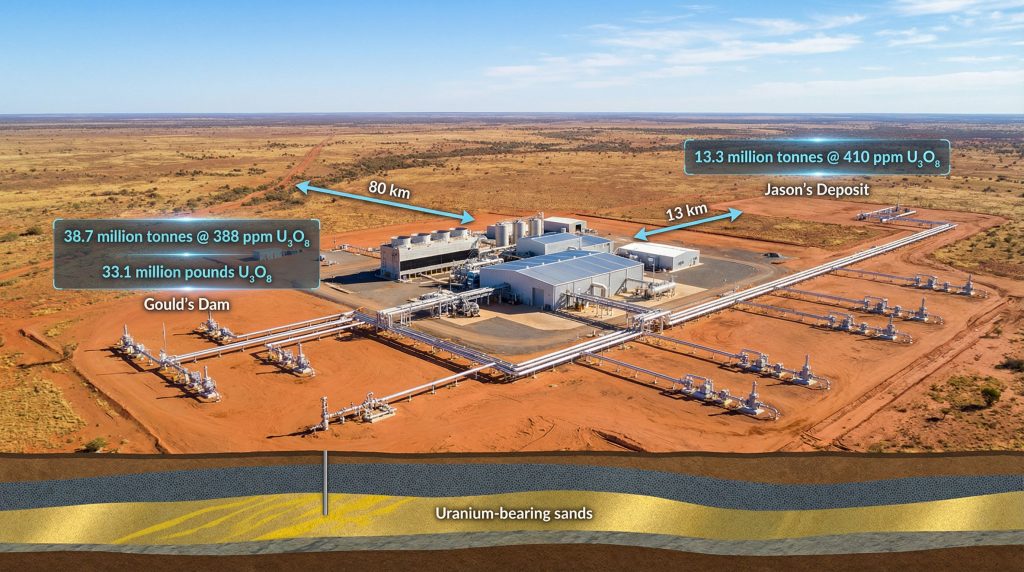
Advanced Paleochannel Systems Drive Strategic Uranium Asset Development
Boss Energy's satellite deposit network demonstrates how geological understanding can transform regional uranium resources into integrated production systems. The Honeymoon project's expansion into satellite operations leverages paleochannel geology across an 80-kilometer radius, creating a distributed extraction network that utilizes centralized processing infrastructure while accessing multiple uranium-bearing formations. Furthermore, developments in US ISR technology continue to influence extraction methodologies globally.
The technical framework underlying this satellite system integrates several critical components:
• Centralized processing hub utilizing existing Honeymoon plant infrastructure
• Distributed extraction network spanning multiple paleochannel systems
• ISR-compatible geology across all satellite locations with proven permeability characteristics
• Shared wellfield technology enabling cost-efficient resource extraction through standardised drilling and completion methods
This integrated approach represents a fundamental shift from traditional single-deposit mining toward regional resource aggregation. Consequently, multiple smaller deposits contribute to sustained long-term production through shared infrastructure investment.
When big ASX news breaks, our subscribers know first
Resource Classification Upgrades Reshape Production Planning Horizons
Gould's Dam Technical Resource Specifications
The updated Gould's Dam resource estimate reveals significant expansion in total contained uranium inventory at Honeymoon satellites, with 38.7 million tonnes at 388 ppm U₃O₈ containing 33.1 million pounds of uranium. This represents a substantial 30% increase in contained metal compared to the previous 2016 assessment, despite a 24% reduction in average grade.
Resource Classification Breakdown:
• Indicated Category: 7.5 million tonnes (19.4% of total resource)
• Inferred Category: 31.2 million tonnes (80.6% of total resource)
• Grade Distribution: Lower average grade offset by expanded resource tonnage
• Geological Configuration: 15+ kilometre mineralised paleochannel corridor
The grade versus tonnage trade-off reflects expanded drilling coverage incorporating lower-grade mineralisation within the paleochannel system. For instance, this expansion pattern is typical when resource models extend beyond previously defined high-grade cores to include perimeter areas with economic uranium concentrations.
Jason's Deposit Operational Integration Parameters
Jason's deposit presents a more compact but higher-confidence resource base, with 13.3 million tonnes at 410 ppm U₃O₈ containing 12.0 million pounds of uranium. The deposit's proximity advantage, located just 13 kilometres from existing Honeymoon operations, positions it as a near-term integration candidate.
Critical Technical Metrics:
• Resource Confidence: 41% Indicated, 59% Inferred classification
• Grade Premium: 410 ppm U₃O₈ exceeds Gould's Dam average
• Infrastructure Synergy: Minimal pipeline and power transmission requirements
• Development Timeline: Potentially accelerated due to proximity factors
The higher indicated resource percentage at Jason's suggests greater geological confidence. Consequently, this likely influences development sequencing decisions within the overall satellite integration strategy.
Wide-Spaced Wellfield Innovation Transforms Extraction Economics
Traditional ISR operations employ closely-spaced wellfield patterns with 5-10 metre intervals between injection and production wells. Wide-spaced wellfield technology represents a paradigm shift toward larger inter-well spacing, potentially 15-30+ metres or greater, fundamentally altering the economics of uranium extraction.
Technical Prerequisites for Wide-Spaced Systems:
• Enhanced Primary Permeability: Reducing dependence on artificial formation stimulation
• Stable pH Buffering Capacity: Preventing uranium precipitation within the formation
• Adequate Uranium Concentration: Compensating for reduced well density through maintained ore grades
• Optimal Hydrogeological Containment: Ensuring controlled fluid circulation patterns
The geological characteristics at both satellite deposits, particularly the highly permeable unconsolidated sands within paleochannel systems, provide potentially favourable conditions for wide-spaced wellfield applications. Moreover, updated uranium resource estimates confirm the technical viability of these systems.
ISR Technology Optimisation Framework
Operational Advantages:
• Reduced Capital Expenditure: Fewer wells required per pound of uranium extracted
• Lower Environmental Footprint: Minimised surface disturbance across extraction areas
• Enhanced Extraction Efficiency: Maximised uranium recovery per individual well
• Simplified Infrastructure: Reduced wellfield complexity and maintenance requirements
Current studies at Honeymoon are evaluating whether wide-spaced wellfield extraction can achieve comparable recovery rates to conventional spacing while delivering significant cost reductions. Success in this technical evaluation could enable substantial resource conversion at both satellite deposits.
Phased Development Timeline Integrates Resource Conversion and Regulatory Pathways
Phase 1: Resource Enhancement and Technical Validation (2026-2027)
The immediate development phase focuses on converting Inferred resources to Indicated classification through additional drilling campaigns planned for the second half of 2026. This resource upgrade process is critical for establishing mineable reserves and supporting mining lease applications.
Key Conversion Targets:
• Gould's Dam: Converting portions of 31.2 million tonnes Inferred resources
• Jason's Deposit: Upgrading classification confidence for 7.9 million tonnes Inferred inventory
• Drilling Programmes: Infill drilling to reduce resource classification uncertainty
• Technical Studies: Feasibility assessments for satellite integration with existing infrastructure
Baseline environmental, groundwater, and radiological studies are progressing in parallel to support subsequent permitting applications. In addition, preliminary technical work establishes engineering parameters for integrated operations.
Phase 2: Regulatory Approval Process (2027-2029)
Regulatory Timeline Framework:
• Application Commencement: Second half of 2026 for state and federal approvals
• Mining Lease Approval: 18-24 months from application submission
• Environmental Protection Programme: Additional 6-12 months for final operational permits
• Total Regulatory Timeline: Approximately 30-36 months from initial application to operational approval
The regulatory pathway encompasses multiple approval layers, including state-level mining lease applications, federal environmental impact assessments, and comprehensive groundwater protection programmes specific to ISR operations. However, developments regarding the US Senate uranium ban demonstrate how regulatory changes can influence global uranium markets.
Phase 3: Infrastructure Development and Production Integration (2029+)
Operational integration involves wellfield development, pipeline installation, and connection to existing Honeymoon processing infrastructure. The distributed extraction network enables gradual production scaling while maintaining operational flexibility across multiple extraction locations.
Production Capacity Expansion Potential:
• Current Licensed Capacity: 36 million pounds U₃O₈ at Honeymoon
• Annual Production Target: 2.45 million pounds U₃O₈
• Combined Satellite Resources: 45.1 million pounds additional inventory
• Potential Licence Expansion: Accommodation of significantly enhanced resource base
Geological Controls Enable Satellite Deposit Economic Viability
Paleochannel Mineralisation Systems
The uranium deposits within the satellite network are hosted in paleochannel systems, ancient river channels now filled with permeable sediments that concentrated uranium-bearing solutions during geological formation. These paleochannel environments provide optimal conditions for ISR extraction due to their inherent permeability characteristics and uranium concentration mechanisms.
Mineralisation Control Factors:
• Structural Continuity: Consistent uranium-bearing horizons across deposit areas
• Permeability Distribution: Natural fluid circulation pathways within unconsolidated sands
• Geochemical Environment: Reducing conditions that concentrated and preserved uranium mineralisation
• Resource Expansion Potential: Open-ended mineralisation for continued exploration growth
The geological continuity between Honeymoon and satellite deposits suggests similar formation processes. Furthermore, this supports the application of operational knowledge gained from existing production to satellite development planning.
Hydrogeological Compatibility Assessment
ISR Suitability Characteristics:
• Aquifer Parameters: Adequate permeability for lixiviant circulation
• Confinement Conditions: Natural barriers preventing off-site fluid migration
• Geochemical Stability: Host rock buffering capacity supporting sustained extraction
• Metallurgical Compatibility: Uranium minerals amenable to existing processing systems
The technical risk assessment indicates favourable hydrogeological conditions across both satellite locations. However, environmental considerations are manageable through established ISR operational protocols.
Combined Resource Inventory Transforms Project Economics and Market Position
Production Capacity and Resource Base Expansion
The integration of satellite deposits creates a substantial expansion in total project resources. The combined satellite inventory of 45.1 million pounds U₃O₈ represents a 433% increase in total project resources when compared to existing licensed capacity.
Economic Value Creation Framework:
• Infrastructure Leverage: Utilisation of existing processing plant, tailings facilities, and administrative systems
• Capital Efficiency: Avoiding duplicative processing infrastructure investment
• Operational Synergies: Shared technical expertise and regulatory frameworks
• Extended Mine Life: Significantly enhanced project longevity supporting long-term investment planning
This resource expansion positions Boss Energy with enhanced uranium supply reliability in a growing market environment. Additionally, uranium market volatility continues to drive demand for secure supply sources, while providing operational flexibility through multiple extraction locations.
Investment Implications and Strategic Value
Market Position Enhancement:
• Supply Security: Long-term uranium production capability supporting contract commitments
• Production Flexibility: Multiple extraction locations enabling operational optimisation
• Resource Growth Potential: Open-ended mineralisation supporting continued exploration investment
• Infrastructure Utilisation: Maximising return on existing processing plant investment
The combined satellite inventory supports potential doubling of licensed production capacity, subject to regulatory approval and successful development of wide-spaced wellfield extraction technology. For those considering uranium investment strategies, these developments represent significant potential for enhanced returns.
The next major ASX story will hit our subscribers first
Environmental Assessment and Regulatory Framework Requirements
Comprehensive Environmental Impact Evaluation
ISR uranium operations require extensive environmental baseline studies to establish pre-mining conditions and demonstrate containment system effectiveness. The regulatory framework encompasses both state and federal approval processes, with specific requirements for groundwater protection and radiological safety management.
Environmental Assessment Components:
• Groundwater Chemistry Characterisation: Baseline water quality and flow patterns
• Radiological Baseline Establishment: Background radiation measurements and dose assessments
• Ecological Impact Studies: Flora and fauna surveys within operational areas
• Surface Water Interaction Assessment: Evaluation of potential impacts on regional water systems
The timeline from baseline study completion to operational commencement typically spans 30-36 months. This reflects the comprehensive nature of environmental impact evaluation for uranium extraction operations, particularly as policies like the NS uranium ban policy demonstrate increased environmental scrutiny.
Regulatory Compliance Timeline
Approval Process Sequencing:
• State Mining Lease Application: Initial regulatory submission with technical and environmental documentation
• Federal Environmental Assessment: Comprehensive impact evaluation and mitigation planning
• Programme for Environment Protection and Rehabilitation: Final operational permit addressing long-term site management
• Stakeholder Consultation: Community engagement and regulatory agency coordination
The regulatory pathway requires coordination between multiple agencies and jurisdictions. Furthermore, approval timelines are influenced by technical complexity, environmental sensitivity, and stakeholder consultation requirements.
Future Exploration and Resource Growth Strategic Planning
Expansion Opportunities and Geological Potential
Both satellite deposits demonstrate open-ended mineralisation, indicating potential for continued resource growth through systematic exploration programmes. The paleochannel systems hosting uranium inventory at Honeymoon satellites extend beyond currently defined deposit boundaries, supporting additional drilling campaigns and resource expansion initiatives.
Exploration Strategy Framework:
• Resource Extension Drilling: Systematic step-out drilling to expand known mineralisation
• Grade Enhancement Programmes: Identification of higher-grade zones within existing resource areas
• New Target Generation: Regional exploration for additional satellite prospects
• Technology Application: Advanced ISR techniques for resource optimisation
The planned H2 2026 drilling programmes represent the initial phase of systematic resource expansion. However, subsequent campaigns depend on geological results and market conditions.
Strategic Development Integration
Phased Development Approach:
• Technical Risk Reduction: Sequential satellite development minimising operational uncertainty
• Market Responsiveness: Flexible production scaling based on uranium demand conditions
• Infrastructure Optimisation: Gradual expansion of extraction network utilising shared processing systems
• Resource Conversion: Systematic upgrade of resource classifications supporting reserve development
The satellite deposit development strategy enables measured expansion of production capacity while maintaining operational flexibility. Consequently, this minimises technical risk through proven ISR technology applications, as detailed in the Honeymoon uranium project documentation.
Investment Disclaimer: This analysis contains forward-looking statements regarding resource development, production timelines, and technical feasibility. Uranium inventory at Honeymoon satellites involves significant technical, regulatory, and market risks. Resource estimates may not convert to economically extractable reserves, and regulatory approvals are subject to government discretion and environmental assessment outcomes. Investors should conduct independent due diligence and consider professional advice before making investment decisions.
Ready to Discover the Next Major Uranium Development?
Discovery Alert's proprietary Discovery IQ model identifies significant ASX mineral discoveries like uranium developments as they're announced, transforming complex geological data into actionable investment insights. Explore Discovery Alert's discoveries page to see how major mineral discoveries have historically delivered substantial returns, then begin your 14-day free trial today to position yourself ahead of the market.