May 24, 2026
The Hidden Architecture of Critical Metals Recycling: Why Process Design Determines Strategic Outcomes
Across the global metals industry, a quiet but consequential divide has emerged between two fundamentally different philosophies of materials recovery. On one side sits pyrometallurgy, the high-temperature discipline that has dominated base and precious metal processing for over a century. On the other, hydrometallurgy offers an alternative built around aqueous chemistry, sealed systems, and tightly integrated process stages. The distinction is not merely technical. When applied to platinum group metals, the choice of processing architecture shapes everything from emissions profiles to working capital requirements to geopolitical supply chain exposure. Understanding why that matters, particularly in the context of the Lifezone Hydromet PGM recycling pilot, requires a close look at what conventional processing actually does, and what it structurally cannot avoid doing.
When big ASX news breaks, our subscribers know first
Why Conventional PGM Recycling Creates Structural Vulnerabilities
The Pyrometallurgical Processing Chain and Its Embedded Costs
Recovering platinum, palladium, and rhodium from spent automotive catalytic converters using traditional methods involves subjecting feedstock to temperatures exceeding 1,000 degrees Celsius in open-vessel smelting furnaces. This thermal intensity is not incidental but thermodynamically necessary: the high heat drives the chemical reactions that liberate PGMs from the ceramic substrate and concentrate them into a metal-rich phase for subsequent refining.
The consequence of this architecture is a set of embedded cost and emissions characteristics that cannot be engineered away without changing the fundamental process. Sulfur compounds present in the feedstock oxidise under high-temperature conditions and are vented as sulfur dioxide gas. Abatement systems can capture a portion of this output, but SO₂ generation is an intrinsic outcome of the open-vessel, high-temperature environment rather than a secondary effect that can be eliminated at source.
Energy intensity is similarly structural: maintaining furnace temperatures above 1,000 degrees Celsius across extended processing periods requires substantial thermal input regardless of operational efficiency improvements at the margin. Furthermore, the multi-stage nature of conventional processing also has a financial dimension that is often underappreciated. Platinum, palladium, and rhodium move through discrete smelting, converting, and refining stages across extended timeframes, during which significant quantities of high-value metal remain locked within the production system. Given that rhodium alone has historically traded at prices exceeding many times those of gold, the working capital tied up in an extended processing pipeline represents a material financial burden.
The US Import Dependency Problem
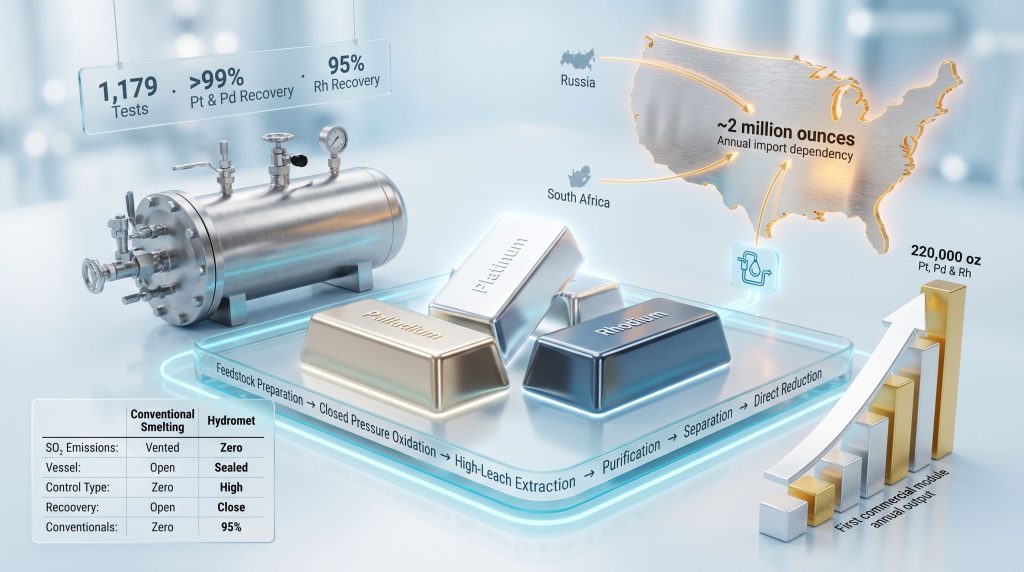
The structural limitations of conventional processing matter in a US context because domestic PGM refining capacity is minimal relative to consumption. The United States imports approximately 2 million ounces of PGMs annually, with Russia and South Africa serving as the dominant sources of supply. This geographic concentration creates a supply chain vulnerability that has become increasingly visible as policymakers reassess the energy security implications of critical minerals import dependency.
The US Geological Survey's 2025 draft critical minerals list places rhodium within the highest supply chain risk category, a classification that reflects both the metal's industrial irreplaceability in autocatalyst applications and the near-total absence of domestic primary production. Against this backdrop, and with US critical minerals policy increasingly prioritising domestic processing capacity, the development of a domestic hydrometallurgical recycling route that can extract PGMs from US-sourced feedstock takes on significance beyond its immediate commercial context.
What the Lifezone Hydromet Technology Actually Does
Closed Pressure Oxidation as a Foundational Design Choice
The Lifezone Hydromet PGM recycling pilot is built around a pressure oxidation vessel whose defining characteristic is that it operates as a completely closed system. Where conventional smelting applies open-vessel high-temperature combustion, the Hydromet approach applies elevated temperature and pressure within a sealed environment. The distinction between open and closed vessel is not merely a technical detail but the architectural decision from which all of the process's claimed advantages flow.
Closed pressure oxidation is not a novel concept in metallurgy. The technology has an extensive track record in refractory gold ore processing, where sealed pressure vessels are used to oxidise sulfide minerals and liberate gold prior to cyanide leaching. What is novel in the Lifezone application is the extension and integration of this approach into a full PGM-specific flowsheet that proceeds from sealed oxidation through to refined metallic product without the open-vessel high-temperature stages that characterise conventional smelting routes. For a detailed breakdown of the underlying science, Lifezone's hydromet technology has been examined in depth by industry analysts.
The Six-Stage Flowsheet: A Step-by-Step Breakdown
The Hydromet flowsheet for PGM recovery from spent autocatalytic converters follows a sequential, integrated pathway:
- Feedstock Preparation – Spent US-sourced autocatalytic converter monolith material is processed and sized for input into the pressure vessel
- Closed Pressure Oxidation – Material enters a sealed pressure vessel operating at elevated temperature and pressure, with the closed architecture structurally preventing atmospheric venting of process gases
- High-Leach Extraction – PGMs are mobilised into aqueous solution through targeted leaching chemistry, separating them from the silicate and ceramic matrix of the spent catalyst substrate
- Purification Stages – Sequential purification steps remove base metal contaminants and gangue elements from the PGM-bearing solution, progressively concentrating the target metals
- Separation Steps – Individual platinum, palladium, and rhodium streams are isolated from each other, enabling separate collection of each metal
- Direct Reduction – Refined metallic products are precipitated from solution, yielding platinum, palladium, and rhodium in solid form
The sequential integration of these six stages into a single flowsheet is the architectural feature from which Lifezone derives both its pipeline compression advantage and its emissions profile. Rather than moving material between discrete facilities or processing units across extended timeframes, the integrated flowsheet compresses the in-process period and thereby reduces the quantity of high-value metal locked within the production system at any given time.
Why Zero SO₂ Is a Design Property, Not an Abatement Achievement
The zero sulfur dioxide emissions claim associated with the Hydromet process is frequently mischaracterised as an environmental management feature. It is more precisely described as a structural consequence of the closed-vessel architecture.
In a sealed pressure oxidation system, sulfur compounds generated during the oxidation of sulfide-bearing feedstock remain contained within the aqueous process environment. Because there is no atmospheric vent through which gas-phase sulfur compounds can escape, SO₂ generation at the point of atmospheric release is architecturally impossible. This is categorically different from installing downstream gas scrubbing equipment to treat SO₂ after it has been generated: the sealed system prevents atmospheric release as a matter of design rather than achieving it through secondary treatment.
This distinction has practical significance for facility siting, regulatory permitting, and community acceptance, all of which become more tractable when the fundamental process chemistry does not generate atmospheric SO₂ rather than when it generates and then treats it. In addition, the broader mining decarbonisation benefits of such architectural choices are increasingly recognised across the industry.
Inside the 24-Month Pilot: What 1,179 Tests Confirmed and What They Did Not
Programme Structure and Testing Parameters
| Parameter | Detail |
|---|---|
| Testing Location | Simulus Laboratories, Perth, Australia |
| Programme Duration | 24 months |
| Total Tests Conducted | 1,179 locked-cycle and pilot batch tests |
| Feedstock Volume | 1 tonne of US-sourced spent autocatalytic converter material |
| Pilot Completion | Q1 2026 |
| First Refined Output | Platinum, palladium, and rhodium metal samples |
The scale and duration of the test programme is notable. At 1,179 individual tests, the campaign provides a substantial dataset for understanding how the flowsheet performs across varying conditions and feedstock compositions. Locked-cycle testing, in which intermediate streams are recycled through multiple process passes to simulate continuous operation, is a methodologically rigorous approach to demonstrating performance in conditions that approximate commercial operation more closely than single-pass batch tests.
Recovery and Purity Results: The Numbers in Full
| Metal | Recovery Rate Achieved | Stage 1 Purity Achieved | Target Commercial Purity |
|---|---|---|---|
| Platinum | >99% | >99% | >99.95% |
| Palladium | >99% | >99% | >99.95% |
| Rhodium | 95% | Not specified | >99.9% |
Recovery rates exceeding 99% for platinum and palladium represent a technically significant outcome. In PGM recycling, recovery rate refers to the proportion of the target metal in the feedstock that is successfully extracted and collected as product. Losses occur through residual metal remaining in the processed substrate, entrainment in waste streams, and process inefficiencies. A greater than 99% recovery rate means fewer than 1% of the platinum and palladium atoms present in the input material are lost to waste, a result that would be commercially competitive with established smelting operations.
The rhodium result of 95% recovery is lower but contextually significant. Rhodium is chemically distinct from platinum and palladium, exhibiting different leaching chemistry and solubility behaviour, and its recovery optimisation typically requires different process conditions. A 95% rhodium recovery at pilot stage represents a meaningful starting point given the metal's extreme rarity and high unit value.
The Purity Gap: The Most Important Outstanding Proof Point
The most consequential unresolved issue from the pilot campaign is not recovery but purity. Stage 1 purities exceeding 99% for platinum and palladium fall short of the commercial product specifications of greater than 99.95% for both metals and greater than 99.9% for rhodium. The gap between pilot purity and commercial specification, while appearing narrow in percentage terms, represents a meaningful engineering challenge. High-purity PGM products are sold to exacting industrial customers, including automotive manufacturers, electronics producers, and laboratory materials suppliers, for whom impurity levels at the parts-per-million scale can materially affect product performance.
What the pilot confirmed:
- Mechanical feasibility of the complete Hydromet flowsheet applied to US-sourced autocat feedstock
- High-recovery extraction of all three primary PGMs at pilot scale
- Flowsheet lock-down sufficient to inform commercial plant design criteria
- First-ever production of refined platinum, palladium, and rhodium from US autocats using hydrometallurgical processing
What remains unresolved ahead of commercial deployment:
- Purity optimisation to meet commercial product specifications above 99.95% Pt/Pd and above 99.9% Rh
- Confirmation of recovery and purity performance at commercial-scale throughput
- Validation of capital and operating cost estimates against actual commercial plant performance
An important methodological nuance: the peak recovery figures cited, including the greater than 99% platinum and palladium performance, are referenced to specific test conditions including test number 0172. Whether these peak results represent typical performance across the full 1,179-test dataset or reflect optimised conditions is a distinction with real informational value for assessing commercial readiness. The distribution of results across the full test programme would provide a more complete picture of expected commercial performance than peak figures alone.
Technology Comparison: Hydromet vs. Conventional Smelting
| Dimension | Conventional Pyrometallurgical Smelting | Lifezone Hydromet Technology |
|---|---|---|
| Vessel Type | Open vessel | Sealed pressure oxidation vessel |
| Operating Temperature | Above 1,000°C | Elevated temperature/pressure (optimisation ongoing) |
| SO₂ Emissions | Generated and vented | Structurally eliminated by closed architecture |
| CO₂ per Tonne of Metal | Higher (directional) | Lower (directional; no quantified differential provided) |
| Primary Energy Requirement | Higher | Lower (directional; no baseline figure provided) |
| Pipeline Length | Multi-stage, extended timeframe | Compressed single-flowsheet integration |
| Working Capital Impact | Higher (metal locked in extended pipeline) | Lower (shortened in-process period) |
| Scale-Up Precedent | Extensively established | Pressure oxidation unit proven; full PGM flowsheet at commercial scale unconfirmed |
One important caveat applies to the environmental comparisons in the table above. The characterisations of energy consumption and carbon dioxide intensity as lower for the Hydromet route are directional rather than quantified in currently available materials. No specific carbon differential or smelting energy consumption baseline figure has been publicly disclosed. Investors and technical evaluators should treat environmental advantage claims as indicative pending completion of a full lifecycle analysis at commercial throughput.
The Glencore Partnership: Reading the Capital Structure
What the Investment Structure Signals
Glencore's recycling strategy in the Lifezone US PGM recycling project is structured in two layers that carry different informational weight:
- Equity position: $1.5 million invested for a 6% equity stake in the US PGM recycling project
- Capital option: An active option to fund 50% of total project capital expenditure
- Marketing role: Glencore holds a marketing function for refined PGM output from the facility
The equity investment of $1.5 million is modest in absolute terms for an organisation of Glencore's scale. Its strategic significance lies less in the capital quantum than in what it establishes: a contractual framework that defines Glencore's relationship with the project and sets the terms of its potential deeper involvement. The option to fund 50% of capital expenditure is the structurally more consequential element.
Why the Unexercised Option Matters More Than the Equity Stake
The option structure creates a defined decision point at which Glencore will either commit to funding half of the commercial plant's capital requirements or decline to do so. That decision, anticipated around the time of the financial investment decision targeted for Q2 2026, will serve as an independent commercial viability signal from one of the world's most sophisticated commodity trading and processing organisations.
Glencore's assessment of the Hydromet flowsheet's commercial viability is arguably more informative than the pilot results themselves for certain categories of investor analysis. The company has extensive experience in PGM processing and trading, has access to independent technical evaluation capabilities, and has reputational and financial incentives to exercise rigorous diligence before committing capital at scale. An affirmative option exercise would therefore represent meaningful third-party validation of the technology and commercial model. A decision not to exercise would carry the opposite implication and should be interpreted accordingly.
The next major ASX story will hit our subscribers first
The US Domestic PGM Supply Landscape
Quantifying the Import Gap
| Metric | Data Point |
|---|---|
| Annual US PGM Import Volume | ~2 million ounces |
| Primary Import Origins | Russia, South Africa |
| Rhodium Classification (USGS 2025 Draft) | Highest supply chain risk category |
| US Primary PGM Mining Capacity | One significant producing mine |
| Planned First Module Annual Output | 220,000 oz Pt, Pd, and Rh combined |
| Planned Rhodium Output vs. Domestic Primary Mine | More than 5x the annual output of the US's only producing primary PGM mine |
The rhodium dimension of this supply picture warrants particular attention. Rhodium has no practical substitutes in three-way automotive catalytic converters, where it performs the chemical function of converting nitrogen oxides to harmless nitrogen and oxygen. Its supply base is extraordinarily narrow: the Bushveld Igneous Complex in South Africa accounts for the dominant share of global primary production, with Russia contributing most of the remainder. The US has no meaningful primary rhodium production.
The USGS critical minerals classification for rhodium reflects this supply concentration combined with the metal's industrial irreplaceability. Furthermore, the surge in critical minerals demand driven by the energy transition has only intensified these supply pressures. A domestic facility capable of recovering rhodium from US-sourced spent catalytic converters would represent a genuinely novel addition to US critical metals supply capacity, not merely a marginal improvement to an existing supply chain.
The Closed-Loop Supply Chain Concept and Its Industrial Logic
The strategic ambition behind the Lifezone project is to vertically integrate the entire scrappage-to-metal process chain within US borders, a model the company describes as a closed-loop, traceable, and responsibly sourced critical metals solution. This concept addresses a structural feature of conventional PGM recycling that is often overlooked: under current arrangements, US-sourced spent autocatalysts are frequently exported to offshore smelting operations in South Africa or Europe for processing, meaning that domestic feedstock generates refined metal that must then be re-imported.
A fully domestic processing chain would consequently eliminate this offshore processing dependency and associated logistical complexity, while also enabling chain-of-custody traceability that increasingly matters to industrial customers with sustainability commitments and supply chain disclosure obligations.
Section 45X and the Domestic Manufacturing Policy Context
The Section 45X Advanced Manufacturing Production Credit under US tax legislation creates financial incentives for domestically produced critical minerals components. The extent to which refined PGMs produced through the Hydromet process qualify under this framework and the magnitude of any benefit remain subject to regulatory interpretation and have not been quantified in publicly available project materials. Investors should treat any policy-related financial benefit as contingent on regulatory confirmation rather than as a guaranteed component of project economics.
From Pilot to Commercial Plant: The Path to Financial Investment Decision
Commercial Module Parameters and Capital Structure
| Module Parameter | Projected Specification |
|---|---|
| Planned Annual Output | 220,000 oz PGMs (Pt, Pd, Rh combined) |
| Feedstock Source | US-sourced spent autocatalytic converters |
| Refining Location | United States (domestic supply chain) |
| Phase 1 Pilot Cost | ~$3 million (Perth, Australia) |
| Phase 2 Commercial Capex Estimate | ~$15-20 million |
| FID Target | Q2 2026 |
Key Risk Factors Between Now and First Production
The distance between a completed pilot campaign and a producing commercial facility involves several discrete risk categories that investors should evaluate independently rather than treating as a unified probability:
- Purity optimisation risk: Achieving commercial-grade specifications above 99.95% for platinum and palladium and above 99.9% for rhodium is unresolved
- Scale-up risk: The full PGM-specific Hydromet flowsheet has not been validated at commercial throughput, despite the pressure oxidation unit operation having established precedent in gold processing
- Capital cost estimation risk: Variance between feasibility-stage cost estimates and actual construction and commissioning costs is a documented pattern in hydrometallurgical plant development
- Regulatory and permitting risk: Timeline uncertainty for approvals applicable to a new US processing facility
- Commodity price exposure: Revenue projections are sensitive to platinum, palladium, and rhodium price movements across all three metals simultaneously
- Partner option exercise: Glencore's capital option exercise or non-exercise will materially affect the project's financing structure and implied commercial viability assessment
Scale-up risk deserves specific attention because the parallel drawn to pressure oxidation's track record in gold processing is technically valid but incomplete. The pressure oxidation unit operation itself has an established precedent in commercial gold processing facilities globally. However, the full Hydromet flowsheet — which combines sealed pressure oxidation with PGM-specific high-leach extraction, multi-stage purification, selective separation of three distinct PGMs, and direct reduction to refined metal — has not been validated at commercial throughput. Each additional process stage introduced beyond the pressure oxidation vessel represents an incremental scale-up challenge that the gold processing analogy does not fully address. Industry observers have noted that Lifezone's first refined metals milestone nonetheless marks a significant step forward in demonstrating the technology's real-world applicability.
The Three Milestones That Define the Next Twelve Months
Milestone 1: Board FID Decision and Its Technical Basis
The Q2 2026 FID target is the most proximate near-term catalyst for the project. Whether the board approves proceeding to construction, defers pending additional technical work, or conditions approval on specific proof points will indicate management's internal assessment of how completely the pilot data supports commercial plant design criteria. The technical basis on which any positive FID rests, particularly in light of the outstanding purity optimisation, will be closely watched.
Milestone 2: Purity Optimisation Results
Achieving platinum and palladium purities above 99.95% and rhodium purity above 99.9% is necessary to access the full range of commercial PGM customers and product markets. Progress toward these targets in the period between pilot completion and commercial plant commissioning represents the most technically significant outstanding proof point and carries the highest information value for assessing commercial readiness.
Milestone 3: Glencore's Capital Option Exercise Decision
As discussed, Glencore's determination on its 50% capital option will function as an independent commercial viability signal from a sophisticated and well-resourced industry participant. Timing of that decision relative to the FID, and the conditions attached to any exercise, will provide material information about how the project's economics are being assessed by a party with both the technical expertise and the financial incentive to evaluate them rigorously.
This article contains forward-looking statements and projections based on information available at the time of writing. Recovery rates, purity figures, capital cost estimates, and output projections referenced herein are subject to change as engineering, feasibility, and optimisation work progresses. This content is informational in nature and does not constitute financial, investment, or professional advice. Past performance of comparable technologies does not guarantee future results. Readers should conduct their own due diligence before making any investment decisions.
Want to Stay Ahead of the Next Major Critical Minerals Discovery?
Discovery Alert's proprietary Discovery IQ model delivers real-time alerts the moment significant ASX mineral discoveries are announced, transforming complex data across more than 30 commodities into clear, actionable insights for investors at every level — begin your 14-day free trial today and explore how historic discoveries have generated substantial returns for those who positioned themselves early.