May 23, 2026
The Catalyst Revolution: How PGM Scarcity Is Transforming Global Energy Manufacturing
The global energy transition hinges on technologies that require some of the rarest metals on Earth. As hydrogen emerges as a cornerstone of decarbonisation strategies, the critical bottleneck isn't engineering prowess or market demand but access to platinum group metals (PGMs) that make these systems function. This scarcity dynamic is reshaping where advanced energy technologies get manufactured, creating entirely new industrial ecosystems around mineral-rich regions that control these essential resources. The South Africa platinum hydrogen technology sector exemplifies this transformation, demonstrating how resource advantages can drive industrial evolution.
Understanding this shift requires examining how electrochemical processes work at the molecular level. Proton exchange membrane electrolysers rely on platinum-based catalysts to split water molecules efficiently, while fuel cells use these same metals to recombine hydrogen and oxygen into electricity. Without adequate PGM supply chains, the ambitious gigawatt-scale hydrogen projects planned globally face fundamental material constraints that no amount of capital can easily overcome.
When big ASX news breaks, our subscribers know first
How PGM Dominance Creates Manufacturing Imperatives
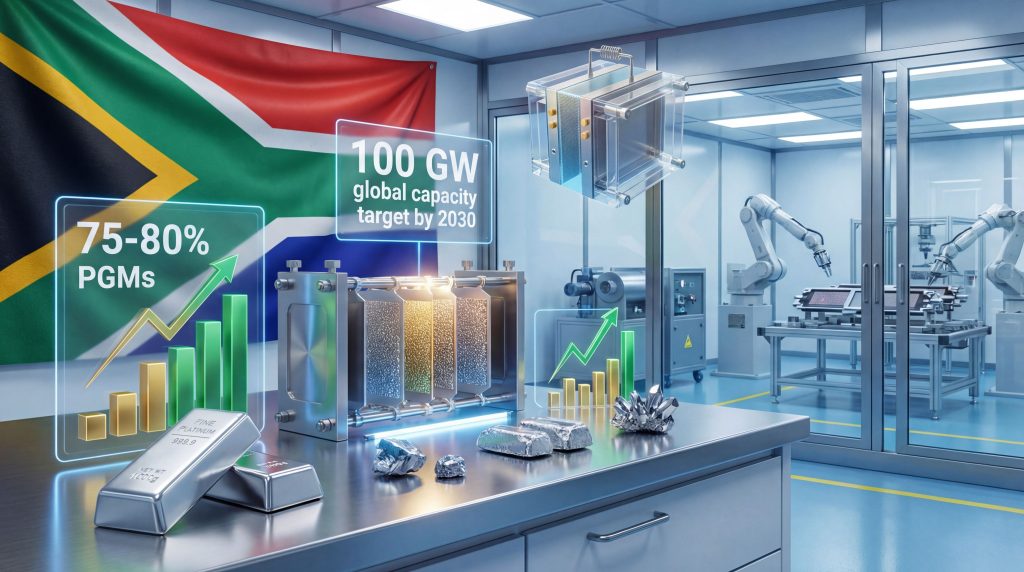
South Africa's control over approximately 75-80% of global platinum group metal reserves positions the nation as an unavoidable partner in hydrogen technology development. These reserves include not just platinum, but critical companion metals like iridium and ruthenium that serve specialised roles in advanced electrolyser systems. The concentration of these resources in South African geological formations creates unique opportunities for domestic value addition that extend far beyond traditional mining operations.
Furthermore, the critical minerals energy transition demonstrates how resource control shapes technological development pathways. This strategic positioning becomes particularly significant as global hydrogen deployment accelerates and PGM demand intensifies across multiple industrial applications.
Table: Critical PGM Functions in Hydrogen Technologies
| Metal | Primary Application | Technical Function | Supply Criticality |
|---|---|---|---|
| Platinum | PEM Fuel Cells | Oxygen reduction catalyst | High |
| Iridium | Water Electrolysis | Oxygen evolution catalyst | Extreme |
| Ruthenium | Advanced Electrolysers | Corrosion-resistant catalyst | Very High |
| Palladium | Hydrogen Purification | Selective membrane component | Moderate |
The strategic implications extend beyond raw material access. Recent partnerships demonstrate how South African companies are leveraging this resource advantage to capture higher-value segments of the hydrogen technology value chain. When ET Energies of the United States signed a memorandum of understanding with Isondo Precious Metals, the collaboration represented more than technology transfer – it established a framework for domestic manufacturing of components that previously required complex international supply chains.
Vinay Somera, CEO of Isondo Precious Metals, emphasised the strategic nature of this positioning: "South Africa holds the world's largest reserves of platinum group metals, which are essential to many hydrogen technologies." This resource advantage becomes particularly significant as global South Africa platinum hydrogen technology initiatives expand.
Why Vertical Integration Transforms Economic Outcomes
The evolution from raw PGM exports to integrated manufacturing represents a fundamental shift in industrial strategy. Traditional mining operations focus on extracting and refining metals for export, capturing relatively modest margins compared to finished technology products. However, the technical complexity of hydrogen technologies creates opportunities for mineral-rich regions to participate in much higher-value manufacturing processes.
Moreover, the mining sustainability transformation aligns with these vertical integration strategies, creating multiple benefits:
- Enhanced supply security through domestic control of critical materials
- Improved cost competitiveness by eliminating multiple intermediary margins
- Technology development capabilities that attract international partnerships
- Circular economy advantages through closed-loop PGM recovery systems
- Export diversification into high-tech manufactured components
Isondo Precious Metals exemplifies this integrated approach through its expansion into multiple value chain segments. The company is developing capabilities spanning catalyst precursor production, catalyst synthesis for PEM electrolysis, membrane electrode assembly fabrication, electrochemical characterisation, and crucially, recycling of spent catalysts and MEAs for PGM recovery and refining.
This comprehensive approach addresses one of the fundamental challenges in hydrogen technology deployment: the high cost and supply risk associated with PGM catalysts. By establishing closed-loop recovery pathways, manufacturers can significantly reduce their dependence on primary PGM mining while improving the economic viability of their systems.
"The circular economy model for PGMs in hydrogen applications can potentially reduce lifecycle costs by 30-40% while enhancing supply security, making it a critical factor in commercial scalability."
The Technical Architecture of Advanced Electrolyser Systems
Understanding the manufacturing implications requires examining the technical complexity of modern PEM electrolyser stacks. These systems integrate multiple specialised components, each requiring precise engineering and high-quality materials. ET Energies has developed a commercial platform incorporating proprietary bipolar plates, compression architecture, cooling systems, and seal technologies that demonstrate the sophisticated engineering required for competitive performance.
Core System Components:
- Bipolar plates – Conductive separators that distribute reactants and collect current
- Membrane electrode assemblies – Heart of the electrochemical process
- Compression systems – Maintain optimal contact pressure across stack layers
- Thermal management – Remove heat generated during high-current operation
- Sealing technologies – Prevent reactant crossover and maintain system integrity
The integration of South African PGM processing capabilities with this advanced engineering creates development pathways that would be difficult to replicate in regions without domestic access to critical materials. Derek Lubie, CEO of ET Energies, described the strategic value: "By combining advanced stack engineering with domestic materials innovation and testing capabilities, we are positioning our technology to scale from prototype to commercial electrolyser systems while contributing to South Africa's hydrogen industrialisation strategy."
Manufacturing Infrastructure Development
The technical requirements for PEM electrolyser manufacturing exceed those of many traditional industrial processes. Isondo Precious Metals has established automotive-standard clean-room assembly facilities and electrochemical testing infrastructure at the OR Tambo Industrial Development Zone, east of Johannesburg. These facilities enable the precise assembly and validation required for high-performance electrolyser components.
In addition, the industry evolution trends indicate that manufacturing capabilities must address:
- Clean-room environments for contamination-free assembly
- Electrochemical testing systems for performance validation
- Catalyst synthesis equipment for PGM-based component production
- Quality control systems meeting automotive industry standards
- PGM recovery facilities for circular economy implementation
How Circular Economy Models Address Supply Constraints
The high value and limited supply of PGMs make circular economy approaches essential for sustainable hydrogen technology deployment. Traditional linear models, where catalysts are used until degraded and then disposed of, create unsustainable cost structures and supply vulnerabilities. Consequently, circular approaches can fundamentally alter the economics of hydrogen systems while reducing environmental impacts.
Furthermore, implementing mining waste management solutions becomes crucial in this context. The circular economy implementation follows these stages:
Stage 1: Collection and Sorting
- Systematic collection of spent MEAs and catalyst components
- Sorting by PGM content and contamination levels
- Initial processing to concentrate valuable materials
Stage 2: Recovery and Refining
- Chemical processing to extract PGMs from used components
- Refining to restore metals to specification-grade purity
- Quality testing to ensure performance equivalency
Stage 3: Remanufacturing
- Integration of recovered PGMs into new catalyst formulations
- Production of recycled MEAs with performance validation
- System-level testing to confirm operational capabilities
The partnership between ET Energies and Isondo specifically addresses these circular economy requirements. As Somera noted: "By establishing closed-loop recovery pathways for PGMs, the collaboration promotes a circular economy model for hydrogen technologies, improving supply security, reducing lifecycle costs, and strengthening the long-term sustainability of electrolyser manufacturing."
The next major ASX story will hit our subscribers first
Strategic Alignment with National Industrial Policy
South Africa's Hydrogen Society Roadmap emphasises industrialisation, localisation of hydrogen technologies, and value addition to critical mineral resources. This policy framework creates supportive conditions for the type of integrated manufacturing being developed through international partnerships. However, the success of these initiatives depends on execution rather than policy declarations alone.
The Department of Science and Technology Innovation has highlighted the importance of technology localisation in its hydrogen strategy. Policy Implementation Areas include:
- Industrial zone development with specialised infrastructure
- Skills development programmes for advanced manufacturing technologies
- Research and development funding for technology innovation
- Export promotion support for manufactured hydrogen components
- Regulatory frameworks supporting new industrial activities
The timing of these developments coincides with broader industry recognition of hydrogen's growth potential. Valterra Platinum, one of South Africa's major PGM producers, stated in its 2025 annual report that "the hydrogen economy is set to be a broad demand sector with strong growth, despite some short-term challenges, as global policy becomes more supportive."
Technology Maturation and Commercial Pathways
The progression from laboratory development to commercial deployment follows predictable phases, each with distinct technical and commercial milestones. Current activities focus on integrating advanced catalyst-coated membranes and MEAs optimised for specific electrolyser platforms, including structured break-in procedures and long-duration durability testing to generate field-relevant performance data.
Development Phase Timeline:
Phase 1: Stack Integration (Current Focus)
- Advanced catalyst-coated membrane development
- MEA optimisation for platform-specific requirements
- Structured break-in procedure validation
- Long-duration durability testing protocols
Phase 2: Pilot Deployment (12-24 months)
- Field-relevant performance data generation
- Supply chain validation for key components
- Customer validation in target applications
- Cost optimisation through initial scale production
Phase 3: Commercial Manufacturing (24-48 months)
- Full electrolyser system integration
- Industrial-scale production capabilities
- Global supply partnerships establishment
- International market penetration strategies
The collaboration creates development pathways that can scale from stack-level validation toward fully integrated electrolyser systems, enabling broader industrial deployment while maintaining domestic control over critical material inputs. Additionally, mine reclamation innovation supports sustainable manufacturing approaches throughout the technology lifecycle.
Investment Implications and Market Opportunities
The convergence of South Africa's PGM advantages with global hydrogen demand creates multiple investment themes spanning infrastructure development, technology manufacturing, and circular economy implementation. These opportunities exist across different risk profiles and time horizons, offering various entry points for capital deployment.
Investment Category Analysis:
Infrastructure Development
- Risk Level: Medium
- Capital Requirements: High
- Time Horizon: 3-5 years
- Key Success Factors: Stable policy environment, skilled workforce availability
Component Manufacturing
- Risk Level: High
- Return Potential: Very High
- Time Horizon: 5-7 years
- Key Success Factors: Technology partnerships, market demand growth
Recycling Technology
- Risk Level: Low to Medium
- Return Potential: Stable Medium Returns
- Time Horizon: 2-4 years
- Key Success Factors: Regulatory support, feedstock availability
The partnership approach being demonstrated reduces individual company risks while accelerating technology development through shared expertise and resources. This collaborative model may become increasingly important as the technical complexity and capital requirements of South Africa platinum hydrogen technology continue to increase.
What Are the Main Implementation Challenges?
Despite significant opportunities, several implementation challenges require strategic attention to ensure successful outcomes. These range from technical and operational issues to broader systemic risks that could affect the entire sector's development trajectory.
Water Resource Management
- Challenge: PEM electrolysers require high-purity water inputs
- Mitigation: Water recycling systems, alternative purification technologies
- Strategic Focus: Integration with existing water infrastructure
Skills Development Requirements
- Challenge: Limited local expertise in advanced electrochemical manufacturing
- Mitigation: International training partnerships, university collaboration programmes
- Strategic Focus: Building sustainable local capability rather than dependence on imported expertise
Global Competition Intensity
- Challenge: Established hydrogen technology centres in Europe, Asia, and North America
- Mitigation: Focus on PGM-specific advantages, cost competitiveness strategies
- Strategic Focus: Leveraging unique resource advantages rather than competing on established technologies alone
Infrastructure Investment Needs
- Challenge: Substantial capital requirements for world-class manufacturing facilities
- Mitigation: Phased development approaches, public-private partnerships
- Strategic Focus: Efficient capital deployment through strategic partnerships
Future Implications for Global Supply Chains
The success of South Africa platinum hydrogen technology manufacturing initiatives could fundamentally alter global supply chain structures for clean energy systems. Currently, most advanced energy technologies are manufactured in regions with limited access to critical materials, creating complex and potentially vulnerable supply networks.
Supply Chain Evolution Factors:
- Reduced transportation costs for raw materials through local processing
- Enhanced supply security through integration of mining and manufacturing
- Improved responsiveness to market demand fluctuations
- Lower inventory requirements due to shorter supply chains
- Reduced geopolitical risks through supply diversification
The broader implications extend beyond hydrogen technologies to other clean energy systems requiring PGMs, including fuel cells for transportation applications and specialised catalysts for chemical processes. Success in hydrogen could establish South Africa as a preferred location for a broader range of PGM-intensive manufacturing activities.
This transformation represents more than industrial policy success – it demonstrates how countries with critical mineral endowments can capture greater value from their resources while contributing to global sustainability objectives. The integration of international technical expertise with domestic material advantages creates competitive positions that would be difficult for other regions to replicate without similar resource access.
The ultimate success of these initiatives will depend on continued investment in technical capabilities, maintenance of competitive cost structures, and development of the skilled workforce required for advanced manufacturing operations. However, the fundamental resource advantages provide a strong foundation for sustainable competitive positioning in the evolving global hydrogen economy.
This analysis is based on publicly available information and industry sources. Investment decisions should consider additional factors including regulatory changes, technology developments, and market conditions. The hydrogen economy remains in early development phases, and actual outcomes may vary significantly from current projections.
Looking to Capitalise on Critical Metals in the Energy Transition?
Discovery Alert's proprietary Discovery IQ model delivers real-time notifications on significant ASX mineral discoveries, instantly identifying actionable opportunities in platinum group metals, rare earths, and other critical minerals driving the global energy transformation. Begin your 14-day free trial today to position yourself ahead of the market as resource-rich companies capture higher-value manufacturing opportunities in hydrogen technologies and clean energy systems.