May 24, 2026
Pilbara Production Excellence Drives Mining Sector Leadership
Global iron ore markets face unprecedented demand volatility as infrastructure development accelerates across emerging economies while established steel-producing nations navigate energy transition challenges. Within this complex operational environment, mining companies must balance production optimization with supply chain resilience to maintain competitive positioning. The intersection of operational excellence, technological advancement, and strategic portfolio diversification increasingly determines which organizations emerge as industry leaders during periods of commodity price uncertainty.
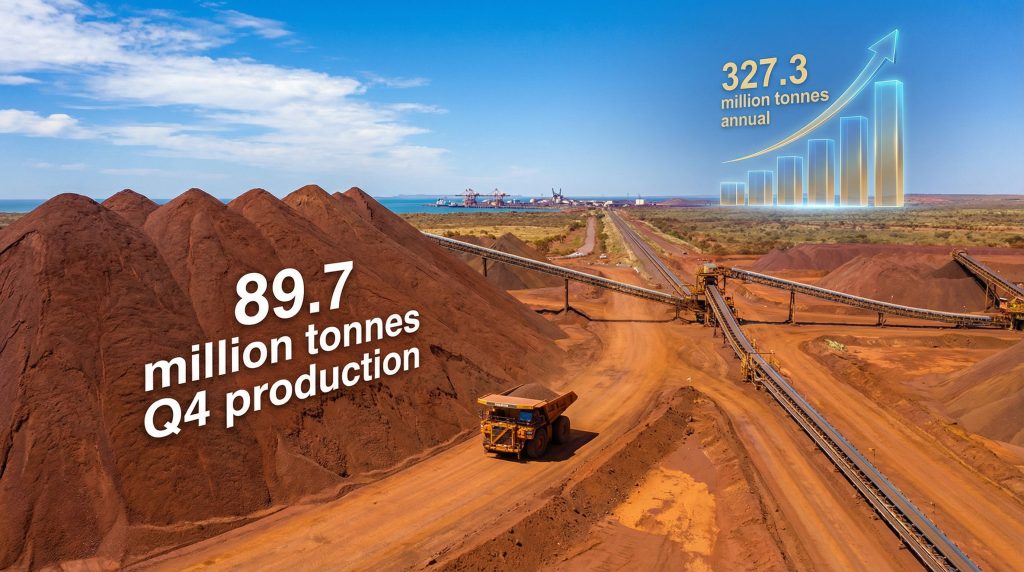
Rio Tinto's fourth quarter 2025 performance demonstrates how systematic operational improvements can generate record production levels while simultaneously expanding into critical minerals markets essential for global energy transition. The company's achievement of 89.7 million tonnes of quarterly iron ore production represents not merely incremental growth, but evidence of comprehensive infrastructure optimization across one of the world's largest integrated mining operations. Furthermore, this rio tinto record q4 iron ore output establishes new benchmarks for operational excellence within the global mining sector.
When big ASX news breaks, our subscribers know first
What Drove Rio Tinto's Record-Breaking Q4 Iron ore Performance?
Pilbara Operations Reach Historic Production Milestones
Rio Tinto's Pilbara operations established a new quarterly production benchmark with 89.7 million tonnes of iron ore extracted during the fourth quarter of 2025, reflecting 4 percent year-over-year growth compared to the same period in 2024. This quarterly achievement translates to an annualized production run rate approaching 360 million tonnes, positioning the integrated Pilbara mining complex among the world's most productive single-region iron ore operations.
The magnitude of this production milestone becomes evident when compared to full-year 2025 output of 336.6 million tonnes. The differential between the Q4-derived annual run rate and actual full-year production reveals approximately 23.4 million tonnes of production capacity that remained underutilized during the first three quarters of 2025, primarily due to extreme weather disruptions affecting Western Australia's mining regions.
Key Production Metrics Q4 2025:
| Metric | Q4 2025 Performance | Year-over-Year Change |
|---|---|---|
| Quarterly Production | 89.7 million tonnes | +4% |
| Annualized Run Rate | ~360 million tonnes | N/A |
| Full Year 2025 Total | 336.6 million tonnes | Lower end of guidance |
The technical complexity of achieving sustained production at this scale involves coordinating multiple integrated systems: sequential mining across dozens of active pit locations, beneficiation processing through magnetic separation and moisture control systems, and logistics coordination across approximately 1,700 kilometers of heavy-duty railway infrastructure. Record quarterly production typically reflects optimized equipment availability through predictive maintenance programs, maximized processing plant throughput via parameter optimization, and enhanced mine sequencing that prioritizes higher-grade ore zones.
Additionally, the onslow haulage operations have contributed significantly to the improved logistics efficiency across Rio Tinto's integrated network. Operational recovery from weather-related disruptions requires sophisticated production planning that compensates for lost capacity through accelerated operations during favorable conditions. The 4 percent year-over-year growth achieved in Q4 indicates that Rio Tinto successfully implemented contingency protocols that not only restored normal production levels but exceeded prior-year performance despite early-year constraints.
Shipment Optimization and Logistics Excellence
Iron ore shipments reached 91.3 million tonnes during the fourth quarter, representing 7 percent year-over-year growth that exceeded production levels by 1.6 million tonnes. This shipment-to-production ratio indicates strategic inventory management where stockpiled ore from previous periods supplemented current production to maximize customer deliveries and capture accumulated demand.
Full-year 2025 shipments totaled 326.2 million tonnes, declining 1 percent relative to 2024 annual performance. The contrast between strong quarterly shipment growth and declining annual performance directly reflects the concentration of operational challenges during the first three quarters, with Q4 acceleration insufficient to overcome earlier shortfalls.
Shipment Performance Analysis:
- Q4 2025 shipments: 91.3 million tonnes (+7% YoY)
- Full-year 2025 shipments: 326.2 million tonnes (-1% YoY)
- Shipment-to-production ratio: 102% (drawing from inventory)
- Recovery trajectory: Strong Q4 momentum following weather disruptions
The logistics achievement becomes more significant when considering the infrastructure complexity required to move 91.3 million tonnes quarterly from mine sites to international customers. This process involves heavy-duty rail transport across the Pilbara region, port facility coordination at Dampier and other coastal locations, and maritime scheduling for Capesize vessel loading capable of 150,000-200,000 deadweight tonnage per shipment.
Modern port facilities typically achieve loading rates between 40,000-60,000 tonnes daily per berth, meaning quarterly shipments of 91.3 million tonnes require sustained utilization across multiple berths with continuous vessel scheduling optimization. The 7 percent year-over-year improvement demonstrates successful logistics coordination that captured pent-up customer demand following supply constraints in earlier quarters, while aligning with broader iron ore price trends affecting global supply chains.
How Does Rio Tinto's 2025 Full-Year Performance Compare to Market Expectations?
Production Targets vs. Actual Delivery Analysis
Rio Tinto's full-year production of 336.6 million tonnes positioned at the lower end of the company's previously communicated guidance range, indicating that initial forecasts anticipated higher output potential before weather disruptions materialised. The variance between Q4's annualised run rate of approximately 360 million tonnes and actual annual achievement of 336.6 million tonnes quantifies the production impact of early-year operational constraints.
If management characterised 336.6 million tonnes as representing the lower end of guidance, the original forecast range likely extended to 345-350 million tonnes at the upper boundary. This suggests that internal planning models initially anticipated production scenarios 8-13 million tonnes higher than actual achievement, reflecting either optimistic weather assumptions or unforeseen operational challenges beyond meteorological factors.
Production Guidance Analysis:
The substantial recovery in Q4 performance indicates that underlying operational capabilities remain robust, with weather-related constraints representing temporary rather than structural limitations to production capacity.
The positioning of results at the lower end of guidance suggests that Rio Tinto's management initially projected production toward the mid-to-upper range of internal forecasts, with subsequent reassessments identifying constraints not anticipated during annual planning processes. This pattern reflects the inherent difficulty of forecasting mining operations across diverse geographical regions subject to variable weather patterns, equipment reliability challenges, and market demand fluctuations.
Recovery Trajectory from Early-Year Weather Disruptions
Extreme weather events during the first three quarters of 2025 created operational disruptions that required comprehensive recovery strategies implemented throughout Q4. Australian mining operations frequently experience significant challenges during austral summer months when tropical cyclone activity affects northern Western Australia, potentially interrupting mining through equipment damage, pit flooding, rail network disruption, and port facility restrictions.
The recovery trajectory demonstrated in Q4 aligns with historical patterns where operational teams implement accelerated production scheduling following weather clearance to maximise annual achievement. This approach typically involves sustained overtime operations, consolidated maintenance activities during non-production periods, and prioritisation of higher-margin ore processing over lower-grade materials.
Weather Recovery Strategies:
- Equipment resilience improvements: Enhanced maintenance protocols for tropical weather exposure
- Infrastructure hardening: Railway and port facility modifications to reduce weather vulnerability
- Production scheduling optimisation: Dynamic planning models that accelerate output during favourable conditions
- Inventory management: Strategic stockpiling to smooth customer deliveries during disruption periods
The magnitude of Q4 recovery, achieving both record quarterly production and 7 percent shipment growth, demonstrates sophisticated contingency planning capabilities that enabled rapid production acceleration once favourable operating conditions returned. This operational flexibility represents a competitive advantage in commodity markets where supply consistency directly impacts customer relationships and market share retention. According to Rio Tinto's latest production results, the company successfully navigated these challenges through strategic operational adjustments.
What Strategic Value Does the Simandou Project Bring to Rio Tinto's Portfolio?
Guinea Operations: First Shipment Milestone Achievement
Rio Tinto achieved a significant portfolio diversification milestone with the first commercial shipment from the Simandou iron ore project in Guinea, representing the company's entry into West African iron ore production. This inaugural shipment of 200,000 tonnes establishes operational capability for the project's 2.3 million wet tonnes annual production capacity on a 100% basis, with Rio Tinto maintaining a substantial ownership stake in this strategic asset.
The Simandou project addresses geographic concentration risk inherent in Rio Tinto's overwhelming dependence on Pilbara operations for iron ore production. While the Guinea operation's annual capacity of 2.3 million tonnes represents approximately 0.7% of Rio Tinto's total iron ore production, the strategic value extends beyond volume contribution to encompass supply chain diversification and customer base expansion opportunities.
Simandou Project Metrics:
| Parameter | Current Status | Strategic Significance |
|---|---|---|
| First shipment volume | 200,000 tonnes | Operational milestone achieved |
| Annual capacity (100% basis) | 2.3 million tonnes | Geographic diversification |
| Current stockpile | 2.1 million tonnes | Production ramp-up inventory |
| Market positioning | West African supply | Customer base expansion |
The accumulation of 2.1 million tonnes in stockpiles indicates successful production ramp-up preceding the inaugural shipment, with inventory management systems established to support consistent customer deliveries as production scales toward full capacity utilisation. This stockpile represents nearly one full year of production at nameplate capacity, providing operational flexibility during the early phases of commercial operations.
Geographic Diversification and Risk Management Benefits
The Simandou project represents Rio Tinto's first significant geographical diversification of iron ore production beyond Australian operations, addressing concentration risk that has characterised the company's iron ore portfolio for decades. While the Pilbara operations provide unmatched scale and cost efficiency, geographic concentration creates vulnerability to regional weather events, regulatory changes, and geopolitical factors affecting Australian mining operations.
West African iron ore production offers several strategic advantages: proximity to European and Middle Eastern steel markets reduces transportation costs relative to Australian supply, seasonal weather patterns differ from Australian cyclone seasons providing natural production timing diversification, and separate regulatory jurisdictions reduce policy risk concentration. Additionally, Simandou's high-grade iron ore characteristics complement Rio Tinto's product portfolio with premium specifications attractive to steelmakers emphasising blast furnace efficiency.
Risk Management Through Diversification:
- Regulatory diversification: Separate jurisdictional exposure reduces policy concentration risk
- Weather pattern differences: Guinea's seasonal patterns complement Australian operational timing
- Logistical redundancy: Alternative supply routes for key customer markets
- Currency exposure: Multi-jurisdiction operations provide natural hedging against exchange rate fluctuations
The timing of Simandou's commercial production coincides with increasing focus on supply chain resilience among global steelmakers seeking to reduce dependence on single-source suppliers. Rio Tinto's ability to offer customers iron ore from both Australian and West African sources enhances commercial flexibility and strengthens long-term customer relationships through improved supply security.
How Is Rio Tinto Optimising Its Iron Ore Product Mix Strategy?
Pilbara Blend Premium Product Development
Rio Tinto has successfully developed market acceptance for its Pilbara Blend premium iron ore product, characterised by 60.8-61.6% iron content that commands price premiums relative to standard-grade products. Fourth quarter sales of Pilbara Blend increased 34% year-over-year, demonstrating strong customer demand for higher-grade concentrate products that improve blast furnace efficiency and reduce steelmaking costs.
The development of premium product categories reflects sophisticated market segmentation where steelmakers prioritise ore quality over price considerations to optimise operational efficiency. Higher iron content reduces the volume of raw materials required per tonne of steel produced, lowering transportation costs, storage requirements, and processing energy consumption for steel producers.
Premium Product Strategy Benefits:
- Margin enhancement: Premium pricing for superior product specifications
- Customer loyalty: Technical advantages create switching costs for buyers
- Market differentiation: Quality positioning versus commodity price competition
- Operational optimisation: Higher-grade processing improves beneficiation plant efficiency
The 34% year-over-year growth in Pilbara Blend sales indicates that Rio Tinto has successfully educated customers about the economic benefits of premium-grade iron ore, with steelmakers willing to pay higher unit prices for improved blast furnace performance. This market development strategy reduces Rio Tinto's exposure to commodity price volatility through product differentiation and customer value creation. However, the performance must be evaluated within the broader context of global iron ore price trends affecting the entire market.
Portfolio Rationalisation Through SP10 Reduction
Rio Tinto implemented strategic portfolio rationalisation by reducing SP10 lower-grade product sales by 50% year-over-year during the fourth quarter, redirecting production capacity toward higher-margin product categories. This strategic shift reflects management's focus on margin optimisation rather than volume maximisation, prioritising profitability over market share in lower-value product segments.
The reduction in SP10 sales coinciding with increased Pilbara Blend production suggests operational flexibility within beneficiation processing systems that enable dynamic product mix optimisation based on market conditions. Lower-grade products typically generate reduced profit margins while consuming similar processing capacity and logistics resources as premium products, creating opportunities for margin improvement through product portfolio rebalancing.
Product Mix Optimisation Strategy:
- Margin prioritisation: Focus resources on higher-value product categories
- Processing efficiency: Optimise beneficiation capacity for premium products
- Market positioning: Establish leadership in quality-focused market segments
- Resource allocation: Direct operational capacity toward profit-maximising activities
This strategic approach aligns with broader industry trends where mining companies increasingly focus on product differentiation and customer value creation rather than competing solely on volume and cost leadership. The ability to dynamically adjust product mix based on market conditions provides operational flexibility that enhances profitability across commodity price cycles.
What Does Rio Tinto's Copper Production Growth Indicate About Market Strategy?
Oyu Tolgoi Underground Project Impact Assessment
Rio Tinto's consolidated copper production reached 240,000 tonnes during the fourth quarter of 2025, representing 5% quarterly growth that contributed to full-year production of 883,000 tonnes. Annual copper output exceeded the upper end of the company's guidance range, indicating successful operational performance across the copper portfolio, particularly from the Oyu Tolgoi underground project in Mongolia.
The Oyu Tolgoi underground project represents one of the world's largest copper development projects, with production contributions driving Rio Tinto's copper portfolio growth trajectory. Underground operations typically provide more consistent production profiles compared to open-pit mining, offering protection from weather-related disruptions and enabling sustained high-grade ore extraction over extended periods.
Copper Production Performance:
| Metric | Q4 2025 | Annual 2025 | Strategic Impact |
|---|---|---|---|
| Quarterly production | 240,000 tonnes | – | +5% growth |
| Annual production | – | 883,000 tonnes | Above guidance range |
| Oyu Tolgoi contribution | Substantial | Major growth driver | Underground ramp-up |
| Market positioning | Strengthened | Enhanced portfolio | Critical mineral exposure |
The achievement of production levels above the upper end of guidance indicates that operational performance exceeded internal expectations, likely reflecting successful underground mining ramp-up, equipment reliability improvements, and processing optimisation initiatives. This outperformance suggests that Rio Tinto's copper operations possess additional production capacity that could support further growth with appropriate capital investment.
Copper Market Positioning and Future Capacity Expansion
Record copper production positions Rio Tinto advantageously within global copper markets experiencing unprecedented demand growth driven by electrification, renewable energy infrastructure, and electric vehicle adoption. Copper's essential role in electrical applications creates structural demand growth that exceeds historical consumption patterns, with supply constraints across the industry supporting favourable pricing environments.
The timing of Rio Tinto's copper production growth coincides with increasing recognition of copper as a critical mineral essential for energy transition initiatives. Government policies supporting renewable energy development, electric vehicle adoption, and grid modernisation create sustained demand drivers that extend beyond traditional industrial applications. These developments align with the broader copper production outlook across global markets.
Strategic Copper Market Advantages:
- Energy transition exposure: Essential mineral for electrification infrastructure
- Supply constrained market: Limited new mine development supports pricing
- Geographic diversification: Mongolia operations complement global portfolio
- Technical expertise: Underground mining capabilities enable complex project development
Rio Tinto's ability to deliver copper production above guidance while simultaneously achieving record iron ore output demonstrates operational capabilities across multiple commodity categories. This diversification provides natural hedging against individual commodity price volatility while positioning the company to capture growth opportunities across different market segments. According to market analysis, Rio Tinto's performance exceeded expectations despite challenging market conditions.
The next major ASX story will hit our subscribers first
How Significant Is Rio Tinto's Lithium Portfolio Performance?
Quarterly Production Momentum Analysis
Rio Tinto achieved 15,000 tonnes of lithium carbonate production during the fourth quarter of 2025, representing 23% sequential quarterly growth from Q3 performance. This production acceleration reflects successful operational ramp-up across multiple lithium facilities, including record quarterly performance at the Bessemer City facility in the United States and seasonal optimisation benefits at both Fenix and Olaroz operations.
The 23% quarter-over-quarter growth in lithium production indicates substantial operational momentum that positions Rio Tinto for continued expansion within critical minerals markets. Lithium carbonate represents the primary feedstock for battery-grade lithium compounds essential for electric vehicle batteries and energy storage systems, markets experiencing exponential growth driven by electrification trends.
Lithium Production Achievements Q4 2025:
- Total production: 15,000 tonnes lithium carbonate
- Quarterly growth: +23% sequential increase
- Bessemer City facility: Record quarterly production achieved
- Fenix operations: Record quarterly performance with seasonal benefits
- Olaroz operations: Record quarterly output with operational optimisation
The achievement of record production levels simultaneously across multiple lithium operations suggests systematic operational improvements rather than isolated facility-specific enhancements. This coordinated performance indicates effective technology transfer, best practice implementation, and centralised operational optimisation across Rio Tinto's lithium portfolio.
Critical Minerals Portfolio Strategic Development
Rio Tinto's lithium operations provide strategic exposure to critical minerals markets essential for global energy transition while complementing the company's traditional iron ore and copper portfolios. Lithium's role in battery technology creates demand growth projections that significantly exceed historical mineral consumption patterns, with supply constraints supporting favourable long-term pricing dynamics.
The company's integrated approach to lithium production includes both lithium carbonate and lithium hydroxide processing capabilities, enabling product optimisation based on customer specifications and market conditions. Battery manufacturers typically require specific lithium compound grades depending on battery chemistry and performance requirements, with technical specifications varying significantly across electric vehicle and energy storage applications.
These developments reflect broader trends in lithium industry innovations that are reshaping the global supply chain. The expansion of lithium processing capabilities aligns with government initiatives supporting domestic critical mineral production and the growing implementation of comprehensive critical minerals strategy frameworks globally.
Critical Minerals Strategic Positioning:
Rio Tinto's diversified approach to critical minerals production, encompassing both traditional commodities and battery materials, creates unique value propositions for customers requiring integrated supply chain solutions across multiple material categories.
The timing of Rio Tinto's lithium production growth coincides with increasing government focus on critical minerals supply chain security, with policies supporting domestic processing capabilities and strategic mineral stockpiling. This regulatory environment creates additional value drivers beyond traditional market demand, potentially supporting premium pricing for domestically produced lithium compounds.
What Investment Implications Emerge from Rio Tinto's Q4 Results?
Capital Allocation Efficiency Across Multi-Commodity Portfolio
Rio Tinto's achievement of record quarterly production across iron ore operations while simultaneously achieving above-guidance copper production and accelerating lithium output demonstrates exceptional capital allocation efficiency across a diversified commodity portfolio. The company's ability to optimise production across multiple asset categories indicates sophisticated resource allocation capabilities that maximise returns across different market segments.
The investment implications become particularly significant when considering the substantial capital requirements typically associated with mining operations. Achieving production growth across iron ore, copper, and lithium simultaneously suggests that incremental capital investments are generating positive returns across all major commodity categories, indicating effective project prioritisation and execution capabilities.
Investment Performance Indicators:
- Production optimisation: Record output achieved across multiple commodities
- Guidance outperformance: Results exceeded expectations in key segments
- Portfolio diversification: Reduced dependence on single commodity exposure
- Operational leverage: Infrastructure investments supporting multiple product categories
The strategic significance extends beyond immediate financial performance to encompass long-term competitive positioning within evolving commodity markets. Rio Tinto's exposure to both traditional commodities (iron ore, copper) and energy transition materials (lithium) provides balanced exposure to different demand drivers and economic cycles.
Shareholder Value Creation Through Operational Excellence
Record production achievement across multiple commodity categories directly supports cash flow generation capabilities that underpin dividend sustainability and capital return programmes. The combination of iron ore production at 89.7 million tonnes quarterly, copper production exceeding guidance, and accelerating lithium output creates diversified revenue streams that reduce volatility relative to single-commodity mining operations.
Operational excellence demonstrated through simultaneous production records across different commodities indicates systematic management capabilities that extend beyond individual asset optimisation to encompass portfolio-wide performance enhancement. This operational leverage creates scalable competitive advantages that improve with asset base expansion and technological advancement.
Shareholder Value Drivers:
- Cash flow diversification: Multiple commodity streams reduce earnings volatility
- Production consistency: Reliable output supports dividend sustainability
- Growth optionality: Portfolio provides expansion opportunities across different markets
- Operational efficiency: Excellence creates competitive cost advantages
The market valuation implications of consistent delivery performance across diverse commodity categories typically include premium valuations relative to single-commodity producers, reflecting reduced risk profiles and enhanced growth optionality. Investors increasingly value mining companies capable of delivering consistent operational performance across commodity price cycles.
How Do These Results Position Rio Tinto for 2026 Market Challenges?
Competitive Advantage Sustainability Analysis
Rio Tinto's record fourth quarter performance establishes strong operational momentum entering 2026, with production capabilities demonstrated across iron ore, copper, and lithium markets. The company's ability to achieve record quarterly iron ore production while simultaneously delivering above-guidance copper output and accelerating lithium production indicates operational capabilities that extend across multiple commodity categories and geographical regions.
The sustainability of competitive advantages depends on the company's ability to maintain operational excellence while adapting to evolving market conditions across different commodity segments. Iron ore markets face potential demand volatility from Chinese steel production policies, copper markets experience supply constraints supporting favourable pricing, and lithium markets encounter rapid capacity expansion that could affect pricing dynamics.
Competitive Positioning Factors:
- Operational scale advantages: Pilbara operations provide cost leadership in iron ore
- Geographic diversification: Multiple jurisdictions reduce regulatory concentration risk
- Technical capabilities: Underground mining and processing expertise enable complex projects
- Portfolio integration: Diversified commodity exposure provides natural hedging benefits
The achievement of production records during Q4 2025 following weather-related disruptions earlier in the year demonstrates operational resilience and recovery capabilities that provide competitive advantages during challenging market conditions. This operational flexibility becomes increasingly valuable as climate variability potentially affects mining operations globally.
Strategic Outlook and Growth Trajectory Assessment
Rio Tinto's Q4 2025 performance establishes a foundation for continued growth across multiple commodity categories, with operational capabilities demonstrated at Simandou supporting geographic diversification objectives, Oyu Tolgoi underground operations driving copper production growth, and lithium facilities achieving production acceleration. The convergence of operational excellence across different asset categories creates strategic optionality for capital allocation and market development initiatives.
The company's positioning within energy transition commodity markets provides exposure to structural demand growth that exceeds traditional commodity consumption patterns. Copper and lithium demand drivers associated with electrification, renewable energy development, and battery technology adoption create long-term growth trajectories that support sustained capital investment and operational expansion.
Growth Trajectory Elements:
- Simandou ramp-up potential: West African operations provide geographic diversification
- Copper project pipeline: Underground mining capabilities enable complex development projects
- Lithium market positioning: Critical minerals exposure captures energy transition demand
- Infrastructure leverage: Existing logistics capabilities support production expansion
Disclaimer: This analysis is based on publicly available information and company disclosures. Commodity markets involve substantial risks including price volatility, regulatory changes, and operational challenges. Past performance does not guarantee future results. Investors should conduct independent research and consider professional advice before making investment decisions.
The strategic outlook for 2026 depends on Rio Tinto's ability to maintain operational excellence while navigating evolving market conditions across iron ore, copper, and lithium segments. The company's demonstrated capabilities across multiple commodity categories and geographical regions provide strategic flexibility for capitalising on market opportunities while managing operational risks inherent in global mining operations. Moreover, this rio tinto record q4 iron ore output positions the company favourably for sustained growth across its diversified portfolio.
Ready to Capitalise on the Next Mining Discovery?
Whilst Rio Tinto demonstrates operational excellence through record production, Discovery Alert's proprietary Discovery IQ model identifies emerging ASX mineral discoveries with the potential to deliver substantial returns ahead of market recognition. Discover how major mineral discoveries have historically generated exceptional returns and begin your 30-day free trial to position yourself at the forefront of the next significant mining breakthrough.