June 6, 2026
The Hidden Cost of Shipping Raw Lithium Out of Australia
For decades, the economics of Australian lithium mining have followed a familiar and structurally disadvantaged pattern. Rock is blasted from the earth, crushed, concentrated, and loaded onto ships destined almost exclusively for processing facilities in China. The spodumene concentrate that leaves Australian ports contains the lithium, but not the value. That value is created elsewhere, by someone else, using technologies and infrastructure that Australia has historically chosen not to build.
This is not a minor inefficiency. It is a fundamental structural weakness in how Australia participates in the global battery materials supply chain, and it is one that the PLS Pilgangoora lithium mid-stream processing plant is now beginning to address in a way no Australian operation has before.
When big ASX news breaks, our subscribers know first
Understanding the Value Chain Gap
To appreciate why the Pilgangoora mid-stream facility matters, it helps to understand exactly where value accumulates in the lithium supply chain and where Australia has historically been locked out of that accumulation.
Spodumene, the lithium-bearing mineral extracted at operations like Pilgangoora, typically grades at around 6% lithium oxide (Li₂O) in concentrate form after beneficiation. This material is a commodity. It trades on reference prices that are deeply influenced by Chinese demand, Chinese inventory cycles, and Chinese processing capacity. Australian miners selling spodumene concentrate are, in effect, selling a raw feedstock into a market where their buyer also controls the next several steps of production.
The value uplift that occurs between spodumene concentrate and battery-grade lithium compounds is substantial. Consider the general hierarchy:
| Product Stage | Relative Value vs. Raw Ore | Primary Historical Processing Location |
|---|---|---|
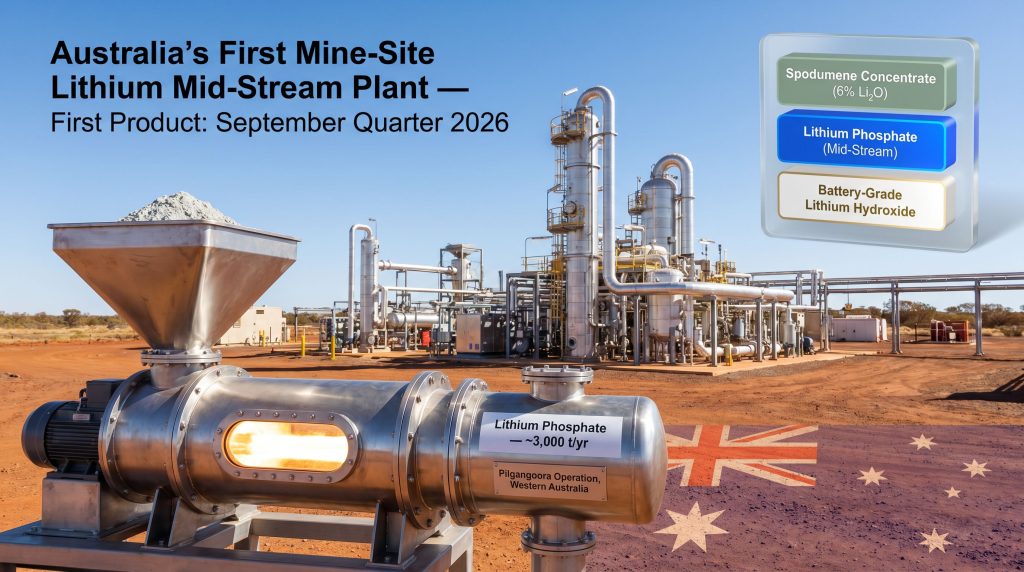
| Spodumene concentrate (6% Li₂O) | Low-to-moderate | Australia (mine site) |
| Lithium phosphate (mid-stream intermediate) | Moderate-to-high | China (predominantly) |
| Battery-grade lithium hydroxide monohydrate | High | China / emerging domestic capacity |
Each step up the processing chain represents not just a higher sale price, but greater insulation from raw commodity volatility, stronger relationships with battery manufacturers, and the ability to capture more of the margin embedded in the final energy storage product. Furthermore, understanding how lithium mining works across different resource types helps contextualise why mid-stream processing, specifically the conversion of spodumene concentrate into refined lithium intermediates like lithium phosphate, is where Australia has been most conspicuously absent.
What the Pilgangoora Mid-Stream Plant Actually Does
The PLS Pilgangoora lithium mid-stream processing plant is a demonstration-scale facility located directly at the Pilgangoora Operation in Western Australia's Pilbara region. Its core function is to take spodumene concentrate produced on site and convert it into lithium phosphate, a refined intermediate product that sits meaningfully higher up the value chain than raw concentrate.
The facility's design parameters are as follows:
| Metric | Specification |
|---|---|
| Facility type | Demonstration-scale mid-stream plant |
| Location | Pilgangoora Operation, Western Australia |
| Spodumene concentrate throughput | ~27,000 tonnes per year |
| Lithium phosphate output target | ~3,000 tonnes per year |
| First product expected | September Quarter 2026 |
| Commissioning status (as of June 2026) | Operational validation underway |
The choice of lithium phosphate as the target output is technically and commercially deliberate. Lithium phosphate is a recognised precursor in certain cathode chemistries and a validated intermediate for further refining into battery-grade compounds. It is also a product form that established cathode active material manufacturers can work with directly, which matters significantly when it comes to building offtake relationships and validating product quality against real battery supply chain specifications.
How Electric Flash Calcination Works
The technology underpinning the Pilgangoora mid-stream plant is electric flash calcination, developed by Australian technology company Calix. This is not a conventional rotary kiln process, and the distinction carries meaningful implications for both processing efficiency and environmental credentials.
In conventional spodumene extraction, raw spodumene (alpha phase) must be thermally converted to beta-spodumene before lithium can be efficiently extracted through subsequent leaching or chemical conversion steps. Historically, this phase transformation has been achieved using large rotary kilns fired by natural gas or other fossil fuels, which are energy-intensive, slow to respond to temperature changes, and produce significant direct carbon emissions.
Electric flash calcination applies concentrated thermal energy to fine mineral particles held in suspension rather than processed in bulk through a rotating drum. The result is a much faster, more controllable reaction environment that achieves the required phase transformation in seconds rather than minutes, with greater temperature uniformity and without direct combustion emissions.
For spodumene specifically, this means:
- Faster phase transformation from alpha to beta-spodumene, enabling more efficient downstream lithium extraction
- Tighter temperature control, which reduces over-calcination and improves lithium recovery rates
- Electrification of the thermal step, removing the direct dependency on fossil fuel combustion at this stage of processing
- A smaller physical footprint relative to conventional kiln-based systems, relevant when integrating processing at a mine site rather than a dedicated refinery
Calix has previously applied its calcination technology in the cement and mineral sectors, but its deployment in lithium mid-stream processing at mine-site scale represents a genuinely novel application. The Pilgangoora plant is the first facility globally to demonstrate this specific configuration at this scale.
Why Electrification Matters Beyond the ESG Narrative
There is a tendency to frame electrified processing as primarily a sustainability story, but the operational advantages are equally compelling. Battery manufacturers and their customers are increasingly applying lifecycle carbon accounting to the materials they purchase. Spodumene concentrate processed through an electrified pathway carries a demonstrably lower Scope 1 emissions intensity than material processed through fossil fuel-dependent kilns.
As battery supply chain scrutiny intensifies globally, this differentiation could translate into real commercial advantages, including access to premium pricing tiers and qualification for supply agreements with manufacturers operating under strict emissions procurement policies. In addition, the broader battery raw materials market is increasingly rewarding producers who can demonstrate low-carbon credentials throughout their processing chain.
Why This Is a Genuine Milestone
The phrase Australia's first mine-site lithium mid-stream processing facility requires some unpacking, because the word first is doing important work here.
Australia does have downstream lithium processing ambitions, and several projects have been proposed or partially developed over the years. However, the critical distinction at Pilgangoora is the integration of mid-stream conversion directly at the mine site, rather than at a standalone refinery or chemical plant located elsewhere.
This matters for several reasons:
- Logistics efficiency: Processing concentrate at the point of production eliminates the double-handling involved in shipping concentrate to a separate facility before further processing.
- Capital concentration: Mine-site integration allows processing infrastructure investment to be co-located with existing operational infrastructure, potentially reducing overall capital requirements.
- Supply chain coherence: A vertically integrated mine-to-intermediate product pathway gives producers more control over product quality and traceability from ore body to refined output.
- Commercial positioning: Selling a mid-stream product rather than a raw concentrate fundamentally changes the commercial relationship with downstream customers, shifting the producer from commodity price-taker to a supplier of a more specified, value-added product.
Previous Australian lithium processing has consistently stopped at the concentrate stage, with all further transformation occurring in China. The PLS Pilgangoora lithium mid-stream processing plant breaks that pattern at the processing architecture level.
Where Other Australian Producers Currently Sit
To contextualise the significance of this development, it is worth noting that the majority of Australian hard-rock lithium producers, including major operations in Western Australia's Goldfields and Pilbara regions, continue to sell spodumene concentrate as their primary product. Some have announced downstream processing ambitions, but operational mid-stream or refining capacity at mine sites remains essentially non-existent in Australia prior to this facility. The Pilgangoora plant establishes a commercial and technical reference point that did not previously exist in the Australian context.
The Offtake Agreement and What It Signals
One of the most strategically informative aspects of the Pilgangoora mid-stream plant is the decision to direct ramp-up production to Ningbo Ronbay New Energy Technology, a well-established Chinese manufacturer of cathode active materials used in lithium-ion batteries.
Ronbay is not a spot market buyer. The company specialises in high-nickel cathode materials and operates significant production capacity serving major battery cell manufacturers. Directing ramp-up output to a cathode material producer of this calibre serves several functions simultaneously:
- It provides immediate commercial validation that the lithium phosphate product meets the specifications required by a sophisticated downstream customer
- It creates a real-world testing environment for product quality at the earliest possible stage of operations
- It establishes a reference customer relationship that could support future offtake negotiations as the plant scales or as full commercial facilities are planned
- It signals that PLS is approaching the mid-stream plant not as an isolated experiment but as the beginning of a deliberate commercial positioning strategy
The choice to supply a ramp-up production stream to an active cathode material manufacturer rather than accumulating inventory or selling into spot markets reflects an intent to stress-test product specifications against actual battery supply chain requirements from commissioning onwards.
The next major ASX story will hit our subscribers first
Risk Factors Investors Should Understand
The PLS Pilgangoora lithium mid-stream processing plant is a demonstration-scale facility, and that designation carries specific implications that investors should weigh carefully.
Scale Risk
Demonstration scale exists to prove technical and commercial feasibility before committing to full commercial capital expenditure. The throughput of approximately 27,000 tonnes of spodumene concentrate annually and approximately 3,000 tonnes of lithium phosphate output is intentionally modest. The critical questions that this facility must answer include:
- Can the Calix electric flash calcination process maintain consistent lithium recovery rates at sustained throughput?
- What are the actual energy consumption and operational cost profiles under real operating conditions?
- Does the lithium phosphate product consistently meet customer specifications across different feed grades?
Until these questions are answered through sustained commercial operation, a decision on full-scale development cannot be made on solid technical foundations. The demonstration phase is, consequently, the evidence-gathering exercise that precedes that decision.
Market Timing Risk
Commissioning a novel processing facility during a period of significant lithium price compression introduces a specific set of challenges. Lithium carbonate and hydroxide prices have retreated substantially from their 2022 peaks, and spodumene concentrate prices have followed. This environment compresses the margin available from mid-stream processing and makes headline economics for any lithium processing investment look less attractive than they would during a price upswing.
However, there is a counter-argument that is worth taking seriously. Pilbara Minerals has noted that demonstration-phase economics are typically evaluated on technical validation metrics and long-run feasibility rather than near-term profitability. Furthermore, building and proving processing infrastructure during a price trough means that when market conditions recover, the facility and its operators will be ahead of any competitor who waited for price signals before starting the construction and commissioning journey.
This counter-cyclical logic has historical precedent in commodity sector infrastructure development. The operations that achieve lowest-cost, highest-capability status at the next price peak are often those whose infrastructure was built and refined during the preceding trough.
Technology Scale-Up Risk
Electric flash calcination is a proven technology in certain industrial applications, but its deployment in lithium mid-stream processing at scale introduces variables that cannot be fully resolved through laboratory or pilot work. Feed variability from the mine, equipment wear profiles under sustained high-temperature operation, and reagent consumption dynamics at scale are all factors that will become clearer through the demonstration phase operation.
Investors should treat the period through to first product delivery and initial offtake supply as a technology de-risking phase rather than a commercial production phase. For context, approaches such as direct lithium extraction have faced similar scale-up scrutiny across the industry, underscoring the importance of thorough demonstration validation before full commercial commitments are made.
The Broader Structural Significance for Australian Lithium
The PLS Pilgangoora lithium mid-stream processing plant is best understood not as a single facility decision but as a potential inflection point in how Australian lithium producers think about their position in the global battery materials supply chain.
If the demonstration phase validates the technical and economic case for mine-site mid-stream processing, several consequential outcomes become possible:
- Other Australian lithium operators may be incentivised to evaluate similar configurations, potentially creating a cluster of mid-stream processing capacity in Western Australia
- The spodumene concentrate export market may begin to bifurcate between producers who sell raw concentrate and those who sell processed intermediates, with different pricing dynamics for each
- Domestic battery precursor supply chains become incrementally more feasible as the gap between Australian raw material production and battery-ready compound production begins to close
- Capital allocation in the sector may shift toward processing infrastructure as technical risk is progressively de-risked through the Pilgangoora demonstration
The pathway from lithium phosphate to fully domestic battery-grade lithium refining remains long and capital-intensive. However, the Pilgangoora facility establishes something that did not previously exist in Australia: a working technical and commercial proof of concept that mine-site mid-stream processing is operationally achievable.
Project Timeline at a Glance
- Pre-2024: Feasibility and technology assessment; engineering and process design work undertaken in partnership with Calix
- 2024-2025: Engineering, procurement, and construction phase executed at the Pilgangoora Operation
- Early 2026: Construction completion confirmed; commissioning and operational validation activities initiated
- June 2026: Facility formally opened as Australia's first mine-site lithium mid-stream processing plant
- September Quarter 2026: First lithium phosphate product targeted for delivery
Frequently Asked Questions
What is the Pilgangoora mid-stream processing plant?
A demonstration-scale facility integrated directly at PLS's Pilgangoora Operation in Western Australia that converts spodumene concentrate into lithium phosphate using electric flash calcination technology developed by Calix. It is the first facility of its kind to be built and operated at a mine site in Australia.
How much lithium phosphate will the plant produce?
At design capacity, the facility is engineered to process approximately 27,000 tonnes of spodumene concentrate per year and produce around 3,000 tonnes of lithium phosphate annually.
When is first product expected?
First lithium phosphate output is targeted for the September Quarter of 2026, with commissioning and operational validation activities underway as of June 2026.
Who will receive the ramp-up production?
Ramp-up production is expected to be supplied to Ningbo Ronbay New Energy Technology under an existing offtake arrangement.
What makes this facility different from previous Australian lithium processing attempts?
The integration of mid-stream conversion directly at the mine site is the critical distinction. Previous Australian lithium processing has stopped at the concentrate stage, with all further value-adding transformation occurring offshore. The Pilgangoora plant changes that configuration for the first time.
What technology does the plant use?
The facility employs electric flash calcination technology developed by Calix, which replaces conventional fossil fuel-fired rotary kiln processing with an electrified thermal system that applies rapid, precisely controlled heat to mineral particles in suspension.
This article contains forward-looking statements and analysis relating to demonstration-phase infrastructure. Outcomes at demonstration scale may differ materially from those achievable at full commercial scale. Readers should conduct their own due diligence and consider seeking independent financial advice before making investment decisions based on the information presented. Lithium price and demand forecasts are inherently uncertain and subject to significant revision.
Want to Know Which ASX Lithium Discoveries Are Worth Watching Right Now?
Discovery Alert's proprietary Discovery IQ model scans ASX announcements in real time, instantly identifying significant mineral discoveries — including lithium — and converting complex data into clear, actionable insights for investors at every experience level. Explore why historic ASX mineral discoveries have delivered extraordinary returns, and begin your 14-day free trial today to position yourself ahead of the broader market.