June 9, 2026
The Last Frontier of Heavy-Vehicle Automation: Why Quarries Have Resisted the Driverless Revolution
For decades, autonomous haulage technology has advanced in lockstep with the scale of the operations deploying it. Giant open-pit iron ore mines in Western Australia's Pilbara region, massive copper operations in Chile, and sprawling coal complexes in Queensland all adopted driverless truck systems relatively early, largely because their operational characteristics made the economic case almost self-evident. Long, predictable haul routes. Enormous fleets. Stable pit geometries. Consistent material types. The return on investment was legible, and the regulatory groundwork had been laid.
Aggregate quarries offered none of these conditions. And yet, as the partnership between Epiroc and Heidelberg Materials in Western Australia now signals, the aggregates sector may be approaching a genuine automation inflection point, one that could reshape how crushed stone, gravel, and construction materials are produced at scale across three continents.
When big ASX news breaks, our subscribers know first
Why Quarry Environments Challenged Every Automation Assumption
The structural gap between large-scale mine automation and quarry automation is not simply a matter of technology maturity. It reflects a deeper mismatch between how autonomous haulage systems were originally designed and the operational realities of mid-scale aggregate production.
Large open-pit mines offered automation vendors a relatively forgiving development environment. Haul roads are wide, long, and consistent. Pit layouts change slowly. Fleets tend to be standardised around a single OEM's equipment. Traffic management logic could be calibrated over months against predictable conditions.
Quarry operations present a fundamentally different challenge:
- Pit geometries change frequently, often after every blasting cycle, requiring automation systems to continuously remap active working areas
- Haul distances are shorter and turning radii tighter, demanding more responsive and precise navigation logic than long-circuit iron ore haulage
- Mixed-fleet configurations are the norm rather than the exception, with trucks, loaders, and auxiliary vehicles from multiple manufacturers operating in close proximity
- The smaller operational scale of most quarries historically compressed the ROI calculation, making the upfront capital and integration cost of automation harder to justify
These barriers created a persistent blind spot in the automation market. While autonomous haulage in quarries matured rapidly in tier-one mining, the aggregates sector, which supplies the raw materials underpinning virtually every construction project on earth, remained largely manual.
The Aggregates Sector by the Numbers
Understanding the scale of what remains unautomated helps frame the commercial opportunity now emerging. Heidelberg Materials, one of the world's largest building materials groups, carries a market capitalisation of approximately €31 billion and operates aggregate quarries across Europe, North America, and Australia.
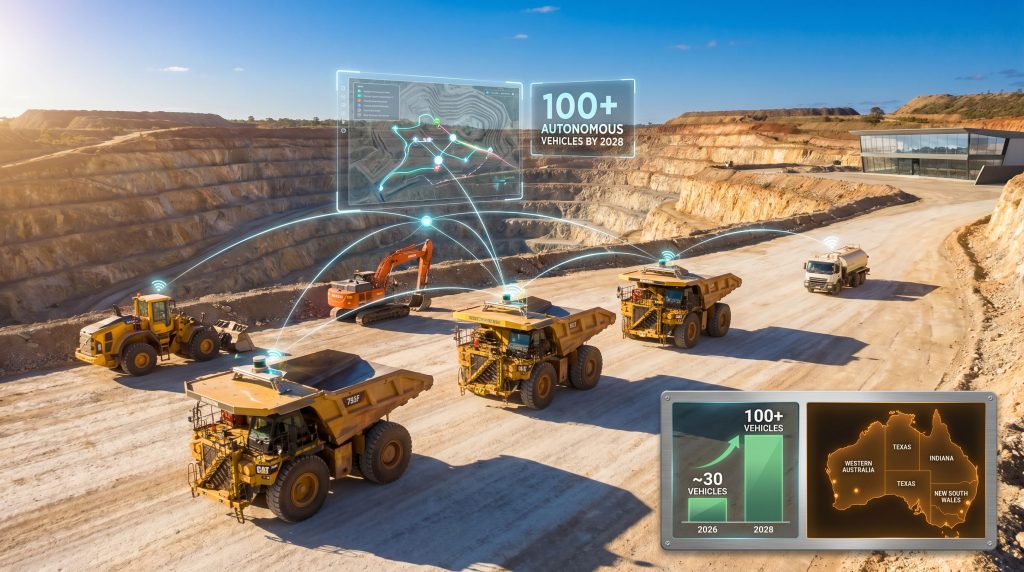
The company has publicly committed to a structured autonomous vehicle rollout with defined milestones:
| Milestone | Target |
|---|---|
| Autonomous vehicles by end of 2026 | ~30 vehicles across global sites |
| Autonomous vehicles by end of 2028 | 100+ vehicles |
| Proof-of-concept vehicle payload | ~60-tonne haul trucks |
| Roy Hill benchmark (LinkOA) | 78 trucks; 350M+ tonnes moved autonomously |
These are not exploratory figures. They represent a structured, multi-year capital commitment from an institution large enough to move an entire sector's technology adoption curve.
"The aggregates sector represents one of the last major surface extraction industries where autonomous haulage has not yet achieved widespread commercial deployment, making it a significant and largely untapped addressable market for automation technology providers."
What Is Epiroc's LinkOA Platform and Why Does OEM-Agnosticism Change the Equation?
At the centre of the Epiroc Heidelberg Materials quarry automation project sits LinkOA, an open, OEM-agnostic autonomy platform designed to operate across equipment from different manufacturers without requiring proprietary hardware lock-in. This architectural choice is not incidental. It is the core reason the platform is technically suited to the heterogeneous reality of most quarry fleets.
LinkOA integrates four primary functional layers:
- Traffic management systems that coordinate movement across mixed fleets in real time, preventing conflicts between autonomous and manually operated vehicles
- On-board automation modules providing vehicle-level sensing, decision-making, and navigation capabilities
- Connectivity infrastructure linking all equipment to a centralised remote operations centre
- Virtual mapping that constructs a continuously updated spatial model of the site to enable accurate autonomous pathfinding
The distinction between LinkOA and the major proprietary autonomous haulage systems becomes critical when assessed against the quarry context:
| Feature | Closed OEM Systems | LinkOA (Open Platform) |
|---|---|---|
| Fleet compatibility | Single OEM vehicles only | Multi-OEM mixed fleets |
| Integration complexity | Lower within OEM ecosystem | Higher initial setup; greater long-term flexibility |
| Scalability across diverse sites | Limited to OEM footprint | Applicable across varied equipment inventories |
| Retrofit capability | Limited | Designed for existing fleet modernisation |
Most aggregate producers have assembled their fleets incrementally over decades, drawing on equipment from multiple manufacturers based on price, availability, and operational preference. A platform requiring full fleet replacement as a precondition for automation deployment would face an almost insurmountable commercial barrier in this environment. Furthermore, LinkOA's open architecture removes that barrier by retrofitting automation capability onto existing mixed fleets rather than demanding a hardware overhaul.
This is a subtler but commercially significant insight: the aggregates sector's fragmented fleet composition, historically viewed as a barrier to automation, may actually become an advantage for open-platform vendors who can offer a lower-capital entry point than proprietary systems.
The Western Australia Proof-of-Concept: What Is Actually Being Tested?
The Epiroc Heidelberg Materials quarry automation trial in Western Australia is focused on four discrete validation objectives, each addressing a different dimension of the quarry automation challenge:
- Safe mixed-fleet operation: Confirming that autonomous vehicles and manually operated equipment can coexist in the same active working environment without safety incidents
- Haulage efficiency improvement: Measuring cycle times, payload consistency, and idle reduction against pre-automation baselines
- Reduced operator dependency: Quantifying the degree to which human supervision can be repositioned to remote operations rather than on-machine presence
- System performance across variable conditions: Stress-testing the platform against the irregular terrain and frequently reconfigured pit layouts that characterise quarry environments
Western Australia was a logical selection for this validation work. The state has the most developed regulatory framework for autonomous haulage anywhere in the world, shaped by years of large-scale deployments at operations including Roy Hill, Fortescue's Pilbara mines, and BHP's iron ore operations. Epiroc also maintains established Australian service and support infrastructure, reducing deployment risk.
Heidelberg Materials itself operates existing aggregate facilities in both Western Australia and New South Wales, meaning the proof-of-concept site sits within an already-understood operational context rather than a greenfield environment.
The Roy Hill Benchmark: Proven Scale as a Commercial Reference
The most credible evidence that LinkOA can deliver on its quarry automation promise comes not from projections but from demonstrated operational history. At Roy Hill iron ore mine in Western Australia's Pilbara, the platform has supported the conversion of 78 haul trucks from manual to fully driverless operation.
The logistics of the Roy Hill deployment underline the platform's maturity:
- Autonomous vehicles navigate Roy Hill's site using a continuously updated virtual map
- All equipment communicates in real time with ancillary vehicles and the remote operations centre
- That ROC is located approximately 1,100 kilometres from the mine itself, in Perth
- Total autonomous material movement at Roy Hill has exceeded 350 million tonnes
Translating these achievements to the quarry context requires understanding where the operational environments diverge:
| Operational Variable | Iron Ore (Roy Hill) | Aggregate Quarry |
|---|---|---|
| Haul distance | Long multi-kilometre circuits | Short to medium distances |
| Pit geometry stability | Relatively consistent | Frequently reconfigured post-blast |
| Fleet size | 78+ trucks | Smaller mixed fleets |
| Payload class | Heavy large-format trucks | ~60-tonne mid-scale |
| Regulatory precedent | Well-established in WA | Emerging |
"The Roy Hill deployment proves that LinkOA can sustain autonomous operations at industrial scale over extended remote distances. The quarry challenge is not one of platform immaturity. It is one of adapting proven technology to a more geometrically dynamic and operationally unpredictable environment."
The next major ASX story will hit our subscribers first
Epiroc's Quarry Sector Strategy: A Deliberate Pattern, Not an Isolated Deal
The Heidelberg Materials engagement does not exist in isolation. In 2025, Epiroc partnered with Luck Stone, one of the United States' major crushed stone producers, to deploy a fully autonomous drill rig at a US quarry. That partnership covered drilling automation. The Heidelberg Materials partnership now covers autonomous haulage. Broader mining automation trends suggest this phased approach is becoming increasingly common across the sector.
Taken together, these engagements reveal a deliberate phased entry strategy into quarry automation:
- Phase 1: Prove autonomous drilling in quarry conditions (Luck Stone, 2025)
- Phase 2: Validate mixed-fleet autonomous haulage in quarry conditions (Heidelberg Materials, 2026 onwards)
- Phase 3 (projected): Integrate drilling, loading, and haulage automation under a unified operational platform spanning the full quarry production cycle
If this trajectory holds, Epiroc would be positioned to offer end-to-end quarry automation capability demonstrated across two of the world's largest aggregate producers, a reference portfolio that no competitor currently holds.
Heidelberg Materials' Global Automation Roadmap: Multi-Continent and Milestone-Driven
Heidelberg Materials is not running isolated pilots. The company's autonomous haulage programme is structured around a foundation deployment at the Lake Bridgeport quarry in Texas, from which a multi-continent rollout is being staged.
Expansion targets for 2026 include additional sites in Indiana and Texas across North America, aggregate operations in New South Wales and Western Australia in Australia, and facilities in northern Germany representing the European dimension of the programme.
The strategic drivers behind this commitment extend beyond technology novelty:
- Labour cost pressures in mature markets across Europe, North America, and Australia are compressing operating margins in an industry where haulage is among the largest cost line items
- Safety liability reduction is a primary motivator, with autonomous systems removing operators from active blast zones and high-traffic haul corridors
- 24/7 operational continuity eliminates shift change downtime, fatigue-related stoppages, and rostering constraints that cap production capacity in manually operated quarries
- ESG alignment is increasingly relevant as major construction materials customers apply sustainability criteria to their procurement decisions, and autonomous systems enable more precise fuel management and emissions tracking
In addition, data-driven mining operations are increasingly underpinning these strategic decisions, providing the operational intelligence needed to justify and optimise automation investments at scale.
The Competitive Landscape: Where Epiroc's Open Platform Sits
The quarry automation market is not a single-vendor story. Several established technology providers are competing for position:
| Vendor | Platform Approach | Notable Deployments |
|---|---|---|
| Epiroc | LinkOA (OEM-agnostic, open) | Roy Hill (iron ore), Luck Stone (quarry drilling), Heidelberg Materials (quarry haulage) |
| Komatsu | FrontRunner AHS (proprietary) | Primarily large-scale open-pit mining |
| Caterpillar | Command for Hauling (proprietary) | Large-scale mining; limited quarry presence |
| Hexagon | HxGN MineOperate (mixed) | Broader mining automation and fleet management |
| Wenco / Hitachi | Fleet management and semi-automation | Surface mining operations |
The structural advantage of open platforms in the quarry context becomes apparent when mapped against actual fleet conditions. Proprietary systems from Komatsu and Caterpillar have achieved significant scale in large mining operations where fleet standardisation around a single OEM is practical. In the quarry sector, however, that precondition rarely exists.
"For aggregate producers operating heterogeneous fleets built over decades, OEM-agnostic platforms lower the capital threshold for automation adoption in ways that proprietary systems architecturally cannot match."
What Quarry Automation Actually Delivers: The Operational and Safety Case
Beyond headline technology narratives, the quantifiable value drivers of autonomous haulage in quarry environments rest on several interconnected mechanisms:
- Continuous operation: Autonomous systems eliminate the production losses associated with shift changes, meal breaks, and fatigue-mandated rest periods, enabling genuinely 24/7 haulage cycles
- Consistent payload optimisation: Human operators naturally vary their loading and speed behaviour across a shift. Autonomous systems maintain optimised speed profiles and payload targets throughout the entire operating cycle
- Accident frequency reduction: Removing operators from active haul corridors eliminates exposure to the collision, rollover, and proximity hazards that account for a significant proportion of serious quarry injuries in Australia, Europe, and North America
- Remote supervision scalability: A single remote operator supervising multiple autonomous vehicles from a centralised operations centre restructures labour deployment rather than simply displacing workers, potentially enabling redeployment to higher-value monitoring and analysis roles
The workforce transition question deserves nuance. Automation in quarry environments is unlikely to be a simple headcount reduction story. Consequently, the skills required to manage a remote operations centre, interpret real-time fleet telemetry, and optimise autonomous system parameters represent a different but genuine employment pathway for workers transitioning from manual operation roles.
The Strategic Outlook: What Success Would Mean for the Broader Industry
If the Epiroc Heidelberg Materials quarry automation proof-of-concept validates mixed-fleet autonomous haulage at commercial scale, the downstream implications extend well beyond a single project:
- A commercially validated reference case for autonomous haulage in mid-scale quarry operations would materially accelerate adoption timelines across the global aggregates industry
- The demonstrated viability of open-platform autonomy in complex, variable quarry environments would strengthen the commercial argument for OEM-agnostic systems over proprietary alternatives across the broader surface mining sector
- Epiroc would establish a new addressable market beyond its core hard rock and large-scale surface mining customer base, with quarry automation representing a largely untapped commercial frontier
- The longer-term trajectory points toward fully integrated quarry automation, where drilling, loading, and haulage operate under a single unified platform managed from remote operations centres overseeing multiple sites simultaneously
Furthermore, AI-powered mining efficiency tools are increasingly being layered on top of these autonomous platforms, adding predictive intelligence that further compounds the operational gains from automation. The aggregates industry has long been characterised as low-technology relative to hard rock mining. That characterisation is becoming harder to sustain.
The Epiroc Heidelberg Materials quarry automation partnership is best understood not as a technology trial in isolation, but as an early-stage market formation event that could define the commercial architecture of quarry automation for the decade ahead. Indeed, this broader mining technology transformation underway across the resources sector suggests that the aggregates industry's automation inflection point has, in all likelihood, already begun.
For ongoing coverage of machinery, equipment, and technology innovation across the global mining and resources sector, visit Mining Beacon, which publishes regular reporting across the full mining value chain.
Want to Stay Ahead of the Next Major Mining Discovery?
Discovery Alert's proprietary Discovery IQ model scans ASX announcements in real time, delivering instant alerts on significant mineral discoveries across more than 30 commodities — turning complex data into clear, actionable investment opportunities for both short-term traders and long-term investors. Explore how major discoveries have historically generated substantial returns on Discovery Alert's discoveries page, and begin your 14-day free trial today to position yourself ahead of the broader market.