June 9, 2026
When Energy Security Overrides Climate Ambition: The Policy Logic Behind Queensland's Coal Commitment
Across the world's energy systems, the most revealing stress tests are not technological failures but political ones. When governments that have made binding renewable energy commitments reverse course within a single electoral cycle, it exposes something fundamental about how energy policy actually works in practice: security of supply, cost stability, and the structural weight of existing infrastructure routinely outcompete long-term decarbonisation timelines when placed under real political pressure.
Queensland extends Meandu coal mine life by approximately 21 years, and this is one of the most significant examples of this dynamic playing out in real time within a developed economy. It is not simply a mining approval. It is a physical and legislative commitment to a particular energy future, one that will shape Queensland's electricity system well into the 2040s regardless of which government holds power in the intervening years.
When big ASX news breaks, our subscribers know first
The Structural Weight of Coal in Queensland's Energy System
Understanding why this decision was made requires appreciating just how deeply embedded coal is in Queensland's power infrastructure. Coal currently accounts for more than 60% of Queensland's total energy consumption, a share that reflects decades of investment in coal-fired generation capacity and the captive fuel supply systems built to support it.
The Tarong coal-fired power stations, with a combined installed capacity of 1,843 megawatts, supply approximately 20% of the state's total electricity needs. These are not marginal assets at the edge of the grid. They sit at the centre of Queensland's baseload generation framework, providing the kind of dispatchable, on-demand power capacity that intermittent renewables cannot yet replace at scale without substantial firming infrastructure.
The Meandu mine is the exclusive fuel supplier to these stations. It is not a commercial open-market operation selling coal to multiple buyers. It functions as an integrated component of a vertically integrated, state-owned energy supply chain, where Stanwell Corporation owns both the mine and the power stations it supplies. This structure concentrates the entire transition risk, financial, operational, and regulatory, within a single government-owned entity.
At a rated extraction capacity of 7.6 million tonnes per year, Meandu represents one of the most consequential single fuel supply assets in Australia's east coast electricity market. Furthermore, coal supply challenges across the region make this captive supply arrangement even more strategically significant for Queensland's energy planners.
What the King 2 East Expansion Actually Unlocks
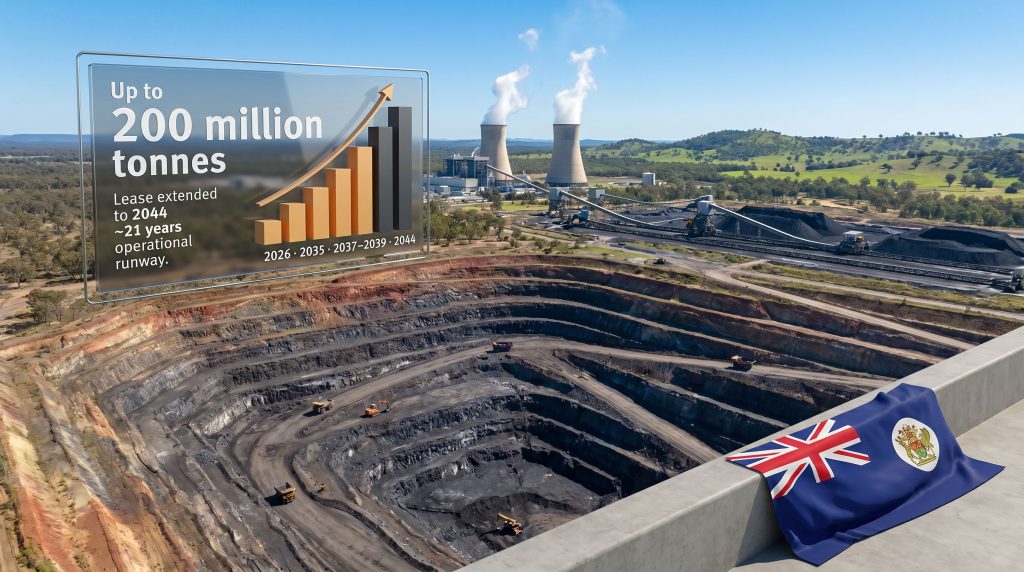
The approved extension is operationally enabled through a specific project component known as King 2 East, or K2E. This expansion covers an additional 186 to 187 hectares of mine footprint and is expected to begin production from 2026. Active mining under K2E is projected to continue through to approximately 2037 to 2039, with the mine's lease tenure formally extended to 2044.
The full scope of what this approval unlocks is substantial:
| Metric | Detail |
|---|---|
| Annual mine capacity | 7.6 million tonnes |
| Extension duration | ~21 years |
| Total additional coal volume | Up to 200 million tonnes |
| K2E expansion footprint | ~186 to 187 hectares |
| Coal supply secured through | At least 2035 |
| Active mining projected until | ~2037 to 2039 |
| Lease extended to | 2044 |
| Power stations supplied | Tarong (1,843MW combined capacity) |
The lease tenure running to 2044 creates an important distinction between the regulatory ceiling and the operational horizon. Even if active extraction concludes by 2037 to 2039, the lease itself extends well beyond that point, preserving optionality while also locking in rehabilitation and compliance obligations that will persist regardless of future political direction.
What is particularly notable from an asset management perspective is the gap between the coal supply security date of at least 2035 and the lease expiry of 2044. This nine-year buffer serves as a form of regulatory insurance, ensuring that if extraction conditions allow or demand requires it, additional volumes can be accessed without requiring a further approval cycle.
The Policy Reversal: How Queensland Dismantled Three Renewable Targets in 14 Months
The approval of the Meandu life extension cannot be understood in isolation from the legislative changes that preceded it. When the Labor government held power in Queensland, it committed in 2022 to ending coal dependency in state-owned utilities by 2035 and converting state-owned coal-fired power plants into clean energy hubs from 2027. Under that framework, all coal-fired generation capacity in Queensland was expected to cease operations by the 2037 to 2038 fiscal year.
The Liberal National Party's victory at the October 2024 state election fundamentally altered this trajectory. Within approximately 14 months of assuming office, the LNP government had:
- Released a five-year Energy Roadmap in October 2025 that repositioned coal-fired generation as a multi-decade pillar of the state's electricity supply
- Passed the Energy Roadmap Amendment Act 2025 in December 2025, which abolished Queensland's three legislated renewable energy milestones
- Approved the Meandu mine life extension, physically embedding the commitment to coal-fired generation through to at least the late 2030s
The renewable targets that were abolished had set milestones of 50% by 2030, 70% by 2032, and 80% by 2035. Their removal does more than simply slow the transition; it eliminates the regulatory pressure mechanism that would have forced accelerated investment in renewable capacity and grid infrastructure. Without those statutory targets, the investment signals driving large-scale renewable development in Queensland are substantially weakened.
Policy architecture note: The removal of legislated renewable targets is a particularly consequential decision because it removes the compliance trigger. Under the previous framework, these targets created mandatory obligations that forced government-owned energy corporations to invest in transition assets. Without them, the pace of transition becomes discretionary rather than compulsory.
These energy transition pressures are not unique to Queensland; however, few jurisdictions have responded as comprehensively by dismantling statutory frameworks rather than simply modifying them.
State minister for natural resources and mines Dale Last confirmed on 9 June 2026 that coal will continue to play a central role in Queensland's energy mix for decades, a statement that reflects the government's long-term strategic positioning rather than a short-term operational necessity.
The Global Context: Coal's Resilience Under Energy Security Pressure
Queensland's decision does not exist in a vacuum. Across the Asia-Pacific region, the economic and strategic case for thermal coal has been reinforced by supply disruptions, price volatility, and geopolitical shocks that have made the cost advantage of coal-fired generation harder to dismiss. In addition, Australia's energy export challenges have further complicated the policy environment for state-level energy planning.
South Korea's Fuel Switching as a Real-World Case Study
South Korea's experience in mid-2026 provides one of the most striking real-world demonstrations of coal's economic resilience under supply-disrupted conditions. Following disruptions to Middle East energy supplies, thermal coal generation costs in South Korea were estimated at approximately 75.83 Korean won per kilowatt-hour, compared with approximately 216.22 won per kilowatt-hour for LNG-fired generation, according to Argus Media analysis from March 2026.
This cost differential drove substantial fuel switching behaviour. South Korean coal burn averaged 15 gigawatts in April 2026, a 42% increase from approximately 10.6 gigawatts in the same period of the prior year, while gas-fired output declined by roughly 6.2%, equivalent to an LNG demand reduction of approximately 110,000 tonnes. This marked the first complete month without Qatari LNG deliveries in South Korea's recorded energy history.
The lesson for Queensland's policymakers is not lost. When geopolitical events compress LNG availability and drive spot prices sharply higher, coal-fired generation with captive fuel supply becomes not merely cost-competitive but strategically essential.
Indonesia's Production Dynamics and Global Thermal Coal Demand
Indonesia, the world's largest coal-exporting nation, set its coal production target at 600 million tonnes for 2026, having revised this downward from 817.5 million tonnes in the prior year as Jakarta sought to tighten oversight of seaborne coal supplies and export flows. Despite the production ceiling reduction, Indonesian thermal coal prices were hovering near three-year highs by mid-2026, with Supramax cargoes of GAR 4,200 kcal/kg coal assessed at $66.30 per tonne fob Kalimantan in early June 2026, according to Argus price assessments.
This price strength, occurring even as production targets were reduced, reflects the structural persistence of thermal coal demand across Asia. It also underlines a dynamic directly relevant to Queensland's policy calculus: in a market where global energy transition demand for alternatives remains constrained by supply chains and infrastructure timelines, extending a domestically captive coal supply asset carries lower financial risk than replacing it with imported alternatives.
The Stranded Asset Problem: A Risk Embedded in the Extension
One of the most underappreciated dimensions of the Meandu life extension is what it creates for future governments. The 21-year extension horizon generates long-dated regulatory commitments that will outlast multiple Queensland electoral cycles. This creates a form of policy inertia that is difficult and potentially costly to reverse.
If a future state government sought to reinstate renewable energy targets and accelerate coal exit timelines, it would face several compounding challenges:
- Stranded asset exposure on Stanwell Corporation's balance sheet if the mine is closed before the approved operational horizon is reached
- Accelerated rehabilitation cost provisioning, given that mine closure triggers immediate rehabilitation obligations under Queensland's resources legislation
- Potential compensation obligations if early closure affects contractual fuel supply arrangements or Tarong's operating licences
- Grid reliability risks if renewable and firming capacity has not been built sufficiently in advance to absorb the loss of Tarong's baseload contribution
The financial implications for Stanwell Corporation as a government-owned entity are also material. A 21-year mine life extension fundamentally alters the asset depreciation schedule for the mine and associated infrastructure, the rehabilitation provisioning timeline, and the long-term balance sheet structure of an entity that simultaneously operates the power stations consuming the fuel it extracts.
Analyst note: The consolidation of mine operator and power generator roles within a single state-owned entity is unusual in international terms. Most comparable energy systems have separated these functions through privatisation or structural separation. Stanwell's integrated structure means that transition decisions at the mine level directly affect the financial viability of the generation assets, and vice versa, creating a governance complexity that is rarely discussed in the public debate about Queensland's energy transition.
The next major ASX story will hit our subscribers first
Three Scenarios for Queensland's Energy Mix Through to 2044
The Meandu extension does not predetermine Queensland's energy future, but it significantly constrains it. Three plausible pathways emerge from the current regulatory architecture:
Scenario 1: Coal Maintains Structural Dominance
The LNP retains government across multiple electoral cycles. Tarong operates at or near full capacity through the mid-2040s. Meandu produces at or close to its 7.6 million tonne annual capacity, approaching the 200 million tonne ceiling over its extended life. Queensland remains structurally dependent on coal for more than 50% of electricity generation into the early 2040s, with renewables growing as a supplementary rather than transitional technology.
Scenario 2: Parallel Renewable Build Reduces Coal Dependency Before 2040
Significant grid infrastructure investment unlocks large-scale renewable capacity ahead of schedule. Tarong's dispatch frequency declines progressively as firming technologies mature and transmission bottlenecks are resolved. Meandu continues operating but at reduced throughput; the 200 million tonne volume ceiling is never reached. Queensland achieves a degree of decarbonisation while retaining coal as a reliability backstop, particularly during peak demand and low-renewable-output periods.
Scenario 3: Policy Reversal Under a Future Government
A future administration reinstates renewable targets and accelerates coal exit timelines. Early closure of Tarong triggers rehabilitation cost acceleration at Meandu and potentially stranded asset write-downs across Stanwell's portfolio. The energy transition accelerates, but at significantly higher fiscal cost than if the extension had never been granted.
The probability of each scenario depends heavily on Queensland's electoral cycle, the pace of grid infrastructure investment, and whether geopolitical energy shocks continue to reinforce the political case for coal as a reliability anchor. Consequently, a coal revival policy shift in major economies may also influence how Queensland's policymakers frame their own long-term energy decisions.
Frequently Asked Questions: Queensland Extends Meandu Coal Mine Life
What is the Meandu coal mine and who operates it?
Meandu is a thermal coal mine located in Queensland's South Burnett region. It is owned and operated by Stanwell Corporation, a wholly government-owned energy company. The mine exclusively supplies coal to the adjacent Tarong coal-fired power stations. Detailed project information is available for those seeking a comprehensive overview of the mine's operational history and infrastructure.
By how many years has the Meandu mine life been extended?
The Queensland Government has approved an extension of approximately 21 years, with the mine's lease running through to 2044. Active mining under the King 2 East expansion is projected to continue through to approximately 2037 to 2039.
How much coal does the extension unlock?
The approved extension provides access to up to 200 million tonnes of thermal coal reserves, which will fuel the Tarong power stations through their extended operational life.
What happened to Queensland's renewable energy targets?
The LNP government abolished all three of Queensland's legislated renewable energy milestones, which had set targets of 50% by 2030, 70% by 2032, and 80% by 2035, through the Energy Roadmap Amendment Act 2025 passed in December 2025.
What share of Queensland's electricity does coal supply?
Coal currently accounts for more than 60% of Queensland's total energy consumption. The Tarong power stations alone supply approximately 20% of the state's electricity needs.
What is the King 2 East project?
K2E is the operational expansion area that enables Queensland extends Meandu coal mine life to become a reality, covering approximately 186 to 187 hectares of additional mine footprint. Production under K2E is scheduled to commence in 2026.
Does the extension conflict with Australia's national climate obligations?
The extension creates a structural tension between Queensland's state-level energy governance and Australia's federal emissions reduction commitments. Australia's constitutional framework grants states significant autonomy over natural resource management and energy infrastructure, which means state-level decisions can diverge materially from national climate policy without requiring federal override.
The Deeper Lesson: What Queensland Reveals About the Global Energy Transition
Queensland's trajectory is not simply a domestic Australian story. It is a real-world demonstration of how the energy transition interacts with democratic politics, existing infrastructure, state-owned asset management, and regional energy security obligations when placed under genuine stress.
The decision that Queensland extends Meandu coal mine life reflects a calculation that is being made, in various forms, across Asia-Pacific energy systems simultaneously. Coal remains the lowest-cost dispatchable generation option in the absence of sufficient firming capacity, and building that firming capacity takes time, capital, and grid infrastructure that most systems are still far from deploying at scale.
What distinguishes Queensland's case is the comprehensiveness of the policy reversal. The combination of legislative target abolition, formal energy roadmap repositioning, and a 21-year mine life extension creates a policy architecture that is genuinely difficult to unwind, not because of technical barriers, but because of the financial and legal commitments embedded in each layer of the framework.
Disclaimer: This article contains forward-looking statements and scenario projections based on publicly available policy documents, regulatory approvals, and third-party market intelligence. These projections are inherently speculative and subject to change based on political, regulatory, technological, and market developments. Nothing in this article constitutes financial, legal, or investment advice.
Want to Stay Ahead of the Next Major Mineral Discovery on the ASX?
While Queensland's coal commitment reshapes Australia's energy landscape for decades to come, Discovery Alert's proprietary Discovery IQ model continuously scans ASX announcements in real time, instantly identifying significant mineral discoveries across coal, critical minerals, and over 30 other commodities before the broader market reacts. Explore how historic discoveries have generated extraordinary returns for early investors and begin your 14-day free trial today to secure a genuine market-leading edge.