June 9, 2026
Why Isolation Failures Continue to Claim Lives in Australian Mining
Maintenance windows are statistically among the most dangerous periods in any mining operation. When machines stop moving and workers move in, the assumption of safety can be deadlier than the machine itself. Across the global resources sector, the single most persistent cause of serious injury during planned maintenance is not mechanical failure or equipment age, it is the inadequate control of hazardous energy before work begins. In surface mining and quarrying environments, where diesel-electric generators, heavy mobile plant, and high-voltage electrical systems operate in close proximity to maintenance crews, the consequences of incomplete energy isolation are swift and catastrophic.
This is the operational reality behind the Queensland mine isolation safety warning, issued by Resources Safety and Health Queensland (RSHQ) in June 2026 following a series of site inspections that revealed systemic deficiencies in how energy isolation is being managed across the state's surface mines and quarries.
When big ASX news breaks, our subscribers know first
The Spectrum of Hazardous Energy in Surface Mining Environments
Before examining what inspectors found, it is worth understanding what energy isolation actually means in practice. In a surface mining or quarrying context, "energy isolation" refers to the complete and verified removal of all energy sources from a piece of plant or equipment before any maintenance, inspection, or repair work is carried out.
The energy types that must be controlled extend well beyond electricity:
- Electrical energy stored in batteries, capacitors, or live circuits
- Hydraulic energy in pressurised fluid systems such as rams, accumulators, and brake circuits
- Pneumatic energy in compressed air reservoirs and lines
- Gravitational potential energy in suspended loads, elevated components, or raised bodies
- Stored mechanical energy in compressed springs, tensioned cables, or wound mechanisms
- Thermal energy in hot surfaces, steam lines, or heated fluids
Heavy mobile plant, particularly diesel-electric haul trucks, excavators, and generating sets, presents a uniquely complex isolation challenge. These machines integrate multiple energy systems simultaneously. A single piece of plant may carry a 24-volt battery system for controls, a high-voltage electrical drive system, a hydraulic circuit operating at thousands of kilopascals, and a pneumatic braking system, all of which must be independently isolated before any worker enters the danger zone. Understanding mining permitting basics also helps contextualise how regulatory requirements are structured across different stages of a project's lifecycle.
What RSHQ Inspectors Found Across Queensland Mine Sites
The Queensland mine isolation safety warning that emerged from RSHQ's June 2026 inspections identified three distinct categories of failure that were observed repeatedly across surface mine sites and quarries.
| Deficiency Type | Description | Risk Consequence |
|---|---|---|
| Absent isolation facilities | No dedicated energy isolation point installed on plant | Workers cannot achieve verified isolation before commencing work |
| Non-lockable isolation points | Isolation mechanism present but cannot accept a personal lock | Machinery can be re-energised while a worker is in the danger zone |
| Incompatible isolation systems | Lock-out hardware does not match the site's established procedures | Isolation locks and tags can be bypassed or rendered ineffective |
Perhaps the most technically alarming finding involved battery isolators on heavy mobile plant and diesel-electric generators. In multiple instances, inspectors observed that battery isolators could still be physically operated or actuated even after workers had applied their personal lock-out and tag-out (LOTO) devices. This means the isolation was never truly achieved. A worker inside the machine's service envelope, relying on their lock as a guarantee of zero energy, was in fact exposed to the risk of inadvertent re-energisation at any moment.
RSHQ Chief Inspector of Mineral Mines and Quarries Hermann Fasching confirmed that ineffective isolation of generating and mobile plant has the capacity to cause serious injury, with inadvertent energisation during maintenance exposing workers to crush, shear, entanglement, injection, and electric shock hazards. Fasching reinforced that the Queensland resources sector carries a responsibility to address the situation without delay, given that a worker could be seriously injured or killed before intervention occurs.
Critical Safety Insight: The battery isolator failure mode identified during Queensland inspections is particularly insidious because the LOTO device appears to be in place. The lock is on the machine. The tag is attached. But the underlying energy source remains accessible. This is a false isolation scenario, and it is one of the most dangerous conditions a maintenance worker can unknowingly be placed in.
How Queensland's Regulatory Framework Addresses Energy Isolation
Queensland operates under two primary legislative frameworks governing mine safety, the Coal Mining Safety and Health Regulation for coal operations and the Mineral Mines and Quarries framework for all other resource extraction activities. Both require operators to achieve positive isolation, which is a legally defined standard demanding that all energy sources are physically disconnected, dissipated, or restrained, and that the isolated state can be verified before work proceeds.
Zero potential testing sits at the heart of this verification requirement. Before any maintenance worker enters a hazard zone, the equipment must be tested to confirm that no residual energy remains. This involves attempting to start or operate the machine after isolation has been applied, verifying that controls are unresponsive, and where electrical systems are involved, using appropriate test instruments to confirm the absence of voltage.
Queensland Government Guidance Note QGN02: Isolation of Plant provides the operational detail behind these legislative requirements. It functions as the primary compliance reference for mine operators across both coal and minerals sectors, specifying how isolation systems must be designed, labelled, and maintained, and how safety and health management systems (SHMS) must document isolation procedures.
Site Senior Executives (SSEs) carry direct legal accountability for isolation compliance under Queensland mining legislation. Following the June 2026 alert, RSHQ issued specific directives to SSEs requiring them to:
- Conduct a comprehensive audit of all generating and mobile plant currently in operation
- Verify that every piece of equipment carries a clearly labelled, fully functional energy isolation facility
- Confirm that all isolation points can be securely locked using the site's established LOTO hardware
- Remove from service any plant where isolation mechanisms are absent, non-lockable, or incompatible with site procedures
- Embed strengthened controls into the site's formal SHMS documentation
Lock-Out Tag-Out: What Effective Practice Looks Like and Where It Breaks Down
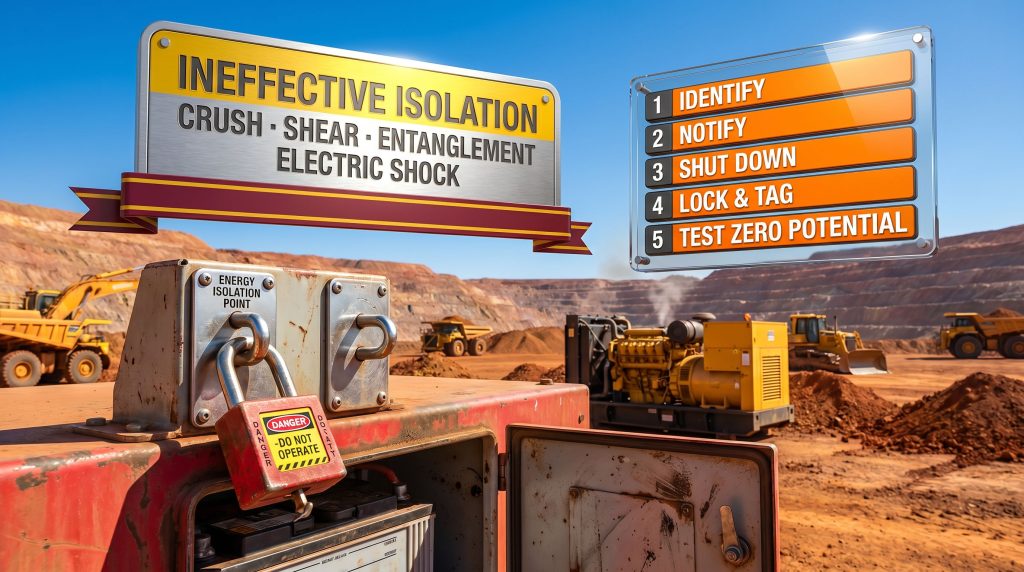
Lock-out tag-out is the foundational procedural control for hazardous energy management across the mining, construction, and manufacturing sectors. When implemented correctly, it creates a physical guarantee that a machine cannot be energised while a worker is exposed. The process operates as a sequential protocol:
- Identify all energy sources across electrical, hydraulic, pneumatic, gravitational, and stored mechanical systems
- Notify all affected personnel in the work area before any isolation activity begins
- Shut the equipment down using its normal operational stopping sequence
- Actuate every isolation device corresponding to each identified energy source
- Apply a personal lock and tag unique to each individual working within the hazard zone
- Test for zero potential by attempting to operate the machine and using instruments to verify no residual energy
- Confirm the isolation is maintained throughout the task, with no locks removed until each individual worker has physically cleared the hazard zone
The critical principle embedded in step five, that each worker applies their own personal lock, is what differentiates robust LOTO from superficial compliance. When a supervisor applies a single shared lock, removing that lock when the supervisor's portion of the job is complete can leave other workers exposed without any physical protection on the isolation point.
Common LOTO Failure Modes in Mining Operations
| Failure Mode | Root Cause | Outcome |
|---|---|---|
| No lockable isolation point | Equipment procured without LOTO compatibility | Workers cannot achieve personal, verified isolation |
| Shared or supervisor-only locks | Single lock applied rather than individual locks for each worker | Re-energisation possible while other workers remain in the hazard zone |
| Incompatible hardware | Site LOTO locks do not physically fit the isolation device | Isolation point left unsecured or procedurally bypassed |
| Inadequate or absent labelling | Isolation points not clearly identified on the equipment | Workers isolate the wrong energy source or miss one entirely |
| Procedural shortcuts under time pressure | Maintenance culture prioritises operational availability over process rigour | Critical isolation steps are skipped during high-demand periods |
| Battery isolator bypass | Battery isolator remains operable after LOTO devices applied | False isolation created on diesel-electric and mobile plant |
The battery isolator failure mode deserves particular attention because it exploits a design gap rather than a purely procedural one. On many heavy mobile machines, the battery isolator is mounted in a location that is accessible and operable independently of the main LOTO attachment point. If a site's LOTO procedure does not explicitly address the battery isolator as a separate, lockable energy source, and if the isolator itself lacks a hasp or lock receiver, then the procedure is structurally incomplete regardless of how diligently workers follow it.
The Compliance Action Framework: What Operators Must Do Now
The Queensland mine isolation safety warning carries practical obligations for every operator running surface mining or quarrying activities in the state. The following framework translates the RSHQ directive into actionable steps:
- Step 1: Site-wide plant audit. Compile a complete register of all generating plant and mobile equipment currently in operational service. This register must be comprehensive, including hired-in equipment and any plant that has recently returned from servicing or procurement.
- Step 2: Isolation facility assessment. For each item of plant, physically verify the presence of a labelled, lockable isolation point for every identified energy source. Confirm that the site's standard LOTO hardware is compatible with each isolation device.
- Step 3: Remove non-compliant plant from service. Any equipment that fails the assessment must be stood down immediately. It must not return to operational use until remediation, whether retrofit or replacement, has been completed and verified.
- Step 4: Strengthen procurement controls. Establish a pre-commissioning isolation compliance checklist as a mandatory gateway before any new plant enters service. Procurement specifications should explicitly define minimum LOTO compatibility requirements.
- Step 5: Update the Safety and Health Management System. Document all findings, corrective actions, and revised procedures within the formal SHMS. Ensure the system reflects current plant configurations and that isolation procedures are version-controlled and accessible to all relevant personnel.
Compliance Warning: A formal safety alert issued by RSHQ is not advisory guidance. Operators who do not act on the directives contained within it may face intensified regulatory scrutiny, enforcement action under Queensland mining legislation, and, far more gravely, the preventable death or serious injury of a worker.
The next major ASX story will hit our subscribers first
How Queensland's Standards Align with National and International Benchmarks
Queensland's prescriptive approach to energy isolation places it broadly in alignment with, and in some areas ahead of, both national and international frameworks. The AS/NZS 4024 Safety of Machinery series provides the applicable Australian standard for machinery safety and energy control, establishing technical requirements for the design and placement of isolation devices on plant. Queensland's guidance through QGN02 operationalises these technical standards within the specific context of mining environments. Furthermore, the broader mining industry evolution continues to raise expectations around equipment design, regulatory alignment, and safety performance across all jurisdictions.
At the national level, Safe Work Australia's Model Work Health and Safety Regulations set a performance-based baseline that all jurisdictions are expected to implement, though the prescriptive depth of Queensland's mining-specific framework goes further than the general WHS model in many respects.
Internationally, the United States Occupational Safety and Health Administration standard OSHA 29 CFR 1910.147, titled The Control of Hazardous Energy, is widely regarded as the global benchmark for LOTO regulation. It mandates documented energy control procedures, authorised employee training, and periodic inspections of energy control programs. Queensland's requirements under QGN02 and the mining safety legislation share significant conceptual alignment with this standard, particularly around positive isolation, personal lock application, and zero energy verification.
One area where Australian practice continues to evolve is the treatment of complex mobile equipment with integrated multi-system energy profiles, precisely the category that generated the most significant findings in the June 2026 Queensland mine isolation safety warning. Regulatory guidance in this space is still catching up with equipment complexity.
Frequently Asked Questions: Queensland Mine Isolation Safety Warning
What is the Queensland mine isolation safety warning about?
Resources Safety and Health Queensland issued a formal safety alert in June 2026 following site inspections at Queensland surface mines and quarries that identified widespread failures in energy isolation practices. Inspectors found equipment with no lockable isolation points, isolation mechanisms incompatible with site LOTO procedures, and battery isolators on heavy mobile plant that remained operable even after personal lock-out devices had been applied. The alert directed Site Senior Executives to audit all generating and mobile plant and remove non-compliant equipment from service.
Who is legally responsible for isolation compliance at a Queensland mine site?
The Site Senior Executive holds the primary legal accountability under Queensland mining legislation and is the individual to whom RSHQ's directives are addressed. Below the SSE, mine operators carry organisational responsibility for ensuring that equipment meets compliance standards, that SHMS procedures are current and enforceable, and that procurement controls prevent non-compliant plant from entering service. Individual workers also carry personal duty of care obligations under the legislation, but the systemic responsibility sits with the SSE and the operator.
What injuries can result from ineffective plant isolation?
The hazards created by inadequate isolation during maintenance include:
- Crush injuries from moving components such as rams, conveyors, or rotating assemblies that re-energise unexpectedly
- Shear injuries from cutting or scissor-action mechanisms
- Entanglement in rotating shafts, augers, or drive components
- Injection injuries from pressurised hydraulic fluid released at high velocity, which can penetrate skin and cause severe internal tissue damage
- Electric shock and electrocution from live electrical circuits or re-energised battery systems
What is a lockable isolation facility?
A lockable isolation facility is an energy isolation point on a piece of plant that is specifically designed to accept a physical padlock or LOTO hasp, preventing the isolation device from being returned to the energised position while the lock is in place. Under Queensland's QGN02 guidance, every energy source on a piece of plant must have a clearly labelled, dedicated isolation point that is compatible with the site's standard LOTO equipment.
What should an operator do if a piece of equipment has no lockable isolation point?
The equipment must be removed from operational service immediately. The SSE must be notified, and a remediation pathway, either retrofitting a compliant isolation facility or procuring a replacement machine, must be initiated before the equipment returns to use. Continuing to operate non-compliant plant after a formal RSHQ safety alert constitutes a failure to act on regulatory direction.
Can mobile plant be used if its battery isolator is incompatible with the site's LOTO system?
No. The RSHQ position, as communicated through the June 2026 safety alert, is that incompatible isolation systems represent an unacceptable risk to workers. Mobile plant where the battery isolator can be operated after personal lock-out devices have been applied must be stood down until the incompatibility is resolved. This is not a discretionary judgement for the operator. It is a regulatory direction.
Building Isolation Compliance Into Operational Culture
The findings underlying the Queensland mine isolation safety warning point to something more systemic than a collection of faulty machines. They point to gaps in procurement gatekeeping, gaps in SHMS review cycles, and gaps in the cultural priority given to isolation compliance during maintenance planning. Equipment that lacks a lockable isolation point did not acquire that deficiency after it arrived on site. It arrived that way, which means procurement processes failed to screen for compliance before the machine entered service.
Addressing this requires mine operators to treat isolation compliance as a design and acquisition standard, not merely an operational procedure. Minimum specifications for LOTO compatibility should be embedded into purchase orders, hire agreements, and commissioning checklists with the same rigour applied to structural certifications or load ratings. In this regard, data-driven mining operations offer considerable promise, as real-time asset tracking and compliance monitoring systems can flag non-conforming plant before it ever reaches the work face.
Strategic Perspective: The cost of retrofitting a non-compliant isolation point, or standing down a piece of plant for remediation, is measurable and finite. The cost of a fatality or serious injury, measured in human terms, regulatory consequences, production downtime, and reputational damage to the broader sector, is neither finite nor recoverable. The business case for proactive compliance is not a close one.
The RSHQ alert also reinforces a principle that experienced safety professionals have long argued: a Safety and Health Management System that is not regularly reviewed against current plant configurations and emerging regulatory guidance is a document, not a system. The June 2026 alert should serve as a mandatory trigger for SHMS review at every Queensland surface mining and quarrying operation, regardless of whether the specific deficiencies were observed at that site. Consequently, the principles of mining sustainability transformation and mining risk management are deeply intertwined with how effectively operators embed safety compliance into their long-term operational frameworks.
Isolation failures that result in serious injury carry consequences that extend beyond the individual operation. They affect the sector's credibility with regulators, communities, and the workers who rely on the industry for their livelihoods. Furthermore, regulators have made clear through recognised safety and health standards that compliance expectations are non-negotiable, and that operators must ensure energy sources are verified as isolated before work commences. Getting isolation right is not a compliance exercise. It is the foundation of a social licence to operate.
This article is intended for informational purposes only and does not constitute legal advice. Operators should consult directly with Resources Safety and Health Queensland and qualified safety professionals when assessing compliance obligations under Queensland mining legislation. Readers seeking further guidance on energy isolation requirements can access QGN02: Isolation of Plant through the official RSHQ website.
Want to Stay Ahead of Significant ASX Mineral Discoveries as They Happen?
While Queensland operators work to strengthen safety and compliance frameworks across their operations, Discovery Alert's proprietary Discovery IQ model scans ASX announcements in real time, instantly identifying significant mineral discoveries and turning complex data across more than 30 commodities into clear, actionable insights for investors at every level. Explore historic examples of major discovery returns and begin your 14-day free trial today to position yourself ahead of the broader market.