June 9, 2026
The Hidden Feedstock Rewriting America's Rare Earth Supply Chain
For most of the past century, the relationship between industrial nations and rare earth elements followed a predictable logic: extract ore from the ground, refine it, and manufacture with it. What was left behind was considered waste. Today, that assumption is being structurally dismantled, not by a change in geology, but by a change in economic urgency.
The United States currently imports the overwhelming majority of its processed rare earth materials, with China controlling an estimated 85% to 90% of global rare earth refining capacity. This is not a mining problem. The U.S. has mineable rare earth deposits. The bottleneck sits firmly at the processing and separation stage, where decades of offshoring have left American manufacturers dangerously exposed. What makes the ElementUSA rare earth processing facility in Louisiana significant is not just its ambition, but its approach: instead of waiting for new mines to come online, it draws its feedstock from industrial residue that has been accumulating for decades.
When big ASX news breaks, our subscribers know first
Red Mud: From Environmental Liability to Strategic Mineral Feedstock
Bauxite residue, colloquially known as red mud, is generated during the Bayer process used to refine alumina from bauxite ore. For every tonne of alumina produced, approximately one to two tonnes of red mud are generated as a caustic, iron-rich slurry. Global alumina production has been running at hundreds of millions of tonnes annually for decades, and the cumulative result is an estimated 4 billion tons of bauxite residue stockpiled at sites across the world.
For most of that time, red mud was classified purely as a liability. It requires engineered containment, poses alkalinity risks to surrounding environments, and has resisted cost-effective large-scale remediation. What changed is the analytical lens applied to its mineral content. The bauxite industry overview reveals how central alumina refining has been to creating these vast legacy stockpiles.
Modern assaying of bauxite residue has confirmed commercially relevant concentrations of rare earth elements, including heavy rare earths such as dysprosium, gadolinium, and ytterbium, alongside gallium, scandium, yttrium, germanium, and iron. Crucially, many of these elements are now designated as critical minerals by the U.S. government, meaning their domestic supply is considered strategically important to defence, energy, and advanced manufacturing sectors.
Bauxite residue is not a conventional ore deposit. It is an engineered accumulation of refining byproduct, which means the infrastructure surrounding it already exists, the feedstock requires no new land disturbance to access, and the environmental calculus shifts from liability to remediation benefit.
How Does Bauxite Residue Compare to Traditional Rare Earth Ore?
| Characteristic | Conventional REE Deposits | Bauxite Residue (Red Mud) |
|---|---|---|
| Feedstock origin | Mined from primary ore | Industrial refining byproduct |
| Infrastructure requirement | New mine development needed | Existing stockpiles already in place |
| Environmental footprint | High (land disturbance, tailings) | Lower (waste remediation model) |
| Payable metals recovery | Varies by deposit | >95% across iron, REEs, and critical minerals |
| Global availability | Geographically concentrated | ~4 billion tons estimated globally |
The >95% payable metals recovery figure cited by ElementUSA is particularly notable. Conventional hard rock rare earth mining operations frequently contend with complex mineralogy, variable grades, and significant mass loss during beneficiation before any hydrometallurgical processing even begins. A feedstock that has already been mechanically and thermally processed retains a degree of chemical accessibility that primary ore bodies often do not.
Why St. John the Baptist Parish Is the Right Place to Start
The ElementUSA rare earth processing facility in Louisiana is being developed at a site in St. John the Baptist Parish, a location chosen with deliberate strategic logic. The parish sits along the Mississippi River industrial corridor, which provides unmatched logistical infrastructure for heavy industrial operations: barge access, pipeline networks, proximity to Gulf Coast ports, and a deep-rooted workforce with chemical processing experience.
Critically, the site provides access to approximately 34 million tons of on-site bauxite residue, a legacy stockpile from historical alumina refining operations at the Gramercy alumina plant. This is not theoretical feedstock that needs to be sourced and transported. It sits adjacent to where the processing facility will be built, significantly de-risking the supply chain for the facility's input material.
Louisiana's industrial corridor also offers existing utility connections, established environmental permitting frameworks for heavy processing, and proximity to downstream steel and manufacturing industries that would consume the pig iron co-product. The decision to site a demonstration and commercial facility here reflects an understanding that processing infrastructure is only viable when logistics costs are structurally manageable.
How ElementUSA's Processing Technology Converts Red Mud Into Critical Minerals
The technological core of the ElementUSA approach combines two established but typically separate processing disciplines into a single integrated flowsheet. Furthermore, understanding the broader context of rare earth processing challenges helps illustrate why this dual-method integration represents a meaningful technical advance.
Hydrometallurgical processing uses aqueous chemical solutions, typically acid or alkaline leach systems, to selectively dissolve target metals from solid material into solution, from which they can be precipitated, extracted, or refined into final products.
Pyrometallurgical processing applies high-temperature thermal treatment, essentially smelting, to transform raw feedstock into usable metal or intermediate products through heat-driven chemical reactions.
ElementUSA's integrated flowsheet applies both methodologies in sequence to the same bauxite residue input. The step-by-step process works as follows:
- Feedstock preparation – Bauxite residue is conditioned, dewatered where necessary, and prepared for thermal treatment.
- Pyrometallurgical smelting – The conditioned residue is subjected to high-temperature processing that drives iron reduction, producing pig iron as a primary co-product and generating a slag phase enriched in rare earth elements and other critical minerals.
- Hydrometallurgical leaching – The REE-enriched slag or processed residue undergoes aqueous leaching to selectively dissolve rare earth elements, gallium, scandium, yttrium, germanium, and related critical minerals into solution.
- Separation and purification – Solvent extraction, ion exchange, or precipitation techniques are applied to isolate individual element streams from the leach solution, producing a mixed rare earth oxide basket with strong heavy REE and yttrium content, alongside discrete gallium, scandium, and other critical mineral streams.
- Final product output – The facility delivers pig iron for steel industry consumption, mixed rare earth oxides for magnet and advanced materials supply chains, and separated critical mineral products for semiconductor, aerospace, and defence applications.
What makes the dual-flowsheet approach strategically important is that pig iron is not a secondary consideration. It is an economically significant co-product that helps underpin project economics, potentially making rare earth and critical mineral recovery financially viable at price points where a single-product rare earth facility might struggle.
The Federal Investment Case: DOE and DOD Awards
The ElementUSA Louisiana project carries a multi-agency federal investment footprint that reflects the breadth of strategic interest in its output. According to Reuters, the project is among a select few to secure this level of combined federal support for domestic rare earth processing.
| Funding Source | Award Amount | Focus Area |
|---|---|---|
| U.S. Department of Energy | $67 million | REE facility design, construction, commissioning, and operation |
| Department of Defense | $29.9 million | Gallium and scandium recovery and commercialisation |
| Total federal awards | ~$97 million | Combined multi-agency investment |
| Full facility investment decision | $850 million | Broader commercial-scale Louisiana refining facility |
The DOD award predates the DOE announcement and specifically targets gallium and scandium, two materials where U.S. import dependence has become acute. China produces approximately 80% of the world's gallium and has historically dominated scandium supply. Both materials are essential for semiconductors, III-V compound devices, solid-state lighting, and high-strength aerospace aluminium-scandium alloys. In addition, the growing critical minerals for semiconductors agenda makes domestic gallium and scandium production a matter of national industrial policy.
The DOE award expands the project's scope to encompass the full rare earth oxide basket, with particular emphasis on heavy rare earths. This distinction matters because heavy rare earths — which include dysprosium and terbium — are required in the high-performance permanent magnets used in electric vehicle motors and wind turbine generators, and are substantially harder to source domestically than light rare earths such as neodymium and praseodymium.
The participation of Colorado School of Mines as a research partner adds technical validation to the commercial development pathway. The DOE's $67 million award to ElementUSA and Colorado School of Mines underscores the federal government's confidence in the integrated processing approach. Colorado School of Mines has been involved in federally funded critical minerals research for years, and its expertise in hydrometallurgical processing, mineralogy, and separation science provides academic rigour to a project that will need to demonstrate reproducible performance at scale.
What the Louisiana Facility Could Actually Supply
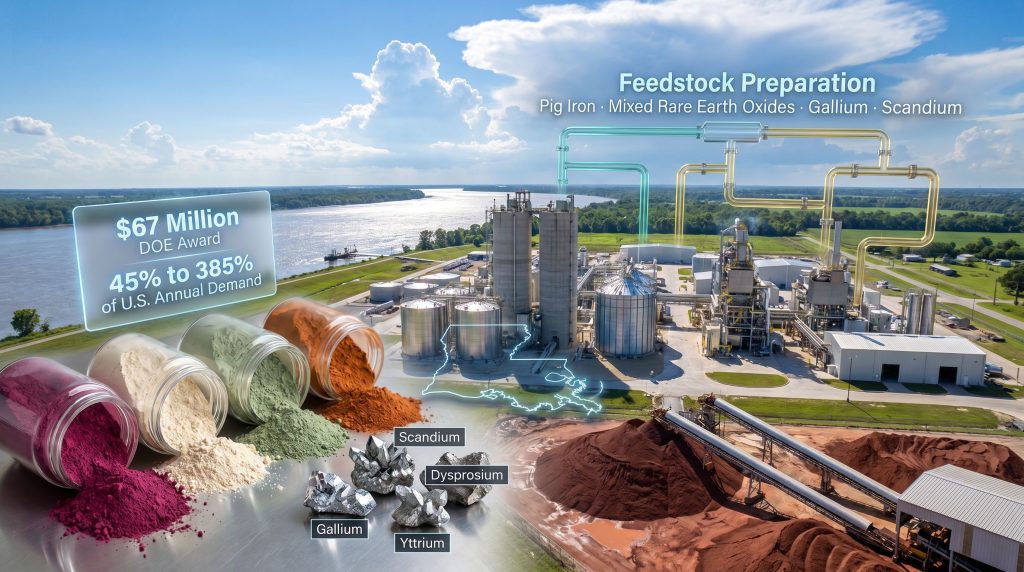
At full commercial scale, processing approximately 1 million tons of bauxite residue per year, the ElementUSA Louisiana facility has been assessed as capable of supplying between 45% and 385% of current U.S. annual demand for gallium, scandium, yttrium, germanium, ytterbium, dysprosium, and gadolinium.
The wide range of that percentage band reflects the relatively small absolute size of U.S. annual consumption for several of these elements. Gallium and scandium, for example, are consumed in relatively modest quantities nationally, meaning a single large-scale production facility can meaningfully shift the domestic supply balance. The output profile covers:
| Output Category | Specific Elements | Strategic Application |
|---|---|---|
| Iron co-product | Pig iron | Steel manufacturing, industrial inputs |
| Light rare earths | Neodymium, praseodymium | Permanent magnets, EV motors |
| Heavy rare earths | Dysprosium, gadolinium, ytterbium | High-performance magnets, medical imaging |
| Specialty critical minerals | Gallium, scandium, germanium | Semiconductors, aerospace alloys, electronics |
| Other REEs | Yttrium | Phosphors, ceramics, energy systems |
Gadolinium deserves specific mention as an element whose strategic significance is often underappreciated. Beyond its role in rare earth magnets, gadolinium is essential in MRI contrast agents and is being researched for use in next-generation nuclear reactor shielding and neutron capture applications. Domestic production capability for gadolinium has been effectively nonexistent.
The next major ASX story will hit our subscribers first
Development Timeline and the Path to Commercial Scale
The project is progressing through a structured, phased development sequence:
| Development Phase | Target Timeline | Key Milestone |
|---|---|---|
| Phase 1 groundbreaking | Mid-2026 | Scale-up construction commences |
| Demonstration facility construction | Mid-2027 | Pilot-scale processing infrastructure complete |
| Initial production commencement | Q3 2028 | First REE and critical mineral output |
| Full commercial-scale operation | Long-term target | ~1 million tons/year bauxite residue processing |
The distinction between the demonstration facility and the full commercial plant is more than semantic. A demonstration facility establishes that the integrated flowsheet produces the expected output at meaningful throughput volumes, providing the performance data necessary to justify the full $850 million investment decision for the commercial plant. It also allows process optimisation and equipment specification refinement before capital is committed at scale.
This phased approach — de-risking through demonstration before committing to commercial capital — is the standard model for novel processing technology deployment and reflects disciplined project development rather than speculative ambition.
Economic Impact: Jobs, Regional Growth, and Industrial Diversification
The employment projections associated with the ElementUSA Louisiana facility reflect a meaningful regional economic contribution:
- 200 direct jobs anticipated from facility operations, concentrated in skilled chemical processing, engineering, and technical roles.
- 754 total potential jobs when indirect and induced employment multiplier effects are applied across the regional economy.
- St. John the Baptist Parish, which has experienced economic displacement from the decline of legacy industrial activity, stands to benefit from a new skilled manufacturing base that does not depend on commodity extraction from virgin land.
Louisiana's broader industrial diversification ambitions align with the project's profile. The state has long sought to transition portions of its industrial economy from legacy petrochemical activities toward advanced materials and manufacturing, and a rare earth and critical minerals processing facility anchored by existing infrastructure fits that strategic direction.
How ElementUSA's Waste-Stream Model Compares to Alternative Domestic REE Pathways
| Approach | Example | Feedstock Type | Development Stage |
|---|---|---|---|
| Primary REE mining | MP Materials (Mountain Pass) | Virgin ore | Operating |
| Coal/mining waste recovery | Various DOE-funded projects | Coal byproducts | Pilot/demo |
| Bauxite residue recovery | ElementUSA (Louisiana) | Industrial waste | Demonstration to Commercial |
| REE recycling | Multiple startups | End-of-life products | Early-stage |
The comparative advantage of waste-stream processing over greenfield mining is not merely environmental optics. A greenfield rare earth mine requires years of exploration, permitting, feasibility study, financing, and construction before the first tonne of ore is processed. Bauxite residue feedstock, however, already sits in permitted containment facilities with known volumes and accessible chemistry. The development timeline compresses substantially.
Recycling of rare earths from end-of-life products remains the most circular approach but is constrained by collection infrastructure limitations, low REE concentrations in most end-of-life materials, and the complexity of separating mixed alloys and magnets at scale. Industrial waste streams like red mud occupy a practical middle ground: large volumes, known composition, and existing site infrastructure.
The Global Scale of the Bauxite Residue Opportunity
The Louisiana project represents the first commercial-scale demonstration of the ElementUSA process platform, but the company has indicated that the technology is designed to be deployable at other bauxite residue sites globally. This matters because the 4 billion ton global inventory of bauxite residue is not concentrated in Louisiana or even in the United States.
Major bauxite residue stockpiles exist in Australia, Jamaica, Brazil, Guinea, India, and across European alumina-producing nations. Several of these locations face significant environmental management costs and regulatory pressure around containment, and a processing model that converts liability into revenue-generating mineral output could be commercially compelling in multiple jurisdictions simultaneously.
The dual benefit framework — producing critical minerals while remediating industrial waste — addresses two policy priorities at once. Consequently, it may prove attractive to national governments seeking domestic critical mineral supply without the political and environmental complexity of opening new mines. The broader critical minerals demand surge underpinning these decisions shows no sign of slowing, and the rare earth supply chain pressures driving federal investment are only intensifying.
Disclaimer: This article contains forward-looking projections regarding production capacity, employment, and supply contribution percentages. These figures are based on company assessments and feasibility analyses and should not be interpreted as guaranteed outcomes. Investors and stakeholders should conduct independent due diligence before drawing conclusions about project performance or commercial viability.
Frequently Asked Questions: ElementUSA Rare Earth Processing Facility in Louisiana
What is the ElementUSA Louisiana facility designed to produce?
The facility is designed to produce pig iron as a primary co-product alongside a mixed rare earth oxide basket, with emphasis on heavy rare earth content including dysprosium, gadolinium, and ytterbium, plus discrete critical mineral streams including gallium, scandium, yttrium, and germanium.
How is bauxite residue different from traditional rare earth mining ore?
Bauxite residue is an industrial byproduct generated during alumina refining, not a primary geological deposit. It requires no new mining activity to access, already exists in large volumes at permitted industrial sites, and contains commercially relevant concentrations of rare earths and critical minerals that were historically not recovered.
What federal agencies are funding the ElementUSA Louisiana project?
The project has received a $67 million award from the U.S. Department of Energy for the rare earth processing facility, and a separate $29.9 million award from the Department of Defense focused specifically on gallium and scandium recovery and commercialisation.
When will the ElementUSA Louisiana facility begin production?
Based on the published development timeline, the demonstration facility is targeted for construction completion around mid-2027, with initial production of rare earth elements and critical minerals expected in Q3 2028.
How many jobs will the Louisiana rare earth processing plant create?
The project is expected to generate approximately 200 direct employment positions, with total potential employment reaching 754 jobs when regional indirect and induced economic multiplier effects are included.
What makes the St. John the Baptist Parish site strategically valuable?
The site provides direct access to approximately 34 million tons of on-site bauxite residue, Mississippi River logistics infrastructure, established heavy industrial utility connections, and proximity to downstream steel and manufacturing consumers of the pig iron co-product.
Can the ElementUSA process be replicated at other bauxite residue sites globally?
ElementUSA has indicated that the integrated hydrometallurgical and pyrometallurgical process platform is designed for deployment at other bauxite residue resources worldwide, where an estimated 4 billion tons of accumulated material presents a large-scale replication opportunity.
Want to Stay Ahead of the Next Major Mineral Discovery on the ASX?
Discovery Alert's proprietary Discovery IQ model delivers real-time alerts on significant ASX mineral discoveries across critical minerals, rare earths, and beyond — turning complex data into actionable investment insights for both short-term traders and long-term investors. Explore historic examples of exceptional discovery returns and begin your 14-day free trial today to position yourself ahead of the broader market.