May 24, 2026
When Sovereign Energy Assets Become Geopolitical Battlegrounds
Across the post-colonial world, the ownership of critical energy infrastructure has rarely been a purely commercial matter. When a refinery sits at the intersection of civil war, foreign military alliances, and contested national legitimacy, arbitration clauses and feedstock agreements become instruments of sovereignty. The Ras Lanuf refinery dispute in Libya is one of the most instructive examples of this phenomenon in the modern era, combining international arbitration, armed conflict, and Gulf geopolitics into a dispute that took nearly two decades to resolve.
When big ASX news breaks, our subscribers know first
Libya's Oil Crescent and the Strategic Weight of Ras Lanuf
To understand why the Ras Lanuf refinery dispute in Libya commanded such intense attention, it helps to understand the facility's position within the country's energy geography. Libya's northeastern coastline hosts a dense concentration of upstream and downstream oil assets collectively referred to as the "oil crescent," a corridor stretching from Brega eastward toward Ras Lanuf and Sidra. This strip of coastline has functioned as both the economic engine of the Libyan state and its most contested military terrain.
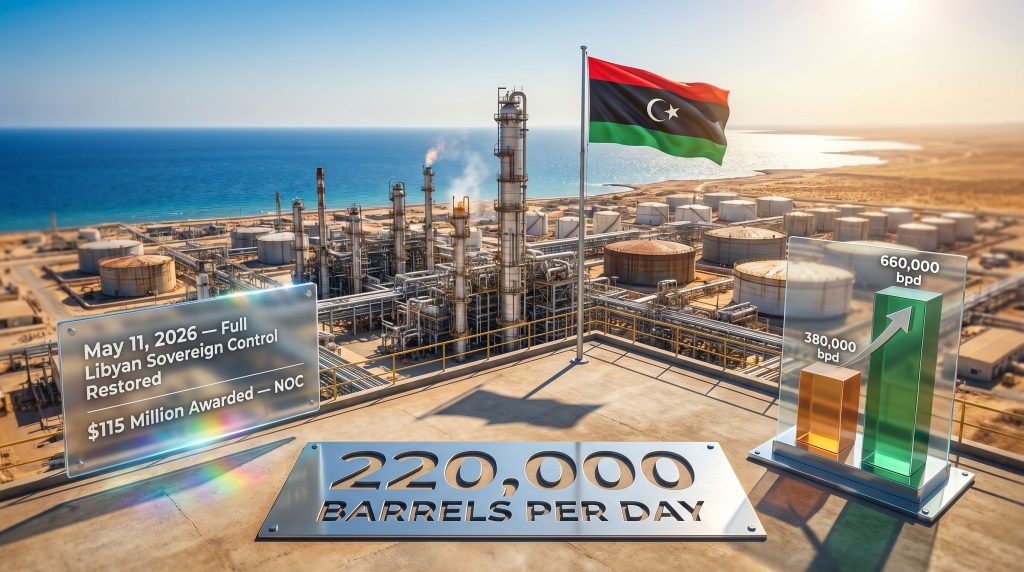
The Ras Lanuf complex sits at the heart of this zone, operating a refinery with a nominal processing capacity of 220,000 barrels per day. Beyond its throughput numbers, the facility also houses petrochemical production units, making it one of the few downstream assets in Libya capable of generating value beyond crude oil export revenues. For a country that has historically exported raw crude and imported refined petroleum products, the refinery represents a rare but underdeveloped opportunity for domestic value capture.
The National Oil Corporation's long-term ambition to scale Libya's total refining capacity from approximately 380,000 barrels per day to 660,000 barrels per day places Ras Lanuf at the centre of the country's industrial strategy. Without this facility operating at nameplate capacity, that target remains structurally unachievable.
The 2008 Partnership: Architecture of a Future Dispute
How LERCO Was Structured
On 14 July 2008, the NOC signed a shareholders' agreement with Trasta Energy, a Dubai-incorporated vehicle established just one month earlier as a subsidiary of the Al Ghurair Investment Group, one of the UAE's most prominent diversified conglomerates. The resulting entity, the Libyan Emirates Oil Refining Company (LERCO), was structured as a 50/50 joint venture with a planned total investment of approximately $2 billion.
By March 2009, when LERCO formally assumed ownership and operational control of the refinery, Trasta had injected $175 million into the venture. Simultaneously, the parties entered into a Feedstock Supply Agreement (FSA) committing the NOC to delivering crude oil to LERCO for 25 years at a fixed but undisclosed price.
| Structural Element | Detail |
|---|---|
| Joint Venture Entity | Libyan Emirates Oil Refining Company (LERCO) |
| Ownership Structure | 50% NOC / 50% Trasta Energy |
| Trasta Parent | Al Ghurair Investment Group (UAE) |
| Planned Investment | ~$2 billion |
| Trasta Capital Injected | $175 million |
| Crude Supply Term | 25-year Feedstock Supply Agreement |
| Refinery Capacity | 220,000 barrels per day |
The Feedstock Clause That Would Define the Conflict
The confidential pricing embedded in the FSA proved to be the structural fault line of the entire partnership. Crude supply agreements with fixed pricing over multi-decade horizons are relatively common in downstream joint ventures, but they carry substantial political risk in resource-nationalist environments. The fact that the terms were never made public made the arrangement particularly vulnerable to post-revolution scrutiny, as successor governments lacked transparency over what exactly had been committed on behalf of the Libyan state.
Furthermore, state oil policy shifts in the broader region have demonstrated repeatedly that fixed-price arrangements negotiated under previous political regimes become flashpoints when new governments seek to reassert sovereign control over energy assets.
Key Insight: Fixed-price crude supply agreements in state-owned downstream joint ventures are a well-known source of long-term political friction, especially where the pricing terms were negotiated under previous political regimes without public disclosure.
Civil War as a Commercial Turning Point
The 2011 Rupture and Its Downstream Consequences
When Libya's uprising began in February 2011, the Ras Lanuf refinery shut down entirely alongside the broader collapse of Libyan oil infrastructure. The fall of Muammar Gaddafi's government by October 2011 triggered a systematic review of agreements signed under the former regime, placing the LERCO partnership directly in the crosshairs of Libya's transitional authorities.
A partial resumption of refinery operations occurred in late August 2012, though conditions remained deeply unstable. Libya's post-revolution security environment had fragmented rapidly, with armed militias, regional factions, and tribal networks filling the vacuum left by the collapsed state apparatus. Operating a 220,000 bpd refinery under such conditions was inherently precarious.
April 2013: Worker Protests Force the Issue into the Open
The commercial tension became impossible to contain when, on 4 April 2013, refinery workers staged public protests outside NOC headquarters. Their core grievance centred on what they characterised as disproportionately favourable terms granted to the Emirati operator, with particular opposition directed toward a proposed 20-month extension of the original crude supply contract. Under significant pressure, the NOC agreed to review the arrangement, but the review process accelerated rather than defused the conflict.
By late August 2013, the NOC had ceased crude oil deliveries to LERCO entirely, bringing all refining operations to a standstill. LERCO responded by declaring force majeure, framing the shutdown as commercially rather than operationally motivated, which laid the legal groundwork for the arbitration proceedings that followed.
Nearly a Decade of International Arbitration
Dual ICC Proceedings and Their Unexpected Outcome
Both Trasta Energy and LERCO independently initiated arbitration before the International Chamber of Commerce (ICC) in Paris toward the end of 2013. The scale of the competing claims was significant:
- LERCO sought approximately $812 million in damages from the NOC
- Trasta filed a separate claim exceeding $100 million
- The NOC simultaneously pursued recovery of unpaid crude oil invoices
What makes the ICC outcome particularly notable is that the tribunal ultimately dismissed every claim filed by both LERCO and Trasta. In November 2017, the ICC rejected Trasta's individual arbitration claim. On 5 January 2018, it dismissed all of LERCO's claims. Within weeks, in February 2018, the same arbitral process awarded the NOC $115 million plus interest for unpaid crude oil supplies, a figure that had grown to more than $132 million by February 2021 as interest accrued.
The French Court Proceedings That Made the Awards Enforceable
International arbitration awards are only as powerful as the judicial systems willing to enforce them. The Paris Court of Appeal became the critical arena in which LERCO and Trasta attempted to overturn the ICC rulings.
| Proceeding | Date | Outcome |
|---|---|---|
| Paris Court of Appeal (Ras Lanuf shutdown ruling) | February 2021 | ICC award upheld; NOC claim made internationally enforceable |
| Second ICC Arbitral Award | 21 February 2022 | Trasta ordered to transfer its full 50% LERCO stake to the NOC |
| Trasta Annulment Application | Filed post-February 2022 | Rejected in full |
| Paris Court of Appeal (annulment ruling) | 23 May 2023 | February 2022 award confirmed; Trasta ordered to pay NOC €100,000 in legal costs |
Each failed appeal strengthened the NOC's legal position and progressively narrowed Trasta's strategic options. By mid-2023, with annulment proceedings exhausted and French courts having confirmed both major ICC awards, the path toward a negotiated transfer had become the only commercially rational route available to the Emirati group.
The Geopolitical Layer: Why UAE Ownership Was Always Sensitive
Khalifa Haftar and the UAE Connection
Understanding why the Ras Lanuf refinery dispute in Libya attracted such sustained attention requires acknowledging a dimension that conventional contract law cannot capture. Ras Lanuf sits within territory that has been repeatedly contested by forces aligned with Khalifa Haftar, the eastern Libyan military commander whose forces have exercised significant control over the oil crescent region at various points since 2014.
The UAE has been a documented supporter of Haftar's military campaign, providing material assistance that the Tripoli-based Government of National Accord viewed as a direct threat to its authority. Consequently, from Tripoli's perspective, a 50% Emirati corporate stake in one of Libya's most strategically sensitive downstream facilities was not merely a commercial arrangement. It represented a potential vector of foreign influence embedded at the heart of the country's energy infrastructure. The broader geopolitical landscape of resource nationalism across the region has further reinforced how deeply political these ownership structures can become.
Geopolitical Framing: The presence of an Emirati partner in a facility located within Haftar-controlled territory created a structural alignment risk that Tripoli's government found untenable regardless of the commercial merits of the original joint venture.
The $10 Billion Liability Calculation That Accelerated Settlement
Libyan officials have indicated that an adverse legal outcome in the arbitration proceedings could have exposed the state to liability claims potentially exceeding $10 billion. This figure is not merely rhetorical. When refinery lost-profits claims, investment recovery demands, and consequential damages are aggregated across a 25-year crude supply commitment with a captive operator, the financial exposure for a breach-of-contract scenario can reach extraordinary levels.
This liability calculus fundamentally shaped the NOC's negotiating posture throughout the post-2023 period. Winning the arbitration was legally important, but the equally urgent objective was finalising a transfer that eliminated the residual risk of Trasta launching fresh legal action under alternative jurisdictions or treaty frameworks.
The next major ASX story will hit our subscribers first
The May 2026 Transfer and What Comes Next
Terms of the Final Agreement
On 11 May 2026, the NOC signed a final agreement with Trasta Energy formally transferring the Emirati company's entire 50% stake in LERCO to the Libyan state. The Ras Lanuf complex returned to full Libyan sovereign ownership for the first time since 2009, a transition that NOC Chairman Masoud Suleman described as one of the most consequential developments for the Libyan oil sector since the 2011 revolution.
Financial Summary of the Dispute
| Financial Element | Amount |
|---|---|
| Trasta's initial capital injection into LERCO | $175 million |
| LERCO's arbitration damages claim | ~$812 million |
| Trasta's separate arbitration claim | >$100 million |
| NOC awarded for unpaid crude supplies (2018) | $115 million + interest |
| Total owed to NOC by February 2021 | >$132 million |
| Legal costs awarded to NOC (May 2023) | €100,000 |
| Estimated refinery restart/maintenance cost | ~$60 million |
| Potential state liability if NOC had lost | >$10 billion |
Rehabilitation Pathway and Capacity Targets
The NOC has set a target of restarting refinery operations within 12 months of the agreement, with maintenance and restart costs estimated at approximately $60 million. Successfully bringing Ras Lanuf back to nameplate capacity would represent a ~58% increase in Libya's available refining throughput relative to current national capacity of around 380,000 barrels per day, moving the country meaningfully toward its stated target of 660,000 barrels per day.
However, legal ownership and operational restoration are fundamentally different challenges. The facility has experienced:
- Extended dormancy spanning more than a decade
- Conflict-related physical damage from multiple phases of fighting in the oil crescent
- Significant deferred maintenance accumulated since the 2013 shutdown
- Loss of experienced operational personnel during years of inactivity
Securing $60 million in rehabilitation financing, establishing reliable security arrangements in a region still subject to factional contestation, and identifying qualified operational partners capable of running a complex petrochemical facility will determine whether the 2026 agreement produces tangible energy output or remains a legal victory without industrial consequence.
Chronological Record of the Dispute
- July 2008 – NOC and Trasta Energy sign shareholders' agreement; LERCO established
- March 2009 – LERCO assumes ownership and operation of Ras Lanuf refinery
- February 2011 – Civil war forces complete shutdown of refinery operations
- August 2012 – Partial operational restart under fragile security conditions
- April 2013 – Worker protests publicly challenge Emirati partnership terms
- August 2013 – NOC halts crude supply deliveries; LERCO declares force majeure
- Late 2013 – Dual ICC arbitration proceedings launched in Paris
- November 2017 – ICC rejects Trasta's individual arbitration claim
- January 2018 – ICC dismisses all LERCO claims
- February 2018 – NOC awarded $115 million for unpaid crude supplies
- February 2021 – Paris Court of Appeal upholds ICC ruling; award made internationally enforceable
- February 2022 – Second ICC award orders Trasta to surrender its 50% LERCO stake
- May 2023 – Paris Court of Appeal rejects Trasta's annulment application; €100,000 in costs awarded to NOC
- May 2026 – Final transfer agreement signed; full Libyan sovereign control restored
What This Resolution Means for Foreign Investment in Libyan Energy
A Precedent That Will Shape Future JV Negotiations
The LERCO case now constitutes a clear reference point for any foreign entity considering a joint venture with a Libyan state entity. Several lessons emerge from the dispute that carry direct relevance for investment structuring:
-
Political legitimacy risk is distinct from commercial risk. Agreements executed under one political regime carry inherent vulnerability when a successor government questions the legitimacy of the original contracting parties and terms.
-
Fixed-price long-term supply agreements in opaque structures attract post-revolution scrutiny. The undisclosed pricing of the FSA made the partnership politically untenable when public pressure intensified.
-
Force majeure declarations in commercially motivated shutdowns invite legal challenge. LERCO's characterisation of the 2013 shutdown as force majeure rather than a contractual dispute was rejected by the ICC, a distinction that shaped the entire arbitration outcome.
-
The geopolitical alignment of a foreign partner can override the commercial logic of a joint venture. Trasta's UAE parentage in the context of the UAE's documented support for Haftar elevated this from a contract dispute to a sovereignty question.
Libya's Downstream Ambitions in Regional Context
Libya's stated refining target of 660,000 barrels per day would position it as a more significant downstream player within North Africa. Egypt, Algeria, and Morocco have all invested substantially in refining capacity expansion over the past decade. In addition, oil price movements and trade wars and oil supply dynamics will inevitably influence the commercial viability of any rehabilitation programme.
Libya's ability to attract the capital, technical expertise, and security conditions necessary for Ras Lanuf's rehabilitation will determine whether it can participate meaningfully in regional downstream development or remain dependent on importing the refined products it could theoretically be producing from its own crude reserves. Understanding the geopolitical oil price factors at play will be essential for any investor assessing the long-term economics of the facility's restart.
Furthermore, the NOC's restored ownership of the Ras Lanuf complex signals a broader intent to reassert sovereign control over downstream infrastructure, a posture that prospective partners would be prudent to factor into any future joint venture negotiations involving Libyan energy assets.
Investor Note: This article contains forward-looking analysis based on stated NOC targets and publicly available legal and financial data. Actual outcomes regarding refinery rehabilitation timelines, capacity restoration, and financing arrangements remain subject to significant uncertainty given Libya's ongoing political and security dynamics. Nothing in this article constitutes investment advice.
Want to Spot the Next Major Mineral Discovery Before the Market Does?
Discovery Alert's proprietary Discovery IQ model delivers real-time alerts on significant ASX mineral discoveries, turning complex resource data into actionable investment insights — just as geopolitical shifts and sovereign asset disputes continue to reshape global commodity markets. Explore Discovery Alert's discoveries page to understand how historic mineral discoveries have generated substantial returns, and begin your 14-day free trial to position yourself ahead of the broader market.