May 25, 2026
The Architecture of a Failed Partnership: How Libya's Most Contested Refinery Changed Hands
When energy-rich nations strike joint venture deals with foreign capital, the contractual architecture erected in peacetime rarely anticipates what civil conflict can dismantle in weeks. Libya's downstream oil sector offers one of the starkest modern illustrations of this reality. The Ras Lanuf refinery dispute between Libya NOC and Trasta Energy unfolded across 13 years, three arbitral proceedings, two French court battles, and one civil war, producing a legal outcome that few observers predicted when the joint venture was first announced in 2008.
Understanding this dispute requires more than tracking its legal chronology. It demands an examination of how fixed-price commodity contracts interact with geopolitical rupture, how force majeure declarations transform commercial grievances into arbitral weapons, and why the choice of international arbitration over unilateral state action ultimately determined the outcome.
When big ASX news breaks, our subscribers know first
The Strategic Weight of the Ras Lanuf Complex
Geography as a Commercial and Geopolitical Variable
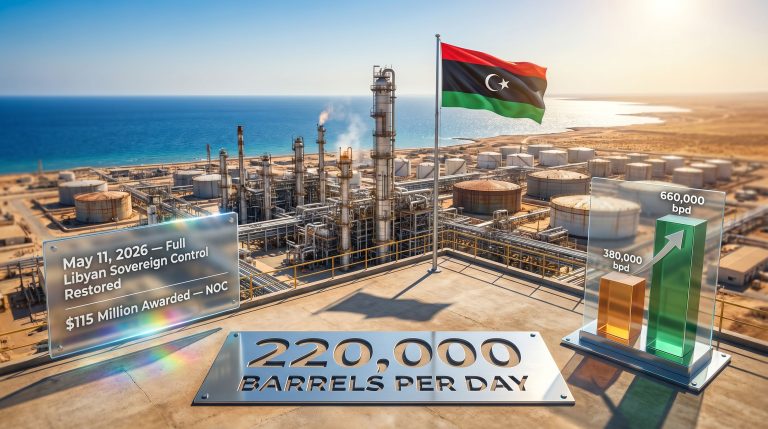
Ras Lanuf sits along Libya's northeastern coastline in the stretch of territory commonly called the "oil crescent," a corridor of refineries, export terminals, and pipeline infrastructure that has historically functioned as the economic spine of Libyan hydrocarbon production. The refinery's nominal processing capacity of 220,000 barrels per day makes it one of the most significant downstream assets in the country.
However, the facility's importance extends well beyond throughput figures. Its geographic position within the oil crescent has repeatedly placed it at the intersection of competing military and political forces, particularly after 2011. Geopolitical risk in mining and energy sectors consistently demonstrates that control of strategically placed assets like Ras Lanuf has never been a purely commercial question, which is precisely why the ownership dispute carried implications far beyond a bilateral contract disagreement.
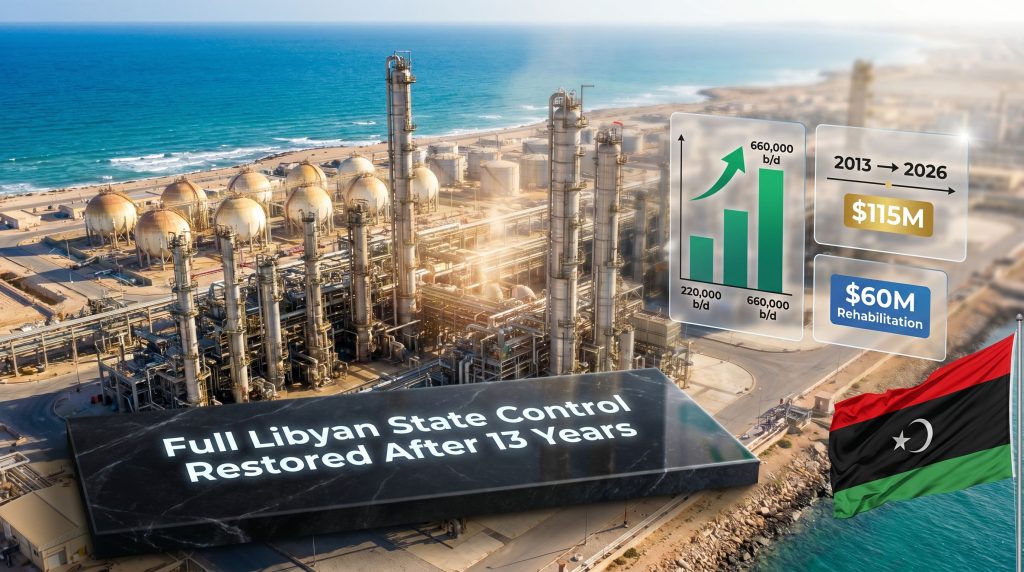
Libya's total refining capacity currently sits at approximately 380,000 barrels per day. The National Oil Corporation has stated a strategic ambition to scale that figure to 660,000 barrels per day, a target that cannot be reached without Ras Lanuf operating at or close to full capacity. The refinery is not simply an industrial asset — it is a structural prerequisite for Libya's downstream energy independence.
From Agreement to Operational Control: How LERCO Was Built
The 2008 Shareholders' Agreement and the Commercial Framework
On July 14, 2008, the NOC signed a shareholders' agreement with Trasta Energy, a company incorporated in Dubai just one month earlier as a subsidiary of the Al Ghurair Investment Group, one of the UAE's largest privately held conglomerates. The resulting entity, the Libyan Emirates Oil Refining Company (LERCO), was structured as a 50-50 joint venture tasked with modernising and operating the Ras Lanuf facility. The planned total investment envelope was approximately $2 billion, according to Gulf News reporting at the time.
By March 2009, LERCO had formally assumed ownership and operational control of the refinery. Trasta's confirmed capital contribution, later established through ICC arbitral proceedings, stood at $175 million. Simultaneously, the parties executed a Feedstock Supply Agreement (FSA), under which the NOC committed to supplying crude oil to LERCO for a period of 25 years at a fixed price that was never publicly disclosed.
| Key Structural Element | Detail |
|---|---|
| Joint Venture Name | Libyan Emirates Oil Refining Company (LERCO) |
| Ownership Split | 50% NOC / 50% Trasta Energy |
| Parent Entity (Trasta) | Al Ghurair Investment Group, UAE |
| Planned Total Investment | ~$2 billion |
| Confirmed Capital Injected | $175 million |
| Crude Supply Term | 25 years (from 2009) |
| Refinery Capacity | 220,000 barrels per day |
The fixed-price crude supply clause was, in retrospect, the most structurally fragile element of the entire arrangement. In stable commodity markets and political environments, such provisions offer operational predictability. In post-conflict Libya, with crude oil prices and political conditions both subject to extreme volatility, a locked-in feedstock price became a source of profound commercial tension. Investors with significant commodity price exposure in unstable jurisdictions will recognise this dynamic immediately.
What the FSA's Fixed-Price Structure Actually Meant in Practice
Fixed-price commodity supply agreements are relatively common in refinery joint ventures. The rationale is straightforward: refinery operators need cost certainty to model margins and plan capital expenditure. The supplier, in this case the NOC, accepts price stability in exchange for volume commitment and a long-term operational partner.
What makes the LERCO arrangement unusual is the 25-year duration combined with a state-owned crude supplier operating in one of the world's most politically unstable jurisdictions. When Libya's civil war disrupted both the security environment and the political legitimacy of existing contracts, the FSA's fixed pricing became a grievance that neither party could easily resolve within the original contractual framework.
Civil War and the Commercial Collapse of LERCO
February 2011 to August 2013: Fragile Restart and Accelerating Tensions
The uprising that began in February 2011 forced a complete shutdown of Ras Lanuf's refining operations. After Muammar Gaddafi's government collapsed in October 2011, Libya's transitional authorities began systematically reviewing contracts executed under the former regime, including the NOC-Trasta partnership.
A partial operational restart was achieved by late August 2012, though the security environment across the oil crescent remained deeply unstable. Furthermore, the resumption was fragile by any measure, as reported by Gulf Business at the time.
Public pressure on the commercial relationship intensified on April 4, 2013, when refinery workers staged demonstrations outside the NOC's headquarters in Tripoli. Employees objected to what they characterised as disproportionate commercial advantages afforded to the Emirati operator and specifically opposed a proposed 20-month extension of the crude supply arrangement. According to Middle East Economic Digest coverage, the NOC agreed under this pressure to review the contractual terms.
The formal breakdown arrived in late August 2013, when the NOC ceased crude oil deliveries to LERCO entirely, bringing all refining activity to a halt. LERCO's subsequent force majeure declaration was legally significant: by asserting that the shutdown resulted from a commercial dispute rather than technical failure or security conditions, LERCO effectively signalled its intent to pursue arbitration rather than absorb the stoppage as an operational risk event.
Force majeure declarations in commodity supply disputes serve a dual function: they preserve contractual rights while simultaneously signalling escalation to international arbitration. LERCO's 2013 declaration was precisely this kind of strategic legal instrument.
The ICC Arbitration: Three Proceedings, One Clear Winner
Parallel Claims Filed in Paris: Late 2013
Toward the end of 2013, both LERCO and Trasta Energy independently initiated arbitration proceedings against the NOC before the International Chamber of Commerce (ICC) in Paris. The two claims were structured differently but shared the same underlying grievance: that the NOC's cessation of crude supply constituted a breach of the FSA.
- LERCO's claimed damages: approximately $812 million
- Trasta's separate individual claim: in excess of $100 million
- Total combined exposure claimed against the NOC: exceeding $912 million
The scale of these claims reflected not just the direct financial losses from the refinery shutdown, but also projected future earnings under a 25-year supply contract that had been effectively nullified by the NOC's actions. Supply chain disruption of this magnitude, particularly where state actors are involved, routinely produces claims of this scale in international arbitration.
The Tribunal's Decisive Rejection
The ICC proceedings produced outcomes that comprehensively reversed the claimants' expectations:
- November 2017: The ICC tribunal dismissed Trasta Energy's individual claim in full.
- January 5, 2018: The ICC dismissed all of LERCO's claims, including the $812 million damages request.
- February 2018: The NOC secured an award ordering LERCO to pay $115 million plus accrued interest for unpaid crude oil invoices accumulated before and during the shutdown period.
By February 2021, the total financial obligation had grown beyond $132 million as interest continued to compound on the original award.
| Arbitration Milestone | Date | Outcome |
|---|---|---|
| Trasta's individual claim dismissed | November 2017 | Trasta loses |
| LERCO's $812M claim dismissed | January 5, 2018 | LERCO loses |
| NOC awarded $115M + interest | February 2018 | NOC wins |
| Debt grows to $132M+ | By February 2021 | NOC claim strengthens |
The reversal was total. A combined claim of over $912 million was extinguished, and the NOC emerged as the creditor rather than the defendant. This outcome was not widely anticipated when the arbitration began, partly because LERCO's force majeure argument was considered commercially strong at the time of filing.
French Courts and the Path to Enforceability
Paris Court of Appeal: February 2021
Unwilling to accept the ICC rulings, LERCO and Trasta jointly sought annulment of the arbitral awards before the Paris Court of Appeal. In February 2021, the court upheld the ICC ruling relating to the 2013 refinery shutdown, rendering the NOC's financial claim internationally enforceable. This was a critical step: ICC awards, once confirmed by national courts, can be enforced against assets in signatory jurisdictions worldwide under the New York Convention framework.
The February 2022 Award: Full Equity Transfer Ordered
The dispute's most consequential legal development arrived on February 21, 2022, when a new ICC arbitral award went considerably further than any prior ruling. According to ICSID case documentation, the tribunal confirmed the $115 million payment obligation and additionally ordered Trasta Energy to transfer its entire 50% stake in LERCO to the NOC, at no additional cost.
Within days of this ruling, Trasta filed an annulment application before the Paris Court of Appeal, its last remaining formal legal avenue.
May 2023: All Judicial Remedies Exhausted
On May 23, 2023, the Paris Court of Appeal rejected Trasta's annulment application in full, confirmed the February 2022 award, and ordered Trasta to pay the NOC €100,000 in legal costs. With no further appeals available, the dispute entered a phase of direct negotiation over the mechanics of the actual transfer.
The next major ASX story will hit our subscribers first
The Geopolitical Dimension: Why the UAE Connection Complicated Everything
The Haftar Factor and Tripoli's Strategic Calculations
The Ras Lanuf refinery dispute between Libya NOC and Trasta Energy cannot be fully understood without reference to its geopolitical subtext. The oil crescent region where Ras Lanuf is located has historically been within the sphere of influence of forces aligned with eastern Libyan military commander Khalifa Haftar.
Trasta Energy's parent, the Al Ghurair Investment Group, is a UAE entity. The UAE has been widely documented as a supporter of Haftar's eastern faction throughout Libya's post-2011 political fragmentation. Tripoli-based authorities therefore regarded the continued presence of a UAE-linked commercial partner operating a strategically sensitive refinery within Haftar-aligned territory as an arrangement carrying security dimensions that went well beyond commercial considerations.
This dual character — a contractual dispute layered over a geopolitical fault line — helps explain why the NOC pursued resolution with particular determination even after the arbitration process extended well beyond a decade. Effective risk management strategies must account precisely for these intersecting pressures that shaped the NOC's long-term positioning throughout this conflict.
Sovereign Asset Recovery Through International Law
A rarely discussed dimension of this case is the strategic choice the NOC made early in the dispute: pursuing international arbitration rather than unilateral administrative action. Libya could theoretically have revoked LERCO's operating licences or nationalised the asset outright, as some post-conflict states have done in analogous situations.
By choosing the ICC arbitration pathway instead, the NOC accepted a longer and more uncertain process, but ultimately achieved an outcome that is internationally enforceable and legally unimpeachable. Government intervention risks of this kind — where a state pursues legal rather than administrative routes — are frequently underestimated in frontier market analysis. Libyan officials have noted that an unfavourable legal outcome in the arbitration could have exposed the country to counter-claims exceeding $10 billion, a figure that contextualises the significance of the NOC's eventual victory.
The NOC's decision to resolve this dispute through internationally recognised arbitration mechanisms rather than administrative force preserved Libya's standing in global investment law while achieving the same substantive outcome that unilateral action might have sought.
The May 2026 Agreement: What Full State Control Actually Means
Final Transfer and the End of a 13-Year Dispute
On May 11, 2026, the NOC announced the signing of a definitive agreement with Trasta Energy transferring the Emirati company's entire 50% stake in LERCO to the Libyan state oil company. NOC Chairman Masoud Suleman described the deal as one of the most consequential developments for Libya's oil sector since 2011, according to Reuters reporting on the refinery restart. LERCO is now wholly controlled by the NOC, removing the last foreign-linked node from the Ras Lanuf ownership structure.
Restart Economics and the $60 Million Rehabilitation Window
The NOC has indicated it aims to recommission the refinery within 12 months of the agreement, with estimated maintenance and rehabilitation costs of approximately $60 million. Considered alongside the asset's 220,000 barrels per day nameplate capacity, this represents an exceptionally capital-efficient rehabilitation pathway by any comparative standard in North African downstream infrastructure.
A functioning Ras Lanuf refinery would contribute materially toward the NOC's 660,000 barrels per day national refining capacity target, up from the current ~380,000 barrels per day. Closing that gap reduces Libya's dependence on refined product imports and improves the country's overall energy trade economics.
Key Lessons for Foreign Investors in Frontier Energy Markets
What the LERCO Case Teaches About Contractual Architecture in Unstable Jurisdictions
The Ras Lanuf refinery dispute between Libya NOC and Trasta Energy offers several lessons that are not widely discussed in mainstream investment analysis:
- Fixed-price commodity supply agreements carry asymmetric risk in politically fragile jurisdictions. When crude oil prices shift materially and the political counterparty changes, fixed-price FSAs become commercially untenable for at least one party.
- Force majeure declarations are strategic instruments, not just operational notifications. LERCO's 2013 force majeure filing was designed to trigger arbitration under terms favourable to the claimant. The tribunal ultimately rejected this framing.
- Joint venture agreements in post-conflict states should include explicit renegotiation triggers linked to changes in political authority, not merely changes in operating conditions.
- Jurisdictional selection in arbitration clauses matters enormously. The choice of ICC Paris as the arbitral forum gave the NOC access to enforcement through the French judicial system, which ultimately confirmed the awards.
- Geopolitical exposure assessment is underweighted in frontier market joint ventures. The UAE-Haftar connection was not a factor visible in the LERCO shareholders' agreement, but it shaped the political environment around the dispute for more than a decade.
Dispute Milestones at a Glance
| Year | Event | Significance |
|---|---|---|
| 2008 | NOC-Trasta shareholders' agreement signed | LERCO established as 50-50 JV |
| 2009 | LERCO takes operational control | 25-year crude supply agreement activated |
| 2011 | Civil war forces refinery shutdown | Partnership placed under political scrutiny |
| 2012 | Partial restart of operations | Fragile resumption amid security instability |
| 2013 | NOC halts crude supply; LERCO declares force majeure | Formal commercial breakdown; arbitration initiated |
| 2017–2018 | ICC dismisses all Trasta and LERCO claims | NOC awarded $115M+ in unpaid invoices |
| 2021 | Paris Court of Appeal upholds ICC ruling | NOC claim becomes internationally enforceable |
| 2022 | ICC orders full stake transfer to NOC | Decisive legal victory for Libya |
| 2023 | Paris Court rejects Trasta annulment bid | All legal remedies exhausted |
| 2026 | Final transfer agreement signed | Full Libyan state control restored after 13 years |
Frequently Asked Questions: Ras Lanuf Refinery and the NOC-Trasta Dispute
What is the Ras Lanuf refinery and why does it matter?
Ras Lanuf is one of Libya's largest downstream hydrocarbon facilities, with a nameplate capacity of 220,000 barrels per day. Its location within the strategically sensitive oil crescent region makes it central to both Libya's industrial energy strategy and its broader geopolitical landscape.
Who is Trasta Energy and what is its connection to the Al Ghurair group?
Trasta Energy is a Dubai-incorporated company established in June 2008 as a subsidiary of the Al Ghurair Investment Group, one of the UAE's largest privately held conglomerates. It entered a 50-50 joint venture with the NOC to own and operate the Ras Lanuf refinery, contributing $175 million in confirmed capital before the partnership collapsed.
Why did the ICC reject LERCO's $812 million claim?
The tribunal found that the NOC's cessation of crude supply did not constitute the kind of actionable breach that would support the damages sought. The force majeure argument advanced by LERCO was not accepted as a basis for the claimed losses, and the tribunal instead found in favour of the NOC's counter-claim for unpaid invoices.
How long did the full dispute last?
The commercial breakdown began with the 2013 refinery shutdown. The final transfer agreement was signed in May 2026, representing approximately 13 years from the point of formal contractual breakdown.
What are the remaining risks to the refinery restart?
Security conditions in the oil crescent remain the primary variable that no legal agreement can fully resolve. Attracting qualified operational and technical partners for the rehabilitation phase, and maintaining crude supply continuity under a wholly state-owned model, are the two most material operational challenges facing the NOC over the next 12 months.
Disclaimer: This article is intended for informational purposes only and does not constitute investment advice or a recommendation to buy or sell any financial instrument. Forecasts and projections referenced in this article are based on publicly available information and involve inherent uncertainty. Readers should conduct independent research before making any investment decisions.
Want to Identify the Next Major Resource Discovery Before the Broader Market Does?
Discovery Alert's proprietary Discovery IQ model delivers real-time alerts on significant ASX mineral discoveries — transforming complex geological and commodity data into actionable investment insights the moment they hit the exchange — and you can explore historic discoveries that have generated substantial returns to understand the magnitude of opportunity involved. Begin your 14-day free trial at Discovery Alert today and position yourself ahead of the market.