June 10, 2026
The Arabian Shield's Untapped Potential: A Strategic Intelligence Brief on Saudi Arabia's 10th Mineral Exploration Licensing Round
Across the global mining landscape, a quiet reordering is underway. The traditional centres of exploration activity in Western Australia, the Canadian Shield, and the Andes are increasingly saturated with data, sunk capital, and declining discovery rates. Meanwhile, one of the planet's most geologically endowed terranes has spent decades sitting largely beneath the radar of international capital: the Arabian Shield. That dynamic is now changing at pace, and the Saudi Arabia mineral exploration licensing round is both a symptom and a driver of that structural shift.
When big ASX news breaks, our subscribers know first
Understanding the Scale of What's at Stake
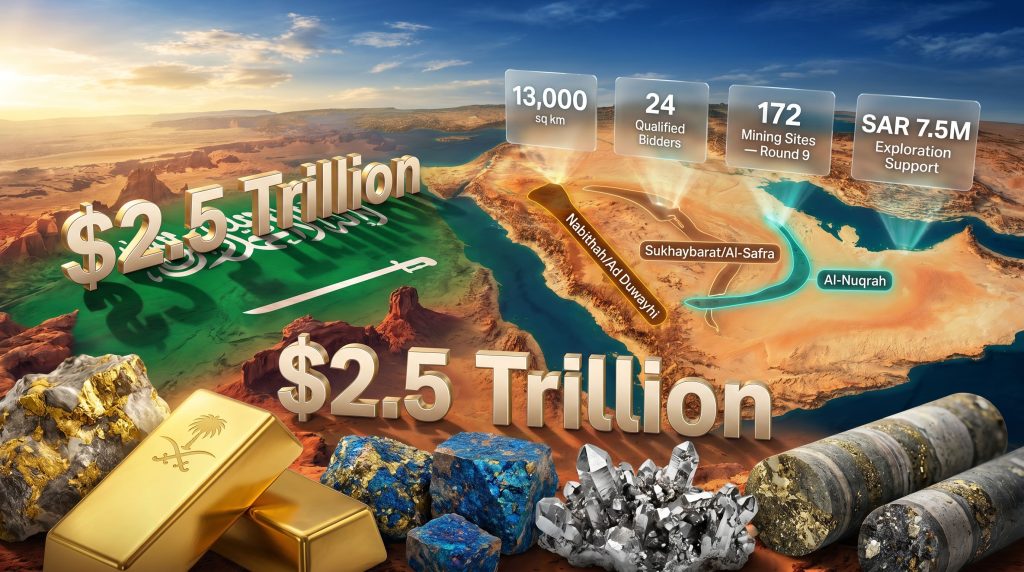
Saudi Arabia's estimated subterranean mineral wealth stands at $2.5 trillion, a figure that would rank the Kingdom among the world's most significant untapped mineral jurisdictions by any measure. Yet unlike comparable Precambrian terranes in West Africa or Western Australia, which have decades of systematic exploration data behind them, the Arabian Shield remains comparatively underdrilled, undersampled, and undercharacterised. For exploration-stage investors, this data gap is precisely what creates opportunity.
The timing matters too. Saudi Arabia's non-oil economy expanded by 3% in Q1 2026, with mining increasingly embedded in the Kingdom's Vision 2030 economic diversification mandate as a non-hydrocarbon growth pillar. This is not incidental background noise. It reflects a sustained policy commitment to building a productive minerals economy from the ground up, backed by institutional architecture, financial incentive programmes, and a progressively maturing licensing ecosystem.
The Arabian Shield occupies parts of western Saudi Arabia and represents the ancient basement geology of the region. As a Precambrian terrane, it shares geological heritage with highly productive shield terranes elsewhere globally, yet its exploration history is a fraction of comparable systems. That discrepancy between geological prospectivity and exploration data density is one of the most compelling structural arguments for early-mover positioning in the Kingdom.
Furthermore, the Arabian Shield geochemical survey work currently underway is deepening the geological understanding of this region, adding a further layer of data-driven confidence for prospective bidders.
How the Saudi Arabia Mineral Exploration Licensing Round System Works
To understand Round 10, it helps to understand the architecture within which it operates. Saudi Arabia's Ministry of Industry and Mineral Resources administers a structured, multi-stage competitive licensing process that has now run through ten consecutive iterations. The process is designed to attract both domestic and international capital while maintaining transparency and competitive integrity.
The three-stage framework operates as follows:
| Stage | Description | Key Requirement |
|---|---|---|
| Prequalification | Technical and financial screening of all applicants | Valid for 12 months across consecutive rounds |
| Site Selection | Qualified bidders choose exploration blocks via the Taadeen digital platform | Based on geological preference and strategic fit |
| Public Auction | Multi-round competitive bidding based on proposed exploration expenditure | Highest committed expenditure typically secures the licence |
The Taadeen platform is a critical enabler here. By digitalising the site selection and bidding interface, the Ministry has materially reduced administrative friction for international participants who would otherwise face significant logistical barriers to engaging with a jurisdiction they may not have existing relationships in.
Equally important is the 12-month pre-qualification validity window, which allows entities that qualify in one round to carry that status into subsequent rounds without reapplying. This is a deliberate design feature, engineered to build a deep, consistent bidder pool that deepens in quality over time rather than resetting with every round. The broader suite of Saudi exploration licences available across rounds reflects this cumulative, systematic approach to opening the Kingdom's geology to international capital.
The Exploration Empowerment Program: Risk-Sharing by Design
A feature of the Saudi licensing architecture that is not widely appreciated outside the sector is the Exploration Empowerment Program, which provides financial assistance of up to SAR 7.5 million per application to qualifying explorers. For junior exploration companies, which typically operate with constrained capital budgets, this risk-sharing mechanism can be the difference between participation and inaction. It materially alters the economics of early-stage programme design and effectively lowers the cost of failure for first-movers.
Round 10's Three Mineralised Belts: A Geological Intelligence Breakdown
Round 10 covers 13,000 square kilometres distributed across five administrative regions: Madinah, Makkah, Riyadh, Qassim, and Hail. These areas are organised into three distinct mineralised belt systems, each offering a different geological character and a different risk-return profile for exploration participants. For a detailed overview of the blocks on offer, the official Round 10 brochure published by the Saudi Mining Services Company provides comprehensive block-level data.
Belt 1: Nabithah/Ad Duwayhi (Dahlat Shabeb) Corridor
This belt is anchored by the Ad Duwayhi Mine, one of Saudi Arabia's most productive gold operations, currently generating approximately 180,000 ounces of gold per year. For exploration companies evaluating nearby blocks, this existing operation provides a significant structural advantage: established metallurgical data, proven geological continuity, and nearby processing infrastructure that could reduce capital requirements for any future discovery.
In exploration parlance, this positions the belt squarely in brownfield territory for adjacent blocks. The geological logic is straightforward: operating mines do not exist in isolation. They typically represent the highest-grade expression of a broader mineralised system, and the surrounding envelope frequently contains satellite deposits, lower-grade extensions, or structurally related mineralisation that was not economic to develop at the time of initial mine construction but may become so under different price conditions or with improved processing technologies.
Belt 2: Sukhaybarat/Al-Safra Polymetallic Zone
The second belt offers a fundamentally different investment thesis: commodity diversification. The Sukhaybarat/Al-Safra zone hosts one of the most diverse multi-metal suites in the Kingdom's exploration pipeline, with meaningful potential across gold, copper, silver, zinc, and nickel. Advanced projects including the Sukhaybarat and Bulghah mines provide geological precedents within the belt.
The polymetallic character of this belt is particularly relevant in the current macro environment. When exploration programmes target a single commodity, project economics are fully exposed to that commodity's price cycle. A belt that offers simultaneous exposure to gold, copper, and base metals provides a natural portfolio hedge, with different metals responding to different demand drivers and price catalysts. Copper and nickel, in particular, are directly exposed to critical minerals demand from electric vehicle manufacturing and grid infrastructure buildout.
Belt 3: Al-Nuqrah Gold and VMS System
The third belt is arguably the highest-risk, highest-reward proposition of the three. Al-Nuqrah is characterised by significant gold potential alongside volcanic massive sulfide (VMS) mineralisation carrying copper and zinc.
VMS ore deposits deserve particular attention from investors unfamiliar with the deposit type. These are formed at or near ancient seafloor volcanic systems, where superheated hydrothermal fluids deposit metal-rich sulfide material in concentrated lenses or mounds. The deposit type is globally recognised for producing high-grade, bulk-tonnage orebodies with strong economic characteristics. Critically, VMS deposits almost never occur in isolation. They form in geological settings that produce multiple related deposits within a defined corridor, meaning a single discovery in the Al-Nuqrah belt could indicate the presence of an entire family of economic targets within a relatively compact area.
For geologically sophisticated exploration companies, the presence of VMS systems in an underexplored terrane is a high-priority signal. The challenge is that VMS systems require sophisticated geophysical survey programmes, including airborne electromagnetic methods and ground-based induced polarisation, to delineate targets beneath cover. This creates a technical barrier that tends to favour well-capitalised, technically experienced explorers over generalist prospectors.
Who Are the 24 Qualified Bidders in Round 10?
The qualification of 24 local and international companies and consortia, comprising 17 returning Round 9 participants and 7 first-time qualifiers, provides a revealing window into how global mining capital is beginning to perceive Saudi Arabia as a destination. Details on the full bidding process and participating entities can be found via the Taadeen bidding portal, which manages the digital interface for all qualified participants.
Newly Qualified Entities: Round 10 Debuts
| Entity | Country of Origin | Strategic Profile |
|---|---|---|
| Saudi Arabian Mining Company (Ma'aden) | Saudi Arabia | State-linked national champion; vertically integrated mining major |
| Aton Resources | Canada | Junior explorer with MENA region experience |
| ANTAM | Indonesia | State-owned mining conglomerate; nickel and gold specialist |
| Power Metallic Mines | Canada | Junior explorer; critical minerals focus |
| Wildsky Resources | Canada | Junior explorer; greenfield discovery specialist |
| Danakali / Masadar Al-Zamarda (Emerald) Consortium | Australia / Saudi Arabia | Cross-border JV combining regional knowledge with technical capability |
| Anaam Al Qarat / Sahara Mining / Thurb Al-Hayya Consortium | Saudi Arabia / Sudan | Regional consortium leveraging local operational expertise |
Returning Bidders: The Round 9 Cohort
The 17 returning participants represent a geographically diverse field spanning:
- India: Vedanta, one of the world's largest diversified metals producers
- Australia: Midana Exploration, Jacaranda Minerals, DesertEx
- United States: Sierra Nevada Gold
- Saudi Arabia: Royal Road Arabia, The Distinguished Consortium Mining Company, Batin Al Ard for Gold Company, Saudi Gold Refinery (SGR), Al Ghazal Al Arabi Mining Company
- UAE: Almasar Minerals Holding
- Saudi Arabia / Indonesia JV: Eqleed-Indotan Mining Company
- Canada: Helderberg, Sun Peak Metals
- Oman: Al Tasnim Enterprises
- China: China National Geological and Mining Corporation
- Uzbekistan: Aurum Global Group
What the Bidder Composition Reveals
Several patterns in the bidder pool carry significant analytical weight for observers of global mining capital flows:
-
The concentration of Canadian junior explorers (Aton Resources, Power Metallic Mines, Wildsky Resources, Helderberg, Sun Peak Metals) is particularly meaningful. Canada's exploration ecosystem produces more greenfield discoveries per dollar invested than almost any other jurisdiction globally, and Canadian juniors are typically the most technically disciplined early-stage operators. Their presence signals genuine geological conviction in the Arabian Shield.
-
State-owned entities from Indonesia (ANTAM), China (China National Geological and Mining Corporation), and Uzbekistan (Aurum Global Group) reflect a different motivation entirely: strategic resource securing, rather than pure commercial return optimisation. For these entities, long-term supply chain positioning often outweighs near-term economics.
-
The formation of cross-border consortia (Australian/Saudi, Saudi/Sudanese) demonstrates sophisticated market awareness. These structures are designed to combine international technical capability with local regulatory and operational knowledge, reducing execution risk in a jurisdiction where on-the-ground relationships still matter.
-
Indian participation via Vedanta connects Saudi exploration activity to one of the world's fastest-growing metals consumption markets, adding a strategic supply chain dimension to what might otherwise appear to be a purely financial investment thesis.
Comparing Saudi Arabia's Licensing Architecture to Global Benchmarks
For investors and exploration companies evaluating the Saudi Arabia mineral exploration licensing round against established jurisdictions, the following comparison provides useful reference context:
| Dimension | Saudi Arabia (Round 10) | Australia | Canada | Chile |
|---|---|---|---|---|
| Geological Prospectivity | High (underexplored Precambrian shield) | Very High (extensively mapped) | Very High (mature) | High (copper/lithium dominant) |
| Licensing Transparency | Improving (Taadeen digital platform) | High | High | Moderate |
| Financial Support for Explorers | Yes (up to SAR 7.5M per application) | Limited | Provincial grants available | Limited |
| Pre-qualification Validity | 12 months (cross-round) | Varies by state | Varies by province | Project-specific |
| Round Frequency | Annual (10 rounds completed) | Continuous/rolling | Continuous/rolling | Project-specific |
| Commodity Diversity | Gold, copper, silver, zinc, nickel, VMS | Broad | Broad | Copper, lithium, gold |
The data above highlights a nuanced reality: Saudi Arabia does not yet match Australia or Canada on exploration data maturity or licensing sophistication. However, it offers a combination of incentives and greenfield potential that neither of those mature jurisdictions can replicate. The Kingdom's financial co-investment mechanism and cross-round pre-qualification validity create a more predictable and lower-friction entry pathway than many comparable emerging jurisdictions.
The next major ASX story will hit our subscribers first
Key Risks and Due Diligence Considerations
A balanced analysis of the Saudi Arabia mineral exploration licensing round requires honest engagement with the risks alongside the opportunities.
Geological Risks
- Exploration data density across the Arabian Shield remains lower than comparable terranes in Australia or Canada, meaning discovery timelines may extend beyond initial projections
- VMS systems in the Al-Nuqrah belt can be structurally complex, requiring sophisticated and capital-intensive geophysical programmes before drill targeting is possible
Regulatory and Operational Risks
- While rapidly maturing, Saudi Arabia's mining regulatory framework is still younger than those of established jurisdictions, and policy evolution risk should be factored into long-term project planning
- Infrastructure in remote areas of Hail and northern Qassim may require material capital investment beyond direct exploration costs, impacting overall programme economics
Competitive Risks
- With 24 qualified bidders competing across 13,000 sq km, the most geologically compelling positions, particularly near-mine brownfield areas in the Nabithah/Ad Duwayhi belt, will attract intense competition and elevated bid commitments
- State-backed entities including Ma'aden, ANTAM, and China National Geological and Mining Corporation may have structural advantages in absorbing longer capital cycles and tolerating lower near-term returns
The Strategic Outlook: Three Structural Trends Defining Saudi Arabia's Mining Trajectory
Round 10 is not an isolated event. It is one iteration in a deliberate, sequentially designed programme to unlock the Arabian Shield's full mineral potential. In addition, three structural trends deserve particular attention from long-horizon investors.
1. Sequential Geographic Unlocking of Contiguous Corridors
The direct spatial extension of Round 10 belts from Round 9 areas demonstrates that the Ministry is applying a data-driven, systematic approach to opening new terrain. As exploration data accumulates from awarded sites, future rounds are likely to push into deeper geological systems and more remote regions, progressively expanding the discovery frontier. The evolution of Saudi mining exploration licences across successive rounds illustrates this disciplined, corridor-by-corridor approach clearly.
2. International Participation as a Credibility Signal
The growth of the qualified bidder pool from a handful of domestic and regional entities in early rounds to participants spanning six continents in Round 10 reflects a measurable improvement in how global mining capital perceives the Kingdom's investment framework. First-time qualification of Indonesian state entity ANTAM and the expanded Canadian junior explorer contingent are particularly strong credibility markers.
3. Alignment with Global Critical Minerals Demand
Saudi Arabia's copper, zinc, and nickel exploration targets sit directly in the path of surging demand from energy transition technologies, including electric vehicle batteries, grid-scale storage, and renewable energy infrastructure. The Kingdom's geographic position, bridging Asian manufacturing demand centres and European industrial markets, positions it as a potentially strategic future supplier of transition metals if exploration activity converts to production at meaningful scale.
If Round 10 delivers outcomes comparable to the 172 mining sites awarded across three belts in Round 9, the cumulative effect of ten completed licensing rounds will represent one of the most significant systematic expansions of active mineral exploration in the Middle East's recorded history. The implications extend beyond the Kingdom's borders, with potential to reshape regional supply chain architecture for critical metals over the coming decade.
This article is provided for informational and educational purposes only and does not constitute financial, investment, or legal advice. Exploration-stage mining investments carry material risks including geological uncertainty, regulatory change, and commodity price volatility. Readers should conduct independent due diligence before making any investment decisions. For ongoing coverage of mining project activity across the Middle East and Africa, Zawya Projects maintains a dedicated mining tracker at zawya.com.
Want to Be First When a Major ASX Mineral Discovery Hits the Market?
Discovery Alert's proprietary Discovery IQ model delivers real-time alerts the moment significant mineral discoveries are announced on the ASX, transforming complex geological and commodity data into clear, actionable investment insights across gold, copper, nickel, and beyond — begin your 14-day free trial today and see why historic discoveries have generated extraordinary returns for investors who positioned early.