June 10, 2026
The Arabian Shield: A Geological Giant Only Beginning to Wake
Few mineral frontiers anywhere in the world combine the scale, grade potential, and institutional momentum currently converging beneath the sands of the Arabian Peninsula. The Arabian-Nubian Shield, a vast geological formation stretching across the Middle East and northeastern Africa, has long been recognised by geoscientists as one of Earth's most prospective hard rock environments. Yet for decades, the commercial machinery required to translate that geological promise into production remained largely absent across Saudi Arabia's portion of the Shield.
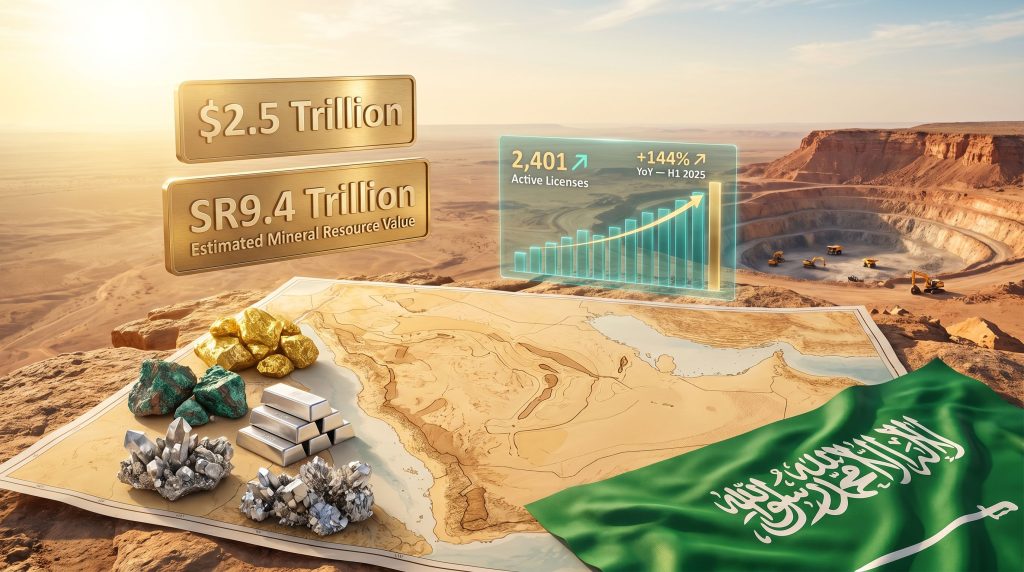
That equation is changing with measurable speed. The Kingdom's Ministry of Industry and Mineral Resources has formally qualified 24 local and international companies and consortiums to compete for Saudi Arabia mining exploration licenses across three multi-mineral belts covering approximately 13,000 square kilometres in five administrative regions: Madinah, Makkah, Riyadh, Al Qassim, and Hail. The mineralised systems within these belts carry an estimated combined resource valuation of SR9.4 trillion (approximately USD $2.5 trillion), spanning gold, silver, copper, nickel, and zinc.
Understanding why this moment matters requires stepping back from the licensing announcement itself and examining the deeper forces that make Saudi Arabia's mineral sector one of the most strategically significant investment frontiers of the decade.
When big ASX news breaks, our subscribers know first
The Geological Architecture Underpinning Saudi Arabia's Mineral Wealth
What Makes the Arabian-Nubian Shield Geologically Exceptional
The Arabian-Nubian Shield is a Precambrian-age geological formation estimated at approximately 900 million years old, representing the exposed basement rocks of what geologists classify as a juvenile continental crust environment. This geological character is critical for understanding why the Kingdom's mineral deposits carry exceptional economic potential.
Precambrian shield environments globally are disproportionately associated with large, structurally controlled gold deposits and VMS ore deposits, both of which are prominent target types across the three licensed belts. VMS deposits in particular are formed at ancient seafloor hydrothermal vents and are notable for concentrating multiple metals simultaneously, including copper, zinc, lead, gold, and silver, into relatively compact, high-grade ore bodies that respond well to conventional processing techniques.
Furthermore, the Arabian Shield geochemical survey data has materially strengthened confidence in the prospectivity of these belts, providing a layer of empirical geological validation that supports the Ministry's resource valuation estimates.
"The significance of VMS-style mineralisation is often underestimated by generalist investors. These systems can host deposits with copper grades exceeding 2-3%, which compares favourably to the global average open-pit copper grade of approximately 0.6%, making them highly attractive targets even in a moderate commodity price environment."
This geological reality explains why the three licensed belts are not interchangeable exploration targets. Each belt has a distinct geological personality:
| Mineral Belt | Geological Character | Key Operational Reference Points | Primary Target Metals |
|---|---|---|---|
| Nabitah-Duwaihi | Structurally controlled gold corridor | Duwaihi mine (~180,000 oz/year gold) | Gold |
| Sukhaybarat-Al-Safra | Polymetallic intrusion-related and VMS systems | Sukhaybarat and Bulghah mines | Gold, Copper, Silver, Zinc, Nickel |
| Al-Nuqrah | VMS-dominant with gold overprinting | Significant undeveloped gold resources | Gold, Copper, Zinc |
The Significance of Existing Production Benchmarks
A fact that tends to receive insufficient attention in discussions of Saudi Arabia mining exploration licenses is that two of the three targeted belts already host operating mines, not just geological anomalies. The Duwaihi mine within the Nabitah-Duwaihi belt produces approximately 180,000 ounces of gold per year, establishing a proven production baseline that substantially de-risks exploration in adjacent and extension targets.
For geologically literate investors, this is an important distinction. Exploration activity extending a known productive belt carries a fundamentally different risk-reward profile than greenfield exploration in an untested terrain. The presence of the Sukhaybarat and Bulghah mines within the Sukhaybarat-Al-Safra belt reinforces this point, suggesting that geological continuity across these systems is already supported by operational evidence rather than theoretical modelling alone.
How Saudi Arabia's Mining Licensing Framework Actually Works
The Three-Stage Process: A Structured Filter for Serious Operators
The Ministry of Industry and Mineral Resources administers Saudi Arabia mining exploration licenses through a deliberately staged competitive framework designed to prioritise technical credibility and financial capacity over speculative participation. Understanding the mechanics of this process is essential for any company evaluating market entry. In addition, the Saudi mining licences framework has been progressively refined to reduce administrative friction while maintaining substantive qualification standards.
Stage 1: Pre-Qualification Assessment
The entry threshold to the Saudi licensing system is substantive, not nominal. Companies seeking pre-qualification must demonstrate:
- Verifiable technical expertise in mineral exploration, including geological capability and prior project track records
- Evidence of financial solvency and capacity to fund the exploration expenditure commitments they intend to bid
- Submission of a credible Environmental Impact Plan addressing site-specific considerations
- A Social Impact Management Plan covering community engagement obligations
- Legal standing and business registration documentation from their home jurisdiction
Application, issuance, and renewal fees are each set at SAR 5,000, keeping administrative costs accessible while the substantive evaluation criteria perform the filtering function.
Stage 2: Bidding Document Access and Site Selection
Qualified companies gain access to detailed geological datasets and bidding documentation compiled by the Ministry. This stage is where the Ta'adeen digital platform plays a critical operational role, providing tools to evaluate site-specific geological merit, infrastructure proximity, and competitive positioning across available blocks. Companies select their preferred exploration blocks based on technical fit and strategic priorities before advancing to the competitive round.
Stage 3: Public Competitive Bidding
The final award is determined through open competitive bids evaluated primarily on minimum exploration expenditure commitments and accompanying technical work programs. This structure deliberately rewards operators who intend to deploy capital aggressively rather than hold licenses passively, which is a common problem in frontier jurisdictions where license hoarding can stall genuine exploration activity.
"The competitive expenditure commitment model is notably sophisticated for a developing mining jurisdiction. By incentivising exploration spending at the bid stage rather than enforcing it through post-award penalties alone, the Saudi framework attempts to pre-select operators with genuine development intent, which ultimately accelerates the pace at which resources advance toward production feasibility."
Foreign Ownership: A Structural Advantage Over Regional Peers
One of the most strategically significant features of Saudi Arabia's mining regulatory framework for international investors is the permission of 100% foreign ownership of mining operations. This is not a default position in the MENA region, where many jurisdictions retain domestic equity requirements or impose foreign participation caps that complicate capital structuring for international operators.
The Saudi exploration licences framework's full foreign ownership provision removes a layer of partnership complexity that often delays project development in frontier markets. Consequently, international companies can maintain operational control, apply their own technical standards, and structure financing without mandatory local equity dilution. Reuters recently reported on this latest licensing round, highlighting the breadth of international participation as evidence that the Kingdom's mining investment proposition is gaining genuine global traction.
Who Are the 24 Qualified Companies?
New Entrants Signal Expanding Global Appetite
The most recent qualification round introduced seven companies that had not participated in any prior Saudi licensing round, a development that the Ministry of Industry and Mineral Resources described as reflecting the growing attractiveness of the Kingdom's mining investment environment.
The seven new entrants are:
- Power Metallic Mines Inc
- PT ANTAM Tbk
- Wildsky Resources
- Maaden
- Danakali Limited
- Emerald Sources Mining Co.
- Sahara Mining Co. Limited and Thurb Al-Hayya for Trading Co.
The presence of PT ANTAM Tbk, a state-owned Indonesian mining corporation with significant nickel and gold operations across Southeast Asia, is particularly noteworthy. ANTAM's participation signals that sovereign-linked mining entities are now viewing Saudi Arabia as a credible exploration destination, not simply a speculative frontier. Indonesia is one of the world's largest nickel producers, and ANTAM's interest in Saudi Arabia's nickel-bearing belts reflects a strategic awareness of geographic supply chain diversification.
Danakali Limited brings a distinct East African potash development background to the Saudi context, suggesting an operator with experience navigating frontier regulatory environments and developing deposits in geopolitically sensitive regions — capabilities that translate directly to the Saudi context.
Returning Qualifiers: Competitive Depth From Established Participants
The 17 returning qualified companies include a cross-section of established operators and regional specialists:
- Vedanta Limited
- Sierra Nevada Gold
- Jacaranda Minerals Pty Ltd
- Midana Exploration Pty Ltd
- Royal Road Arabia
- The Distinguished Consortium Mining Co.
- DesertEx Pty Ltd
- Eqleed-Indotan Mining Co.
- Sun Peak Metals
- Helderberg Limited
- Al Tasnim Enterprises LLC
- Batin Al Ard for Gold Mining
- Aurum Global Group
- Almasar Minerals Holding Limited
- SGR Saudi Gold
- Al Ghazal Al Arabi Mining Co.
The retention of returning qualifiers alongside new entrants creates a competitive dynamic that benefits the Ministry's objective of attracting the most technically capable and financially committed operators to each available exploration block.
Quantifying the Acceleration: Saudi Arabia's Licensing Momentum in Numbers
A Licensing Program Running at an Entirely Different Velocity
The pace at which Saudi Arabia mining exploration licenses are being issued has undergone a structural step-change rather than an incremental improvement. The data tells a clear story:
| Metric | Value |
|---|---|
| Total active mining licenses (end-2024) | 2,401 |
| New exploration licenses issued in H1 2025 | 22 |
| Year-on-year growth rate (H1 2025 vs H1 2024) | +144% |
| Total belt area in current licensing round | ~13,000 km² |
| Estimated resource value across targeted belts | SR9.4 trillion (~USD $2.5 trillion) |
| Qualified companies in current round | 24 |
| New entrants in current round | 7 |
| Regions covered | 5 (Madinah, Makkah, Riyadh, Al Qassim, Hail) |
A 144% year-on-year increase in new exploration licence issuance represents a pace of activity that is difficult to attribute to any single policy decision. It reflects the cumulative effect of regulatory modernisation, competitive licensing design, and sustained international marketing of the Kingdom's mineral sector as an investment destination.
The Ta'adeen Platform: Digital Infrastructure as a Competitive Differentiator
The deployment of the Ta'adeen digital platform across the licensing process is more consequential than it might appear in a headline context. In many frontier mining jurisdictions, the opacity and administrative friction of licensing processes represent a material deterrent to international participation, particularly for smaller or mid-tier companies with limited capacity to navigate complex bureaucratic environments.
By digitising the application, geological data access, site evaluation, and bidding workflows, the Ministry has effectively lowered the operational cost of market assessment for prospective applicants. A company in Melbourne or Vancouver can evaluate Saudi exploration block options and assess competitive positioning without committing to expensive in-country presence during the pre-qualification phase, fundamentally expanding the addressable pool of potential applicants.
This digital-first approach also enhances transparency, which is a factor that institutional investors — particularly those operating under ESG frameworks — weigh heavily when evaluating jurisdictional risk in mining portfolios.
The Critical Minerals Dimension: Saudi Arabia in a Global Supply Chain Context
Copper, Nickel, and Zinc: The Energy Transition Metals Hidden in Saudi Geology
The multi-commodity character of the Sukhaybarat-Al-Safra and Al-Nuqrah belts positions Saudi Arabia mining exploration licenses as relevant not only to gold-focused operators but also to companies seeking exposure to the metals driving global critical minerals demand through the energy transition.
Copper is the metal most central to this demand story. Electrification at scale — from EV charging infrastructure to offshore wind transmission cables — requires copper in volumes that existing and planned production pipelines are widely considered insufficient to meet. Nickel, particularly the sulfide nickel varieties that respond well to conventional processing into battery-grade nickel sulfate, is similarly constrained in supply terms.
The VMS-style mineralisation characteristic of the Al-Nuqrah belt is geologically significant in this context because VMS systems can host both copper and zinc in laterally extensive ore bodies that offer scale potential alongside grade. The same hydrothermal processes that concentrate base metals in VMS systems often produce gold and silver credits that enhance the overall economics of development, creating polymetallic projects with natural commodity diversification built into the geology itself.
"For mining companies assessing exploration portfolio strategy, the polymetallic character of Saudi Arabia's VMS systems represents a structurally different opportunity compared to single-commodity gold plays. A successful VMS discovery in the Al-Nuqrah belt could deliver copper, zinc, gold, and silver from a single deposit, providing natural revenue diversification that is increasingly valued by investors concerned about commodity price volatility."
How Saudi Arabia Compares to Peer Jurisdictions
Placing Saudi Arabia's licensing framework in comparative context helps clarify its relative attractiveness for international operators evaluating allocation of limited exploration capital. Mining Technology's analysis of the Kingdom's licensing evolution further reinforces the view that the regulatory architecture is now meaningfully competitive with established mining jurisdictions:
| Jurisdiction | Foreign Ownership | Key Target Minerals | Digital Licensing Platform | Regulatory Transparency |
|---|---|---|---|---|
| Saudi Arabia | 100% permitted | Gold, Copper, Zinc, Nickel, Silver | Ta'adeen (fully digital) | High (structured competitive process) |
| Egypt | Majority foreign ownership permitted | Gold, Phosphate | Partially digitised | Moderate |
| Morocco | Majority foreign ownership permitted | Phosphate, Copper, Gold | Partially digitised | Moderate |
| Kazakhstan | Up to 100% in select categories | Uranium, Copper, Gold | Developing | Variable |
Note: Jurisdictional regulatory data should be verified against current regulatory publications for each country before making investment decisions. The above comparison is indicative.
Saudi Arabia's combination of full foreign ownership rights, a competitive expenditure-based licensing model, and a digital platform infrastructure places it at the more permissive end of the MENA spectrum for international mining investment.
The next major ASX story will hit our subscribers first
What Prospective Applicants Need to Know
Eligibility Checklist for Incoming Operators
For companies evaluating participation in Saudi Arabia mining exploration licensing rounds, the qualification framework requires the following to be demonstrated:
- Documented geological and technical expertise relevant to the target mineral types and exploration methods appropriate for the belt being pursued
- Financial solvency evidence including audited accounts, bank references, or demonstrated access to exploration financing
- A credible Environmental Impact Plan specific to the nature of the proposed exploration activities
- A Social Impact Management Plan addressing engagement with local communities in the relevant administrative regions
- Commitment to a minimum exploration expenditure threshold per licensed area, which will form part of the competitive bid evaluation
- Valid business registration and legal standing documentation from the applicant's home jurisdiction
- Payment of applicable fees: SAR 5,000 for application, SAR 5,000 for issuance, and SAR 5,000 for renewal
The relatively modest fee structure keeps administrative barriers low while the substantive technical and financial requirements perform the genuine selection function — a deliberate design choice that maximises the quality of the competitive field.
The Long Game: What Saudi Arabia's Mining Ambitions Mean for the Sector
Structural Targets and the Vision 2030 Mining Architecture
The Ministry of Industry and Mineral Resources has been explicit that successive Saudi Arabia mining exploration licensing rounds are components of a sustained programme with defined structural objectives. These include:
- Increasing total exploration spending across the Kingdom's mineral belts
- Attracting high-calibre technical operators with the capability to advance deposits from discovery through feasibility
- Developing domestic processing capacity to capture value beyond raw ore extraction
- Integrating the mining sector into Vision 2030's broader industrial diversification architecture
This last point deserves particular emphasis. Saudi Arabia is not simply attempting to monetise its mineral resources through export. The longer-term vision involves developing integrated mining and processing corridors where extracted minerals undergo beneficiation and refining within the Kingdom before reaching global markets. This upstream-to-midstream integration strategy, if executed successfully, would position Saudi Arabia not merely as a mineral supplier but as a value-added participant in global commodity supply chains, analogous to the role it plays in petroleum refining.
The Investor Calculus: Balancing Opportunity Against Frontier Risk
Any intellectually honest assessment of Saudi Arabia's mining exploration landscape must acknowledge that the country remains a relatively early-stage mining jurisdiction despite its extraordinary geological endowment. However, several frontier-market considerations apply:
- Exploration risk remains real: the presence of operating mines in adjacent belt areas reduces but does not eliminate geological uncertainty in extension targets
- Infrastructure variability across the five targeted regions means that capital cost estimates for project development can differ substantially depending on block location
- Workforce development requirements for a sector that is scaling rapidly create execution risk that experienced operators will factor into their project planning
- Commodity price sensitivity affects the economics of all exploration investment, and the current licensing round spans a multi-year timeframe during which market conditions will inevitably shift
"For investors monitoring the mining sector, the Saudi exploration licensing programme represents a genuine frontier opportunity with measurable momentum, but it carries the characteristics of a long-duration investment thesis. Discovery, feasibility, and production timelines in hard rock mining typically extend across 7 to 15 years from exploration licence grant to first production, meaning today's licensing activity is building the foundation for production capacity in the 2030s and beyond."
This article contains forward-looking assessments based on publicly available information. It does not constitute investment advice. Readers should conduct independent due diligence before making investment decisions related to any jurisdiction or company referenced.
Key Metrics at a Glance
| Data Point | Detail |
|---|---|
| Qualified companies (current round) | 24 |
| New entrants | 7 |
| Total licensed belt area | ~13,000 km² |
| Administrative regions covered | Madinah, Makkah, Riyadh, Al Qassim, Hail |
| Estimated mineral resource value | SR9.4 trillion (~USD $2.5 trillion) |
| Target minerals | Gold, Silver, Copper, Nickel, Zinc |
| Active licenses nationally (end-2024) | 2,401 |
| New exploration licenses (H1 2025) | 22 |
| YoY growth in exploration licenses (H1 2025) | +144% |
| Foreign ownership cap | None (100% permitted) |
| Licensing stages | 3 (Pre-qualification, Site selection, Public bid) |
| Digital licensing platform | Ta'adeen |
| Key operational belt reference | Duwaihi mine (~180,000 oz gold/year) |
Want To Be First When the Next Major Mineral Discovery Hits the ASX?
Discovery Alert's proprietary Discovery IQ model delivers real-time alerts the moment significant ASX mineral discoveries are announced, turning complex geological data across 30+ commodities into clear, actionable opportunities for both short-term traders and long-term investors — start your 14-day free trial today and see why historic discoveries have generated extraordinary returns.