June 9, 2026
The Quiet Repricing Nobody Is Talking About: Silver Mining Stocks in a New Monetary Era
Commodity super-cycles do not announce themselves with a press release. They unfold slowly, then all at once, pulling capital across asset classes in ways that leave late-arriving investors wondering how they missed the early innings. The transition from a four-decade deflationary era into a structurally inflationary one is precisely this kind of seismic, slow-moving shift. For investors focused on the silver mining stocks bull market, understanding this macro backdrop is not optional context. It is the entire thesis.
The period from 1980 to 2020 was an extraordinary anomaly in monetary history, one defined by falling interest rates, expanding credit, and the steady suppression of hard asset prices. A generation of portfolio managers built entire careers extrapolating that deflationary framework into the future. That extrapolation, according to a growing number of hard-asset specialists, is now the single most dangerous assumption an investor can make.
When big ASX news breaks, our subscribers know first
Why the Inflationary Bias Has Not Peaked Yet
Monetary Debasement as a Structural Force, Not a Cyclical Blip
One of the more consequential investment arguments circulating among veteran precious metals fund managers is that monetary debasement is not a temporary policy response. It is a structural condition baked deeply into the financial architecture of modern economies. Governments and central banks face a compounding dilemma: the system requires increasing quantities of money simply to function, and every downturn accelerates the pace of expansion.
This framework explains why inflation tends to arrive in multiple waves rather than a single spike. The post-COVID surge in consumer prices was the first wave. The argument that a second, potentially larger wave is forming rests on the observation that the structural conditions enabling monetary expansion have not been resolved. Interest rates were raised to combat inflation, but the underlying fiscal dynamics that produce inflationary pressure have only grown larger.
The 1970s Analog and What It Implies for Hard Assets
Historians of monetary cycles point to the 1970s as the most instructive analog for the current environment. Inflation did not arrive once and leave. It came in distinct waves, with intermittent periods of apparent cooling that convinced many investors the storm had passed. Each wave, however, was followed by a more severe one. Silver rose more than 3,000% between 1971 and its 1980 peak, a move that is frequently dismissed as a historical anomaly rather than recognised as a structural outcome of monetary excess.
The 40-year deflationary period from 1980 to 2020 is increasingly viewed by commodity specialists not as the default state of modern economies, but as the exception. The inflationary bias that began emerging around 2020 may still be in its early stages, with the full duration of the cycle potentially spanning a decade or more.
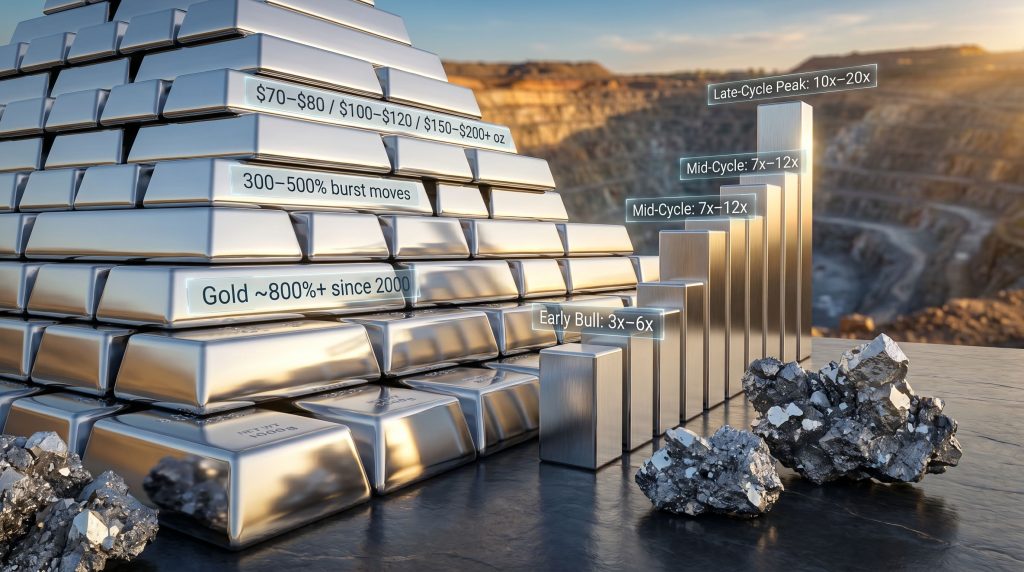
The gold market provides a data point that most mainstream investors simply have not absorbed. Since the year 2000, gold has appreciated by more than 800%, while the S&P 500 has returned approximately 300-400% over the same period. A non-dividend-paying, inert metal has outperformed the benchmark equity index for a quarter century. That is not noise. That is signal. Furthermore, the precious metals market outlook for 2025 suggests these structural tailwinds remain firmly in place.
| Asset | Approximate Return Since 2000 |
|---|---|
| S&P 500 (price return) | ~300-400% |
| Gold (spot price) | ~800%+ |
| Silver mining equities (peak bull cycle moves) | 300-500% burst moves (historical cycle data) |
Source: Publicly available market data; precious metals sector commentary 2024-2025. Past performance is not indicative of future results.
How Operating Leverage Turns a Silver Rally Into Equity Outperformance
The Mechanics of Miner Leverage: Why Equities Move Faster Than the Metal
Understanding why silver mining stocks can dramatically outperform the physical metal during a bull market requires grasping the concept of operating leverage. Mining companies carry a largely fixed cost base. Underground equipment, labour, energy, and sustaining capital expenditures do not automatically increase when silver prices rise. Revenue, however, does, and it rises with every dollar increase in the spot price.
When silver prices climb materially, the incremental revenue flows almost entirely to the bottom line. A 30% move in silver can translate into a 100-200% improvement in miner free cash flow, depending on a company's cost structure, production scale, and debt position. This is why junior and mid-tier silver producers can generate returns that look almost implausible relative to the underlying commodity. In addition, silver supply deficits are compounding the upside case for producers who can deliver growing output into a constrained market.
The Three-Engine Growth Model: How the Best Silver Producers Compound Returns
Among mining equity specialists, the most compelling opportunities tend to sit in a specific category: emerging producers with growing output profiles. These companies benefit from not one, but three simultaneous drivers of value creation:
- Metal price appreciation increases revenue and expands profit margins without any operational change.
- Multiple re-rating occurs as investor confidence grows. Companies trading at three to four times cash flow in early bull market conditions can re-rate to eight, ten, or twelve times cash flow as the cycle matures, a purely sentiment-driven gain layered on top of earnings growth.
- Production growth amplifies both of the above effects. A company increasing output from 100,000 to 150,000 ounces annually has delivered a 50% earnings improvement through operational execution alone, before any metal price or multiple contribution.
The compounding interaction of all three engines simultaneously is what creates the extraordinary return profiles that attract specialist capital to this sector.
Where Are Silver Mining Valuations Right Now?
Cash Flow Multiples: Still in Early-Cycle Territory
One of the most frequently cited measures of sector positioning is the cash flow multiple at which silver producers trade. At the peak of the 2011 precious metals cycle, leading producers commanded multiples of 10 to 20 times cash flow. At present, sector averages appear to hover in the five to ten times range, suggesting meaningful upside potential before the market reaches historical peak valuations, assuming the bull market thesis remains intact.
| Market Phase | Typical Cash Flow Multiple Range |
|---|---|
| Early bull market (undervalued) | 3x – 6x |
| Mid-cycle (fair value) | 7x – 12x |
| Late-cycle peak (2011 analog) | 10x – 20x |
Illustrative ranges based on historical cycle data and sector commentary. Not financial advice.
The "Staircase Up, Elevator Down" Volatility Pattern
Sharp single-session declines are an inherent feature of precious metals equity investing, not a signal of trend reversal. In prior cycles, drawdowns of 8-10% in a single trading session were commonplace even during strong bull markets. These events are typically triggered by macro catalysts such as unexpectedly strong employment data generating expectations of tighter monetary policy, rather than any deterioration in the fundamentals of the underlying companies.
Experienced fund managers who have navigated multiple commodity cycles treat these corrections as the cost of participation, not as reasons to exit. The investors who tend to be shaken out at the worst possible moments are those who have not internalised the sector's structural volatility patterns.
The Four-Bucket Framework: Finding the Best Risk-Reward in Silver Mining Stocks
Categorising Mining Equities by Stage and Risk Profile
Not all mining company exposure carries the same risk-reward profile. Veteran fund managers typically organise the universe into four broad categories:
| Bucket | Stage | Risk Level | Key Upside Driver |
|---|---|---|---|
| Drill Stories | Exploration | Very High | Discovery potential |
| Developers (pre-production) | PEA/PFS/Feasibility | High | De-risking and financing |
| Emerging Producers (growing output) | Early production | Medium-High | Triple-engine compounding |
| Established Producers | Mature operations | Medium | Cash flow and multiple re-rating |
The Sweet Spot: Emerging Producers With Growing Output
After nearly two decades of navigating the junior mining sector, experienced managers converge on a consistent conclusion: the emerging producer with a growing production profile represents the most attractive risk-reward trade-off across the full cycle. These companies have moved past the binary risk of exploration, generate real operating cash flow, and carry the kind of production growth trajectory that attracts institutional attention. Consequently, understanding junior mining risks and rewards is essential before allocating capital to this part of the market.
A particularly powerful but frequently overlooked catalyst in this category is index inclusion. As a small producer's market capitalisation scales, it crosses thresholds that trigger inclusion in relevant ETF indices. This brings a wave of passive capital that can re-rate the stock independent of silver's spot price, creating a structural tailwind that has nothing to do with the underlying commodity.
How a Developer Unlocks Value Over Time: A Step-by-Step Progression
For investors evaluating developer-stage companies, understanding the de-risking pathway is essential to assessing when and how value gets realised:
- Drill results establish deposit scale, continuity, and grade quality.
- A Preliminary Economic Assessment (PEA) models mine economics using current metal prices, providing a rough project valuation.
- A Pre-Feasibility Study (PFS) refines capital cost and operating cost estimates with greater precision.
- A Feasibility Study confirms project bankability, enabling third-party debt financing discussions.
- Mine construction commences, representing the peak of capital consumption and execution risk.
- First production triggers a significant re-rating event as the company transitions from speculative to cash-generative.
- A growing production profile attracts institutional research coverage, analyst attention, and eventual index inclusion.
An important valuation shortcut used by experienced managers is comparing a company's market capitalisation against the estimated in-ground value of its metal. Recent acquisition benchmarks suggest gold and silver deposits have been changing hands in the range of $100 to $300 per gold-equivalent ounce. Exploration companies still trading at significant discounts to that range, such as $30 per ounce, may represent deep value, provided the deposit has been sufficiently de-risked and the geological thesis is credible.
Practical Screening: How to Evaluate Silver Mining Stocks
Key Metrics That Separate Quality Operators From Promotional Stories
| Metric | What to Look For |
|---|---|
| All-In Sustaining Cost (AISC) | Meaningfully below current silver spot price |
| Cash Flow Multiple | Below 8x in current cycle context |
| Production Growth Profile | Year-on-year output expansion |
| Balance Sheet | Low dilution risk; ideally funded through operating cash flow |
| Management Track Record | Demonstrated mine-building or operating history |
| Jurisdiction | Stable, mining-friendly regulatory environment |
Share Dilution: The Silent Killer of Junior Mining Returns
One of the most underappreciated risks in early-stage mining investment is share dilution. Exploration-stage companies have no operating revenue and must continually issue new shares to fund drilling programmes. Each capital raise reduces existing shareholders' percentage ownership, and if the company fails to make a discovery of sufficient quality, the accumulated dilution results in permanent capital impairment. This is a primary reason why experienced managers prefer companies with operating cash flow, which reduces or eliminates the need for external financing.
Jurisdictional Risk: Regions Attracting Increased Scrutiny
Political and regulatory risk is not static. Regions that were considered acceptable investment destinations several years ago can deteriorate due to changes in government policy, resource nationalism, or instability. West African jurisdictions including parts of Burkina Faso and Mali have drawn increased scrutiny in recent cycles. Parts of South America, including sections of Peru and Bolivia, have also seen investor caution increase due to evolving political dynamics. These risk factors must be integrated into any position sizing decision. For a broader view, Sprott's analysis of the bull market in gold, silver and miners provides useful context on how jurisdictional factors are being weighed by institutional managers.
The next major ASX story will hit our subscribers first
Silver ETFs, Long-Dated Options, and Portfolio Construction
SIL and SILJ: Diversified Exposure Without Stock-Picking
For investors who lack the time or specialist knowledge to evaluate individual mining companies, silver miner ETFs such as SIL (the Global X Silver Miners ETF) and SILJ (the ETFMG Prime Junior Silver Miners ETF) offer diversified exposure to the sector. These instruments capture a basket of silver-producing and developing companies, providing broad participation in the sector's performance without concentration in any single name.
Long-dated options, specifically LEAPS contracts on silver miner ETFs, represent a higher-leverage alternative for more sophisticated market participants. These instruments trade at significant discounts to their face value when struck well above current market prices, enabling aggressive positioning with defined downside.
Position Sizing: How Experienced Fund Managers Structure Exposure
Veteran precious metals portfolio managers typically structure individual positions as follows: starter positions sized at approximately 0.5-1% of the total portfolio, core conviction holdings at 2-4%, and maximum single-stock exposure capped near 5%. This discipline reflects the binary nature of mining equity risk, where exceptional winners can return ten times or more, but individual project failures occur in every cycle.
A practical approach to capital preservation within this framework is the house money strategy: taking partial profits at meaningful multiples such as 2x, 4x, and 6x returns, thereby recovering the initial capital outlay while allowing the remaining position to run. Holding a diversified basket of 15 to 25 names rather than concentrating in a handful of high-conviction ideas is also a widely endorsed approach in the sector, given the unpredictability of individual project outcomes.
Bull Case, Bear Case, and Key Scenarios for Silver Mining Stocks
What Could Accelerate or Derail the Bull Market Thesis?
Accelerating Catalysts:
- A pivot toward more accommodative monetary policy, including unexpected interest rate reductions.
- Continued weakness in the U.S. dollar, which historically correlates with precious metals strength.
- A broadening commodity super-cycle encompassing copper, oil, and critical minerals alongside gold and silver.
- Federal Reserve policy that proves more dovish than current market pricing implies.
Key Risks to Monitor:
- Hawkish policy surprises that sustain elevated real interest rates, reducing the appeal of non-yielding assets.
- Operational failures at individual mine sites, including permitting delays, geotechnical problems, or environmental opposition.
- Jurisdictional instability in key mining regions.
- Promotional companies entering the silver space without genuine assets, eroding retail investor confidence broadly.
Silver Price Scenarios and Their Impact on Miner Valuations
| Silver Price Scenario | Implied Miner Upside (vs. Current) | Key Assumption |
|---|---|---|
| Base Case: $70-$80/oz | Modest re-rating; 30-60% upside | Rates stable; moderate inflation |
| Bull Case: $100-$120/oz | Significant re-rating; 100-200% upside | Rate cuts and dollar weakness |
| Extreme Bull Case: $150-$200+/oz | Transformational re-rating; 300%+ possible | Monetary reset; fiscal dominance |
Illustrative scenarios based on historical miner leverage ratios and publicly available sector commentary. These are not financial forecasts. Investors should conduct their own due diligence.
The "You Can't Print Molecules" Framework and the Commodity Super-Cycle
Goldman Sachs alumnus Jeff Curry has articulated a framework that resonates deeply with hard-asset investors: physical commodities are irreplaceable in a way that financial instruments are not. Copper, oil, silver, gold, helium, and critical minerals all share the fundamental characteristic of having a finite supply constrained by geology, not by policy. Monetary authorities can expand the supply of dollars at will. They cannot expand the supply of silver deposits or copper ore bodies.
This conceptual distinction underlies the broader commodity super-cycle thesis, which holds that we are in the early stages of a sustained multi-year shift in the relative value of physical assets versus paper ones. Silver sits at the intersection of this monetary thesis and growing industrial demand, making it arguably the most asymmetric commodity exposure available to investors who accept the structural inflation argument. Furthermore, gold-silver ratio analysis suggests silver remains historically undervalued relative to gold, adding further weight to the long-term repricing thesis.
Red Flags: How to Distinguish Genuine Silver Stories From Hot-Sector Promotions
Warning Signs That Every Junior Mining Investor Must Recognise
Every commodity bull market generates a predictable wave of opportunistic company formation and rebranding. During the dot-com era, hundreds of companies attached technology-adjacent identities to legacy businesses with no credible connection to the sector's growth drivers. The current silver market is producing analogous behaviour: dormant mining projects being revived, companies with no qualified resource attaching silver terminology to promotional materials, and management teams with no mine-building history positioning themselves as silver specialists.
Investors entering the silver mining space for the first time should apply a disciplined filter: no qualified mineral resource, no credible management track record, and no independently verified geological data are disqualifying characteristics, regardless of how compelling the sector narrative sounds.
Watching for management red flags is, however, only one part of the due diligence process. Specific permitting risk deserves particular attention. Regulatory opposition, particularly in jurisdictions with complex environmental approval processes, can indefinitely delay or permanently prevent mine development even where the underlying geology is excellent and the economic case is compelling. This risk is not theoretical. It has derailed projects with high-grade deposits in otherwise well-understood geological settings. For investors seeking a broader survey of the opportunity set, reviewing the best silver stocks can help establish useful benchmarks against which to measure individual names.
Frequently Asked Questions: Silver Mining Stocks Bull Market
Are silver mining stocks still undervalued in 2025?
Based on cash flow multiple analysis, most silver producers appear to trade at five to ten times cash flow, below the ten to twenty times multiples observed at the 2011 cycle peak, suggesting re-rating potential remains if the silver mining stocks bull market continues. This is not a guarantee of future returns.
What is the difference between a silver developer and a silver producer?
A developer holds a defined deposit and is working through the economic studies and permitting process toward mine construction. A producer has an operating mine generating cash flow. Developers carry higher execution risk but offer greater upside potential if they successfully reach production.
How much portfolio exposure should investors allocate to silver mining stocks?
Given the sector's volatility profile, including single-session moves of 8-10% that occur even in bull markets, most professional frameworks treat precious metals equities as a speculative allocation rather than a core holding. Individual risk tolerance and investment objectives should govern position sizing.
What triggers a re-rating event in silver mining stocks?
Key re-rating catalysts include sustained silver spot price appreciation, positive drill results establishing or expanding a resource, feasibility study completion, project financing announcements, first production milestones, and index inclusion events that bring passive capital into a stock.
Can silver ETFs substitute for individual stock selection?
For investors without the time or expertise to evaluate individual companies, silver miner ETFs provide diversified sector exposure. Long-dated options on these ETFs can provide leveraged participation for more sophisticated investors with a clear understanding of options risk dynamics.
The Patient Capital Advantage in a Volatile Sector
Why Long-Term Conviction Outperforms Reactive Trading in Commodity Cycles
The investors who generate the most significant returns in precious metals equity cycles are almost universally those who entered with a well-constructed thesis and held through the volatility that shook out weaker hands. Reactive trading in response to sharp short-term drawdowns, which are a structural feature of this asset class rather than an anomaly, consistently destroys returns for participants who have not genuinely internalised why they own the exposure in the first place.
The macro thesis underlying the silver mining stocks bull market rests on a small number of durable premises: that monetary debasement is structural and accelerating, that the 40-year deflationary era was an exception rather than the rule, that physical commodities cannot be replicated by financial engineering, and that silver mining equities remain, by historical valuation measures, in the early innings of a repricing cycle that may have years to run.
None of this constitutes financial advice, and all mining equity investment carries genuine risk of capital loss. However, for investors who accept the macro framework and approach the sector with appropriate position sizing, diversification, and a willingness to hold through volatility, the structural argument for silver mining stocks in 2025 remains among the more compelling available in the current investment landscape.
This article is intended for informational purposes only and does not constitute financial advice. Precious metals and mining equities are highly volatile investments. Past performance is not indicative of future results. Readers should conduct their own research and consult a qualified financial adviser before making any investment decisions.
Want to Catch the Next Major Silver Discovery Before the Market Does?
Discovery Alert's proprietary Discovery IQ model delivers real-time alerts on significant ASX mineral discoveries, instantly cutting through complex geological data to surface actionable opportunities in silver and precious metals — explore the historic returns major discoveries have generated and begin your 14-day free trial to position yourself ahead of the market.