May 24, 2026
The Infrastructure Equation Behind the World's Biggest Manganese Endowment
Every major commodity cycle eventually arrives at the same conclusion: geology is not destiny. The nations that convert raw mineral wealth into sustained economic power are not simply those sitting above the richest deposits. They are the ones that build the systems to move material from ground to market at a cost and velocity that the world will actually pay for.
This is precisely the tension defining South Africa manganese logistics right now. The country possesses what is widely recognised as the most significant concentration of manganese ore on the planet, yet that endowment is being progressively undermined not by depletion, price weakness, or competitive extraction costs, but by a transport and export infrastructure that cannot keep pace with the demands of a rapidly evolving global supply chain.
Understanding why this matters requires unpacking how manganese actually moves from the Northern Cape to a steel mill in East Asia, and what happens when the systems responsible for that journey fail to perform.
When big ASX news breaks, our subscribers know first
Why the Distance Between Mine and Market Defines Competitiveness
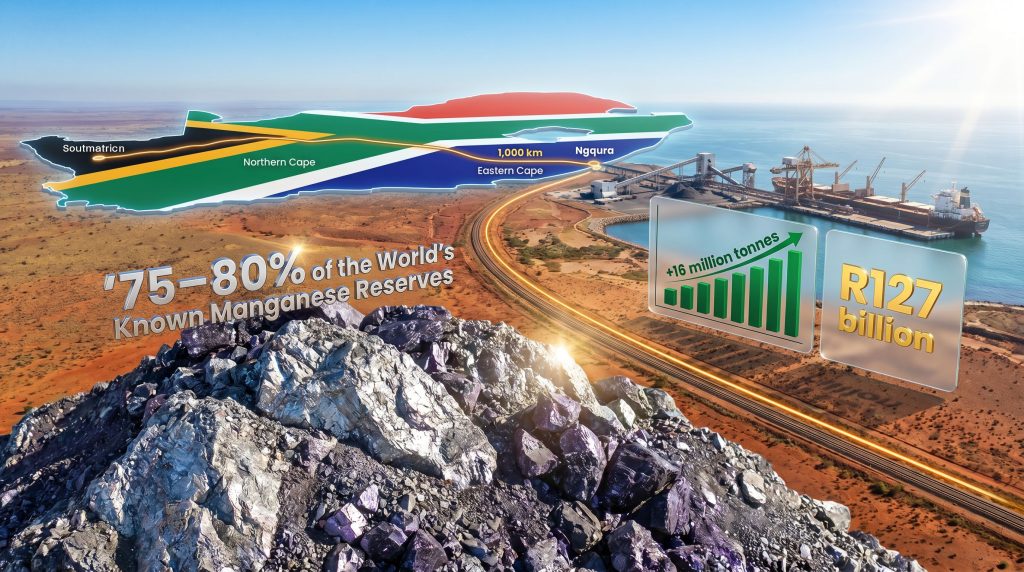
South Africa's primary manganese ore bodies are concentrated in the Northern Cape province, centred on the area around Hotazel and the broader Kalahari Manganese Field. This ore field is not merely significant on a regional scale. The United States Geological Survey consistently identifies South Africa as holding the commanding majority of global manganese reserves, with estimates in the range of 75% to 80% of known reserves worldwide.
The challenge is geographic as much as it is logistical. The ore bodies sit approximately 1,000 kilometres from the nearest export terminals, a distance that immediately places the cost burden of transport at the centre of every commercial decision a producer makes. In commodity markets, where margins are compressed by global manganese ore pricing benchmarks that producers cannot control, the cost of moving ore to port is not a secondary variable. It is frequently the variable that determines whether a mine is profitable or not.
Compare this with competing manganese jurisdictions. Australia's primary operations in the Northern Territory, operated by South32 at Groote Eylandt, sit adjacent to a dedicated export terminal with relatively short haulage distances. Gabon's Moanda mining complex connects to the coast via a purpose-built mineral railway. In both cases, the logistics chain was engineered to serve the mine, not inherited from a network designed for general freight.
South Africa's rail infrastructure was developed incrementally and serves multiple freight streams simultaneously. The consequence is that manganese ore competes for capacity on networks not designed around bulk mineral throughput, which elevates cost and reduces throughput predictability.
When Logistics Becomes the Largest Cost Line
Industry analysis consistently points to transport accounting for approximately one-third of total manganese production costs in South Africa. This is not a marginal overhead. It is a structural cost burden that compounds during periods of price weakness and limits the country's ability to respond to demand surges with the speed that global buyers require.
The practical effect is a paradox that the sector has long recognised but struggled to resolve. South Africa has the reserves, the mining expertise, and the operational capacity. What it lacks is a logistics platform that converts those advantages into delivered tonnage at globally competitive cost. As noted by Creamer Media's Martin Creamer in Mining Weekly (May 2026), the private sector is extracting ore competitively, but the absence of a competitive logistics platform risks the full value of the country's manganese endowment being forfeited.
The Road Transport Dead End
When rail capacity fails or congestion prevents scheduled loading, producers face a difficult alternative: road haulage. It is worth being precise about why this option is not viable at scale.
The per-tonne cost of moving bulk manganese ore by road is materially higher than rail on any equivalent corridor. Beyond direct cost, the consequences of bulk mineral road transport cascade across several dimensions:
- Road surfaces degrade rapidly under the axle loads of heavy ore vehicles, shifting infrastructure maintenance costs onto the public purse
- Carbon emissions per tonne-kilometre are significantly higher for road versus rail freight, creating direct conflicts with the sustainability commitments that major European and Asian steel buyers now embed in their procurement criteria
- Regulatory exposure increases as governments globally tighten restrictions on heavy vehicle movements and road-based commodity transport
- Scheduling reliability decreases compared to dedicated rail corridors, reducing the predictability that long-term supply contracts require
The industry's position on this is unambiguous. Forcing bulk commodity producers to resort to road transport is not a contingency plan. It is a commercially damaging outcome that signals the failure of the logistics system to fulfil its core function.
Manganese's Expanding Role in Global Industrial Systems
Any discussion of South Africa manganese logistics must be grounded in the demand context that makes resolving it urgent.
Manganese remains a non-substitutable input in steel production, functioning as both a deoxidising agent during smelting and a critical alloying element that determines the hardness, tensile strength, and wear resistance of finished steel. Approximately 90% of global manganese consumption is tied to the steel industry, and no commercially viable substitute has emerged for its deoxidation and alloying functions in standard steelmaking processes.
Global steel demand is projected to remain robust through the latter part of this decade, driven by several structural forces:
- Infrastructure construction cycles across India and Southeast Asia, where steel-intensive urbanisation and transport projects are generating sustained demand
- The transition toward electric arc furnace steelmaking in decarbonisation pathways, where higher-grade manganese ore is increasingly important for process efficiency
- The emergence of battery-grade manganese as a separate demand stream, particularly as lithium-manganese-iron-phosphate (LMFP) battery chemistry gains commercial traction in electric vehicle applications
Furthermore, the growing appetite for battery raw materials is reshaping how investors and producers evaluate the long-term viability of manganese assets. The LMFP demand story deserves specific attention because it represents a structural demand addition rather than a substitution. Unlike lithium-iron-phosphate (LFP) batteries, which contain no manganese, LMFP chemistry incorporates manganese as a core component. As EV adoption accelerates and battery manufacturers seek chemistries that reduce dependence on higher-cost nickel and cobalt, LMFP has attracted significant investment from major cell producers. This creates a demand pathway for South African manganese ore beyond the traditional steel sector.
The Supply Responsiveness Problem
One of the least-discussed consequences of South Africa's logistics constraints is the country's inability to capitalise on supply disruptions elsewhere. When weather events, political instability, or operational failures reduce manganese supply from competing regions, the standard market response should be for the world's largest reserve holder to absorb displaced demand.
In practice, South Africa's export throughput is constrained by logistics capacity rather than mining output. The ceiling on how much ore can physically move from mine to ship on any given corridor sets an absolute limit on export volume, regardless of how much material is being extracted underground. The result is a recurring pattern where supply windows close before South African producers can respond, allowing Australia, Gabon, and Brazil to consolidate market positions during precisely the periods when South Africa should be strengthening its own.
| Country | Reserve Share (approx.) | Logistics Maturity | Recent Infrastructure Direction |
|---|---|---|---|
| South Africa | 75-80% | Constrained | Ngqura terminal development |
| Australia | 5-10% | High | Ongoing port and rail investment |
| Gabon | 5-10% | Moderate | Active rail and port expansion |
| Brazil | 3-5% | Moderate | Incremental corridor upgrades |
Understanding South Africa's Export Corridor Structure
South Africa's manganese producers currently rely on several export routes, each carrying distinct operational and cost profiles.
The Saldanha Bay Corridor on the west coast has historically been associated with iron ore exports and offers relatively lower competing freight traffic. Its bulk handling infrastructure is more aligned with commodity export requirements than east coast alternatives.
The East Coast Routes, primarily through Gqeberha and Durban, operate within multi-commodity port environments where manganese competes for handling capacity alongside automotive freight, containerised cargo, and passenger operations. This configuration creates structural inefficiencies. Terminal scheduling conflicts between freight types, combined with the inherently different handling requirements of bulk minerals versus general cargo, push up per-tonne processing costs and reduce throughput predictability.
The rail infrastructure connecting these corridors to the Northern Cape operates on narrow-gauge track with axle load limits and gradient profiles that compare unfavourably with bulk commodity rail systems in Australia or Brazil. The practical consequences for throughput are significant:
- Higher wagon counts are required per equivalent tonne of ore, increasing rolling stock demand
- Energy consumption per tonne-kilometre is elevated due to gradient management requirements on key sections of the corridor
- Network resilience is lower when rolling stock or infrastructure maintenance issues arise, because the system has less redundancy than purpose-built bulk rail corridors
These are systemic constraints, not operational inefficiencies that can be resolved through better scheduling or management. They require capital investment in physical infrastructure.
The Ngqura Terminal: What a Purpose-Built Solution Looks Like
The proposed relocation of manganese export capacity to Ngqura deep-water port in the Eastern Cape represents the most consequential infrastructure development in South Africa's manganese sector in a generation. The case for developing Ngqura as the primary manganese export terminal rests on several converging arguments.
Gqeberha's multi-freight configuration limits its practical throughput ceiling for manganese. Health concerns relating to manganese dust exposure in the Gqeberha urban area have been raised by civil society and political stakeholders, adding a public health dimension to an already compelling operational case for relocation.
Ngqura, by contrast, was developed as a deep-water port capable of accommodating larger bulk carrier vessels than Gqeberha's infrastructure can handle. Larger vessel sizes translate directly into lower per-tonne shipping costs on the route to Asian steel mills, which represent the largest global consumer base for manganese ore. The project targets an addition of up to 16 million tonnes of annual manganese export capacity, and Transnet's broader capital investment programme across rail and port infrastructure is reported at R127-billion over a five-year period. Indeed, as the shift from rail to road has exposed the fragility of the current system, the Ngqura development becomes even more critical.
The Consortium Model as a Risk Management Tool
A Manganese Producers Consortium (MPC) has been formed by the sector's major operators to bid for the design, construction, and operation of the Ngqura terminal under a private-sector framework. The consortium includes African Rainbow Minerals (through subsidiary Assmang), South32, Anglo American, and Tshipi é Ntle Manganese Mining, entities that collectively account for more than 60% of South Africa's total manganese exports.
The significance of private-sector involvement extends beyond capital availability. It fundamentally alters the risk structure of the project. When producers bear the commercial risk of terminal performance, the accountability mechanisms for delivery timelines and operational standards are materially different from a purely state-executed infrastructure project.
Private capital at risk creates an alignment of incentives that public procurement frameworks alone rarely achieve. The consortium members are direct beneficiaries of terminal throughput performance, which means underperformance has a direct and quantifiable cost for the organisations responsible for delivery.
This model also introduces operational expertise that is directly relevant to terminal performance. These are not passive investors. They are the operators who will depend on the facility's throughput capacity to fulfil supply contracts with steel mills across Asia.
The next major ASX story will hit our subscribers first
The Broader Stakes: What Logistics Reform Would Unlock
The case for resolving South Africa manganese logistics challenges is not merely sectoral. The economic consequences of persistent underperformance extend across multiple layers of the national economy.
Every tonne that cannot be exported due to infrastructure constraints represents a compound loss. Export revenue that does not flow to producers reduces the tax and royalty base available to the state. Underutilised rail and port capacity suppresses employment in logistics and port operations. Reduced foreign exchange earnings from commodity exports weakens the currency position. These are not abstract concerns. They accumulate across every quarter that infrastructure reform is delayed.
For policymakers, the lever set required to close this gap involves coordinated action across several dimensions:
- Treating the Ngqura terminal completion target as a maximum timeline rather than an aspirational one, with project acceleration measures applied proactively
- Establishing commercially viable and transparent concession frameworks that enable private terminal operation with appropriate risk allocation
- Prioritising manganese and broader bulk commodity freight in capital allocation decisions across Transnet's investment programme
- Investing in rail corridor upgrades on the Northern Cape to coast routes that reduce the per-tonne cost and time of export movements
- Providing regulatory certainty sufficient for private sector entities to commit long-term capital to infrastructure development without excessive sovereign risk
A Pattern That Extends Beyond Manganese
It is worth situating the manganese logistics challenge within a broader pattern that recurs across South Africa's mineral economy. The country's extraordinary endowment spans platinum group metals, chrome, vanadium, manganese, and increasingly battery minerals relevant to the global energy transition. Across each of these sectors, a recurring dynamic emerges: world-class geology constrained by infrastructure that cannot match the scale of the resource base.
In addition, the broader picture of critical minerals demand reinforces why getting South Africa's logistics infrastructure right is a matter of strategic urgency, not merely operational improvement. Resolving the manganese logistics problem would not only benefit that sector in isolation. It would demonstrate a replicable model of public-private infrastructure delivery with applicability across the country's entire resource economy.
The Ngqura terminal, if delivered on time and at the capacity levels specified, becomes a proof of concept for what coordinated state and private sector infrastructure investment can achieve. As Mining Weekly has repeatedly highlighted in its editorial coverage of the sector, the countries that will define the next phase of global manganese markets are making infrastructure decisions now. South Africa's geological position gives it the right to compete at the top of that market. Whether it retains that position will be determined not underground, but in the engineering offices, concession negotiations, and policy chambers where the future of the country's export logistics is being decided.
Frequently Asked Questions: South Africa Manganese Logistics
Why does South Africa struggle to convert its reserve dominance into export competitiveness?
The core issue is not geological or related to mining costs. South Africa's ore bodies in the Northern Cape sit approximately 1,000 kilometres from export terminals, and the rail network connecting them was not engineered for high-volume bulk commodity throughput. The result is logistics costs that account for roughly one-third of total production costs, a proportion that erodes margins and limits the country's ability to compete on delivered cost to Asian buyers.
What is the Ngqura terminal project and why is it significant?
The Ngqura project proposes developing a dedicated deep-water manganese export terminal in the Eastern Cape to replace and significantly expand on the capacity currently managed through Gqeberha. As a deep-water facility, Ngqura can accommodate larger bulk vessels, reducing per-tonne shipping costs. The project targets up to 16 million additional tonnes of annual export capacity and involves a private-sector consortium of major producers bidding to design, build, and operate the facility. This kind of manganese mine expansion in export infrastructure mirrors the capacity growth strategies being pursued across the global sector.
Who are the major manganese producers in South Africa?
The dominant producers include African Rainbow Minerals through its Assmang subsidiary, South32, Anglo American, and Tshipi é Ntle Manganese Mining. These entities collectively represent more than 60% of the country's total manganese exports and form the core of the Manganese Producers Consortium bidding for the Ngqura terminal concession. South32's Kalahari operations, for instance, are considered a strategic manganese deposit of global significance.
Why is battery-grade manganese demand significant for South Africa?
LMFP battery chemistry, which incorporates manganese as a structural component, is gaining commercial traction as EV manufacturers seek alternatives to nickel- and cobalt-heavy battery formulations. This creates a demand pathway for South African manganese beyond the traditional steel market, adding a second structural demand driver that strengthens the long-term investment case for export infrastructure expansion.
What is the risk if South Africa does not resolve its logistics challenge?
The core risk is permanent market share loss to competitors with superior logistics infrastructure. Australia, Gabon, and Brazil are actively improving their export systems. Each year that South Africa's throughput ceiling remains constrained by infrastructure is a year in which competitors strengthen their positions with buyers who require reliability and cost competitiveness, not just reserve abundance.
Key Takeaways: The Strategic Imperative for South Africa Manganese Logistics
| Strategic Dimension | Current State | Target State |
|---|---|---|
| Global reserve share | 75-80% of known reserves | Maintained through continued investment |
| Logistics cost burden | ~33% of total production costs | Reduced through infrastructure upgrades |
| Ngqura export capacity addition | Under development | Up to 16 million tonnes per annum |
| Rail network capability | Narrow gauge, constrained axle loads | Upgraded corridors with higher throughput |
| Private sector involvement | MPC consortium bid in progress | Formalised concession framework |
| State infrastructure commitment | R127-billion five-year programme | Full deployment and on-schedule delivery |
South Africa's manganese sector does not face a resource problem or a mining competitiveness problem. It faces a logistics delivery problem that is structurally solvable, provided the coordination between state infrastructure investment and private sector execution materialises at the pace and scale the sector requires. The private sector has demonstrated the will and the capital capacity to invest in solutions. The decisive variable is whether the policy and infrastructure decisions being made now match the urgency that South Africa's manganese endowment demands.
Want to Stay Ahead of the Next Major Mineral Discovery?
Discovery Alert's proprietary Discovery IQ model scans ASX announcements in real time, instantly identifying significant mineral discoveries across manganese, battery materials, and more than 30 other commodities — turning complex data into actionable investment insights before the broader market reacts. Explore how historic discoveries have generated substantial returns on the Discovery Alert discoveries page, and begin your 14-day free trial today to position yourself at the forefront of the next major find.