
June 9, 2026
The Governance Gap That Costs Billions: Understanding Mineral Rights Administration in Resource-Rich Nations
Every major resource jurisdiction in the world faces the same fundamental tension: extraordinary geological wealth sitting beneath complex layers of historical administrative decisions, conflicting records, and regulatory frameworks built across multiple generations of mining activity. The quality of the system used to manage those records, known as a South Africa mining cadastre, has become one of the most consequential variables in determining where exploration capital flows in the modern mining investment cycle.
This is not a peripheral governance concern. Research consistently shows that licensing transparency and rights certainty rank among the top three factors influencing junior exploration investment decisions, sitting alongside geological prospectivity and fiscal terms. For South Africa, a nation holding one of the most remarkable mineral endowments on the planet, the state of its mineral rights registry has become an increasingly urgent strategic issue.
When big ASX news breaks, our subscribers know first
What a Mining Cadastre Actually Does and Why It Matters
A mining cadastre is far more than a database. At its core, it is a geospatially enabled, publicly accessible registry that records the precise boundaries, ownership status, duration, and conditions attached to every mineral rights licence across a jurisdiction. A well-functioning cadastre allows companies to identify open ground for exploration, check for overlapping claims, submit licence applications online, and track application status in real time.
The technical architecture of a modern cadastre typically integrates several core capabilities:
- Real-time geospatial mapping that overlays existing rights on topographic and geological data
- Automated overlap detection that prevents double-granting of rights over the same ground
- Online application portals that remove the need for in-person or paper-based submissions
- Transparent processing queues that allow applicants to monitor progress
- Public-facing interfaces that allow exploration companies to screen ground availability before committing to due diligence expenditure
The exploration investment case for cadastre quality is straightforward. A junior mining company planning a greenfields exploration programme typically operates with limited capital and needs near-certainty on rights status before allocating a drill budget. If the licensing system is opaque, slow, or prone to conflicting records, the rational response is to redirect capital toward jurisdictions where rights certainty can be established quickly and cheaply.
Furthermore, the mineral discovery curve illustrates precisely how administrative friction affects the timing and scale of capital deployment at the earliest exploration stages.
A functional cadastre doesn't just improve administrative efficiency. It removes the rights-uncertainty discount that investors apply to exploration assets in jurisdictions where the registry cannot be trusted, and that discount can be substantial.
How South Africa Compares to Global Peers
Leading mining jurisdictions have built digital cadastre systems that now function as active tools for investment attraction. The contrast with legacy systems is instructive:
| Jurisdiction | System Type | Online Applications | Real-Time Mapping | Processing Transparency |
|---|---|---|---|---|
| Canada (most provinces) | Digital cadastre | Yes | Yes | High |
| Australia (most states) | Digital cadastre | Yes | Yes | High |
| Chile | Digital registry | Partial | Yes | Moderate-High |
| DRC | Partially modernised | Limited | Limited | Low-Moderate |
| South Africa (current) | SAMRAD (legacy) | Limited | Constrained | Low |
| South Africa (target) | New cadastre | Full | Real-time | High |
The gap between South Africa's current system and international benchmarks is significant, and this gap has measurable consequences for how the country competes for exploration capital. For context, mapping Africa's mining cadastre demonstrates how geospatial modernisation is increasingly recognised as foundational to unlocking mineral wealth across the continent.
The SAMRAD Legacy: How Decades of Data Complexity Created a Structural Problem
South Africa's legacy mineral rights platform, known as SAMRAD (South African Mineral Rights Administration and Data), has drawn sustained criticism from industry participants for years. The platform's limitations are not simply a matter of outdated technology. They reflect a deeper data governance challenge that is almost uniquely difficult to solve.
South Africa has one of the longest continuous commercial mining histories of any country on earth. Gold mining on the Witwatersrand dates back to the 1880s. Platinum-group metal extraction in the Bushveld Complex has been ongoing for over a century. This means the mineral rights dataset that any new system must migrate and clean contains records accumulated across multiple distinct regulatory regimes, administrative systems, and geological survey methodologies.
The specific problems that have been documented with SAMRAD include:
- Persistent processing backlogs that have extended licensing timelines significantly beyond statutory targets
- Limited geospatial visibility, making it difficult to identify ground availability or verify boundary accuracy
- Duplicate and conflicting historical applications that create legal uncertainty over rights status
- Weak transparency on overlapping applications, meaning multiple parties have sometimes proceeded on the assumption of rights that were contested
- Restricted accessibility for smaller operators who lack the administrative resources to navigate a complex, paper-heavy process
The downstream effect of these systemic weaknesses has been a contraction in junior miner activity relative to what South Africa's geology should logically attract. Exploration-stage companies, which lack the balance sheet resilience of major producers, are particularly sensitive to administrative uncertainty. When licensing timelines are unpredictable and rights status is difficult to verify, capital migrates to jurisdictions where those risks are lower, even if the geology is less compelling.
The Investment Signal Problem
There is a broader signalling dimension to cadastre quality that goes beyond direct operational impact. Institutional investors and capital allocators who assess country-level mining investment risk use administrative transparency as a proxy for overall governance quality. A jurisdiction with a functioning digital cadastre signals institutional credibility. One without signals risk, regardless of the underlying resource endowment.
South Africa's resource base remains exceptional. The country is the world's leading producer of platinum-group metals, accounting for roughly 70% of global platinum supply and an even larger share of rhodium production. It also holds the world's largest known reserves of chrome ore and manganese. The Bushveld Complex alone is considered one of the most remarkable geological formations in the world from an economic mineralogy perspective.
Yet despite this endowment, the country has watched faster-growing deal pipelines develop in Guinea, Zimbabwe, and the Democratic Republic of Congo, all of which have structural disadvantages relative to South Africa in terms of infrastructure, geological documentation, and institutional stability. The common thread in South Africa's underperformance on exploration deal flow relative to its geological potential is administrative friction, and the cadastre problem sits at the centre of that friction.
Building the New System: Architecture, Timeline, and Risk
In January 2024, the Department of Mineral and Petroleum Resources appointed a consortium of firms to design and construct the replacement cadastre platform. The decision to pursue a phased, province-by-province migration rather than a simultaneous national rollout reflects a pragmatic acknowledgement of the data complexity involved.
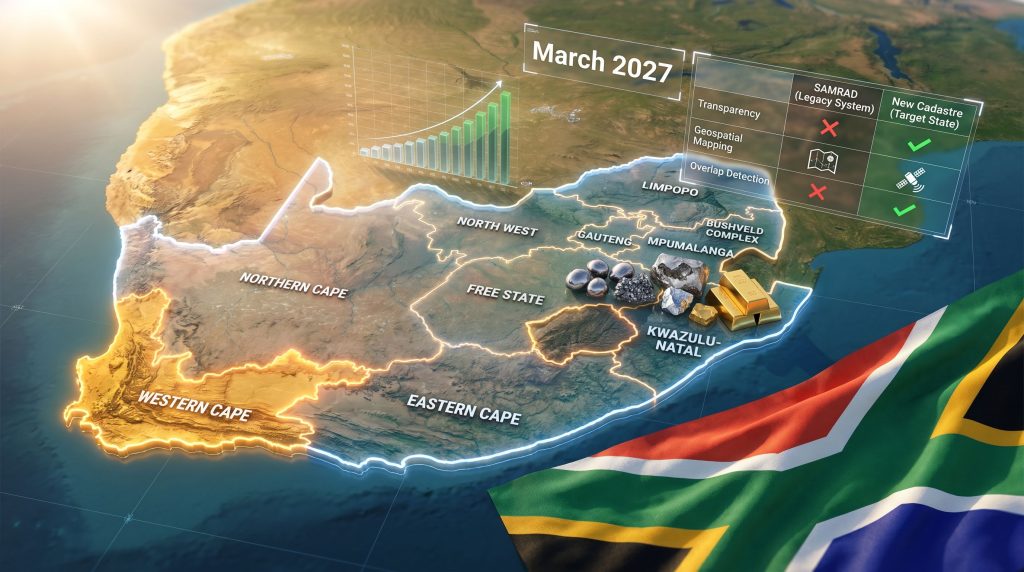
The Western Cape was selected as the pilot province for a specific reason: it carries the lowest mining activity density in South Africa, which means its historical mineral rights dataset is smaller, less contested, and more manageable than any other province. Successfully integrating the Western Cape first allows the consortium to validate the platform's technical architecture, data migration protocols, and user interface before tackling provinces with far heavier data burdens.
The provinces that will follow present significantly greater challenges. Limpopo, Mpumalanga, the Northern Cape, and the North West province collectively account for the vast majority of active mining and exploration activity. Their historical records include the most complex overlapping applications, the oldest legacy data, and the highest concentration of disputes. Migrating these provinces requires not just technical data transfer but active resolution of conflicting records.
The Department's stated target of completing all nine provinces by the end of March 2027 implies migrating eight remaining provinces in approximately ten months following the Western Cape's integration. That is an ambitious schedule given the data complexity involved, and it is worth noting that the cadastre has already experienced multiple implementation delays. Parliamentary oversight committees raised concerns in late 2025 that the system must demonstrate its core anti-overlap and anti-backlog functions at the pilot stage before national rollout can be credibly validated. Indeed, parliament's response to the cadastre system highlighted these same concerns about demonstrable progress before broader rollout.
Key Risk Factors for the March 2027 Deadline
- Data migration complexity: Resolving decades of conflicting, duplicate, and overlapping records across high-activity provinces represents the single largest technical and legal obstacle
- Inter-departmental coordination: Successful integration requires consistent engagement across provincial and national government structures with different administrative capacities
- Provincial data quality variance: Records quality varies significantly between provinces, with older mining districts carrying greater legacy data degradation
- Historical implementation pattern: The cadastre has been delayed multiple times before, and investors are likely to apply a risk discount to the stated March 2027 target
Who Gains Most When the System Works
The beneficiary landscape for a functional South Africa mining cadastre is tiered, with different classes of market participant standing to gain in different ways.
Junior and exploration-stage companies are the primary beneficiaries. The system is specifically designed to lower barriers to entry for smaller operators by making ground availability visible, rights status verifiable, and licence applications submittable without navigating a complex bureaucratic process. For companies that depend on rights certainty before committing drill budgets, a functioning cadastre can mean the difference between initiating an exploration programme in South Africa or deploying capital elsewhere.
Mid-tier producers benefit from cleaner licence renewal processes and improved visibility over adjacent ground for resource extension. In mature mining districts, the ability to identify and secure ground adjacent to existing infrastructure can materially change the economics of resource development.
Major operators including Gold Fields, Exxaro Resources, and Valterra Platinum stand to gain through reduced administrative overhead and faster processing of compliance obligations, freeing internal resources for operational rather than regulatory management.
Foreign capital allocators and institutional investors respond to the governance signal that a functioning cadastre provides. Improved administrative transparency supports a re-rating of South Africa's investment risk profile, which over time should compress the country risk premium applied to South African mining assets.
The Policy Coherence Problem: When Two Directions Pull Against Each Other
The cadastre reform does not exist in isolation. Its investment impact depends heavily on the coherence of the surrounding policy framework, and on that front, the signals from mid-2026 are mixed.
At the same conference where the March 2027 cadastre target was announced, the Minerals Council South Africa released a critical assessment of a new industrial strategy published by the Department of Trade, Industry and Competition. The industry lobby specifically flagged proposals to introduce taxes and export quotas on chrome ore, and to attach beneficiation conditions, meaning requirements for additional downstream processing, to mining licence allocation decisions.
The concern expressed by the Minerals Council is substantive from an investment theory perspective. Beneficiation conditions attached to licensing decisions introduce a discretionary element into what should be a rules-based administrative process. When the criteria for licence approval extend beyond technical and financial capability to include commitments about downstream industrial activity, the licensing process becomes less predictable and more subject to political interpretation.
This creates a direct tension with the transparency objectives of the cadastre reform. A system designed to make rights allocation transparent, predictable, and accessible loses some of its value if the approval decision itself can be influenced by industrial policy considerations that fall outside the cadastre's technical framework.
Regulatory coherence matters as much as individual policy quality. Investors calibrate country risk based on the interaction between policies, not just individual measures in isolation.
Chrome ore is a particularly sensitive test case. South Africa holds the world's largest chrome reserves, and the ferrochrome industry built around domestic chrome processing has historically benefited from access to domestic ore. Export restrictions on chrome ore have been a recurring policy debate, with the industrial policy rationale being that restricting raw ore exports forces value addition onshore. The mining industry's counter-argument is that such restrictions reduce the revenue available to fund exploration and new mine development, ultimately constraining the upstream pipeline that feeds the beneficiation sector itself.
The next major ASX story will hit our subscribers first
South Africa's Mineral Endowment: The Strategic Stakes
Understanding why the South Africa mining cadastre reform carries outsized significance requires appreciating the scale of what is at stake geologically. Beyond platinum-group metals and chrome, South Africa is a major producer of gold, manganese, iron ore, coal, vanadium, and diamonds. The Witwatersrand Basin remains one of the most prolific gold-producing geological formations ever discovered, even after more than 130 years of intensive extraction.
The challenge facing South Africa is one of pipeline sustainability. Mature mining districts require continuous exploration investment to replace depleting reserves. Junior miners, which are typically the primary vehicle for early-stage exploration, are precisely the companies most sensitive to administrative barriers. A cadastre that genuinely lowers the entry threshold for smaller operators is therefore directly linked to the country's ability to sustain production volumes in its most important commodity categories over the medium and long term.
The competitive dynamic with other African jurisdictions adds urgency to the reform timeline. Guinea has emerged as a major force in bauxite and iron ore. Zimbabwe is attracting significant lithium investment. However, the critical minerals demand driven by the global energy transition means South Africa's reserves of platinum-group metals, vanadium, and manganese carry growing strategic importance. These are not countries that have surpassed South Africa's resource endowment. They are countries where administrative improvements, whether real or perceived, have redirected a meaningful share of exploration capital that might otherwise have been allocated to South African ground.
Frequently Asked Questions: South Africa Mining Cadastre
What is the South Africa mining cadastre?
The South Africa mining cadastre is a planned digital registry and geospatial platform designed to replace the legacy SAMRAD system. It enables companies to view existing mineral rights, identify open ground, and submit licence applications online, improving transparency and reducing administrative delays across all nine provinces.
When will South Africa's new mining cadastre be fully operational?
The Department of Mineral and Petroleum Resources has set a target of March 2027 for full integration of all nine South African provinces. As of mid-2026, only the Western Cape has been incorporated into the platform.
Why has the cadastre rollout taken so long?
The primary obstacle is the complexity of migrating and cleaning historical data from SAMRAD, including resolving decades of overlapping, duplicate, and conflicting mineral rights records accumulated across South Africa's exceptionally long commercial mining history.
Who benefits most from a functioning cadastre?
Junior and exploration-stage mining companies are the primary beneficiaries, as the system is designed to lower barriers to entry and improve rights visibility for smaller operators. Institutional investors also benefit from the improved governance signal. In addition, the mining claims framework developed in other jurisdictions illustrates how rights clarity directly correlates with increased exploration participation.
What risks could delay the March 2027 deadline?
Data migration complexity in high-activity provinces, inter-departmental coordination challenges, provincial data quality variance, and the project's historical pattern of implementation delays all represent credible risk factors. Consequently, a definitive feasibility study for any South African project will need to account for these administrative uncertainties in its risk modelling.
How does industrial policy interact with the cadastre reform?
Proposals to attach beneficiation conditions to licence approvals and to introduce export restrictions on chrome ore create policy coherence risks that could partially offset the investment confidence gains from cadastre modernisation.
Key Takeaways at a Glance
- March 2027 is the Department of Mineral and Petroleum Resources' stated deadline for full nine-province cadastre integration
- Only the Western Cape had been incorporated into the new system as of mid-2026, chosen specifically for its low data complexity
- A consortium appointed in January 2024 is responsible for building the replacement platform
- Data migration complexity across high-activity provinces, not technical platform design, is the primary implementation risk
- Junior miners and exploration companies stand to gain the most from a functioning system, with direct implications for South Africa's long-term reserve replacement pipeline
- Simultaneous industrial policy proposals including chrome export quotas and beneficiation licensing conditions create regulatory coherence risks
- South Africa's competitive position relative to emerging African mining jurisdictions depends on resolving administrative friction that its geological endowment alone cannot overcome
This article is intended for informational purposes only and does not constitute financial or investment advice. Mining project timelines and government policy positions are subject to change. Readers should conduct independent due diligence before making any investment decisions related to South African mining assets or equities.
Want to Track the Next Major ASX Mineral Discovery in Real Time?
Discovery Alert's proprietary Discovery IQ model instantly scans ASX announcements across more than 30 commodities, delivering real-time alerts on significant mineral discoveries so subscribers can act ahead of the broader market — explore historic discoveries and their returns to understand what's possible, then start your 14-day free trial at Discovery Alert and position yourself at the forefront of the next major find.