May 24, 2026
The Supply Chain Calculus Behind Kasiya's Dual-Commodity Ambition
The global race to secure non-Chinese sources of battery-critical and defence-critical minerals has fundamentally altered how institutional investors, multilateral lenders, and major mining companies evaluate early-stage projects. For most of the past decade, the titanium feedstock market operated in a quiet corner of industrial commodities, while graphite's strategic profile remained largely invisible outside specialist circles. Both dynamics have since reversed sharply. The completion of the Sovereign Metals Kasiya DFS now places one of the most structurally unusual mineral projects in the world at the centre of that conversation.
Understanding what the DFS actually confirms, and what it does not, requires separating technical achievement from development authorisation. These are not the same thing, and conflating them is one of the more common errors investors make when evaluating mining project milestones.
When big ASX news breaks, our subscribers know first
What the Kasiya DFS Actually Confirms
A definitive feasibility study represents the highest level of technical and economic definition a mining project achieves before financing and construction. It is not a green light to build. For the Kasiya project in Malawi, operated by Sovereign Metals (ASX: SVM | AIM: SVML | OTCQX: SVMLF), the completed DFS delivers validated engineering parameters, confirmed production assumptions, and a bankability-aligned cost structure, but two entirely independent critical paths must still be resolved before any construction decision can be made.
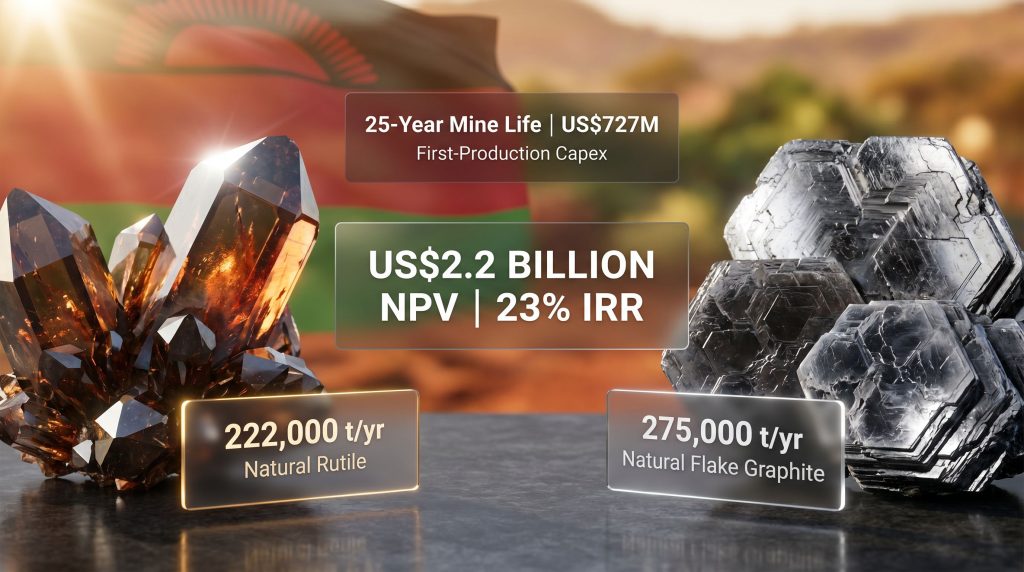
The headline economics are substantial. The study returns a pre-tax net present value of US$2.2 billion at an 8% discount rate and a pre-tax internal rate of return of 23%, set against first-production capital expenditure of US$727 million. Over the full life of the mine, total development capital reaches US$1,239 million, with sustaining capital of US$431 million on top of that.
| Metric | Value |
|---|---|
| Pre-Tax NPV (8% Discount Rate) | US$2.2 billion |
| Pre-Tax IRR | 23% |
| First-Production Capex | US$727 million |
| Total Life-of-Mine Development Capital | US$1,239 million |
| Sustaining Capital | US$431 million |
| Total Life-of-Mine Revenue | ~US$16.2 billion |
| Annual EBITDA (Steady State) | ~US$476 million |
| Annual Free Cash Flow | ~US$452 million |
| Mine Life | 25 years |
Investor note: The NPV of US$2.2 billion is a pre-tax figure calculated at an 8% discount rate. It does not reflect post-tax returns, project financing costs, or potential dilution from future equity capital raises. Investors should treat this figure as a technical measure of project value under study assumptions, not a guaranteed financial return.
The DFS was overseen by the Sovereign-Rio Tinto Technical Committee and aligned with International Finance Corporation (IFC) Performance Standards, a deliberate choice that positions the study output for institutional project finance review. A completed Pilot Mining Programme incorporating real-world operational data provided ground-truthed validation across key study workstreams, while a Mineral Resource Estimate upgrade delivered the classification standard typically required by project finance lenders.
Three Engineering Changes That Distinguish the DFS From the PFS
One of the more instructive aspects of the Sovereign Metals Kasiya DFS is how substantially the engineering design shifted from the earlier Pre-Feasibility Study. Three structural changes define the evolution, and each one improves the project's cost structure, environmental profile, or financing attractiveness in a meaningful way.
1. Dry Mechanical Mining Replaces Hydro-Mining
The earlier PFS modelled hydro-mining, a water-intensive extraction method that requires drilling, blasting, and water cannons to mobilise ore. The DFS replaces this entirely with dragline-based dry mechanical mining. This approach requires no drilling, blasting, crushing, or milling, and it substantially reduces operational complexity. Importantly, the soft, unconsolidated nature of Kasiya's mineralisation makes it particularly well suited to this method. The ore body's low strip ratio and near-surface positioning are physical characteristics that enable this kind of low-disturbance extraction, which is not possible at harder-rock deposits.
2. In-Pit Co-Disposal Replaces a Conventional Tailings Storage Facility
Conventional tailings dams represent one of the most significant long-term environmental liabilities in mining. By redesigning the waste management approach to return processed material directly into the mine void, the DFS eliminates the need for a standalone tailings storage facility. This reduces the project's surface footprint, lowers closure liability, and strengthens the environmental section of the ESIA, which is directly relevant to the permitting critical path.
3. Hydropower Grid Connection Replaces the Independent Power Producer Model
The PFS modelled a standalone power generation solution. The DFS instead connects to Malawi's national hydropower grid, reducing capital intensity upfront and improving the long-term operating cost structure. This change also reduces the project's carbon footprint, which carries weight for institutional lenders operating under ESG mandates.
Production Scale, Staged Development, and the Global Context
At confirmed design capacity, the Kasiya project is positioned to become the world's largest single-operation producer of both natural rutile and natural flake graphite simultaneously — a scale distinction no currently operating mine holds for either commodity, let alone both.
Annual production targets are confirmed as follows:
| Commodity | Annual Production Target | Mine Life |
|---|---|---|
| Natural Rutile | 222,000 tonnes | 25 years |
| Natural Flake Graphite | 275,000 tonnes | 25 years |
| Resource Base | 2.1 billion tonnes | — |
The project is structured as a staged development across two processing plants, each rated at 12 million tonnes per annum. The South Plant commences in Year 1, while the North Plant follows in Year 5. This sequencing is not merely a logistical choice. Staging reduces front-end capital concentration, lowers execution risk during the most capital-intensive phase, and allows operational learnings from the South Plant to inform North Plant commissioning.
Why These Two Commodities Carry Strategic Weight
Natural Rutile: A Feedstock Without a Credible Alternative Pipeline
Natural rutile is a high-grade titanium dioxide feedstock used in aerospace components, defence systems, industrial coatings, and pigment production. Unlike synthetic rutile or titanium slag, natural rutile requires minimal processing before entering the titanium metal or pigment supply chain, giving it quality and processing advantages for specific end-use applications.
The critical supply gap is structural. There are no other advanced-stage, large-scale primary rutile development projects publicly identified at a scale comparable to Kasiya. The global market currently depends on a small number of ageing mineral sands operations, most of which are in long-term production decline. Furthermore, both the United States and the European Union have designated natural rutile as a critical mineral, reflecting its role in defence and industrial supply chains rather than simply its commercial value. This aligns directly with the broader critical minerals demand narrative reshaping commodity markets globally.
Natural Flake Graphite: The China Dependency Problem
The graphite supply chain presents a different kind of risk. China accounts for the dominant share of global natural graphite production and, critically, controls the downstream processing infrastructure used to convert natural flake graphite into the spherical graphite used in lithium-ion battery anodes. This creates a dual-layer dependency for Western battery manufacturers: reliance on Chinese raw material supply and reliance on Chinese processing capacity.
Kasiya's graphite is characterised as suitable for all major end-use markets, with quality characteristics comparable to leading Chinese battery anode producers. The project's incremental graphite production cost is confirmed at US$216 per tonne, a figure that positions Kasiya as economically competitive rather than merely strategically convenient. When the managing director of Sovereign Metals described the company's ability to challenge Chinese producers at that cost level, the implication was not purely rhetorical. At US$216 per tonne, Kasiya's graphite economics sit within the range of Chinese production costs before any freight, geopolitical risk premium, or supply chain security premium is applied by buyers.
The Monazite Layer: Unquantified Upside Outside the DFS
A detail that tends to be overlooked in DFS coverage is the potential monazite by-product. Monazite recovered from Kasiya ore contains dysprosium, terbium, and yttrium — three heavy rare earth elements that are simultaneously subject to active Chinese export controls and classified as critical for defence systems and advanced aerospace applications. Consequently, disruptions to rare earth supply chains have already begun repricing Western critical mineral assets broadly.
This is meaningful for two reasons. First, the value of these elements is not captured in the current DFS economics. The US$2.2 billion NPV figure carries no monazite contribution. Second, the potential economic contribution of monazite recovery at Kasiya could be materially larger than it would have appeared two years ago. Monazite recovery remains a continuing workstream and should be understood as potential upside with no disclosed timeline or quantified value.
The Two Critical Paths to a Construction Decision
Critical Path 1: Environmental and Social Impact Assessment Approval
All specialist biological, social, and biophysical studies underpinning the ESIA have been finalised and integrated into project design. However, the ESIA itself has not been finalised, submitted for regulatory review, or approved. No target date for any of these steps has been publicly disclosed. A separate mining licence application constitutes a further unresolved parallel workstream.
| Permitting Workstream | Current Status |
|---|---|
| ESIA Finalisation | Pending, no disclosed target date |
| ESIA Regulatory Submission | Pending, no disclosed target date |
| ESIA Regulatory Approval | Unresolved, open precondition |
| Mining Licence Application | Separate workstream, unresolved |
On the ground, Sovereign has established a 22-person core social team and a 90-member Community Liaison Team, conducted successful rehabilitation trials, and received requests from 28 local farmers to establish a post-closure farming co-operative. These are substantive social licence indicators, but they do not substitute for regulatory approval and should not be interpreted as a proxy for permitting progress.
Critical Path 2: Project Financing Closure
The IFC is positioned as a potential co-lead mandated lead arranger under an existing Collaboration Agreement. This institutional relationship provides a credible framework for project finance engagement and signals that Kasiya meets the environmental and social standards that multilateral lenders apply before considering involvement. However, no binding financing commitments have been secured, and no committed capital position exists.
The Interdependency Problem
These two critical paths are not independent in practice. Project finance lenders require binding offtake agreements before committing capital. Binding offtake agreements require Rio Tinto's consent under its Investment Agreement with Sovereign. Rio Tinto holds an 18.5% strategic equity stake, representing a total investment of A$60 million, and its rights under the Investment Agreement constitute a required condition for converting both current offtake MOUs into binding definitive agreements.
| Partner | Commodity | Volume | Term | Status |
|---|---|---|---|---|
| Mitsui & Co. | Natural Rutile Concentrate | Up to 70,000 tpa | Initial 4-year period | Non-binding MOU |
| Traxys North America LLC | Natural Flake Graphite | 40,000 to 80,000 tpa | 5 to 10 years | Non-binding MOU |
The Traxys relationship carries a dimension beyond standard offtake. Traxys North America LLC is one of only three trading houses selected to procure critical minerals for the US Government's US$12 billion Project Vault strategic reserve programme. This positions Kasiya's graphite output as a potential direct supplier to US government strategic stockpiling — an arrangement that, if formalised, would represent a materially different buyer profile from conventional commercial offtake. In addition, this aligns with the broader critical minerals strategy that Western governments are actively pursuing to reduce supply chain vulnerabilities.
Structural risk note: The sequencing dependency between permitting, financing, offtake conversion, and Rio Tinto consent means that no single workstream can close in isolation. Investors should evaluate the project timeline as a convergence problem across multiple independent approval processes, not a linear pathway.
The next major ASX story will hit our subscribers first
Frequently Asked Questions
Has Sovereign Metals Made a Final Investment Decision on Kasiya?
No. DFS completion advances the project into the permitting and financing phase but does not constitute a Final Investment Decision or construction authorisation. Both ESIA approval and financing closure must be achieved before a construction decision becomes possible.
What Does the US$216 Per Tonne Graphite Cost Mean in Competitive Terms?
This figure represents Kasiya's incremental cost of graphite production once rutile revenue is applied as a by-product credit. It positions Kasiya within the cost range of Chinese natural graphite producers before applying any supply chain risk premium, transport costs, or geopolitical security premium that Western buyers increasingly apply when sourcing outside China. For context, analysts reviewing the Kasiya DFS results have highlighted this cost position as one of the project's most compelling competitive attributes.
What Is Project Vault and Why Is the Traxys Connection Significant?
Project Vault is a US$12 billion US Government programme to build strategic reserves of critical minerals. Traxys North America is one of only three trading houses selected to procure materials for this programme. The non-binding MOU with Traxys creates a potential pathway connecting Kasiya's graphite output to US government stockpiling, though conversion to a binding agreement requires multiple independent approvals including Rio Tinto's consent.
Is the Monazite By-Product Included in the DFS Economics?
No. The potential monazite recovery workstream — which could yield dysprosium, terbium, and yttrium — is explicitly excluded from current DFS economics. The US$2.2 billion NPV figure carries no monazite value contribution, meaning any successful development of the monazite workstream would represent additional value not captured in the study. Furthermore, technologies such as direct lithium extraction illustrate how processing innovation can unlock value in complex multi-element deposits, a parallel worth monitoring at Kasiya.
When Will the ESIA Be Approved?
No target date for ESIA finalisation, submission, or regulatory approval has been disclosed. This represents an open-ended schedule risk that sits independently of financing and commercial progress. The Sovereign Metals Kasiya DFS has advanced the project substantially, but regulatory timelines remain the single most uncertain variable in the overall development schedule.
This article is for informational purposes only and does not constitute financial advice. All figures are drawn from publicly available DFS disclosures. Forecasts, projections, and NPV estimates reflect study assumptions and are subject to change. Investors should conduct independent due diligence before making any investment decisions.
Want To Stay Ahead Of The Next Major Mineral Discovery On The ASX?
Discovery Alert's proprietary Discovery IQ model delivers real-time alerts on significant ASX mineral discoveries — instantly translating complex data into actionable investment insights for both short-term traders and long-term investors. Explore how historic discoveries have generated exceptional returns on Discovery Alert's dedicated discoveries page, and begin your 14-day free trial today to position yourself ahead of the broader market.