May 24, 2026
When Abundance Ends: Understanding the Global Supply Chain Crisis at the World's Most Dangerous Chokepoint
Most investors, policymakers, and consumers frame economic risk through familiar lenses: interest rates, inflation data, earnings reports, and central bank commentary. But the most consequential disruptions in economic history rarely arrive through the channels everyone is watching. They arrive through the channels everyone has stopped thinking about because nothing went wrong there for a very long time.
That is precisely what is unfolding now. A narrow strip of water, 33 kilometres wide at its tightest point, is currently threatening to undo decades of global trade architecture. The Strait of Hormuz supply chain disruption is not simply an energy story. It is a story about what happens when a civilisation that quietly offshored its industrial capacity discovers that the supply lines feeding that offshore capacity have been severed.
Understanding this requires going several levels deeper than the oil price headlines suggest.
When big ASX news breaks, our subscribers know first
Why a 33-Kilometre Gap in the Map Controls the Global Industrial Machine
The Strait of Hormuz sits between Iran and Oman, connecting the Persian Gulf to the Arabian Sea and onward to the world's major ocean trade lanes. At its narrowest navigable point, vessels travelling in opposite directions pass through shipping lanes barely a few kilometres wide. Despite this extraordinary geographic constraint, the volume of commerce transiting this corridor is almost incomprehensible in its scale.
Every single day, approximately 20% of the world's seaborne oil passes through this passage. Roughly one-third of globally traded liquefied natural gas follows the same route. Alongside these headline figures flow volumes of refined petroleum products, naphtha, fertilizers, ammonia, urea, sulfur, helium, aluminium, and industrial chemicals that collectively sustain manufacturing operations across four continents.
The International Energy Agency has identified the Strait of Hormuz as carrying unparalleled systemic trade risk. No other geographic feature carries comparable exposure across so many commodity categories simultaneously.
"The Strait of Hormuz is not merely an energy corridor. It is the arterial junction of the entire global industrial supply chain. Closing it does not simply raise fuel prices. It halts factories, empties shelves, and disrupts manufacturing on a planetary scale."
The Difference Between Disruption and Closure
A critical analytical distinction exists between a full closure of the Strait and a partial or threat-based disruption. Both produce cascading economic effects, but through different mechanisms and timelines.
Full closure produces immediate, severe commodity price spikes and supply shortages. Partial disruption or sustained threat environments produce something arguably more damaging: persistent uncertainty that drives insurance premium escalation, freight surcharge application across all global trade lanes, and corporate inventory management decisions that create demand surges and supply gaps far from the conflict zone.
During peak disruption phases, estimates suggest approximately 500,000 shipping containers have been stranded within the Persian Gulf. Vessels rerouting via the Cape of Good Hope face 10 to 14 additional days of transit time, substantially increased bunker fuel consumption, and higher operating costs passed directly into freight pricing globally. Furthermore, the congestion consequences cascade outward to major transshipment hubs including Singapore, Tanjung Pelepas, and Port Klang as rerouted vessel volumes converge simultaneously.
What Actually Flows Through the Strait, Sector by Sector
The energy figures attract all the attention, however the full commodity profile of Hormuz-transiting trade reveals why the disruption is structurally different from previous supply shocks.
| Commodity Category | Share of Global Seaborne Trade | Primary Destination Markets | Key Disruption Impact |
|---|---|---|---|
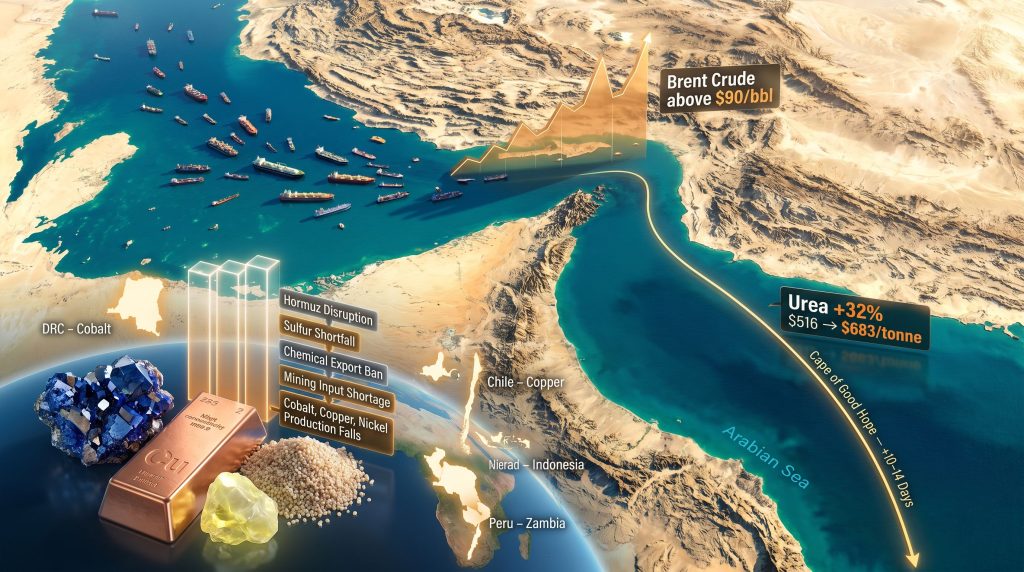
| Crude Oil | ~20% of global supply | China, India, Japan, South Korea | Brent crude surging above $90/bbl |
| LNG / LPG | ~30% of global seaborne gas | Asia-Pacific energy markets | Energy rationing risk across East Asia |
| Naphtha / Petrochemicals | ~24% of global seaborne naphtha | Plastics, packaging, electronics | Production halts across Asian manufacturing |
| Fertilizers (Urea, Ammonia) | Significant Gulf export volumes | Global agriculture | US urea prices up 32% ($516 to $683/tonne in one week) |
| Sulfur / Industrial Chemicals | Majority of China's sulfur imports | Chinese chemical processing | Export bans triggering mining sector shortages globally |
| Helium, Aluminium, Specialty Metals | Material volumes | Semiconductor and aerospace sectors | Supply tightening with no near-term substitutes |
The fertilizer figures deserve particular attention. A 32% spike in urea prices within a single week represents a supply shock with direct consequences for agricultural production costs in every market that relies on nitrogenous fertilizer inputs. That includes virtually every major food-producing nation on Earth.
The Energy Self-Sufficiency Fallacy
Perhaps the most dangerous misconception circulating in public discourse is the assumption that domestically energy-sufficient nations are effectively immune from Strait of Hormuz supply chain disruption consequences.
The United States is the world's largest oil producer. It exports liquefied natural gas to multiple continents. On paper, American energy self-sufficiency represents one of the genuine industrial advantages the country still holds relative to most of its peers. However, this framing confuses one input with an entire industrial system.
A modern industrial economy does not run on energy alone. It runs on:
- Copper, cobalt, lithium, nickel, and rare earth elements
- Fertilizers, specialty chemicals, and industrial processing inputs
- Precision machinery, semiconductors, and electronic components
- Pharmaceuticals, medical equipment, and isotopes used in healthcare
- Approximately 10,000 intermediate manufactured goods that never appear in energy statistics
The United States has offshored the majority of its intermediate goods production to Asia over the past three decades. That choice was economically rational at the time it was made. However, the consequence is that domestic energy abundance provides no protection against disruption to the industrial input supply chains that now flow primarily through Asian manufacturers directly exposed to Hormuz disruption.
The analogy is straightforward: possessing abundant raw ingredients without the manufacturing infrastructure to convert them into finished products is industrially inert. Having oil when you no longer have the factory is like having flour when you no longer have an oven.
The Hidden Cascade: How the Strait Destabilises Global Mining
The most under-reported dimension of the current disruption is its effect on global mining operations through an indirect but structurally devastating pathway that runs through Chinese industrial chemistry. In addition, the critical minerals supply chain carries its own pre-existing vulnerabilities that compound this pressure significantly.
Sulfur, Sulfuric Acid, and the Chemistry of Metal Extraction
Extracting copper and cobalt from ore is not a mechanical process. It is primarily a chemical one. Miners use industrial chemicals, principally sulfuric acid and sodium metabisulfite, to dissolve target metals from surrounding rock. These chemicals function as the essential processing agents without which raw ore cannot be converted into usable metal regardless of how much ore is available or how advanced the mining equipment might be.
The vast majority of these industrial chemicals are manufactured in China. China's primary sulfur feedstock for this manufacturing, however, is sourced from the Persian Gulf and shipped to Chinese ports through the Strait of Hormuz.
With Hormuz disrupted, Chinese chemical manufacturers face raw material shortfalls. Beijing's policy response, initiated in May 2026, was the suspension or severe restriction of industrial chemical exports to preserve remaining domestic supply for Chinese industry and agriculture. Chemical prices on whatever stock remained available on international markets approximately doubled following the onset of disruption.
Which Mining Nations Are Now at Risk?
The geographic breadth of the impact reflects how completely global mining depends on this single supply chain node:
| Country | Global Ranking | Primary Commodity | Exposure Level |
|---|---|---|---|
| Democratic Republic of Congo | No.1 cobalt (70% of global output), No.2 copper (~15%) | Cobalt, Copper | Critical – advised to ration remaining chemical stocks |
| Chile | No.1 copper producer globally | Copper | High – orders slowed, cancelled, or repriced |
| Indonesia | No.1 nickel producer globally | Nickel | High – dependent on Chinese chemical inputs |
| Peru | No.3 copper producer globally | Copper | High – supply chain exposure confirmed |
| Zambia | No.2 copper producer in Africa | Copper | Elevated – facing similar input shortages |
Every single one of these nations runs its mining operations on Chinese industrial chemicals. Consequently, every single one of them is now facing order cancellations, supply constraints, or dramatically repriced inputs.
The Cobalt Problem and Why It Carries Disproportionate Risk
Cobalt occupies a uniquely vulnerable position in this cascade. The Democratic Republic of Congo produces roughly 70% of the world's cobalt output. That extraordinary concentration creates a systemic fragility that exists nowhere else in the critical minerals complex. The DRC cobalt supply risks are therefore amplified further by Hormuz-related chemical shortages.
Cobalt is a non-substitutable input in lithium-ion batteries across smartphones, laptops, and electric vehicles. It is also present in jet engine superalloys, military-grade materials, and the medical isotopes used in cancer treatment. No commercially viable alternatives exist at scale for any of these applications.
"A 10 to 15% reduction in DRC cobalt output would create shortages that propagate simultaneously through the electric vehicle sector, consumer electronics, aerospace manufacturing, and oncology treatment supply chains. The cobalt supply chain has no meaningful redundancy."
Global copper demand is projected to roughly double by 2035 as electrification accelerates. Losing meaningful production capacity from the top three copper producers simultaneously, during an already supply-constrained decade, is not a cyclical problem. It is a structural one. The critical minerals demand surge already under way makes this structural constraint considerably more severe.
Tracing the Full Cascade From Shipping Lane to Retail Shelf
The transmission mechanism from a disrupted maritime passage to higher consumer prices follows a sequential logic that becomes clear once the full chain is mapped:
- Strait of Hormuz disruption triggers global shipping rerouting, freight cost escalation, and insurance premium increases across all trade lanes
- China's sulfur import shortfall constrains domestic industrial chemical production capacity
- Beijing restricts chemical exports to preserve remaining supply for domestic Chinese industry and agriculture
- Mining operations across five major producing nations lose access to critical processing inputs
- Copper, cobalt, and nickel production volumes fall across the DRC, Chile, Indonesia, Peru, and Zambia
- Industrial metal prices rise globally, feeding cost increases into all metal-dependent manufacturing
- Consumer goods prices escalate: electric vehicles, smartphones, household wiring, data centre infrastructure, and medical devices all face input cost pressure
- Fertilizer and petrochemical disruptions drive food production cost increases and plastic and packaging price escalation
- Freight surcharges apply universally, meaning every imported product becomes more expensive regardless of its geographic origin
Which Consumer Products Face the Highest Near-Term Price Pressure?
- Smartphones and consumer electronics: cobalt battery inputs combined with disrupted Asian semiconductor supply chains
- Electric vehicles: cobalt, copper, nickel, and lithium all simultaneously supply-constrained
- Residential construction: copper wiring, aluminium framing, and chemically processed building materials
- Food and agriculture: urea fertilizer up 32%, flowing through into crop production costs within weeks
- Air travel: jet fuel is the first refined product to spike; Asian route premiums already elevated
- Data centres and AI infrastructure: copper-intensive construction facing both material availability and cost headwinds simultaneously
The next major ASX story will hit our subscribers first
Why Re-Industrialisation Is Structurally Harder Than It Sounds
Three responses dominate public discourse whenever Western industrial vulnerability is raised. Each sounds plausible. None survives rigorous economic scrutiny.
Barrier One: The Competitive Obsolescence Problem
Idle industrial capacity exists across former manufacturing regions. Mothballed plants, dormant assembly lines, and emptied industrial facilities dot the landscape across North America and Europe. The argument for restarting them is superficially appealing.
However, those facilities were not shut down arbitrarily. They were shut down because they lost the competitive contest in the global marketplace, in most cases 30 to 40 years ago. Since then, Asian manufacturing competitors have spent three decades automating, scaling, innovating, and driving per-unit costs down continuously. Reactivating facilities that were uncompetitive in 1995 does not produce competitive output in 2026.
Barrier Two: The Wage-Price Affordability Gap
Reshoring manufacturing sounds straightforward until the price arithmetic is applied to the consumer base expected to purchase the output. A significant proportion of Western households are already financially extended, relying on consumer credit to cover essential living expenses. They are doing so while purchasing goods manufactured by workers in nations with dramatically lower wage structures.
Domestically manufactured goods priced at domestic wage rates would carry price tags that current household incomes, across most income brackets, cannot realistically absorb. The gap between what Americans can afford to pay and what American-made goods would need to cost is not a political problem. It is an arithmetic one.
Barrier Three: The Fiscal Mathematics of Re-Industrialisation
China's industrial buildout over three decades required an estimated $41 trillion USD in capital formation, achieved with lower labour costs and construction economics that no longer exist. A comparable Western effort, priced at current labour and construction rates, would conservatively require $100 to $150 trillion.
The United States currently carries approximately $39 trillion in national debt, growing at roughly $4 trillion annually. Financing a $100 trillion industrial renaissance through monetary expansion would generate inflationary consequences that would substantially exceed the economic damage caused by the supply shortages the programme intended to address.
"Three widely circulated solutions to Western industrial dependence: restarting old factories, reshoring production, and state-funded re-industrialisation. Each fails under rigorous economic scrutiny. The path forward requires an entirely different frame."
What Genuine Industrial Reinvention Actually Looks Like
Despite the structural barriers above, a version of re-industrialisation is already occurring. It does not look like restarting 20th-century factories. It looks like applying 21st-century technology to irreplaceable physical asset bases.
Weyerhaeuser and the Digital Twin Industrial Model
Weyerhaeuser, founded in 1900, is the largest private landowner in the United States. The company manages timberland across the US and Canada covering an area roughly equivalent to the state of Indiana. It plants more than 100 million seedlings every year, a rate equivalent to approximately 190 seedlings per minute, sustained continuously for 125 years.
What makes Weyerhaeuser relevant to the current industrial reinvention conversation is not its scale but its strategy. The company is constructing a digital twin of its entire forest estate, integrating satellite imagery, drone surveillance, and LiDAR technology to map every tree across every property it owns. Parameters captured include species, size, distance from neighbouring trees, health status, and projected growth rate.
AI systems are already processing drone footage to calculate seedling survival rates, a task that previously required entire crews of foresters walking difficult terrain manually. Those same AI systems are beginning to operate logging equipment autonomously. Driverless skidders and AI-assisted harvesters now allow a single remote operator to manage output volumes that previously required full crews on site.
The Weyerhaeuser CEO has communicated to investors an intention to add $1 billion per year to the company's bottom line by the end of the decade, approximately doubling current profits, without relying on lumber price increases. The mechanism is technology-driven productivity gain applied to an irreplaceable physical asset base.
Prototown and the Hard Tech Cluster Model
Approximately 45 minutes south of Austin, Texas, a project called Prototown represents a different but complementary model of industrial reinvention. Founded in 2024 by Josh Farzid and Merl Nye with under $100,000 in initial funding, Prototown is a purpose-built community designed to house and support hard technology founders and companies.
Hard tech, as distinct from software, refers to companies building physical-world technologies with real industrial applications. Current occupants include:
- Dynamo: developing autonomous drones capable of carrying 10,000-pound payloads
- Tan: testing machines that 3D print structures from dirt and clay
- Bedrock Robotics: building autonomous excavators that operate without human operators
- Oaklow: a nuclear technology company that announced in March 2026 it would conduct a test reactor on site to produce medical isotopes, including those used in cancer therapy
The founders of Prototown have cited China's manufacturing model, specifically Shenzhen's concentrated industrial cluster structure, as explicit inspiration. Their stated ambition is to build an American equivalent of the world's most productive industrial city.
Regional Exposure Analysis: Vulnerability Is Not Evenly Distributed
Asia-Pacific: Highest Direct Exposure
China, India, Japan, and South Korea collectively represent the majority of oil and gas volumes transiting the Strait of Hormuz. Japan and South Korea have minimal domestic energy production and near-complete import dependence. India faces simultaneous pressure across energy, fertilizer, and petrochemical import categories. China carries dual exposure as both an energy-importing consumer and the primary global processor of industrial chemicals now in short supply.
Europe: Indirect but Significant Exposure
European energy markets remain partially connected to LNG pricing benchmarks influenced by Gulf supply conditions. European manufacturing supply chains depend heavily on Asian intermediate goods now facing production disruptions. Furthermore, universal freight cost escalation increases the cost of all imports across the board regardless of origin. The metals and mining geopolitics dimension adds a further layer of strategic complexity for European policymakers.
North America: Relative Resilience With Structural Vulnerabilities
Domestic energy production provides a meaningful buffer against direct fuel price shocks. However, dependence on Asian-manufactured intermediate goods, including electronics, chemicals, and precision machinery, creates substantial indirect exposure. Fertilizer price escalation directly impacts domestic agricultural economics. No domestic substitute exists at scale for cobalt, rare earth elements, or the majority of precision electronic components.
Developing Economies: Highest Systemic Risk
Debt-constrained developing nations face simultaneous pressure across energy costs, fertilizer prices, and food inflation with limited fiscal capacity to absorb shocks or subsidise affected industries. In addition, critical minerals and energy security concerns compound the vulnerability of resource-dependent developing economies. UNCTAD assessments indicate prolonged disruption creates conditions for sovereign debt stress in import-dependent developing economies. For a comprehensive overview of these global trade implications, the UNCTAD analysis on Hormuz disruptions provides detailed modelling of projected economic consequences.
Duration Scenarios and the Economic Timeline
| Time Horizon | Primary Effects |
|---|---|
| Days to Weeks | Freight surcharges applied globally, port congestion at Asian hubs, inventory drawdown begins in just-in-time supply chains, jet fuel and diesel prices spike |
| Weeks to Months | Chemical and metals shortages emerge in Asian manufacturing, price waves propagate from energy through petrochemicals to industrial metals, mining production reductions become measurable |
| Months to Years | Structural supply chain redesign accelerates, strategic stockpiling becomes standard corporate risk management, investment in domestic hard asset capacity increases, food price pressure intensifies as fertilizer costs flow through to crop economics |
PwC and Roland Berger assessments both indicate that disruptions of this nature require structural supply chain redesign beyond reactive resilience measures. Restoring prior conditions is not a viable planning assumption. For a detailed breakdown of the broader commodities affected beyond oil, the World Economic Forum analysis offers valuable insight into LNG and other commodity impacts.
The Investment Framework for a Transitioning Era
Over the five years preceding 2026, Weyerhaeuser returned approximately negative 25% including dividends. Over that same period, the S&P 500 returned close to 80%. That is a gap of roughly 100 percentage points between a company with an irreplaceable physical asset base and an active AI productivity strategy, and a market index inflated by software and platform valuations.
That divergence reflects a market that spent five years rewarding digital asset-light businesses and penalising hard asset operators. It also, viewed through a different lens, represents a potential structural mispricing.
"In every historical transition between economic eras, the assets that outperformed were those that produced what the world needed but could not make enough of. The current disruption environment is accelerating that transition."
The investment thesis that emerges from this analysis is not complicated, but it requires accepting that the era of abundant, cheap raw materials, cheap freight, cheap labour, and cheap money that defined the past 70 years is ending. What is replacing it is a transition period characterised by material scarcity, supply chain fragility, and rising input costs across every sector that depends on physical goods.
Hard asset sectors with direct relevance to the transition include:
- Timber and land holdings operated with technology-integrated productivity models
- Mining operations producing copper, cobalt, and nickel in jurisdictions with stable supply chains
- Domestic fertilizer production capacity
- Domestic energy with chemical processing capability
- Medical isotope and specialty chemical production with reduced import dependence
Current market valuations in many of these categories reflect assumptions of continued abundance. The divergence between that assumption and emerging supply realities is precisely where structural investment opportunities tend to form.
Frequently Asked Questions: Strait of Hormuz Supply Chain Disruption
What percentage of global oil passes through the Strait of Hormuz?
Approximately 20% of global seaborne oil trade transits the Strait of Hormuz daily, alongside roughly one-third of the world's seaborne liquefied natural gas. This makes it the single most concentrated point of energy trade vulnerability in the global system.
How does the Strait of Hormuz disruption affect countries that do not import Middle Eastern oil?
Even energy-independent nations face significant indirect exposure. Disruption reduces global oil and gas supply, raising prices across all markets. More critically, it constrains the industrial chemical supply chains underpinning global mining and manufacturing, affecting the cost and availability of consumer goods, electronics, electric vehicles, and construction materials regardless of a country's domestic energy position.
Which industries face the most severe impact from a prolonged Hormuz closure?
The most severely affected sectors include petrochemical manufacturing, agriculture through fertilizer price escalation, mining through industrial chemical shortages, electric vehicle production, consumer electronics, air transportation, and data centre and AI infrastructure construction.
What is the connection between the Strait of Hormuz and cobalt prices?
The Strait of Hormuz is the primary export route for Persian Gulf sulfur, a key feedstock for industrial chemicals manufactured in China. Those chemicals are essential for processing cobalt and copper ore. Hormuz disruption reduces China's sulfur imports, constraining chemical production, prompting Beijing to restrict chemical exports. This directly reduces cobalt processing capacity in the DRC, the source of approximately 70% of global cobalt supply.
Is the US protected from Strait of Hormuz disruption because of domestic oil production?
Domestic energy production provides meaningful insulation against direct fuel price shocks but does not protect against broader supply chain effects. The US imports the majority of its consumer electronics, electric vehicle components, specialty chemicals, and industrial machinery from Asian manufacturers who are directly exposed to Hormuz disruption. The indirect transmission of shortages through global value chains reaches North American consumers regardless of domestic energy status.
How long would a Strait of Hormuz closure need to last to cause lasting economic damage?
Industry and UNCTAD assessments indicate that disruptions lasting weeks produce significant price shocks, disruptions lasting months create measurable supply shortages across multiple sectors, and disruptions extending beyond six months risk structural damage to global supply chains that would require years to fully repair.
This article contains forward-looking analysis, economic projections, and investment perspectives based on publicly available information current at the time of writing. It is intended for informational purposes only and does not constitute financial advice. Readers should conduct independent research and consult qualified financial professionals before making investment decisions. Commodity prices, geopolitical conditions, and supply chain dynamics are subject to rapid change.
Want to Identify the Next Major Mineral Discovery Before the Market Does?
The supply chain pressures reshaping global mining — from cobalt shortfalls in the DRC to copper disruptions across Chile and Peru — are creating structural investment opportunities in critical minerals that demand rapid, informed action. Discovery Alert's proprietary Discovery IQ model delivers real-time ASX mineral discovery alerts, instantly transforming complex geological and commodity data into actionable insights, so subscribers can position themselves ahead of the broader market — start your 14-day free trial today, or explore historic discovery returns to understand just how significant these opportunities can become.