
May 22, 2026
Understanding Strategic Energy Dependencies in North American Gas Markets
Global energy markets have witnessed unprecedented disruptions across multiple continents, fundamentally reshaping how nations approach energy security strategies planning. From Europe's costly lessons with single-supplier dependency to Asia's scramble for LNG alternatives, the strategic risks of concentrated energy imports have become starkly apparent. Against this backdrop, Mexico's energy position represents one of the most pronounced examples of import vulnerability in the Western Hemisphere, creating compelling pressures for strategic recalibration.
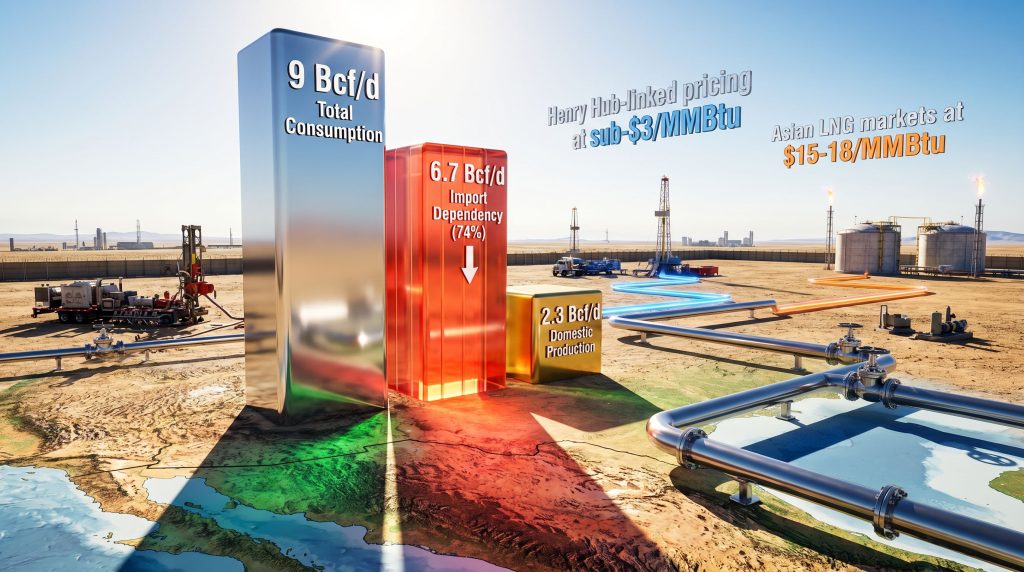
Mexico's current energy architecture reveals a stark mathematical imbalance that places the nation among the world's most import-dependent major economies. Domestic natural gas consumption reaches approximately 9 billion cubic feet per day (Bcf/d), while indigenous production contributes merely 2.3 Bcf/d. This creates a supply gap of 6.7 Bcf/d, representing a 74% import dependency ratio that has profound implications for national energy security.
The concentration risk extends beyond simple volume metrics. Analysis of Mexico's pivot away from US gas dependence reveals that 99% of these imports originate from United States sources, creating what energy analysts describe as near-total reliance on a single external supplier for the backbone of the country's energy system. This dependency becomes particularly acute when considering that natural gas accounts for more than 60% of Mexico's electricity generation, embedding US supply directly into the nation's power infrastructure.
Key Dependency Metrics:
• Total consumption: ~9 Bcf/d
• Domestic production: 2.3 Bcf/d
• Import requirement: 6.7 Bcf/d (74% dependency)
• Primary supplier: United States (99% of imports)
• Power generation reliance: 60% gas-fired electricity
When big ASX news breaks, our subscribers know first
Economic Forces Driving Import Dependency Patterns
The evolution of Mexico's energy import model reflects rational economic optimisation that has created structural dependency over time. Henry Hub-linked pricing mechanisms have historically delivered natural gas to Mexican markets at sub-$3/MMBtu levels, establishing compelling cost advantages over domestic production alternatives. Furthermore, this pricing structure has effectively transformed Mexico's energy sector into an extension of US domestic markets.
Historical data demonstrates the rapid acceleration of this dependency. Pipeline imports have grown substantially from 2.2 Bcf/d in 2015 to an average of 6.6 Bcf/d in 2025, illustrating how economic incentives have driven infrastructure investment and operational decisions. The arrangement provides Mexico access to US domestic markets through Henry Hub-linked purchases, currently below $3/MMBtu, making it one of the cheapest energy sources available globally.
However, this economic efficiency comes with hidden strategic costs that extend beyond simple price considerations. Seasonal demand volatility creates additional vulnerability windows, with gas consumption reaching approximately 5.5 Bcf/d during summer 2025 peak periods. Simultaneously, hydroelectric capacity has deteriorated significantly, with summer 2023-2025 output declining to approximately 2 TWh, representing roughly half of 2018 levels.
This reduction in backup generation capacity forces greater reliance on gas-fired power precisely during periods of highest cooling demand. Additionally, the gas price trends demonstrate how external market volatility directly affects Mexican energy costs. The mathematical reality illustrates the depth of structural dependency.
More than 70% of imported gas is used to generate roughly half of Mexico's electricity supply, meaning supply interruptions would immediately impact both industrial and residential consumers across the entire economy.
What Geopolitical Pressures Are Accelerating Policy Transformation?
The convergence of global energy disruptions and shifting US foreign policy dynamics has fundamentally altered the strategic calculus surrounding Mexico's energy dependency. President Claudia Sheinbaum's policy evolution represents a significant departure from environmental opposition toward pragmatic energy security assessment, driven by recognition that import dependence has shifted from economic convenience to geopolitical vulnerability.
This transformation becomes particularly notable given Sheinbaum's background as an environmental scientist and documented opposition to hydraulic fracturing technologies. On April 8, 2026, she announced the establishment of a new committee to evaluate shale development, focusing on making the process less environmentally damaging. This policy pivot reflects broader recognition that global energy disruptions have demonstrated the strategic risks of over-reliance on single suppliers.
Strategic Energy Risk Assessment
| Risk Category | Current Exposure | Potential Impact |
|---|---|---|
| Single Supplier Dependency | 99% US imports | Supply disruption vulnerability |
| Pipeline Concentration | 6+ major cross-border points | Infrastructure bottleneck risk |
| Political Leverage | Energy as diplomatic tool | Policy autonomy constraints |
| Price Volatility | Henry Hub linkage | Economic shock transmission |
The timing of this policy reassessment coincides with heightened geopolitical tensions and Washington's increasingly assertive approach to regional energy relationships. Furthermore, the introduction of US economic tariffs has highlighted the risks of economic interdependence. As external pressures mount and the strategic risks of concentrated dependency become more pronounced, maintaining the existing arrangement becomes increasingly difficult to sustain from a national security perspective.
The historical precedent for rapid policy shifts exists within Mexico's own energy development timeline. Previous exploration between 2010-2016 included pilot projects and limited hydraulic fracturing operations, demonstrating technical feasibility before development stalled following the 2014 oil price collapse and subsequent policy shifts under the López Obrador administration.
Domestic Shale Development Potential and Economic Constraints
Mexico's unconventional gas potential centres on its portion of the Eagle Ford formation, where geological surveys indicate substantial recoverable reserves. The technical foundation for development has been established through historical pilot programmes, with Pemex testing unconventional resources through pilot projects and dozens of fracked wells between 2010 and 2016. The last meaningful production increase occurred in 2023, driven by Quesqui and Ixachi field development, yielding over 600 MMcf/d increase before output plateaued.
Production Cost Analysis:
• Current regional breakeven: $5-6/MMBtu
• Optimised development target: $3-4/MMBtu
• US benchmark comparison: ~$2.50/MMBtu
• Import price advantage: Henry Hub + transportation (~$3/MMBtu)
The economic challenge facing Mexican shale development remains substantial even under optimised operational scenarios. Cost reduction trajectories observed in US shale regions demonstrate both potential and constraints. Technological advances in horizontal drilling and hydraulic fracturing, combined with scale efficiencies across the Lower 48 states, reduced marginal shale gas production costs from nearly $15/MMBtu to around $4/MMBtu by 2014.
However, replicating this cost reduction model in Mexico faces fundamental structural obstacles. The US transformation was not simply a matter of deploying superior technologies, but rather developing an integrated industrial ecosystem combining extensive pipeline infrastructure, mature oilfield services capacity, and operational scale advantages. Mexico lacks much of this supporting framework, meaning that even with regulatory backing, development timelines would be extended and costs would remain structurally higher.
Infrastructure Deficits and Development Requirements
Critical infrastructure deficits include extensive pipeline gathering networks, mature oilfield services sector capabilities, processing and treatment facilities, skilled workforce development at scale, and comprehensive regulatory frameworks for unconventional development. Building this supporting infrastructure would require multi-year implementation timelines and substantial capital investment, likely exceeding $10 billion for meaningful production capacity.
Infrastructure Development Requirements and Financing Challenges
The infrastructure gaps constraining Mexico's energy independence options extend far beyond simple drilling and completion capabilities. Unlike the integrated industrial ecosystem that enabled rapid US shale cost reductions, Mexico faces systemic deficiencies across multiple sectors that would require coordinated development efforts and sustained capital investment.
Missing Infrastructure Components:
• Extensive pipeline gathering networks
• Mature oilfield services sector
• Processing and treatment facilities
• Skilled workforce at scale
• Regulatory framework for unconventional development
State-owned Pemex would need to lead development alongside international partners, assuming adequate financing can be secured. This financing constraint reflects both the magnitude of required capital investment (>$10 billion) and the political sustainability challenges inherent in maintaining long-term energy infrastructure projects across Mexican electoral cycles.
The temporal requirements for infrastructure development create additional strategic complications. Multi-year timelines for gathering system construction, processing facility development, and workforce training mean that even aggressive development programmes would require sustained political commitment extending well beyond individual presidential terms.
Comparative analysis with other emerging shale regions suggests that integrated infrastructure development, rather than isolated drilling programmes, represents the binding constraint on production scaling. Mexico's 2010-2016 pilot programme demonstrated technical feasibility for individual well completions, but the transition from pilot projects to commercial-scale production requires fundamentally different infrastructure and operational capabilities.
How Do LNG Export Economics Affect Development Viability?
Asian LNG markets present the most economically viable pathway for justifying Mexican shale development costs, given current pricing differentials between domestic and international gas markets. JKM benchmark pricing currently ranges $15-18/MMBtu during supply disruptions, and historically maintains $10-11/MMBtu levels outside crisis periods. These premium pricing levels would substantially improve project economics compared to domestic sales competing with Henry Hub-linked imports.
However, Mexico's existing LNG infrastructure serves import functions rather than export capacity for domestic production. The Energía Costa Azul terminal represents Mexico's primary LNG facility, but operates as a joint venture involving TotalEnergies, Japanese buyers, and Sempra Infrastructure as operator. The business model focuses on liquefying US pipeline gas for Asian export rather than processing Mexican domestic production.
This infrastructure configuration reinforces existing dependency patterns rather than providing outlets for domestic gas development. Dedicated export infrastructure for Mexican-produced gas remains absent, requiring additional capital deployment and extended development timelines beyond upstream production investments. In addition, understanding LNG market implications becomes crucial for strategic planning.
"The contradiction inherent in export-focused development strategies becomes apparent: prioritising LNG exports would leave domestic demand structurally reliant on continued US imports, preserving rather than resolving Mexico's exposure to external pressure."
LNG Development Timeline Analysis:
• Infrastructure requirement: $5-8 billion additional investment
• Development timeline: 4-6 years minimum
• Export capacity target: 2-3 Bcf/d liquefaction
• Market access: Asian premium pricing ($10-15/MMBtu)
The next major ASX story will hit our subscribers first
Strategic Pathway Analysis and Investment Requirements
Mexico's pivot away from US gas dependence presents three distinct strategic pathways, each carrying different risk-reward profiles and capital requirements. The selection among these alternatives will fundamentally determine the nation's energy security trajectory and economic competitiveness over the coming decades.
Strategic Development Pathways
| Pathway | Timeline | Investment Required | Energy Security Gain | Economic Cost |
|---|---|---|---|---|
| Status Quo | Immediate | Minimal | Low (maintains vulnerability) | Lowest short-term |
| Gradual Shale Development | 5-7 years | $8-12 billion | Moderate (reduces dependency to ~50%) | High upfront |
| Accelerated Independence | 3-5 years | $15-20 billion | High (achieves 70%+ domestic supply) | Very high |
The status quo pathway preserves short-term economic efficiency through continued reliance on Henry Hub-linked imports, but perpetuates strategic vulnerability to external pressure and supply disruptions. This approach requires minimal additional investment but provides no reduction in geopolitical exposure.
Gradual shale development offers balanced risk reduction through phased unconventional gas development, potentially reducing import dependency to approximately 50% over a 5-7 year timeline. This pathway requires $8-12 billion in coordinated infrastructure and upstream investment, but demands sustained political commitment across multiple electoral cycles.
Accelerated independence maximises energy security through rapid development of domestic resources, potentially achieving 70%+ domestic supply within 3-5 years. This pathway demands unprecedented capital mobilisation ($15-20 billion) and significant environmental policy flexibility, but provides maximum strategic autonomy.
Regional Energy Integration and Cross-Border Dynamics
North American energy integration creates complex interdependencies that extend beyond bilateral Mexico-US relationships, influencing the strategic calculus surrounding Mexican energy independence initiatives. Canada's LNG export development, US shale production growth trajectories, and evolving continental climate policies all affect the viability and timing of Mexican domestic development programmes. Furthermore, energy export challenges in other regions provide lessons for Mexican strategy.
The continental energy system has evolved toward integrated optimisation, with pipeline infrastructure, regulatory frameworks, and market structures designed around cross-border energy flows. Mexico's pivot away from US gas dependence would fundamentally disrupt these established patterns, creating both opportunities and risks across multiple sectors.
Supply chain considerations become particularly relevant as Mexican development would compete directly with established US and Canadian producers for oilfield services, equipment, and skilled workforce. The timing of Mexican development programmes could therefore influence costs and availability of critical inputs required for successful project execution.
Technology transfer mechanisms present additional strategic considerations. Mexican development success would likely depend on partnerships with US and Canadian operators possessing unconventional gas expertise, creating potential conflicts between strategic autonomy objectives and operational requirements for foreign technical assistance.
Continental Market Integration Effects
The transition away from import dependency would have ripple effects throughout North American energy markets. Mexican domestic production could reduce US export volumes to Mexico by up to 6 Bcf/d, potentially affecting US gas pricing and export capacity utilisation. However, this shift might also create opportunities for US producers to redirect exports to higher-value international markets.
Investment Implications and Market Psychology
Mexico's pivot away from US gas dependence creates distinct investment opportunities and risks across upstream development, midstream infrastructure, and downstream utilisation sectors. The transformation timeline will largely determine investment attractiveness, with gradual development allowing technology transfer and cost optimisation while accelerated programmes could generate premium returns for early participants.
Investment Sector Analysis:
• Upstream development: High capital requirements, potentially attractive returns given Asian LNG pricing premiums
• Midstream infrastructure: More predictable returns but substantial initial investment and regulatory clarity requirements
• Technology services: Opportunities for Mexican oilfield services development and foreign partnership arrangements
• Power generation: Potential for domestic gas-fired generation expansion supporting industrial competitiveness
Market psychology factors suggest that successful Mexican shale development could demonstrate viability of unconventional resources in emerging markets, potentially catalysing similar programmes across Latin America. Conversely, development failures could reinforce scepticism about unconventional gas viability outside established North American and Australian markets.
The risk-reward calculus for international investors depends critically on political sustainability and regulatory consistency. Mexico's energy sector has experienced significant policy reversals across recent electoral cycles, creating uncertainty about long-term investment protection and contract sanctity. In addition, broader concerns about Mexico's approach to reducing reliance on US natural gas imports affect investor confidence.
Currency and financing considerations add additional complexity, as peso-denominated revenues from domestic sales would compete with dollar-denominated export opportunities. Infrastructure investment requirements exceed typical project finance thresholds, likely requiring sovereign guarantees or multilateral development bank participation.
Furthermore, Mexico's pivot away from US gas dependence represents more than a technical energy transition—it constitutes a fundamental shift in North American energy geopolitics that could reshape regional trade relationships and energy security frameworks for decades to come.
This analysis is based on publicly available information and industry reports. Readers should conduct independent research before making investment decisions. Energy market developments and policy changes may significantly affect the viability and timeline of proposed development scenarios.
Could Mexico's Energy Independence Drive Create Investment Opportunities?
Mexico's strategic pivot towards domestic gas production to reduce its 74% import dependency presents compelling opportunities for investors tracking North American energy transitions. Discovery Alert's proprietary Discovery IQ model delivers real-time alerts on significant ASX mineral discoveries, instantly empowering subscribers to identify actionable opportunities ahead of the broader market whilst navigating complex energy sector developments globally. Begin your 14-day free trial today and secure your market-leading advantage.