May 24, 2026
Strategic Energy Infrastructure Requirements
The transformation of global energy markets reflects a fundamental shift in how artificial intelligence workloads demand power delivery. Traditional energy planning focused on peak capacity management, but AI data centers require continuous, high-density electricity supply that operates independently of daily consumption patterns. This evolution demonstrates the critical intersection of nuclear power and artificial intelligence in modern infrastructure development.
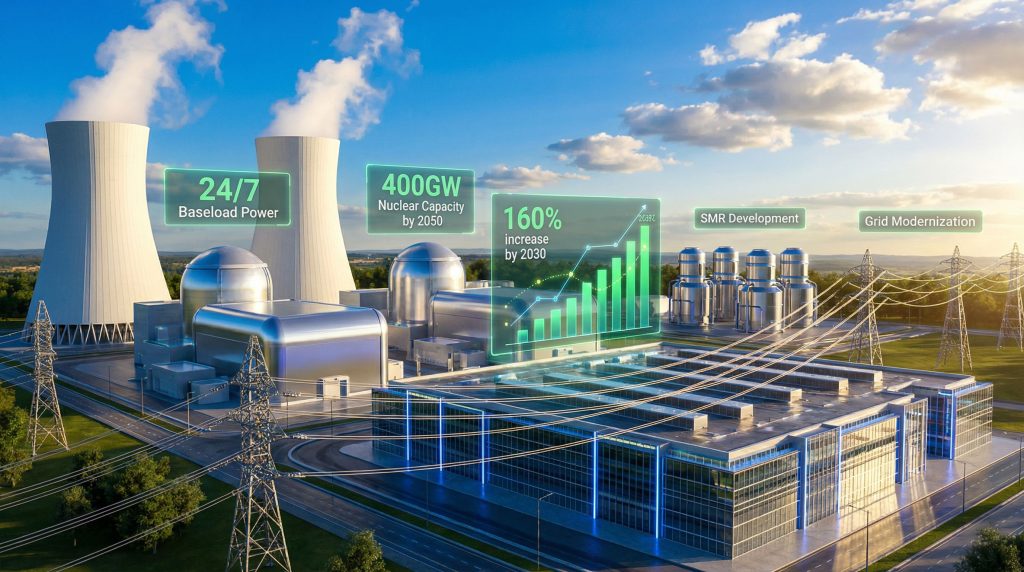
Baseload Power Architecture: Modern AI training facilities consume electricity at consistent rates approaching 99.9% uptime requirements. Unlike conventional computing centers that experience predictable usage cycles, machine learning operations run continuous mathematical computations that cannot tolerate power interruptions without significant economic losses.
Nuclear facilities provide this reliability through inherent design characteristics that distinguish them from weather-dependent renewable sources. While solar and wind installations experience capacity factors between 25-45%, nuclear plants typically maintain 90%+ availability rates throughout their operational cycles.
Grid Stability Framework: The integration of large-scale AI infrastructure creates new challenges for electrical grid management. Nuclear power's ability to provide consistent output regardless of atmospheric conditions offers grid operators predictable supply curves that simplify load balancing calculations.
Contemporary data center designs increasingly prioritise geographic proximity to reliable power sources rather than traditional factors like fibre connectivity or real estate costs. This shift reflects recognition that AI computational intensity creates power requirements that exceed what intermittent renewable sources can consistently provide.
Furthermore, the U.S. uranium production technology continues advancing to support these growing energy infrastructure demands.
When big ASX news breaks, our subscribers know first
Market Demand Evolution and Corporate Strategy
The convergence of nuclear power and artificial intelligence emerges from fundamental changes in corporate energy procurement strategies. Technology companies historically focused on renewable energy purchasing to meet sustainability commitments, but AI workload requirements have introduced new decision criteria emphasising reliability and continuous availability.
Goldman Sachs projects that data center electricity consumption will increase by 160% by 2030, creating unprecedented demand for baseload power sources. This growth trajectory reflects not only expanded AI training operations but also the increasing computational complexity of machine learning algorithms.
| Demand Driver | Growth Projection | Power Characteristics | Timeline Impact |
|---|---|---|---|
| AI Model Training | 300% expansion | Continuous high-density load | 2025-2027 acceleration |
| Data Center Operations | 160% increase by 2030 | 24/7 baseload requirements | Immediate deployment |
| Cloud Infrastructure | 200% growth trajectory | Reliable grid connectivity | Ongoing expansion |
Technology Giant Positioning: Major technology corporations including Microsoft, Google, Amazon, and Meta have shifted from exclusively renewable energy procurement to include nuclear power agreements. This strategic evolution reflects practical recognition that AI infrastructure cannot accommodate the intermittency associated with wind and solar installations.
The International Energy Agency acknowledges that gas-fired power plants currently provide the largest share of electricity for U.S. data centres, with clean power sources including nuclear expected to capture larger market share after 2030 as installed capacity expands.
Policy Acceleration Framework: Current U.S. energy policy explicitly targets expanding nuclear capacity from 100GW to 400GW by 2050. This quadrupling of nuclear infrastructure reflects government recognition that AI leadership requires energy security through domestic, reliable power sources.
Executive orders are removing regulatory barriers to co-locating data centres with nuclear generation sources, including development on federal land. The Department of Energy allocated $400 million in cost-shared funding to both Tennessee Valley Authority and Holtec International for advancing small modular reactor deployments.
How does global nuclear capacity address AI energy demand?
The international nuclear landscape demonstrates divergent strategic approaches to meeting AI-driven energy demand. While some nations focus on restarting existing facilities, others prioritise new capacity development using advanced reactor technologies.
United States: Restart and Life Extension Model
BloombergNEF projects approximately 15 reactors will commence operations in 2026, adding close to 12 gigawatts of new capacity after global nuclear capacity declined by 1.1 gigawatts in 2025. This reversal reflects coordinated policy support and commercial demand convergence.
The Palisades nuclear facility in Michigan represents a historic milestone as the first U.S. nuclear plant returning from decommissioning status. With $1.52 billion in federal loan support, the facility targets early 2026 restart and operates under licence through 2031, with Holtec planning a 20-year extension application.
Retired coal plant sites across the United States could accommodate up to 174 gigawatts of new nuclear capacity, offering faster development timelines through existing grid connections and simplified site preparation requirements.
In addition, current uranium market volatility impacts these capacity expansion plans significantly.
China: Comprehensive Expansion Strategy
China's nuclear development demonstrates systematic capacity building through domestic technology advancement. The country approved 10 new nuclear generating units with total investment approaching $27 billion, exclusively utilising domestic reactor designs.
| China Nuclear Metrics | Current Status | Projection |
|---|---|---|
| Operational Reactors | 57 units | Continued expansion |
| Installed Capacity | Nearly 60 GW | Doubling by 2040 |
| Electricity Supply Share | 5% current | 10% by 2040 |
| Investment Scale | 146.9 billion yuan | Record annual levels |
China's Linglong One small modular reactor is scheduled for commercial operation in the first half of 2026, making it the world's first commercial onshore SMR deployment. This technological milestone positions China as the leader in advanced reactor commercialisation.
Approximately 50% of all reactors under construction globally are located in China, demonstrating concentrated strategic investment in nuclear infrastructure development. China is projected to become the world's largest nuclear power market by 2030, surpassing both the United States and France.
Small Modular Reactor Technology Integration
Small modular reactors address specific challenges in nuclear-AI convergence through design characteristics that align with data centre deployment requirements. Unlike traditional large-scale nuclear facilities, SMRs offer deployment flexibility that matches AI infrastructure expansion patterns.
Technical Architecture Advantages:
- Reduced construction timelines compared to gigawatt-scale reactor projects
- Modular capacity scaling allowing incremental expansion based on demand growth
- Enhanced site flexibility enabling closer proximity to AI data centres
- Simplified grid integration through reduced transmission infrastructure requirements
The Department of Energy's selection of Tennessee Valley Authority and Holtec International for $400 million each in SMR funding targets delivery of new nuclear generation in the early 2030s. These projects aim to strengthen domestic supply chains while supporting broader nuclear industry revival.
Economic Framework Characteristics:
- Lower capital intensity reducing upfront investment barriers compared to large reactors
- Distributed risk profile through smaller individual project exposure
- Standardisation potential enabling mass production cost reduction strategies
- Accelerated deployment supporting rapid AI infrastructure expansion timelines
SMR designs provide load-following capabilities that can adjust output based on real-time demand fluctuations, addressing the variable computational loads associated with different AI training phases. Multiple SMR units can provide redundancy options, ensuring continuous power availability even during maintenance cycles.
However, nuclear waste disposal safety remains a critical consideration for all reactor technologies.
Investment Landscape and Market Opportunities
The nuclear-AI convergence creates distinct investment opportunities across multiple time horizons and technology categories. Early-stage investments focus on enabling infrastructure and technology development, while longer-term opportunities centre on operational facilities and supply chain expansion.
Near-term Investment Categories (2025-2027):
- Plant restart projects leveraging existing infrastructure with accelerated deployment timelines
- SMR development through technology companies advancing commercial deployment
- Uranium supply chain positioning for increased fuel demand from capacity expansion
- Grid modernisation supporting nuclear-data centre integration requirements
The $1.52 billion federal loan support for Palisades demonstrates the scale of government backing for nuclear restart projects. This financing model may extend to additional shutdown facilities, creating opportunities for infrastructure investment with reduced development risk.
Medium-term Market Development (2028-2032):
| Sector | Investment Characteristics | Growth Drivers |
|---|---|---|
| SMR Manufacturing | Commercial deployment phase | Technology validation and scaling |
| Uranium Markets | Supply tightening dynamics | Capacity expansion demand |
| Digital Integration | AI-optimised plant operations | Efficiency and safety improvements |
| Transmission Infrastructure | Grid expansion requirements | Nuclear-data centre connectivity |
Coal Site Conversion Economics: The 174 GW potential nuclear capacity at retired coal plant locations represents systematic investment opportunities. These sites offer existing grid connections, trained workforces, and community acceptance that reduce development barriers compared to greenfield projects.
China's 146.9 billion yuan investment in nuclear engineering and construction demonstrates the scale of capital deployment supporting nuclear expansion. International investors may access this growth through technology partnerships, equipment supply agreements, and uranium supply contracts.
Moreover, comprehensive uranium investment strategies become increasingly important as this sector evolves.
Economic Transformation Through AI Demand
Nuclear power economics are experiencing fundamental changes as AI demand creates new revenue models and operational optimisation opportunities. Traditional nuclear economics focused on steady baseload electricity sales, but AI integration introduces premium pricing possibilities for reliable, carbon-free power.
Revenue Model Evolution:
- Long-term power purchase agreements with AI companies seeking 15-20 year contracts
- Premium pricing for 24/7 reliable power compared to intermittent renewable sources
- Capacity payments providing additional revenue for grid stability services
- Carbon-free certification meeting corporate sustainability requirements
AI companies demonstrate willingness to pay premium rates for power reliability that supports continuous computational operations. Unlike traditional industrial customers who can adjust operations during power disruptions, AI training cannot tolerate interruptions without significant economic losses.
Operational Cost Optimisation:
- AI-enhanced plant management reducing operational expenses through predictive analytics
- Maintenance optimisation using machine learning to predict equipment failures
- Fuel efficiency improvements through AI-optimised reactor operations
- Safety system enhancement via advanced monitoring and diagnostic capabilities
Market Positioning Insight: Nuclear facilities provide competitive advantages through baseload availability when renewable sources experience low output periods, creating arbitrage opportunities in electricity markets.
The combination of carbon-free electricity production and domestic fuel sources positions nuclear power as a strategic energy security option, reducing exposure to geopolitical supply chain disruptions that affect natural gas and other fossil fuel alternatives.
Furthermore, the current U.S. uranium import policy significantly influences domestic energy security strategies.
The next major ASX story will hit our subscribers first
Technical Integration Challenges and Solutions
The convergence of nuclear power and artificial intelligence creates complex technical challenges requiring coordinated solutions across multiple engineering disciplines. Grid integration, cybersecurity, and safety coordination represent primary areas where innovative approaches are necessary.
Grid Integration Complexity:
- Load balancing between consistent nuclear output and variable AI computing demands
- Transmission capacity upgrades supporting large-scale power transfers to data centre locations
- Storage coordination integrating battery systems for peak demand management
- Frequency regulation maintaining grid stability with high-density load additions
Nuclear facilities traditionally operate as baseload generators providing consistent output, but AI applications may require more dynamic power delivery patterns. Advanced reactor designs incorporate load-following capabilities that can adjust output based on real-time computational requirements.
Cybersecurity Framework Development:
- Network segmentation isolating nuclear safety systems from AI infrastructure connectivity
- Threat detection using AI-powered monitoring for both nuclear and data centre security
- Emergency coordination establishing protocols for cyber incidents affecting either system
- Regulatory compliance meeting nuclear security requirements while enabling AI integration
Digital twin technology enables virtual testing of nuclear-AI integration scenarios before physical implementation, reducing risks and optimising performance characteristics. These simulation environments allow operators to model different operational scenarios and emergency response procedures.
Safety System Coordination:
Advanced nuclear facilities increasingly incorporate AI-powered monitoring systems that enhance safety through real-time data analysis and predictive maintenance scheduling. However, nuclear safety regulations require careful evaluation of any digital systems affecting reactor operations.
Physical security considerations become more complex when nuclear facilities operate in proximity to data centres containing valuable intellectual property and computational infrastructure. Coordinated security protocols must address both nuclear material protection and data centre asset security.
What are the future market scenarios for nuclear power and artificial intelligence?
The nuclear-AI landscape by 2030 will likely reflect the success or failure of current technology deployment and policy initiatives. Multiple scenarios exist depending on SMR commercialisation progress, regulatory framework development, and alternative energy technology advancement.
High Growth Scenario Characteristics:
- 50+ GW of new nuclear capacity specifically supporting AI infrastructure
- Commercial SMR deployment at scale with standardised manufacturing
- Nuclear-AI partnerships becoming standard industry practice
- Technology export leadership for nations achieving early SMR commercialisation
In this scenario, countries achieving first-mover advantage in SMR deployment may capture significant export markets as other nations recognise nuclear power's role in supporting AI competitiveness. China's Linglong One represents an early example of this potential competitive dynamic.
Moderate Growth Scenario Framework:
- Selective nuclear deployment supporting critical AI infrastructure in key markets
- Technology validation proving SMR commercial viability through pilot projects
- Regulatory stabilisation providing clear frameworks for predictable investment
- Market segmentation with nuclear serving premium reliability requirements
Under moderate growth conditions, nuclear power captures specific market segments requiring maximum reliability rather than achieving broad market penetration. This scenario reflects continued competition from alternative clean energy sources and slower technology deployment.
Conservative Growth Assessment:
- Limited capacity expansion beyond currently planned reactor additions
- Technology development delays pushing SMR commercialisation beyond 2030
- Alternative energy competition from improved battery storage and renewable sources
- Regulatory complexity slowing approval processes for nuclear-AI integration
Strategic Risk Consideration: Organisations positioning themselves at the nuclear-AI intersection must evaluate technology risks, regulatory uncertainties, and competitive dynamics from alternative energy sources when developing investment strategies.
The ultimate market structure will depend on successful demonstration of SMR technology, continued AI demand growth, and policy support for nuclear development. Early participants in this convergence may capture significant value if the high growth scenario materialises.
According to the MIT Technology Review, the convergence of AI and nuclear power represents one of the most significant energy infrastructure developments of our time.
Long-term Energy Infrastructure Evolution
The integration of nuclear power and artificial intelligence represents more than incremental energy market adjustment. This convergence signals fundamental changes in how societies organise energy infrastructure to support digital economy requirements.
Success in nuclear-AI integration requires coordinated development across technology advancement, regulatory framework evolution, and market mechanism design. Organisations recognising this intersection early may establish competitive advantages as AI energy demands continue expanding.
The experience of leading nations in nuclear-AI integration will likely influence global energy infrastructure development patterns, particularly as AI capabilities become central to economic competitiveness. Countries achieving reliable, carbon-free power for AI applications may gain significant advantages in technological leadership and economic development.
In addition, The Conversation highlights how AI's growing energy consumption may necessitate nuclear solutions for sustainable power generation.
Future energy infrastructure planning must account for AI computational demands that differ significantly from traditional electricity consumption patterns. The success of nuclear power and artificial intelligence integration will influence broader discussions about energy security, carbon reduction, and technological sovereignty in an increasingly AI-dependent global economy.
This analysis is based on current market conditions and policy frameworks. Actual outcomes may vary based on technological developments, regulatory changes, and market dynamics. Readers should conduct additional research and consult qualified advisors before making investment decisions related to nuclear power or artificial intelligence technologies.
Looking for Investment Opportunities in Energy Infrastructure?
Discovery Alert's proprietary Discovery IQ model delivers real-time alerts on significant ASX mineral discoveries, including uranium and energy-related commodities that support the growing nuclear-AI infrastructure demand. Explore how major mineral discoveries can generate substantial returns by visiting Discovery Alert's dedicated discoveries page, then begin your 30-day free trial today to position yourself ahead of the market.