
May 23, 2026
Strategic Infrastructure Networks Define Market Position
The global energy landscape continues to evolve as Saudi Red Sea oil exports demonstrate the critical importance of diversified infrastructure during geopolitical tensions. While traditional supply chain theories emphasize cost efficiency, recent market disruptions reveal that strategic infrastructure diversification creates competitive advantages that transcend normal economic calculations. Furthermore, the petroleum sector's response to chokepoint closures demonstrates how pre-existing alternative pathways determine market survival rather than production capacity alone.
Alternative Export Corridors as Competitive Differentiation
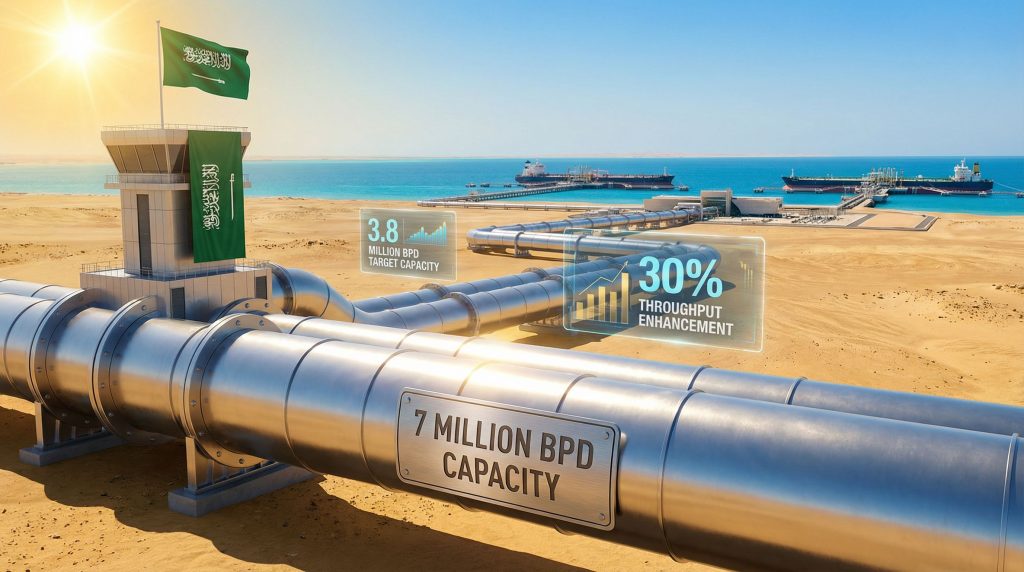
Saudi Arabia's East-West pipeline system represents a strategic asset class distinct from conventional production infrastructure. The system maintains 7 million barrels per day (bpd) theoretical capacity, with approximately 5 million bpd available for export operations after domestic refinery supply requirements. This infrastructure enables the kingdom to maintain substantial export volumes when traditional routing becomes unavailable.
Current operational data reveals the system's responsiveness during crisis conditions. Average loadings at Yanbu increased from 1.3 million bpd in January 2026 to 2.6 million bpd in March, with projections targeting 3.8 million bpd by month-end. This represents a 192% increase in monthly throughput accomplished through operational optimisation rather than capital expansion.
The Yanbu terminal's strategic positioning on the Red Sea provides access to global markets without dependence on Persian Gulf chokepoints. Unlike regional competitors facing severe constraints, Saudi Arabia's infrastructure portfolio enables continued market participation during supply disruptions. This differentiation becomes particularly valuable when neighbouring producers experience complete export shutdowns due to oil price movements and geopolitical tensions.
Pipeline Optimisation Through Chemical Enhancement
Drag-reducing agent (DRA) technology transforms existing pipeline capacity through chemical intervention rather than infrastructure expansion. Industry sources indicate that DRA implementation can boost flow rates by 30% or more, with Saudi Arabia maintaining adequate inventory levels from primary suppliers in the United States and China.
The methodology involves injecting friction-reducing chemicals into crude oil streams, enabling higher throughput through existing pipeline diameter. European pipeline operators employed similar techniques during Russian oil sanctions, establishing precedent for DRA utilisation during supply chain disruptions. This demonstrates practical applications for maximising infrastructure capacity without immediate capital deployment.
Technical implementation requires coordination between chemical suppliers, pipeline operators, and receiving terminals. The sustained effectiveness of DRA over pipeline distance and the optimisation of injection concentrations represent key operational considerations. Saudi Arabia's current inventory position suggests strategic planning for extended DRA utilisation during crisis periods.
When big ASX news breaks, our subscribers know first
Export Volume Redistribution and Maritime Logistics
Tanker Deployment Patterns and Destination Analysis
Maritime logistics reveal the scale of export rerouting through comprehensive tanker scheduling data. Approximately 70 tankers are scheduled to load at Yanbu during March 2026, including 40 Very Large Crude Carriers (VLCCs) still en route. This deployment pattern indicates efficient logistics coordination for maximum-capacity vessel utilisation.
Destination analysis shows concentrated demand in Asia-Pacific markets, with China accounting for approximately 2.2 million bpd of Saudi Red Sea oil exports. The geographic distribution reflects both structural demand patterns and voyage efficiency considerations for Red Sea-to-Asia routing. China's allocation represents the largest single destination, demonstrating the country's absorption capacity for redirected Saudi volumes.
The deployment of 40 VLCCs from 70 total tankers indicates that 57% of March loading involves maximum-capacity vessels. Each VLCC typically carries 2 million barrels per voyage, suggesting optimisation for long-distance deliveries to major consuming regions. This tanker mix enables flexible scheduling for different voyage distances and delivery timeframes.
| Loading Month | Average Daily Volume (bpd) | Monthly Increase |
|---|---|---|
| January 2026 | 1.3 million | Baseline |
| February 2026 | 1.4 million | 7.7% |
| March 2026 | 2.6 million | 85.7% |
| March Target | 3.8 million | 46.2% |
Port Infrastructure Capacity Under Stress Testing
Yanbu's ability to accommodate 70 tanker loadings within a single month demonstrates port infrastructure scaling under emergency conditions. The facility's berth capacity, loading equipment, and storage systems enable sustained high-throughput operations significantly above historical averages.
Loading efficiency metrics become critical when port utilisation approaches maximum capacity. Tanker queuing times, berth availability, and weather-related delays influence overall throughput achievement. The coordination of vessel arrivals with storage tank levels and crude quality specifications requires sophisticated logistics management.
Storage facility utilisation at receiving ports represents another constraint factor. Chinese, Japanese, and other Asian refineries must accommodate increased crude deliveries within existing storage infrastructure. Consequently, this creates downstream logistics pressures that can influence loading schedules and voyage timing, particularly amid concerns about a potential US oil production decline affecting global supply patterns.
Production Adjustments and Regional Competitive Dynamics
Targeted Production Curtailment Strategy
Saudi Arabia's production response demonstrates strategic field management rather than across-the-board reductions. Production decreased by approximately 2 million bpd, or 20%, to about 8 million bpd following output curtailment at two major offshore fields. This targeted approach preserves onshore production capacity while addressing infrastructure constraints.
The geographic specificity of offshore field curtailment reflects pipeline connectivity limitations rather than reservoir constraints. Offshore facilities in the Persian Gulf primarily feed export infrastructure through the Strait of Hormuz, while onshore fields maintain access to East-West pipeline capacity. This infrastructure geography determines which production sources remain operational during export route disruptions.
Revenue implications of the 2 million bpd reduction depend on crude price levels and the duration of curtailment. At current elevated price levels, continued production through alternative routes generates positive cash flow despite higher transportation costs. The kingdom's financial position enables temporary revenue reduction in exchange for maintained market access, particularly as tariffs' market impact continues to influence global trade flows.
Comparative Regional Infrastructure Analysis
Saudi Arabia's infrastructure advantage becomes apparent through regional comparison. While the kingdom maintains 5 million bpd alternative export capacity, neighbouring producers face more severe constraints. Iraq, Kuwait, and the UAE experience limited alternative export routes, forcing sharper production cuts during chokepoint closures.
Iraq's export infrastructure relies heavily on southern Persian Gulf terminals and northern pipeline routes through Turkey. Kuwait's export capacity centres on Persian Gulf facilities with minimal alternative routing options. The UAE maintains some export flexibility through Fujairah terminals on the Gulf of Oman, but capacity limitations restrict volume redirection.
| Country | Alternative Export Capacity | Production Impact | Infrastructure Flexibility |
|---|---|---|---|
| Saudi Arabia | 5 million bpd | 20% reduction | High |
| Iraq | Limited pipeline capacity | Severe constraints | Low |
| UAE | 1-2 million bpd (Fujairah) | Moderate to high | Medium |
| Kuwait | Minimal alternatives | Severe constraints | Low |
This comparative advantage translates into market share preservation during crisis periods. While competitors experience production shutdowns, Saudi Arabia maintains substantial export volumes through alternative infrastructure. The kingdom's ability to serve Asian markets through Red Sea routing provides competitive positioning during supply disruptions, particularly as the US–China trade war continues to reshape global energy markets.
Security Frameworks for Alternative Export Corridors
Maritime Risk Assessment in the Red Sea
Red Sea shipping security has stabilised following previous disruption periods. Traffic through the Red Sea and Bab el-Mandeb Strait has returned to historical levels, with approximately 40 vessel transits recorded in recent 24-hour periods. This normalisation enables sustained crude oil transportation without significant maritime security premiums.
Naval information centres report no attacks on commercial shipping since the initiation of current regional conflicts. The West's naval information centre JMIC confirmed no incidents targeting oil tankers during March 2026, distinguishing current security conditions from previous disruption periods when Houthi forces targeted commercial vessels.
Historical context reveals periodic security challenges in the Red Sea corridor. Previous Israeli-Hamas conflict periods experienced shipping attacks that disrupted commercial traffic. However, current military deployments and naval coordination appear to maintain secure passage for crude oil transportation. According to recent maritime security reports, enhanced naval coordination has significantly improved passage safety for commercial vessels.
Infrastructure Protection and Contingency Planning
Yanbu terminal security encompasses both physical infrastructure protection and operational continuity planning. The facility's strategic importance requires comprehensive security measures including pipeline monitoring systems, terminal perimeter security, and coordination with maritime protection forces.
Pipeline protection along the East-West corridor involves sophisticated monitoring technology and rapid response capabilities. The 1,200-kilometre pipeline crosses diverse terrain requiring different security approaches for desert, urban, and coastal sections. Automated monitoring systems detect pressure variations, unauthorised access attempts, and potential sabotage activities.
Contingency planning addresses multiple disruption scenarios including cyber attacks, physical damage, and personnel security issues. Backup systems, alternative routing options, and emergency response protocols enable continued operations during various threat conditions. The kingdom's investment in redundant systems reflects recognition of infrastructure vulnerability during geopolitical tensions.
The restoration of normal transit levels through critical maritime chokepoints demonstrates how naval coordination can preserve commercial shipping during regional conflicts, enabling alternative export routes to function effectively.
Long-term Strategic Implications for Energy Infrastructure
Investment Priorities and Infrastructure Development
Saudi Arabia's current infrastructure advantage results from decades of strategic investment in alternative export routes. The East-West pipeline system required substantial capital deployment during periods when such infrastructure appeared unnecessary for normal operations. This long-term planning approach created competitive advantages during actual crisis conditions.
Future infrastructure development likely emphasises further diversification and capacity enhancement. Additional pipeline routes, expanded terminal capacity, and enhanced storage facilities represent potential investment priorities. The kingdom's experience during current disruptions provides operational data for optimising future infrastructure configurations.
Regional cooperation frameworks may emerge for infrastructure sharing and mutual support during crisis periods. Neighbouring countries lacking alternative export routes might seek access arrangements or joint infrastructure development projects. In addition, Saudi Arabia's infrastructure surplus creates opportunities for strategic partnerships and regional influence expansion, particularly as trade war oil markets continue to evolve.
Technology Integration for Operational Optimisation
DRA technology represents one approach to maximising existing infrastructure capacity. Future applications might include enhanced chemical formulations, automated injection systems, and real-time flow optimisation. The integration of artificial intelligence and machine learning could optimise pipeline operations based on crude quality, destination requirements, and market conditions.
Digital monitoring and control systems enable remote pipeline management and predictive maintenance. Advanced sensors throughout the East-West pipeline provide continuous data on flow rates, pressure variations, and chemical composition. This information supports operational decisions and maintenance scheduling to maximise throughput reliability.
Automation technologies reduce operational complexity and human resource requirements during high-throughput periods. Automated loading systems, tanker scheduling coordination, and crude blending operations enable sustained high-volume exports with reduced manual intervention. These systems prove particularly valuable during crisis periods requiring rapid operational scaling.
Market Psychology and Investment Implications
Risk Assessment Frameworks for Energy Security
Current events demonstrate how infrastructure diversity creates premium valuations during crisis periods. Companies with alternative transportation routes, multiple export terminals, and flexible distribution networks command market premiums reflecting their operational resilience. This valuation differential becomes particularly pronounced during geopolitical disruptions.
Investment frameworks increasingly incorporate infrastructure resilience as a fundamental analysis factor. Traditional financial metrics fail to capture the value of operational flexibility during supply chain disruptions. Alternative export capacity, redundant systems, and crisis response capabilities represent intangible assets with material value during market stress periods.
Energy security considerations influence government policy and strategic petroleum reserve management. Consuming nations reassess import diversification strategies and domestic storage requirements based on recent supply disruption experiences. These policy adjustments create long-term demand patterns for suppliers with proven delivery reliability.
Scenario Planning for Energy Market Evolution
Current infrastructure utilisation patterns provide data for modelling future crisis responses. Saudi Arabia's ability to redirect 5 million bpd through alternative routes establishes baseline capacity for scenario planning. This operational experience informs investment decisions and policy development for both producers and consumers.
Permanent infrastructure reconfigurations may emerge from temporary crisis responses. If Red Sea routing proves more efficient for certain destinations or market conditions, export patterns might shift permanently. This potential restructuring influences long-term contract negotiations and infrastructure investment priorities.
Technology adoption accelerates during crisis periods as operators seek immediate capacity enhancements. DRA utilisation, automated systems, and digital monitoring expand rapidly when conventional solutions prove insufficient. Furthermore, these crisis-driven technology adoptions often continue post-crisis, creating permanent operational improvements.
The next major ASX story will hit our subscribers first
What Does the Future Hold for Global Energy Infrastructure?
Infrastructure Resilience as Competitive Advantage
The Saudi Red Sea oil exports pivot demonstrates how strategic infrastructure investments create decisive competitive advantages during market disruptions. While short-term financial metrics might favour cost-optimised systems, actual crisis conditions reveal the premium value of operational flexibility and alternative pathways.
Energy companies worldwide likely reassess infrastructure portfolios based on resilience criteria rather than purely economic optimisation. Redundant systems, alternative routes, and excess capacity represent insurance policies against supply chain disruptions. The cost of maintaining such systems proves justified when disruptions occur. As Bloomberg reports, Saudi Arabia has successfully revived half of its oil exports through the Hormuz bypass system.
Regional infrastructure development may shift toward cooperation and mutual support arrangements. Countries lacking adequate alternative export routes seek partnerships with those possessing surplus capacity. These arrangements create new forms of energy diplomacy and strategic relationships based on infrastructure complementarity.
Technology and Operational Innovation Integration
Crisis periods accelerate technology adoption and operational innovation as companies seek immediate solutions to capacity constraints. DRA technology, digital monitoring systems, and automated operations expand rapidly when conventional approaches prove inadequate. These innovations often persist beyond crisis periods, creating permanent operational improvements.
Future energy infrastructure likely incorporates flexibility and adaptability as design principles. Modular systems, scalable capacity, and multi-route connectivity become standard features rather than premium additions. The operational lessons from current disruptions inform next-generation infrastructure planning and design.
However, these developments occur against a backdrop of broader geopolitical tensions. The sustained ability to maintain alternative export routes becomes increasingly valuable as global trade patterns shift. Investment decisions in energy infrastructure increasingly emphasise operational resilience and crisis response capabilities alongside traditional economic metrics.
Investment decisions in energy infrastructure increasingly emphasise operational resilience and crisis response capabilities alongside traditional economic metrics, reflecting recognition that infrastructure flexibility creates competitive advantages during market disruptions.
Disclaimer: This analysis is based on publicly available information and current market conditions. Energy infrastructure investments and geopolitical developments involve significant risks and uncertainties. Readers should conduct independent research and consult qualified advisors before making investment decisions. Past performance and current operational capabilities do not guarantee future results or crisis response effectiveness.
Searching for Your Next Energy Infrastructure Investment?
Discovery Alert's proprietary Discovery IQ model delivers real-time alerts on significant ASX mineral discoveries, including those crucial to global energy infrastructure development, instantly empowering subscribers to identify actionable opportunities ahead of the broader market. Explore Discovery Alert's dedicated discoveries page to understand why major mineral discoveries can lead to substantial market returns, then begin your 14-day free trial today to position yourself ahead of the market.