May 24, 2026
Strategic Investment Thesis Behind Clean Energy Venture Capital
The Bill Gates and BMW back lithium refiner trend represents an unprecedented convergence of governmental policy support and strategic venture capital deployment, fundamentally reshaping how critical mineral processing capabilities are developed across North America. This investment landscape reflects a sophisticated understanding that lithium refining represents more than traditional commodity processing but rather serves as strategic infrastructure for continental energy transition objectives. Furthermore, this strategic alignment demonstrates the growing importance of critical minerals & energy transition initiatives in securing future energy security.
Breakthrough Energy's Portfolio Strategy in Critical Minerals
Breakthrough Energy Ventures, the clean technology investment platform co-founded by Bill Gates, has positioned electrochemical lithium refining as a cornerstone technology within its broader decarbonization portfolio. The venture capital firm's participation in the $85 million funding package for Mangrove Water Technologies represents a calculated bet on next-generation mineral processing that addresses both emissions reduction and supply chain resilience simultaneously.
The investment thesis centres on technology-enabled processing solutions that can dramatically reduce the environmental footprint of battery material production while establishing domestic processing capacity. Breakthrough Energy's mandate focuses specifically on technologies capable of preventing substantial emissions through industrial process innovation, making electrochemical refining an ideal strategic fit for their portfolio architecture.
This positioning reflects a broader venture capital trend toward infrastructure investments that combine financial returns with measurable climate impact. The multi-stage commitment structure demonstrates institutional confidence in scaling breakthrough technologies from pilot demonstration to commercial deployment within compressed timeframes. Additionally, this approach aligns with the broader battery metals investment landscape that continues to evolve rapidly.
BMW's Vertical Integration Through i Ventures
Automotive manufacturers have fundamentally altered their venture capital strategies, moving beyond traditional component supplier relationships toward strategic investments in upstream battery material processing. BMW's i Ventures arm exemplifies this evolution, maintaining consistent investment positions across multiple funding rounds spanning three years of Mangrove Water Technologies development.
The German automaker's approach contrasts sharply with Tesla's internally-developed vertical integration model, instead leveraging venture capital to secure strategic supplier relationships while sharing development risks with co-investors. This partnership-based integration allows BMW to maintain supply chain optionality while building preferred access to advanced processing technologies.
BMW's sustained commitment through Series A-1 and subsequent growth rounds signals validation of the electrochemical processing platform's commercial viability. The investment structure provides BMW with strategic supplier access while enabling the technology developer to maintain operational independence and serve multiple automotive customers. Consequently, this model demonstrates how automotive manufacturers are securing lithium supply through strategic investments rather than traditional procurement methods.
When big ASX news breaks, our subscribers know first
What Makes Electrochemical Lithium Refining a Game-Changing Technology?
Traditional lithium processing relies heavily on energy-intensive thermal methods that require substantial infrastructure investments and generate significant waste streams. Electrochemical refining represents a fundamental departure from these conventional approaches, utilising controlled electrical processes to achieve mineral separation and purification with dramatically different operational characteristics.
Technical Advantages Over Traditional Processing Methods
The electrochemical approach addresses three critical limitations of traditional thermal processing: energy consumption, waste generation, and facility scalability. Unlike evaporation-based systems that require continuous high-temperature operations, electrochemical methods operate at ambient temperatures while maintaining precise control over chemical reactions.
This processing methodology enables modular facility design, allowing operators to scale production capacity incrementally rather than committing to large-scale thermal processing infrastructure. The modular approach reduces capital intensity barriers and enables geographic distribution of processing capacity closer to both raw material sources and end-market demand centres.
Closed-loop system architecture eliminates many traditional waste streams by recycling process chemicals and minimising environmental discharge requirements. This operational efficiency translates into both cost advantages and simplified regulatory compliance compared to conventional processing facilities. Moreover, the technology represents a significant advancement in direct lithium extraction methods that are transforming the industry.
Cost Structure Analysis and Competitive Positioning
The investment structure supporting Mangrove Water Technologies suggests institutional confidence in competitive cost positioning, though specific operational cost metrics remain proprietary. The combination of government backing through the Canada Growth Fund and strategic investor participation implies that independent technical due diligence has validated the economic advantages of electrochemical processing.
Capital requirements for electrochemical facilities appear substantially lower than traditional thermal processing infrastructure, enabling faster deployment and reduced financial risk. The modular design philosophy allows for staged capacity expansion that matches market demand growth rather than requiring speculative large-scale capacity commitments.
Operational cost advantages stem primarily from reduced energy consumption and simplified chemical handling requirements. The elimination of continuous high-temperature processing reduces facility operating costs while improving operational reliability and maintenance scheduling flexibility.
How Does Geographic Positioning Create Strategic Value in Battery Materials?
Delta, BC Facility Location Analysis
The selection of Delta, British Columbia, for commercial operations reflects sophisticated supply chain optimisation that addresses both regulatory advantages and logistics efficiency. The facility's proximity to the US border provides direct access to Washington State and the broader Western North American EV manufacturing corridor while maintaining operations within Canada's supportive regulatory environment.
This geographic positioning enables Mangrove Water Technologies to serve as a bridge between Canadian mineral extraction capabilities and US automotive manufacturing demand. The facility location provides competitive advantages in cross-border logistics while positioning the company to benefit from both Canadian critical minerals policy support and US Inflation Reduction Act battery component incentives.
The Delta location offers specific advantages in shipping logistics to major EV manufacturing centres, including Tesla's Nevada facility and traditional automotive manufacturing hubs in Michigan and Ontario. However, reduced transportation costs and delivery timeframes provide competitive advantages compared to processed lithium imported from South American or Australian sources.
Supply Chain Resilience Through Domestic Processing
The investment in North American lithium refining capacity addresses structural vulnerabilities in battery material supply chains that have become increasingly apparent through geopolitical tensions and trade policy uncertainties. Domestic processing capability reduces import dependency while providing supply chain resilience for the automotive manufacturing sector.
Current North American lithium refining capacity remains limited relative to projected EV production scaling requirements through the remainder of the decade. Industry Minister Melanie Joly's emphasis on ensuring that minerals mined in Canada are refined in Canada reflects governmental recognition that processing capabilities represent strategic infrastructure equivalent to traditional defence or energy security considerations.
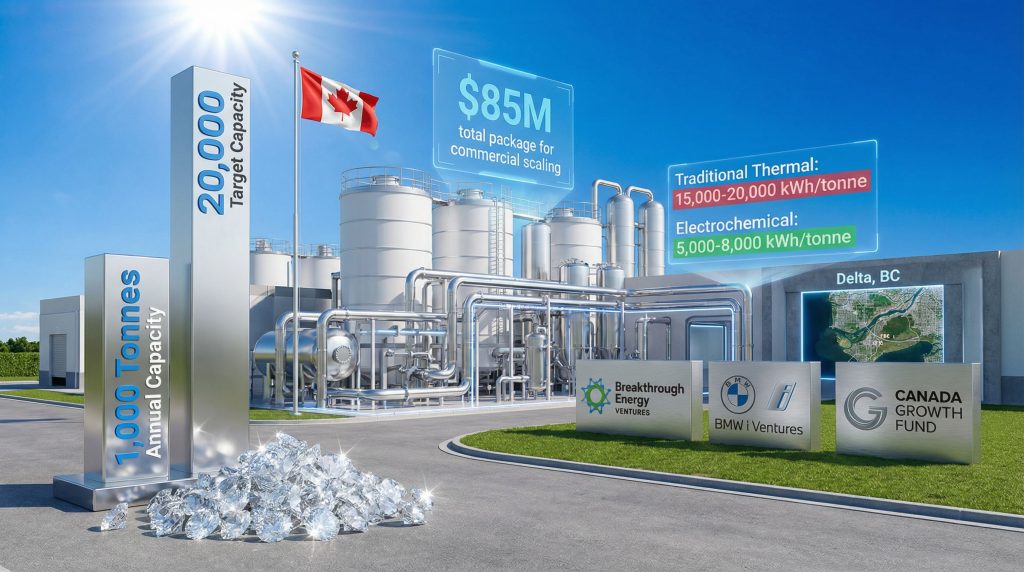
The facility's 20,000-tonne annual capacity target for Phase 2 operations could significantly impact continental supply chain dynamics. This processing volume would provide sufficient refined lithium hydroxide to support approximately half a million electric vehicles annually, representing meaningful domestic capacity relative to projected North American EV production volumes. Furthermore, this capacity aligns with the development of a comprehensive battery-grade lithium refinery infrastructure across North America.
What Investment Structure Signals Long-Term Market Confidence?
Canada Growth Fund's $65M Strategic Commitment
The Canada Growth Fund's leadership position in the $85 million funding package represents the largest single commitment within the investment structure, demonstrating governmental confidence in electrochemical processing technology and strategic importance placed on domestic critical mineral processing capabilities.
As an arms-length government investment vehicle with a C$15 billion total mandate, the Fund operates with commercial investment criteria while pursuing policy objectives related to emissions reduction and clean technology deployment. The structured financing approach suggests institutional assessment that Mangrove Water Technologies represents a commercially viable investment opportunity rather than purely policy-motivated funding.
The Fund's participation alongside strategic private investors creates a risk-sharing structure that validates the investment thesis through independent institutional due diligence. Government backing provides downside protection while private investor participation ensures commercial performance accountability.
Multi-Stage Funding Progression and Scalability Metrics
The investment timeline reveals systematic capital deployment aligned with technology development milestones and commercial scaling requirements. Beginning with Breakthrough Energy Ventures' Series A leadership in 2022, the funding progression demonstrates consistent investor confidence through successive development stages.
Investment Evolution Timeline:
• 2022 Series A: Breakthrough Energy Ventures leadership establishing technology validation
• 2022 Series A-1: BMW i Ventures strategic participation expanding automotive industry validation
• 2025 Strategic Round: $35 million multi-investor round including Mitsubishi Corporation, Asahi Kasei Corporation, and Canadian institutional investors
• 2026 Growth Round: $85 million package led by Canada Growth Fund enabling commercial deployment
This progression indicates systematic risk reduction as the technology advanced from pilot demonstration to commercial readiness. The participation of strategic industrial investors alongside venture capital firms suggests market validation from both financial and operational perspectives.
How Do Production Capacity Targets Compare to Market Demand Projections?
Phase 1 Commercial Facility: 1,000 Tonnes Annual Capacity
The initial commercial facility represents a strategic market entry scale designed to establish operational capabilities while maintaining manageable execution risk. The 1,000-tonne annual capacity provides sufficient volume to supply battery materials for approximately 25,000 electric vehicles annually, establishing meaningful market presence without requiring massive capital deployment.
This Phase 1 scale enables comprehensive operational validation of the electrochemical processing technology under commercial conditions while generating revenue to support subsequent expansion phases. The facility timeline targeting Q4 2025 to Q1 2026 commercial production aligns with broader North American EV production scaling requirements.
Revenue projections remain proprietary but benefit from lithium hydroxide pricing stability relative to commodity lithium pricing volatility. In addition, refined lithium hydroxide commands premium pricing compared to basic lithium carbonate, providing improved margin opportunities for specialised processing technologies.
Phase 2 Expansion: 20,000 Tonnes Target Capacity
The Phase 2 expansion represents a 20-fold capacity increase that would position Mangrove Water Technologies as a significant North American lithium processor. The 20,000-tonne annual capacity could support battery material requirements for approximately 500,000 electric vehicles annually, representing substantial market penetration potential.
Scale-up economics benefit from proven technology deployment and operational experience gained through Phase 1 operations. The modular facility design enables incremental capacity additions that match market demand growth rather than requiring single large-scale expansion commitments.
Market share implications extend beyond raw processing volume to include strategic positioning within North American battery supply chains. The facility would represent one of the largest domestic lithium processing operations, providing supply chain resilience for automotive manufacturers while reducing import dependency.
What Are the Broader Industry Implications of This Investment Pattern?
Venture Capital Trends in Battery Materials Processing
The Bill Gates and BMW back lithium refiner investment reflects broader venture capital deployment patterns in critical minerals processing that have accelerated significantly throughout 2025. Industry data indicates that venture capitalists invested more than $628 million in US startups working on rare earth minerals and critical materials processing during 2025, representing substantial increased activity compared to historical investment levels.
This investment surge reflects institutional recognition that battery material processing represents strategic infrastructure rather than traditional commodity extraction. Technology-focused processing solutions command venture capital attention due to their potential for rapid scaling and competitive differentiation compared to traditional mining operations.
The participation of strategic industrial investors alongside venture capital firms creates a hybrid investment model that combines financial returns expectations with operational validation. This pattern suggests that successful battery material processing ventures require both technological innovation and strategic market positioning.
Competitive Response Scenarios from Established Players
Traditional lithium processors including Albemarle, SQM, and Livent face strategic decisions regarding their response to electrochemical processing technology advances. These established players possess operational scale advantages but may face technological disruption from energy-efficient processing methods.
Competitive responses could include internal technology development, acquisition strategies targeting electrochemical processing companies, or strategic partnerships with technology developers. The investment validation provided by BMW's strategic backing creates pressure on established processors to evaluate their technology portfolios.
New market entrants leveraging similar electrochemical technologies may emerge as the processing methods prove commercially viable. The venture capital investment patterns suggest institutional appetite for supporting multiple technology platforms that address energy efficiency and environmental performance improvements.
The next major ASX story will hit our subscribers first
How Does This Investment Align with Global EV Market Growth Projections?
North American EV Production Scaling Requirements
Continental EV production projections through 2030 indicate substantial lithium processing capacity requirements that exceed current domestic capabilities. The Mangrove Water Technologies facility expansion timeline aligns with automotive manufacturers' battery supply chain development schedules and production scaling requirements.
Lithium demand forecasting suggests that domestic processing capacity development must accelerate significantly to support projected EV adoption rates. The 20,000-tonne processing capacity target represents meaningful progress toward domestic supply chain capabilities but requires additional industry capacity expansion to achieve supply chain independence.
Import substitution potential through domestic refining expansion provides strategic value beyond raw cost considerations. Supply chain resilience benefits include reduced transportation costs, improved delivery reliability, and mitigation of geopolitical supply disruption risks.
Strategic Value Creation Through Supply Chain Integration
| Supply Chain Metric | Current Baseline | 2028 Projection | Strategic Impact |
|---|---|---|---|
| NA Processing Capacity | Limited | 25,000+ tonnes | High |
| Cross-Border Logistics | Complex | Streamlined | Medium-High |
| Technology Leadership | Emerging | Established | High |
| Market Penetration | Nascent | Significant | High |
The strategic value creation extends beyond traditional processing economics to include technology leadership positioning and supply chain control. Electrochemical processing capabilities provide competitive advantages that compound over time as the technology proves commercially superior to traditional methods.
What Risk Factors Could Impact This Investment Thesis?
Technology Commercialisation Challenges
Scaling advanced processing technologies from pilot demonstration to commercial production presents inherent execution risks that could impact investment returns and timeline projections. The transition from controlled laboratory conditions to continuous commercial operations typically reveals engineering challenges that require iterative problem-solving and additional capital deployment.
Competitive technology development in electrochemical processing creates intellectual property protection requirements and potential technological obsolescence risks. The rapid pace of innovation in battery material processing means that technological advantages may prove temporary without continuous research and development investment.
Quality control maintenance across scaled operations represents a critical success factor for battery-grade lithium production. Automotive manufacturing requirements demand consistent material specifications that may prove challenging to maintain as production volumes increase substantially.
Market and Regulatory Risk Assessment
Lithium price volatility impacts processing margins and project economics, particularly during periods of rapid supply or demand adjustments. While refined lithium hydroxide pricing remains more stable than commodity lithium pricing, substantial market movements could affect facility profitability projections.
Trade policy changes affecting cross-border operations between Canada and the United States could impact the strategic advantages of the Delta, BC facility location. Tariff modifications or regulatory compliance requirements could affect operational costs and competitive positioning.
Environmental regulatory compliance costs and timeline risks require ongoing management as processing operations scale. For instance, electrochemical processing reduces many traditional environmental concerns but requires continuous regulatory compliance monitoring and potential adaptation to evolving environmental standards.
How Should Investors Evaluate Similar Opportunities in Critical Minerals Processing?
Investment Framework for Battery Materials Ventures
Technology readiness level assessment represents a critical evaluation criterion for battery materials processing investments. Investors should prioritise companies with demonstrated pilot-scale operations and clear pathways to commercial deployment rather than early-stage laboratory technologies.
Management team experience in scaling industrial processes provides crucial competitive advantages in executing complex technology commercialisation. Successful processing ventures typically require leadership teams combining technology development expertise with industrial operations experience and strategic market positioning capabilities.
Strategic investor alignment with end-market demand creates validation and supply chain positioning advantages. Companies with automotive manufacturer backing or strategic partnerships demonstrate market validation and potential customer relationships that pure venture capital funding cannot provide.
Portfolio Diversification Strategies in Clean Energy Infrastructure
Risk-return profiles across battery supply chain segments vary significantly based on technology maturity, capital requirements, and competitive dynamics. Processing technologies typically offer better risk-adjusted returns than raw material extraction but require more sophisticated technical due diligence.
Geographic diversification in critical minerals processing provides portfolio resilience against regulatory changes and supply chain disruptions. Investment portfolios should consider processing capacity distribution across multiple jurisdictions while maintaining strategic focus on major end-market regions.
Timeline considerations for venture capital exit strategies require alignment with technology commercialisation schedules and strategic acquirer development cycles. Consequently, battery materials processing investments typically require longer development timelines than software technologies but offer clearer strategic value creation pathways for industrial acquirers.
Investment Disclaimer: This analysis contains forward-looking projections and speculative assessments regarding technology commercialisation, market development, and investment outcomes. Critical minerals processing investments involve substantial technological, operational, and market risks that could result in partial or total investment losses. Readers should conduct independent due diligence and consult qualified investment advisors before making investment decisions based on this analysis.
Want to Discover the Next Major Mineral Investment Before the Market Does?
Discovery Alert's proprietary Discovery IQ model delivers real-time notifications of significant ASX mineral discoveries, transforming complex geological announcements into actionable investment insights that could position you ahead of broader market recognition. Explore Discovery Alert's dedicated discoveries page to understand how historic mineral discoveries have generated substantial returns for early investors, then begin your 30-day free trial to gain immediate access to the next wave of breakthrough discoveries.