
May 24, 2026
Strategic Investment Models Driving Electric Vehicle Charging Infrastructure Expansion
Private capital deployment in electric vehicle charging infrastructure represents a complex interplay of technology choices, geographic positioning, and business model optimization. Understanding these dynamics requires examining how different investment approaches address market gaps while generating sustainable returns in an evolving regulatory landscape.
When big ASX news breaks, our subscribers know first
Technology-Driven Market Segmentation Analysis
The electric vehicle charging infrastructure expansion demonstrates distinct market segments, each requiring different technological approaches and investment strategies. Current deployment patterns reveal a sophisticated ecosystem where infrastructure maturity depends heavily on geographic density and consumer behavior patterns.
Performance Indicators for Infrastructure Maturity
Infrastructure maturity extends beyond simple charger counts to encompass utilisation efficiency and user experience consistency. Transportation infrastructure analysts measure successful networks through coverage density ratios, operational uptime percentages, and payment system interoperability. These metrics distinguish between infrastructure existence and infrastructure maturity, particularly as charger-to-EV ratios vary dramatically by region.
Industry standards suggest maintaining minimum 1:15 ratios for DC fast chargers relative to EV populations within specific markets. California operates at approximately 1:18, indicating near-optimal density for current demand levels. Network uptime benchmarks target 96-99% availability, though industry averages report 92-94% operational consistency across major operators.
Regional Deployment Effectiveness Metrics
Geographic variations in deployment effectiveness reveal underlying market dynamics and consumer adoption patterns. Urban markets demonstrate higher utilisation rates for Level 2 charging, while interstate corridors show concentrated demand for DC fast charging infrastructure. This geographic segmentation drives investment allocation strategies across different technology types.
Session duration optimisation varies significantly by location type. Level 2 charging averages 4-6 hours in workplace environments, while DC fast charging maintains 20-35 minute sessions at 150kW+ capacity. These patterns inform revenue modelling and site selection criteria for infrastructure operators.
Charging Technology Strategic Positioning
Electric vehicle charging infrastructure expansion depends heavily on understanding how different charging technologies serve distinct market segments and use cases. Technology selection impacts both deployment costs and long-term revenue potential.
Level 2 vs DC Fast Charging Strategic Positioning
Level 2 charging serves as backbone infrastructure for urban and suburban markets, particularly addressing workplace and residential multi-unit dwelling applications. Cost-effectiveness ranges from $500-2,500 per unit installed compared to $40,000-100,000 for DC fast chargers, enabling density deployment in areas with lower commercial ROI potential.
DC fast charging networks demonstrate higher revenue per transaction, ranging $12-18 compared to Level 2's $3-7, but face lower utilisation rates in lower-traffic areas. Strategic deployment concentrates on commercial corridors, highway clusters, and retail integrations where traffic volume justifies infrastructure investment.
Power Output Evolution and Consumer Behaviour Impact
Ultra-fast charging technology shows the most aggressive growth patterns, with 250kW+ deployments increasing 70-85% annually through 2024. This expansion reflects automaker battery technology evolution and competitive differentiation strategies. Tesla's V3 and V4 Superchargers, alongside Electrify America's 350kW stations, target reducing charge time parity with traditional refuelling.
Grid infrastructure limitations and deployment costs ranging $150,000-250,000 per station restrict ultra-fast charging to strategic highway corridors and metropolitan centres. These constraints create geographic concentration patterns that influence network accessibility and consumer adoption rates.
| Technology Type | Deployment Cost Range | Revenue Per Session | Strategic Application |
|---|---|---|---|
| Level 2 AC | $500-2,500 | $3-7 | Workplace, residential |
| DC Fast 150kW+ | $40,000-100,000 | $12-18 | Commercial corridors |
| Ultra-Fast 250kW+ | $150,000-250,000 | $15-25 | Highway, metro centres |
Connector Standardisation Effects on Network Growth
North American Charging Standard (NACS) adoption removes fragmentation barriers that previously required multi-network subscriptions or membership management. This standardisation projects 25-35% increases in network interoperability utilisation as customers access broader networks without proprietary adapter requirements.
Under previous multi-standard environments encompassing J1772 Level 2, CHAdeMO, SAE Combo CCS, and Tesla Proprietary systems, charger incompatibility reduced effective network size by 30-40% for non-Tesla EV owners. This created artificial scarcity despite adequate absolute charging port availability.
Capital Deployment Models Reshaping Market Dynamics
Investment strategies in electric vehicle charging infrastructure expansion demonstrate three primary models, each addressing different market segments and risk profiles. Understanding these approaches reveals how private capital allocation drives infrastructure development.
Private Capital Deployment Strategies
Network-as-a-Service models prioritise high-traffic corridors and dense urban areas with favourable unit economics targeting 20-40% annual ROI. Companies deploying this approach focus on transaction fees and subscription revenue streams while maintaining ownership of charging infrastructure assets.
Retail integration strategies subsidise charger capital costs 30-50% below standalone economics through increased customer visit frequency and secondary purchasing behaviour. Major retail chains installing Level 2 chargers drive dwell time while capturing additional revenue from extended customer presence.
Workplace charging deployment serves dual purposes as employee amenity and fleet asset optimisation. Corporate operators including logistics companies deploy charging infrastructure with 5-10 year ROI horizons justified by fleet electrification roadmaps and operational efficiency gains.
"Private sector commitments currently total approximately 150,000-175,000 DC fast charger placements through 2030, representing potential overcoverage of projected DC fast charging needs while Level 2 infrastructure requires additional 38% investment to meet demand projections."
Public-Private Partnership Effectiveness
Federal Infrastructure Act implementation through the National Electric Vehicle Infrastructure (NEVI) programme allocated $5 billion for DC fast charger deployment along major interstate corridors. As of March 2026, approximately $3.2 billion has been deployed across projects targeting completion by 2028-2030.
NEVI programme requirements mandate minimum 150kW DC fast charging capability with 4+ chargers per site, establishing performance standards that influence private sector deployment decisions. Target deployment reaches 500,000 EV chargers nationally by 2030 through NEVI and complementary programmes.
State-specific public-private partnerships demonstrate varying effectiveness levels. California's model combining $800 million in state rebates with utility infrastructure investment achieved approximately 34,000 public chargers by 2025, representing roughly 60% of total US deployment. Furthermore, the sustainable EV battery recycling initiatives support this infrastructure development through circular economy approaches.
Retail Integration Business Models
Retail integration strategies transform charging infrastructure from standalone business models into customer acquisition and retention tools. Major retail chains deploy charging stations to extend customer dwell time while generating secondary revenue streams from increased shopping behaviour.
These models typically justify charging infrastructure investment through combined metrics including direct charging revenue, increased customer visit frequency, and higher per-visit transaction values. Successful retail integration requires balancing charging infrastructure costs against projected revenue increases from extended customer engagement.
Geographic Market Maturation Patterns
Electric vehicle charging infrastructure expansion demonstrates distinct geographic patterns that reveal underlying market dynamics and investment priorities. Understanding these patterns provides insight into where infrastructure development succeeds and where gaps persist.
California's Leadership Model and Replication Challenges
California's aggressive infrastructure development combined state incentives, utility investment, and private sector deployment to achieve market leadership. The state deployed approximately 34,000 public chargers by 2025, establishing templates for infrastructure density and technology mix optimisation.
Replicating California's success faces challenges in markets with different policy frameworks, population density, and utility structures. States attempting similar approaches must adapt California's model to local grid infrastructure, consumer adoption rates, and regulatory environments.
Northeast Corridor High-Density Deployment Success
The Northeast Corridor demonstrates successful high-density deployment along I-95 and connecting interstate highways. This region benefits from consistent traffic patterns, favourable demographics for EV adoption, and state-level coordination across multiple jurisdictions.
Geographic advantages including shorter average trip distances, higher population density, and established electrical grid infrastructure support more efficient charging network deployment. These factors enable higher utilisation rates and faster ROI achievement for infrastructure operators.
Rural and Interstate Charging Gap Analysis
Rural and interstate charging gaps represent the most significant infrastructure development challenges. Lower population density, extended distances between destinations, and limited electrical grid capacity create unfavourable economics for traditional charging network deployment.
Addressing these gaps requires modified investment approaches including government subsidies, utility partnerships, and innovative business models that account for lower utilisation rates. Federal programmes specifically target these corridors through dedicated funding mechanisms and relaxed economic requirements.
Consumer Perception Impact on Infrastructure Economics
Consumer perception barriers significantly influence electric vehicle charging infrastructure utilisation and return on investment. Understanding these psychological factors reveals why infrastructure deployment alone does not guarantee market success.
Access Anxiety and Market Development
Consumer surveys indicate that approximately 53% of potential EV buyers cite charging access concerns as primary purchase barriers. This perception often exceeds actual infrastructure limitations, creating market resistance despite adequate charging availability in many regions.
Access anxiety correlates with unfamiliarity rather than absolute infrastructure scarcity. Markets with established charging networks still demonstrate consumer hesitation based on perceived rather than actual charging limitations. This dynamic influences infrastructure utilisation below optimal levels despite adequate deployment.
Range Confidence vs Infrastructure Reality
Range confidence issues persist even in markets with mature charging infrastructure. Consumer behaviour demonstrates preference for charging station redundancy that exceeds technical necessity, creating demand for infrastructure density above minimum operational requirements.
This preference pattern influences infrastructure investment strategies, requiring higher deployment density to achieve consumer confidence compared to purely technical charging needs. Understanding this dynamic helps explain why successful markets often deploy infrastructure above minimum technical requirements.
Education and Experience Correlation Analysis
Consumer experience with charging infrastructure demonstrates strong correlation with adoption confidence. Markets with established infrastructure and consumer education programmes show higher EV adoption rates independent of absolute charger availability.
Experience-based confidence building requires sustained infrastructure operation and customer support systems. First-time charging experiences significantly influence long-term adoption decisions, emphasising the importance of infrastructure reliability and user experience optimisation.
The next major ASX story will hit our subscribers first
Policy Framework Changes and Deployment Timelines
Regulatory and policy environments significantly influence electric vehicle charging infrastructure expansion timelines and investment decisions. Understanding these frameworks reveals how government action accelerates or constrains market development.
Federal Infrastructure Implementation Progress
The Bipartisan Infrastructure Law allocated $7.5 billion for EV charging infrastructure through 2031, establishing federal framework for nationwide charging network development. Implementation progress varies by state based on administrative capacity and coordination with private sector operators.
Federal programmes require coordination between Department of Transportation, Department of Energy, and state agencies to achieve deployment targets. This multi-agency approach creates both opportunities for comprehensive planning and risks of administrative delays affecting timeline achievement.
State-Level Incentive Programme Effectiveness
State-level programmes demonstrate varying effectiveness based on incentive structure, coordination mechanisms, and local market conditions. Successful programmes combine direct financial incentives with regulatory streamlining and utility coordination.
New York's Charge NY initiative exemplifies coordinated state approach combining rebates, utility incentives, and energy authority coordination. This model deployed approximately 5,000-6,000 public chargers statewide by 2025, concentrating on urban corridors and major highways. Additionally, understanding battery raw materials update helps inform infrastructure planning decisions.
Regulatory Streamlining Impact on Project Velocity
Permitting and interconnection processes significantly influence infrastructure deployment velocity. Grid upgrade bottlenecks average 6-18 months for high-power chargers, while land acquisition and municipal permitting average 4-8 months per location.
States implementing streamlined permitting processes demonstrate faster deployment timelines and higher private sector investment attraction. Regulatory efficiency becomes competitive advantage in attracting infrastructure investment and achieving deployment targets.
Market Consolidation and Competition Dynamics
Electric vehicle charging infrastructure expansion occurs within evolving competitive landscape where market consolidation and strategic positioning determine long-term market structure.
Tesla Supercharger Network Opening Strategy
Tesla's decision to open Supercharger networks to non-Tesla vehicles represents significant strategic shift affecting competitive dynamics. This move expands Tesla's addressable market while potentially commoditising charging infrastructure through standardisation.
Network opening requires technological adaptation and business model evolution as Tesla transitions from proprietary advantage to market-wide infrastructure provider. This change influences pricing strategies and capacity planning across Tesla's charging network.
Traditional Energy Company Market Entry
Major oil companies and utilities increasingly invest in charging infrastructure as strategic diversification. These companies leverage existing real estate assets, electrical infrastructure, and customer relationships to enter charging markets.
Traditional energy company advantages include capital availability, operational experience, and existing customer bases. However, these companies face challenges adapting business models from fossil fuel operations to electricity-based transportation infrastructure. Moreover, EVs transforming mining transportation presents new opportunities for industrial applications.
| Market Participant Type | Competitive Advantages | Strategic Challenges |
|---|---|---|
| Tesla | Integrated ecosystem, technology leadership | Network opening transition |
| Oil Companies | Real estate, capital, customer base | Business model adaptation |
| Utilities | Grid expertise, infrastructure | Regulatory constraints |
| Pure-play Networks | Specialisation, agility | Capital limitations |
Technology Platform Standardisation Trends
NACS adoption accelerates technology platform standardisation, reducing competitive differentiation based on connector types. This standardisation shifts competition toward operational efficiency, customer experience, and strategic location control.
Standardisation benefits consumers through broader network access while potentially reducing charging network differentiation. Companies must develop competitive advantages beyond proprietary technology to maintain market position in standardised environment.
Utilisation Optimisation and Revenue Generation
Electric vehicle charging infrastructure expansion success depends heavily on optimising utilisation patterns and revenue generation strategies. Understanding these operational dynamics reveals pathways to sustainable infrastructure economics.
Peak Hour Demand Management
Charging demand patterns create peak hour concentration that influences infrastructure capacity planning and revenue optimisation. DC fast charging shows concentrated usage during travel hours, while Level 2 demonstrates more distributed usage patterns aligned with work and residential schedules.
Peak hour management strategies include dynamic pricing, reservation systems, and load balancing technologies. These approaches maximise infrastructure utilisation while managing grid impact and customer experience during high-demand periods.
Session Duration Optimisation Strategies
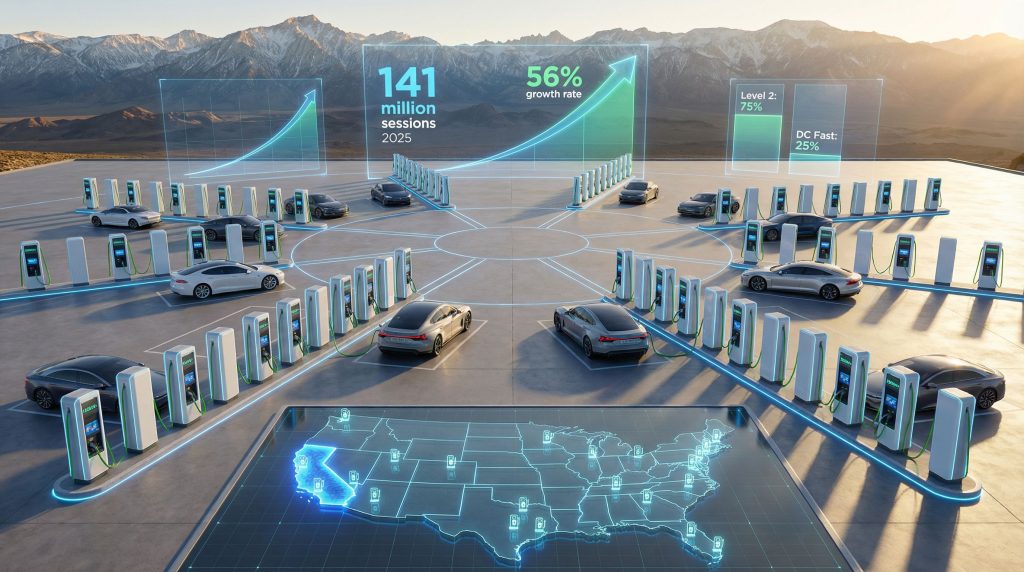
Fast-charging sessions reached 141 million in 2025, representing 30% annual increase and demonstrating strong utilisation growth despite infrastructure expansion. Session optimisation balances charge time minimisation with infrastructure throughput maximisation.
Optimal session management requires understanding vehicle charging curves, customer behaviour patterns, and infrastructure capacity constraints. Successful operators develop strategies that maximise both customer satisfaction and infrastructure utilisation efficiency. Moreover, the latest Australian EV charging infrastructure assessment provides valuable insights into market development.
Pricing Model Innovation and Revenue Maximisation
Innovative pricing models address varying customer needs while optimising infrastructure revenue. Time-based pricing, subscription models, and dynamic pricing based on demand patterns provide alternatives to simple per-kilowatt-hour charging.
Revenue maximisation strategies must balance customer acquisition with profitability objectives. Markets demonstrate preference for transparent, predictable pricing while accepting premium charges for convenience and speed advantages.
Infrastructure Technology Innovation Impact
Technological advancement significantly influences electric vehicle charging infrastructure expansion efficiency and capability. Understanding these innovations reveals future development trajectories and investment opportunities.
Smart Grid Integration and Load Management
Smart grid integration enables dynamic load management that optimises charging infrastructure operation within broader electrical grid constraints. These technologies balance charging demand with grid capacity while minimising infrastructure and operational costs.
Load management systems prevent grid overload during peak charging periods while maximising infrastructure utilisation during off-peak hours. This optimisation reduces infrastructure costs while improving grid stability and charging network reliability.
Battery Storage Co-location Benefits
Battery storage integration with charging infrastructure provides multiple operational benefits including demand charge reduction, grid services revenue, and charging capacity expansion without grid infrastructure upgrades.
Co-located storage systems enable charging infrastructure deployment in grid-constrained areas while providing backup power and grid stabilisation services. These installations demonstrate multi-revenue stream approaches that improve infrastructure economics.
Predictive Maintenance and Uptime Optimisation
Predictive maintenance technologies address charging infrastructure reliability challenges that affect customer experience and operator economics. These systems identify potential failures before they impact service availability.
Uptime optimisation requires balancing maintenance costs with service reliability objectives. Leading operators achieve 96-99% uptime targets through proactive maintenance strategies and rapid response systems.
Strategic Investment Recommendations
Electric vehicle charging infrastructure expansion presents both opportunities and challenges requiring sophisticated investment strategies. Success depends on understanding technology trends, market dynamics, and regulatory environments.
Portfolio Diversification Across Charging Technologies
Successful infrastructure investment requires balanced portfolios across Level 2, DC fast charging, and ultra-fast charging technologies. Each technology serves different market segments with varying risk and return profiles.
Portfolio optimisation considers geographic distribution, technology mix, and customer segment targeting. Diversified approaches reduce risk while capturing opportunities across different charging market segments. Meanwhile, battery metals investment strategies complement infrastructure development.
Geographic Risk Management Strategies
Geographic diversification addresses regulatory, competitive, and market development risks that vary by region. Investment strategies must account for state policy differences, utility structures, and local market conditions.
Risk management includes understanding local permitting processes, grid interconnection requirements, and competitive landscapes. Successful investors develop region-specific strategies adapted to local market conditions. The IEA global EV charging outlook provides essential market intelligence for these decisions.
Partnership Optimisation for Market Entry
Strategic partnerships enable market entry while sharing risks and leveraging complementary capabilities. Effective partnerships combine financial resources, operational expertise, and market access advantages.
Partnership strategies include utility collaboration, retail integration, and technology platform agreements. These relationships provide competitive advantages while reducing individual company risk exposure. Additionally, comprehensive investment strategy components support long-term portfolio planning.
The US electric vehicle charging infrastructure expansion represents a complex market opportunity requiring sophisticated understanding of technology, geography, regulation, and consumer behaviour. Success demands integrated strategies addressing multiple market segments while managing technological and competitive evolution. Current trends indicate robust infrastructure development with selective geographic and technological focus areas offering the strongest investment potential.
Ready to Capitalise on the Infrastructure Revolution?
Discovery Alert's proprietary Discovery IQ model delivers real-time alerts on significant mining and exploration discoveries, including critical battery metals essential for electric vehicle infrastructure development. Subscribers gain immediate insights into actionable opportunities ahead of the broader market, positioning themselves to benefit from the ongoing transformation in energy and transportation sectors.