May 22, 2026
Strategic Supply Chain Transformation in Critical Mineral Markets
The global mining industry stands at an inflection point where traditional commodity extraction models are rapidly evolving into complex, technology-driven ecosystems. This transformation reflects not merely market dynamics, but fundamental shifts in geopolitical positioning, technological capabilities, and social expectations that are reshaping how nations and corporations approach mineral security. The convergence of artificial intelligence infrastructure demands, clean energy deployment requirements, and strategic national security considerations has created an unprecedented opportunity for mining companies that can successfully integrate operational excellence with community development and technological innovation.
Modern mining operations must navigate multiple strategic frameworks simultaneously: meeting exponential demand growth while managing resource quality degradation, implementing circular economy principles while maintaining cost competitiveness, and securing social license while accelerating project timelines. The companies that master this multi-dimensional challenge will emerge as the dominant players in the next phase of global mineral supply chain development.
When big ASX news breaks, our subscribers know first
Geopolitical Realignment and Strategic Mineral Security
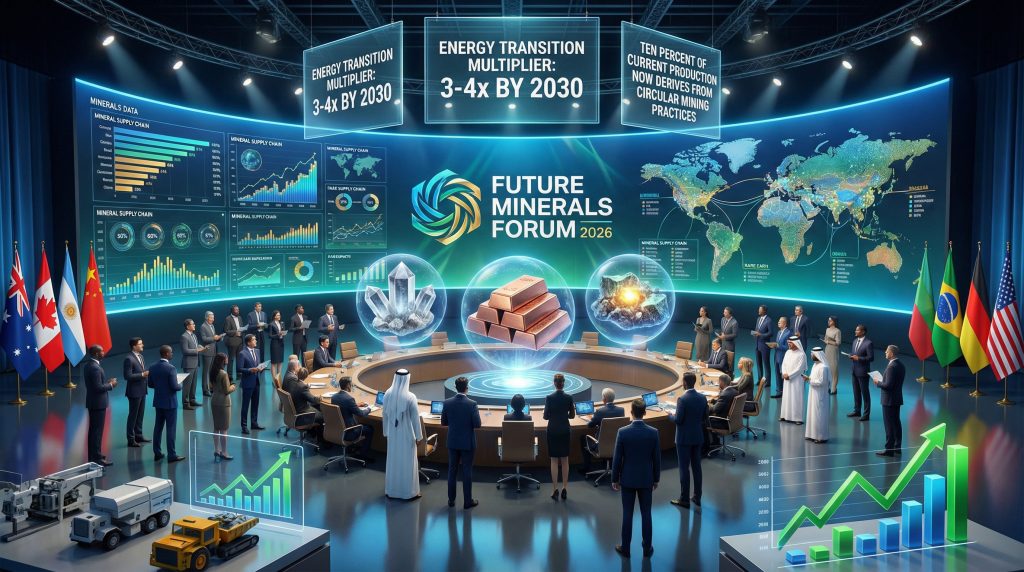
The future minerals forum 2026 revealed a fundamental shift in how major economies approach mineral security, with the United States implementing what officials describe as a complete reversal in national minerals policy. This transformation encompasses four critical strategic pillars that are reshaping global supply chain dynamics and investment priorities.
Four-Pillar Strategic Framework Implementation
The new American approach centers on massive investment acceleration in domestic mining projects, strategic stockpiling at levels unseen since Cold War-era programs, competitive protection mechanisms against state-sponsored mining operations, and comprehensive regulatory streamlining to compress approval timelines. This represents a transition from market-based mineral acquisition to national security-integrated supply chain management, elevating mineral access to the same strategic importance as traditional defense capabilities.
Furthermore, this framework directly complements initiatives like the Australia critical minerals reserve, which demonstrates how allied nations are coordinating strategic stockpiling efforts. The investment acceleration component involves unprecedented capital deployment across critical mineral projects, with government officials indicating hundreds of billions in committed funding.
Strategic stockpiling initiatives aim to build reserves at peacetime levels comparable to wartime preparation programs from the 1950s and 1970s, demonstrating the severity of perceived supply chain vulnerabilities.
Key Strategic Stockpiling Targets:
• Lithium reserves for battery manufacturing independence
• Rare earth elements for defense and technology applications
• Copper for electrical infrastructure modernization
• Cobalt and nickel for energy storage systems
• Tungsten and other specialty metals for advanced manufacturing
The competitive protection pillar addresses concerns about subsidized international mining operations that can undercut market-based pricing through government support. This involves implementing trade mechanisms and investment incentives that level the competitive landscape for domestic producers while maintaining compliance with international trade agreements.
International Response and Alliance Formation
The American policy shift has triggered corresponding responses from allied nations, creating opportunities for strategic partnership development and technology sharing arrangements. Countries with significant mineral resources are positioning themselves as reliable supply partners, while nations with advanced processing capabilities are offering downstream integration opportunities.
Consequently, the European critical materials facility represents another key component of this coordinated alliance response. Saudi Arabia has emerged as a key player in this realignment, leveraging its sovereign wealth fund capabilities and strategic geographic position to become a processing and manufacturing hub for critical minerals.
Alliance Formation Patterns:
• Resource-rich nations partnering with processing-capable countries
• Technology transfer agreements between allied mining companies
• Joint stockpiling programs among strategic partners
• Shared research and development initiatives for processing innovations
• Coordinated investment in transportation and logistics infrastructure
Exponential Demand Growth and Market Transformation
The scale of demand transformation facing the mining industry exceeds any previous commodity cycle in modern history. Industry analysis suggests that current mineral production levels must multiply by five to six times through 2035 to meet combined energy transition and artificial intelligence infrastructure requirements. This demand multiplication creates both unprecedented opportunities and operational challenges that require fundamental rethinking of traditional mining approaches.
Energy Transition Mineral Requirements
Electric vehicle penetration rates are accelerating beyond most forecasting models, with battery mineral demand experiencing exponential growth curves. The International Energy Agency projects electric vehicles could represent 60% of new car sales globally by 2030, driving lithium demand to approximately 1.3 million tonnes annually by 2040, compared to roughly 350,000 tonnes consumed in 2021.
Critical Mineral Demand Multipliers (2026-2035):
| Mineral Category | Current Baseline | 2030 Projection | 2035 Target |
|---|---|---|---|
| Lithium (Battery Grade) | 1x | 4x | 6x |
| Cobalt (Cathode Material) | 1x | 3x | 5x |
| Nickel (Battery Chemistry) | 1x | 3x | 4x |
| Rare Earth Elements | 1x | 2x | 3x |
| Copper (Infrastructure) | 1x | 2x | 3x |
Grid-scale energy storage represents an additional demand vector that compounds electric vehicle requirements. Utility-scale battery storage capacity must increase 10-15x through 2035 to stabilise renewable energy grids, creating parallel demand streams for the same mineral inputs required for transportation electrification.
Artificial Intelligence Infrastructure Impact
The rapid deployment of artificial intelligence systems creates substantial demand for specialty minerals used in advanced semiconductor manufacturing, data center construction, and high-performance computing applications. Moreover, AI drilling innovations are revolutionising how these minerals are extracted. While AI infrastructure represents a smaller absolute volume compared to energy transition requirements, it demands higher-grade materials and creates premium pricing opportunities for producers capable of meeting stringent quality specifications.
AI-Driven Mineral Requirements:
• Silicon for advanced semiconductor fabrication
• Gallium and germanium for high-frequency applications
• Indium for display technologies and touchscreen interfaces
• Tantalum for capacitor manufacturing in high-density electronics
• Specialty rare earth elements for permanent magnets in cooling systems
The convergence of energy transition and AI infrastructure deployment creates compounding demand effects, as electrification of transportation and industrial processes requires both battery minerals and the computational power to manage complex electrical grids and autonomous systems.
Operational Excellence Through Circular Economy Integration
Leading mining companies are implementing circular economy principles that transform traditional waste streams into revenue-generating products while addressing resource quality degradation challenges. This approach represents a fundamental shift from linear extraction models to closed-loop material utilisation systems that maximise resource efficiency and minimise environmental impact.
Circular Mining Implementation Strategies
Vale's circular mining programme demonstrates the commercial viability of reprocessing historical waste materials, with 10% of current production derived from previously discarded tailings. This involves revisiting decades-old tailings dams where extraction technology was insufficient to process lower-grade ore materials, applying modern flotation and separation technologies to historically rejected material.
The economic impact extends beyond additional production volumes. Circular mining reduces the environmental liability associated with historical tailings facilities while generating new revenue streams from existing infrastructure. Additionally, mine reclamation innovation demonstrates how these practices create value whilst addressing environmental obligations.
Circular Mining Value Creation:
• Historical tailings reprocessing generating 10%+ additional production
• Waste rock utilisation for construction materials and aggregate products
• Water recycling systems achieving 90%+ reuse rates
• Energy recovery from mining processes for grid contribution
• By-product extraction maximising ore body utilisation
Technology Integration for Resource Optimisation
Digital transformation initiatives are enabling mining companies to optimise resource extraction from increasingly complex ore bodies. Advanced processing technologies including coarse particle flotation systems, sulfide heap leaching, and AI-driven ore body optimisation are making previously uneconomic deposits commercially viable.
The integration of artificial intelligence in mining operations extends beyond process optimisation to predictive maintenance, equipment performance enhancement, and real-time quality control systems. These technologies are particularly valuable when processing lower-grade materials that require more precise handling to maintain economic viability.
"The industry faces a fundamental challenge: good ore bodies are being depleted, forcing operations toward lower quality deposits that require technological innovation to maintain profitability."
Advanced Processing Technologies:
• Coarse particle flotation increasing recovery rates by 15-20%
• Sulfide heap leaching extending mine life for low-grade deposits
• AI-driven ore sorting reducing processing volumes by 30-40%
• Automated extraction systems improving safety and precision
• Real-time ore grade monitoring optimising processing parameters
Community Integration as Competitive Advantage
The mining industry's relationship with local communities has evolved from corporate social responsibility compliance to strategic competitive advantage. Companies that successfully integrate community development with operational planning are achieving measurable acceleration in project development timelines while building long-term operational security.
Social License as Operational Velocity
Sigma Lithium's experience in Brazil's Jequitinhonha Valley demonstrates how community support translates directly into operational advantages. The company implemented social capital expenditure before achieving revenue generation, investing in microfinance programmes, agricultural support initiatives, and local economic development projects that created community prosperity beyond mining employment.
This approach generated overwhelming community support that enabled accelerated project development timelines. Local officials and community leaders actively support permitting processes and regulatory approvals, creating what company executives describe as moving at competitive speeds typically associated with less regulated jurisdictions.
Community Integration Components:
• Pre-revenue social investment creating stakeholder alignment
• Microfinance programmes supporting local entrepreneurship development
• Agricultural support diversifying regional economic base
• Processing infrastructure localisation retaining high-skilled employment
• Educational partnerships developing local technical capabilities
Regional Development Catalyst Models
Mining operations in economically marginalised regions can function as transformation engines that create sustainable prosperity beyond extraction activities. The Jequitinhonha Valley project demonstrates how integrated mining and processing facilities generate multiple economic multiplier effects through direct employment, secondary service industries, and supply chain development.
The regional development approach requires long-term commitment and substantial upfront investment in social infrastructure. However, the operational benefits include reduced labour turnover, accelerated permitting processes, community advocacy during regulatory reviews, and protection from activist opposition that can delay or halt project development.
Economic Multiplier Effects:
• Direct mining employment in high-skilled processing operations
• Secondary employment in support services and supply chain
• Tertiary economic activity through increased regional purchasing power
• Educational institution development creating long-term human capital
• Infrastructure improvements benefiting entire regional economy
Investment Capital Mobilisation and Funding Innovation
The mining industry faces unprecedented capital requirements to meet demand multiplication scenarios, with industry estimates suggesting trillion-dollar investment gaps across the mineral supply chain development. Traditional financing mechanisms are insufficient for this scale of capital deployment, necessitating innovative funding structures and institutional participation.
Multilateral Development Bank Reform
The World Bank and regional development banks are restructuring investment mandates to accommodate mining and mineral processing project financing. This represents a significant policy shift, as development finance institutions historically focused on infrastructure and social development rather than extractive industry support.
The reformed approach recognises that mineral supply chain security is essential for global development goals, particularly clean energy deployment and economic development in resource-rich developing countries. For instance, ASX capital raising methods showcase innovative approaches to mobilising capital for these strategic projects. New funding mechanisms combine concessional government financing with institutional investor participation to reduce project risk whilst maintaining commercial returns.
Development Finance Innovation:
• Sovereign wealth fund deployment in strategic mineral partnerships
• Pension fund and insurance company participation in mining infrastructure
• Private equity specialisation in processing and technology development
• Blended finance mechanisms combining public and private capital
• Export credit agency support for strategic mineral projects
Hybrid Public-Private Capital Structures
The emergence of specialised investment vehicles like the Orion Critical Mineral Consortium demonstrates new approaches to mobilising both sovereign and private capital for mineral supply chain development. These structures address the scale and risk characteristics of modern mining projects whilst providing returns appropriate for different investor categories.
Gulf Cooperation Council sovereign wealth funds are particularly active in this space, leveraging substantial capital reserves to establish processing and manufacturing hubs that complement upstream mining operations. This approach creates integrated supply chains that reduce dependency on traditional processing centres whilst building regional industrial capacity.
Capital Mobilisation Mechanisms:
• Sovereign-private partnerships for strategic mineral projects
• Infrastructure debt facilities for processing and transportation
• Technology venture capital for mining innovation development
• Strategic stockpiling programmes creating guaranteed demand
• Regional development funds supporting integrated supply chains
The next major ASX story will hit our subscribers first
Technology Transfer and Innovation Acceleration
The acceleration of mining technology development and deployment has become critical for meeting demand growth timelines whilst addressing operational challenges including resource quality degradation, environmental requirements, and social licence expectations. Industry leaders are implementing collaborative approaches to technology sharing that compress traditional development timelines.
Data Collaboration and Shared Innovation
Mining companies are establishing collaborative platforms for sharing geological data, processing techniques, and operational best practices to accelerate mineral discovery and development. This represents a significant departure from traditional industry secrecy around technical innovations and resource information.
The data sharing approach enables faster mineral discovery through shared geological databases, processing optimisation through distributed experimentation, and risk reduction through collective learning from operational experiences. Companies maintain proprietary advantages in core operations whilst collaborating on common challenges.
Technology Sharing Frameworks:
• Geological data consortiums accelerating exploration success rates
• Processing technique exchanges optimising recovery rates
• Environmental technology collaboration reducing compliance costs
• Safety innovation sharing improving industry-wide performance
• Equipment automation standards enabling interoperability
Advanced Processing Technology Deployment
The deployment of advanced processing technologies is enabling economic extraction from previously unviable ore bodies whilst improving environmental performance and operational efficiency. These technologies are particularly important for addressing resource quality degradation as high-grade deposits become depleted.
Coarse particle flotation systems are improving recovery rates by 15-20% whilst reducing energy consumption and processing time. Sulfide heap leaching technologies are extending mine life for low-grade deposits that would otherwise be economically unviable. AI-driven ore sorting systems are reducing processing volumes by 30-40% by removing waste material before expensive processing steps.
Processing Innovation Impact:
• Recovery rate improvements extending ore body economic life
• Energy efficiency gains reducing operational costs and emissions
• Processing time reduction accelerating cash flow generation
• Waste volume minimisation reducing environmental liability
• Quality consistency improvements meeting premium market specifications
Market Psychology and Investment Positioning
The mining industry is experiencing a fundamental shift in market psychology as investors recognise the strategic importance of mineral supply security and the scale of investment opportunities created by demand multiplication scenarios. This transformation extends beyond traditional commodity cycle dynamics to encompass geopolitical positioning, technology integration, and social impact considerations.
Talent Acquisition and Industry Repositioning
Mining companies are implementing comprehensive strategies to attract engineering talent that would traditionally pursue technology sector careers. This involves repositioning mining as a technology-driven, socially impactful career path that offers opportunities to address global challenges including climate change and economic development.
In Chile, Codelco has successfully positioned itself as the preferred employer for engineering talent, surpassing technology companies like Google and Apple in recruitment appeal. This achievement demonstrates the potential for mining companies to compete effectively for top technical talent when offering compelling mission alignment and career development opportunities.
Talent Acquisition Strategies:
• Technology integration showcasing advanced engineering applications
• Social impact messaging emphasising community development contributions
• Career development programmes offering rapid advancement opportunities
• Compensation packages competitive with technology sector offerings
• Innovation-focused work environments encouraging creative problem-solving
ESG Integration and Sustainable Investment
Environmental, social, and governance considerations have evolved from compliance requirements to competitive advantages that attract capital and enable operational acceleration. Companies that successfully integrate ESG principles into core business strategies are accessing broader investor pools and achieving premium valuations.
The integration approach involves developing measurable sustainability metrics, implementing community development programmes that create shared value, and maintaining governance standards that support long-term operational security. This comprehensive approach addresses investor requirements whilst building operational resilience.
"Mining operations must demonstrate that profitability and sustainability can coexist, as customers and investors will not support environmental initiatives that compromise economic competitiveness."
ESG Competitive Advantages:
• Access to sustainable investment capital at favourable terms
• Premium pricing for responsibly sourced materials
• Accelerated permitting through community and regulatory support
• Reduced operational risk through stakeholder alignment
• Enhanced corporate reputation attracting talent and partnerships
Future Scenario Planning and Strategic Positioning
Mining companies are implementing sophisticated scenario planning processes to navigate the complex intersection of geopolitical dynamics, technological change, and market evolution. Successful organisations are developing flexible strategies that can adapt to multiple potential futures whilst maintaining consistent progress toward strategic objectives.
Geographic Risk Distribution
Leading mining companies are implementing strategic asset allocation across multiple jurisdictions to minimise political, regulatory, and operational risks whilst maximising resource access. This approach involves balancing exposure between established mining jurisdictions with stable regulatory environments and emerging markets with significant resource potential.
The geographic distribution strategy extends beyond traditional political risk considerations to encompass regulatory efficiency, infrastructure availability, social licence complexity, and strategic partnership opportunities. Companies are particularly focused on jurisdictions that offer integrated supply chain development potential rather than isolated extraction opportunities.
Geographic Strategy Components:
• Jurisdiction diversification across political and regulatory systems
• Infrastructure access optimisation for transportation and processing
• Regulatory environment assessment for permitting efficiency
• Social licence complexity evaluation for operational sustainability
• Strategic partnership potential with local governments and companies
Vertical Integration and Value Capture
Mining companies are expanding into downstream processing and manufacturing to capture additional value whilst reducing supply chain vulnerabilities. This vertical integration approach creates more resilient business models whilst positioning companies to benefit from the highest-value components of mineral supply chains.
The integration strategy involves selective expansion into processing activities that leverage existing operational capabilities and market positions rather than comprehensive vertical integration across all activities. Companies are partnering with downstream manufacturers to develop specialised processing capabilities whilst maintaining focus on core mining competencies.
Value Integration Opportunities:
• Battery material processing for electric vehicle supply chains
• Specialty alloy production for aerospace and defence applications
• High-purity material refining for semiconductor manufacturing
• Construction material production utilising mining waste streams
• Regional processing hubs serving multiple downstream markets
Strategic Implications for Industry Evolution
The future minerals forum 2026 demonstrated that the mining industry is undergoing fundamental transformation that extends far beyond traditional commodity cycle dynamics. The convergence of exponential demand growth, geopolitical realignment, technological innovation, and social licence requirements is creating opportunities for companies that can successfully integrate multiple strategic dimensions whilst maintaining operational excellence and financial discipline.
Furthermore, upcoming events like the Future Minerals Forum 2026 in Riyadh continue to serve as crucial platforms for industry collaboration and strategic planning. The organizations positioned for success in this environment will demonstrate simultaneous capabilities in operational efficiency, community integration, technological innovation, and geopolitical positioning.
This multi-dimensional excellence requirement represents a significant departure from traditional mining business models that could succeed through operational focus alone. In addition, the Future Minerals Forum initiative emphasises the importance of transparent governance frameworks in building investor confidence and operational sustainability.
The strategic frameworks emerging from industry leaders suggest that sustainable competitive advantage will derive from integrated approaches that create value for multiple stakeholder groups whilst addressing global challenges including energy transition, economic development, and supply chain security. Companies that can execute these complex strategies whilst maintaining financial performance will capture disproportionate value creation as the industry scales to meet unprecedented demand growth.
Disclaimer: This analysis contains forward-looking statements and projections based on industry discussions and expert opinions. Actual results may vary significantly from projections due to market conditions, technological developments, regulatory changes, and geopolitical factors. Investment decisions should be based on comprehensive due diligence and professional financial advice.
Ready to Capitalise on the Critical Minerals Transformation?
The seismic shift towards strategic mineral security and exponential demand growth is creating unprecedented opportunities across ASX mining companies. Discovery Alert's proprietary Discovery IQ model identifies these game-changing mineral discoveries the moment they're announced, empowering investors to position themselves ahead of the broader market and explore historic examples of exceptional discovery returns that demonstrate the transformative potential of early positioning.