May 23, 2026
Understanding Sudan's Energy Governance Structure
Sudan's petroleum sector operates under a complex constitutional framework that has evolved through decades of political upheaval. The current governance structure stems from the 2019 Constitutional Declaration, which replaced earlier frameworks following the removal of Omar al-Bashir's government. This legal foundation establishes federal authority over petroleum resources, though implementation remains fragmented due to ongoing conflict conditions.
The regulatory architecture centers on the Ministry of Energy and Mining, which maintains nominal oversight despite operational constraints. Before the 2023 civil war escalation, petroleum revenues comprised approximately 70% of Sudan's government revenue and over 90% of export earnings, highlighting the sector's critical importance to national finances. Furthermore, these developments reflect broader patterns of oil price stagnation affecting regional energy markets.
Constitutional Framework Governing Oil Resources in Sudan
Sudan's petroleum governance operates under the Petroleum Act of 1984 and subsequent amendments, which establish state ownership of all petroleum resources. The constitutional framework delegates resource management to federal authorities, though territorial disputes and conflict zones have complicated implementation.
The Sudan Petroleum Corporation (SPC) serves as the primary state entity responsible for petroleum resource management. However, its operational capacity has been severely constrained since the outbreak of armed conflict between the Sudanese Armed Forces (SAF) and Rapid Support Forces (RSF) in April 2023. Moreover, these constraints parallel challenges faced in other regions, as evident in the Alaska drilling policy shifts affecting global energy governance.
Federal vs. State Jurisdiction Over Petroleum Assets
Current jurisdictional frameworks reflect the complex interplay between federal authority and regional control. The constitutional structure theoretically centralizes petroleum oversight at the federal level, but practical implementation varies significantly across Sudan's different regions.
Oil production has declined dramatically from approximately 500,000 barrels per day (bpd) in 2010 to just 60,000-80,000 bpd by 2023, largely due to South Sudan's independence in 2011 and subsequent pipeline disruptions caused by ongoing conflicts. Consequently, this decline has broader implications for energy security insights across the region.
Legal Status of Disputed Border Territories and Resource Rights
The 2009 Permanent Court of Arbitration ruling established crucial legal precedents for cross-border resource management. This decision determined that the Heglig oil field Sudan lies within Sudanese sovereign territory, though it did not resolve all resource-sharing complexities between Sudan and South Sudan.
International law applications in this context involve multiple frameworks including the Comprehensive Peace Agreement provisions, bilateral transit agreements, and UN Convention on the Law of the Sea principles applied to shared river basins and pipeline infrastructure. In addition, such approaches differ significantly from Venezuela oil policy frameworks operating under different legal systems.
When big ASX news breaks, our subscribers know first
What Makes the Heglig Oil Field Strategically Critical?
The strategic importance of Heglig oil field Sudan extends far beyond its production capacity. Rather than serving as a primary production asset, Heglig functions as a critical infrastructure node within the broader petroleum processing and transit corridor connecting Sudan and South Sudan.
Table: Heglig Field Technical Specifications
| Metric | Capacity/Output |
|---|---|
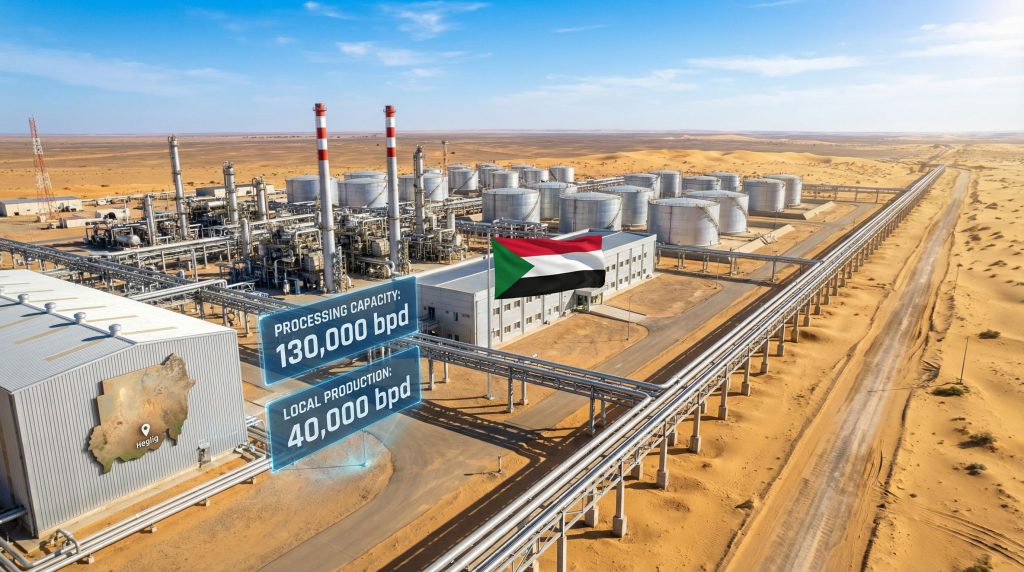
| Processing Capacity | 130,000 bpd (South Sudanese crude) |
| Local Production | 40,000 bpd |
| Well Count | ~75 active wells |
| Pipeline Connection | 1,600 km Greater Nile Oil Pipeline |
Geographic Positioning Within the Greater Nile Petroleum Corridor
Heglig's geographic location places it at approximately 6°N, 33°E, positioned 320 km south of Khartoum within disputed border territory. The field serves as a crucial link in the Greater Nile Petroleum Operating Company (GNPOC) corridor, which represents the primary export route for South Sudanese crude oil.
The facility integrates directly with the Greater Nile Oil Pipeline (GNOP), a 1,600 km system connecting to Port Sudan's export terminal on the Red Sea. This infrastructure represents the only viable large-scale export route for South Sudanese petroleum, creating critical dependencies between the two nations. Similarly, global production decisions continue to influence these dynamics, as reflected in OPEC production insights affecting regional supply chains.
Processing Capacity and Infrastructure Specifications
Heglig hosts sophisticated crude stabilization and processing facilities capable of handling both Sudanese and South Sudanese crude grades. The infrastructure can process up to 130,000 bpd of South Sudanese crude while generating approximately 40,000 bpd from local production across roughly 75 active wells.
Current operational status indicates partial functionality, with processing capacity significantly below theoretical maximum due to conflict-related maintenance constraints and security concerns affecting personnel rotation and equipment servicing.
Transit Fee Structures and Revenue-Sharing Mechanisms
Sudan generates estimated $2-3 per barrel in transit fees from South Sudanese crude passing through the Heglig oil field Sudan infrastructure. These transit arrangements represent a crucial revenue stream for Sudan while providing South Sudan with its primary export pathway.
The revenue-sharing framework operates under bilateral agreements that evolved from the original Comprehensive Peace Agreement, though specific terms remain largely confidential. South Sudan's dependence on this corridor means approximately 98% of its government revenue derives from oil exports transiting through Sudan.
How International Law Governs Cross-Border Oil Operations
International legal frameworks governing the Heglig oil field Sudan operations represent a complex hybrid system combining multiple jurisdictional authorities. The 2009 Permanent Court of Arbitration ruling established fundamental boundary determinations, though operational complexities persist.
2009 Permanent Court of Arbitration Ruling Implications
The July 22, 2009 PCA decision demarcated the Abyei territory boundary using the Bahr al-Arab River as the primary boundary line. This ruling determined that Heglig falls within Sudanese sovereign territory, though it did not eliminate all resource-sharing ambiguities between the two nations.
The arbitration outcome established legal frameworks but did not resolve operational complexity. International courts and subsequent bilateral negotiations clarified that while Heglig remains in Sudanese territory, South Sudan retains pipeline transit and processing access rights under various agreement frameworks.
Bilateral Agreements Between Sudan and South Sudan
Cooperation mechanisms for joint oil operations operate under frameworks established in the Comprehensive Peace Agreement and maintained through subsequent protocols. These arrangements allow joint management of frontier fields while establishing dispute resolution procedures.
Pipeline transit arrangements require South Sudan to pay transit fees to Sudan for processing and exporting crude through Heglig and the GNOP system. Fee structures typically range from 1-3% of crude value or involve fixed per-barrel rates, though exact terms remain confidential.
International Arbitration Mechanisms for Oil Disputes
The Sudan-South Sudan Joint Commission on Bilateral Issues provides the primary forum for resolving operational disputes, supplemented by international arbitration provisions when bilateral mechanisms prove insufficient.
The Permanent Court of Arbitration retains ongoing jurisdiction for boundary and resource allocation disputes, while the International Court of Justice remains available as a final appellate mechanism for unresolved bilateral commission disputes.
UNCLOS framework applications extend to transboundary water resources affecting pipeline routes through the Nile basin, creating additional layers of international legal oversight for petroleum operations.
Why Security Frameworks Matter for Energy Infrastructure
Security considerations for the Heglig oil field Sudan operations have become paramount since the April 2023 outbreak of armed conflict. Infrastructure control in conflict zones requires operators to navigate complex insurance frameworks, where perceived security directly impacts operational viability and international partnership agreements.
Insurance Requirements for International Oil Operations
International insurance frameworks for petroleum operations in conflict zones demand comprehensive security risk assessments determining whether infrastructure can be maintained and adequately staffed. Political risk insurance and war exclusion clauses have become standard requirements for Sudan operations.
Insurance evaluations focus on four critical factors:
- Territorial control by recognised government authorities
- Demonstrated capacity to protect infrastructure assets
- Documented absence of armed group presence in operational zones
- Established protocols for evacuation and force majeure implementation
Force Majeure Clauses in Petroleum Contracts
Production disruption statistics reveal the conflict's impact on operations. Sudanese oil production declined from approximately 90,000 bpd in 2022 to 60,000-80,000 bpd between 2024-2025 following the armed conflict outbreak.
Personnel impact measurements show international oil company staff evacuations resulted in approximately 80-90% reduction in foreign technical personnel at Sudanese oil facilities following the conflict's beginning.
Force majeure activation triggers in most petroleum contracts specify that sustained armed group presence within 50-100 km of operational facilities, or documented threats to pipeline access, automatically invoke force majeure suspension clauses.
Risk Assessment Protocols for Foreign Operators
The International Energy Agency framework employs a nine-point security assessment scale evaluating territorial control, personnel safety, infrastructure integrity, and dispute resolution mechanisms for operations in conflict-affected regions.
China National Petroleum Corporation corporate standards require quarterly security audits in conflict-affected regions. CNPC has classified Sudan as elevated-risk since the 2023 conflict outbreak, with public statements indicating interest in potential exit due to security concerns. However, Sudan's conflict has disrupted energy operations across multiple fields beyond Heglig.
Regional energy security increasingly depends on multilateral frameworks that can adapt to changing political realities while maintaining infrastructure integrity.
Infrastructure vulnerability assessments indicate that armed groups can affect operations through their ability to threaten access routes, pipelines, and personnel movements without necessarily occupying core facilities directly.
Which Regulatory Bodies Oversee Sudan's Oil Sector?
Sudan's petroleum sector oversight involves multiple institutional layers, though operational capacity has been severely constrained by ongoing conflict conditions. The regulatory framework continues to function despite significant operational challenges.
Ministry of Energy and Mining Jurisdiction
The Ministry of Energy and Mining, established in its current iteration following 2019 cabinet restructuring, maintains oversight responsibility for all petroleum exploration, production, refining, and export activities across Sudan.
Current operational status remains severely constrained by conflict conditions. Khartoum-based operations continue, but field oversight capabilities are minimal due to security concerns and personnel limitations in conflict-affected areas.
Greater Nile Petroleum Operating Company Structure
GNPOC shareholding structure as of 2023 consists of:
- Sudan National Petroleum Corporation: 40%
- China National Petroleum Corporation: 30%
- Petronas Malaysia: 30%
The company manages the Heglig processing facility, GNOP infrastructure, and field production across multiple concessions. GNPOC continues nominal operations under CNPC management despite ongoing security challenges and public statements about potential exit strategies. Furthermore, the RSF capture of Heglig has raised concerns about operational continuity and security.
Chinese National Petroleum Corporation's Regulatory Compliance
CNPC's entry into Sudan dates to 1996 with initial exploration agreements. The company currently serves as the largest foreign operator, holding interests in GNPOC, Sudan Petroleum Operating Company (SPOC), and Nile Blending Company.
Table: Regional Oil Export Dependencies
| Country | Export Route | Daily Capacity | Revenue Impact |
|---|---|---|---|
| South Sudan | Sudan Pipeline | 350,000 bpd potential | 98% of government revenue |
| Sudan | Port Sudan Terminal | Processing fees | $2-3 per barrel transit |
CNPC has publicly indicated interest in potential exit citing security concerns, though as of January 2026, the company remains registered and operational across production, refining, and pipeline assets according to Sudan's energy ministry claims.
How Transit Agreements Impact Regional Energy Policy
Transit agreements between Sudan and South Sudan create fundamental dependencies that shape regional energy policy across both nations. These arrangements extend far beyond simple commercial contracts to influence broader diplomatic and economic relationships.
South Sudan's Export Dependency on Sudanese Infrastructure
South Sudan faces critical infrastructure dependency with approximately 98% of government revenue deriving from oil exports transiting through Sudan. The Greater Nile Petroleum corridor has theoretical processing and export capacity of 350,000-400,000 bpd under normal operational conditions.
No single alternative export route currently exists for South Sudanese crude, creating absolute dependency on the Sudan corridor. This dependency shapes South Sudan's foreign policy choices and limits its negotiating position in bilateral disputes.
Revenue Allocation Formulas for Pipeline Usage
Pipeline transit arrangements require South Sudan to pay transit fees typically ranging 1-3% of crude value or fixed per-barrel rates to Sudan. These payments represent crucial revenue streams for Sudan while providing South Sudan's only viable large-scale export pathway.
The revenue-sharing framework operates under agreements that evolved from the Comprehensive Peace Agreement, though specific allocation formulas remain largely confidential. Sudan generates estimated $2-3 per barrel in transit fees from South Sudanese crude.
Alternative Export Route Development Challenges
Alternative export infrastructure development faces substantial technical and financial obstacles. Proposed pipeline routes through Ethiopia, Kenya, or other neighbouring countries would require:
- Multi-billion dollar infrastructure investments
- Complex international transit agreements
- Environmental and social impact assessments
- Long-term commercial viability studies
- Regional political stability guarantees
Current geopolitical conditions and South Sudan's limited financial resources make alternative route development extremely challenging in the near term.
The next major ASX story will hit our subscribers first
What Role Do International Sanctions Play?
International sanctions frameworks significantly influence petroleum operations in Sudan, though the regulatory landscape has evolved considerably since 2017. Current sanctions regimes create complex compliance requirements for international operators and financial institutions.
U.S. Sanctions Framework Evolution Since 2017
The United States lifted comprehensive economic sanctions against Sudan in October 2017, ending nearly two decades of broad-based restrictions. However, targeted sanctions remain in place focusing on specific individuals, entities, and activities related to human rights violations and terrorism concerns.
Current U.S. sanctions framework includes:
- Sectoral sanctions on specific government entities
- Asset freezes on designated individuals
- Transaction restrictions with listed entities
- Enhanced due diligence requirements for financial institutions
European Union Energy Sector Restrictions
European Union sanctions maintain more restrictive approaches compared to U.S. policy. EU frameworks include targeted measures affecting:
- Technology transfer restrictions for oil sector equipment
- Financial transaction limitations through EU banking systems
- Investment restrictions in certain petroleum sector activities
- Export controls on dual-use technologies
Impact on Foreign Investment and Technology Transfer
Sanctions frameworks create substantial barriers for international petroleum companies considering Sudan operations. Key constraints include:
Due diligence costs for compliance assessments and ongoing monitoring requirements that increase operational expenses significantly.
Financial sector limitations where major international banks avoid Sudan-related transactions due to compliance concerns and reputational risks.
Technology access restrictions limiting availability of advanced petroleum extraction and processing equipment from Western suppliers.
Insurance market limitations where international insurers impose elevated premiums or exclude coverage entirely for Sudan operations.
How Conflict Affects Energy Sector Governance
Armed conflict fundamentally alters energy sector governance structures, transforming peacetime regulatory frameworks into conflict-survival management systems. The ongoing civil war between SAF and RSF forces has created unprecedented challenges for petroleum sector oversight.
Emergency Protocols for Oil Infrastructure Protection
Emergency governance protocols have evolved to address conflict conditions affecting the Heglig oil field Sudan operations. These protocols prioritise:
- Personnel evacuation procedures for international staff
- Infrastructure protection measures for critical facilities
- Supply chain continuity for essential maintenance operations
- Communication systems with government authorities
- Force majeure activation procedures for contract obligations
International Humanitarian Law Applications
International humanitarian law frameworks establish protections for civilian infrastructure during armed conflict, though enforcement remains challenging. Key principles include:
Proportionality requirements prohibiting attacks on civilian infrastructure unless providing definite military advantage.
Distinction obligations requiring parties to differentiate between civilian and military targets.
Precautionary measures mandating efforts to minimise civilian harm during military operations.
Recovery facilitation promoting rapid restoration of essential services following conflict resolution.
Regional Mediation Mechanisms for Resource Disputes
Regional mediation efforts involve multiple actors working to address petroleum sector disputes:
- Egyptian mediation initiatives focusing on regional stability frameworks
- Saudi Arabian diplomatic efforts supporting conflict resolution mechanisms
- African Union energy cooperation protocols promoting regional integration
- IGAD (Intergovernmental Authority on Development) frameworks facilitating bilateral negotiations
- International Crisis Group monitoring providing independent conflict analysis
These mechanisms face substantial challenges due to competing regional interests and ongoing military operations affecting petroleum infrastructure.
Which International Standards Apply to Sudan's Oil Operations?
International standards governing Sudan's petroleum operations encompass environmental, transparency, and corporate governance frameworks. These standards influence operational practices despite implementation challenges in conflict conditions.
Environmental Compliance Requirements
Environmental standards applicable to Heglig oil field Sudan operations include:
- International Finance Corporation Performance Standards for environmental and social sustainability
- Equator Principles for project finance environmental risk management
- ISO 14001 Environmental Management Systems for operational environmental controls
- UNEP Guidelines for petroleum sector environmental protection
Implementation remains constrained by conflict conditions limiting monitoring capabilities and enforcement mechanisms.
Transparency Initiatives and Revenue Reporting
Extractive Industries Transparency Initiative (EITI) standards require disclosure of petroleum sector revenues and payments. Sudan's EITI compliance status remains suspended due to governance challenges and conflict-related reporting constraints.
Revenue transparency frameworks theoretically require disclosure of:
- Government petroleum revenues from production and transit fees
- Company payments to government entities and agencies
- Production data for transparency and verification purposes
- Beneficial ownership information for petroleum sector entities
Corporate Governance Standards for State Enterprises
State enterprise governance standards for entities like GNPOC include:
Board composition requirements ensuring appropriate technical expertise and oversight capabilities.
Financial reporting standards aligned with international accounting principles and transparency requirements.
Audit and oversight mechanisms providing independent verification of operational and financial performance.
Stakeholder engagement protocols facilitating communication with affected communities and international partners.
How Regional Powers Influence Energy Policy
Regional power dynamics significantly shape Sudan's petroleum sector policies, with multiple external actors pursuing competing interests through diplomatic, economic, and security channels.
Egyptian Mediation in Sudanese Energy Disputes
Egypt's regional influence stems from strategic interests in Nile River basin stability and concerns about refugee flows from Sudan. Egyptian mediation efforts focus on:
- Conflict resolution mechanisms between SAF and RSF forces
- Infrastructure protection initiatives for petroleum sector assets
- Regional stability frameworks preventing conflict spillover effects
- Economic cooperation agreements supporting post-conflict reconstruction
Egypt has increased pressure on eastern Libyan commander Khalifa Haftar to curb UAE-linked supply flows to RSF forces, demonstrating regional interconnections affecting Sudan's petroleum sector.
Saudi Arabia's Role in Regional Stability Frameworks
Saudi Arabian engagement reflects broader regional security concerns and competition with Iranian influence across the Red Sea region. Key initiatives include:
Diplomatic pressure on regional actors to limit external support for armed groups affecting petroleum infrastructure.
Financial assistance for humanitarian needs reducing civilian displacement pressures.
Security cooperation with legitimate government authorities for infrastructure protection.
Economic development commitments contingent on conflict resolution and governance improvements.
African Union Energy Cooperation Protocols
African Union frameworks promote regional energy integration while addressing conflict-related disruptions. Relevant protocols include:
- Continental Energy Framework promoting resource sharing and infrastructure development
- Peace and Security Council mechanisms addressing energy sector conflicts
- Regional Economic Community integration supporting cross-border petroleum trade
- Infrastructure development initiatives connecting regional energy markets
- Capacity building programmes for petroleum sector governance improvement
Regional energy security increasingly depends on multilateral frameworks that can adapt to changing political realities while maintaining infrastructure integrity.
What Future Policy Frameworks Could Emerge?
Future policy frameworks for Sudan's petroleum sector will likely depend on conflict resolution outcomes and international community engagement levels. Multiple scenarios remain possible depending on political developments.
Post-Conflict Reconstruction Governance Models
Reconstruction governance frameworks could involve:
Hybrid governance structures combining international oversight with domestic authority during transition periods.
Revenue management mechanisms ensuring transparent allocation of petroleum resources for reconstruction and development.
Capacity building initiatives rebuilding institutional capabilities for effective petroleum sector oversight.
Infrastructure rehabilitation programmes restoring damaged petroleum facilities and transportation systems.
International Trusteeship Options for Critical Infrastructure
International trusteeship models might include:
- UN trusteeship arrangements for critical petroleum infrastructure during transition periods
- Regional organisation oversight involving African Union or IGAD frameworks
- International financial institution management ensuring revenue transparency and proper utilisation
- Multi-stakeholder governance involving government, private sector, and civil society representation
Revenue-Sharing Mechanisms for Disputed Territories
Future revenue-sharing frameworks could establish:
Escrow account systems managing petroleum revenues from disputed areas until final political settlements.
Community benefit sharing ensuring local populations receive appropriate compensation for resource extraction.
Inter-governmental transfer mechanisms allocating revenues between federal and regional authorities.
Development fund establishments directing petroleum revenues toward infrastructure, education, and healthcare improvements.
Regulatory Resilience in Energy Infrastructure
The Heglig oil field Sudan case demonstrates both the vulnerabilities and potential resilience of energy infrastructure regulatory frameworks in conflict-affected environments. Lessons from Sudan's experience offer insights for international energy law development.
Lessons for International Energy Law Development
Key regulatory lessons include:
Flexibility requirements for governance frameworks operating in unstable political environments requiring adaptive management approaches.
Multi-jurisdictional coordination mechanisms ensuring continued operations despite political fragmentation and territorial disputes.
International oversight capabilities maintaining standards and preventing resource misappropriation during conflict periods.
Private sector engagement frameworks balancing commercial interests with humanitarian concerns and conflict sensitivity requirements.
Policy Recommendations for Conflict-Affected Regions
Recommended policy approaches for similar contexts include:
- Pre-positioned governance frameworks establishing clear procedures for conflict scenarios
- International guarantee mechanisms protecting critical infrastructure from military targeting
- Rapid response capabilities for infrastructure protection and personnel evacuation
- Revenue transparency systems preventing conflict financing through petroleum resources
- Regional cooperation agreements ensuring continued operations despite political instability
Framework Adaptations for Changing Geopolitical Realities
Adaptive governance mechanisms must address:
Dynamic security environments where territorial control and threat levels change rapidly requiring flexible operational protocols.
Multiple stakeholder management involving government forces, armed groups, international partners, and local communities with competing interests.
Economic viability maintenance despite elevated security costs and operational constraints affecting commercial sustainability.
International compliance requirements balancing sanctions frameworks, humanitarian law obligations, and commercial operational needs.
The experience of Heglig oil field Sudan operations demonstrates that energy infrastructure can maintain functionality even in challenging circumstances, provided appropriate governance frameworks, international support, and adaptive management approaches are implemented effectively. Future policy development must incorporate these lessons to enhance regulatory resilience for critical energy assets in unstable regions worldwide.
Are You Tracking the Next Major Commodity Discovery?
Sudan's complex energy governance challenges highlight the critical importance of staying ahead of market-moving discoveries and geopolitical shifts in resource sectors. Discovery Alert's proprietary Discovery IQ model monitors ASX announcements across 30+ commodities daily, transforming complex mining data into actionable investment insights that can help investors capitalise on significant discoveries before they become mainstream knowledge.