June 9, 2026
Gulf Capital Meets African Geology: Understanding the UAE's Resource Expansion
Sovereign wealth rarely moves without purpose. When Gulf states began redirecting capital toward African mining assets over the past decade, the financial logic was straightforward: hydrocarbon revenues are finite, transition-critical minerals are not, and Africa holds an estimated 30% of the world's mineral reserves within borders that remain chronically underfinanced. What makes the UAE African mining strategy distinct from ordinary foreign investment is the precision with which Abu Dhabi has identified gaps between what African governments need and what Western capital markets are willing to provide.
This is not a story about philanthropy or development aid. It is a story about structural positioning in a world where copper, cobalt, lithium, and graphite have graduated from industrial inputs to geopolitical instruments. Furthermore, understanding mining geopolitics 2025 helps contextualise how these deals fit into a broader global reshaping of resource access.
When big ASX news breaks, our subscribers know first
Why the UAE Lacks the Luxury of Waiting
The United Arab Emirates holds negligible domestic mineral reserves. That single fact shapes everything. As the global economy accelerates its pivot away from hydrocarbons, Abu Dhabi's sovereign investment apparatus faces a narrowing window to convert oil-generated wealth into upstream exposure to the metals that will power the next century.
According to analysis from the Arab Gulf States Institute, the UAE's approach mirrors parallel diversification strategies being executed by Saudi Arabia and Qatar, both of which are deploying state capital to reduce structural dependency on hydrocarbon revenues. The difference with the UAE is the specificity of its African focus and the sophistication of the commercial vehicles being used.
The African Union's African Green Minerals Strategy frames the continent's mineral wealth as a foundation for climate-resilient industrialisation. In principle, this creates a philosophical alignment with UAE clean-energy transition rationale. In practice, the alignment is primarily commercial: Africa offers scale, undercapitalised assets, and governments that are structurally motivated to accept deals that multilateral lenders and Western institutional investors frequently decline to fund.
The UAE is not entering African mining because it is the most obvious investor. It is entering because it recognised, earlier than most, that the combination of fiscal pressure, governance constraints, and abundant mineral endowment creates precisely the type of asymmetric opportunity that patient sovereign capital is designed to exploit.
A Portfolio Built on Distress, Scale, and Strategic Timing
The UAE African mining strategy has been constructed deal by deal, each transaction following a recognisable template: identify an asset of strategic significance, arrive when the host government faces acute fiscal or operational pressure, assume legacy liabilities that deter conventional investors, and secure long-term exposure to transition-critical supply chains.
The Mopani Copper Acquisition: Anatomy of the Emirati Playbook
The March 2024 acquisition of a 51% controlling stake in Mopani Copper Mines by International Resources Holding (IRH), a subsidiary of Abu Dhabi's International Holding Company (IHC), illustrates this model in its most complete form.
Mopani arrived as a deeply distressed asset. The Zambian copper operation carried approximately $1.5 billion in legacy debt owed to Glencore and had been accumulating operational losses. Zambia retained a 49% interest, preserving nominal national ownership while transferring day-to-day operational authority to IRH.
The timing was not coincidental. Zambia required more than $300 million over three years to double Mopani's copper output, capital it could not access domestically or through traditional multilateral channels. IRH absorbed the legacy debt and committed the required capital. In exchange, Abu Dhabi secured direct equity exposure to one of Africa's most strategically significant copper operations at a moment when the ongoing copper supply crunch was entering a structural upswing driven by electric vehicle manufacturing and grid infrastructure demands.
| Deal Feature | Detail |
|---|---|
| Acquirer | International Resources Holding (IRH), subsidiary of IHC |
| Stake acquired | 51% controlling interest |
| Zambian state retention | 49% |
| Legacy debt absorbed | ~$1.5 billion (previously owed to Glencore) |
| Capital commitment required | $300+ million over three years |
| Acquisition completion | March 2024 |
| Strategic rationale | Copper supply chain exposure for energy transition |
The DRC Gold and 3T Minerals Agreements: Formalisation With Opacity
The Democratic Republic of Congo represents the UAE's most complex African mining engagement, combining genuine formalisation achievements with significant governance concerns. Indeed, the Congolese cobalt rivalry adds another layer of geopolitical complexity to the UAE's positioning in this region.
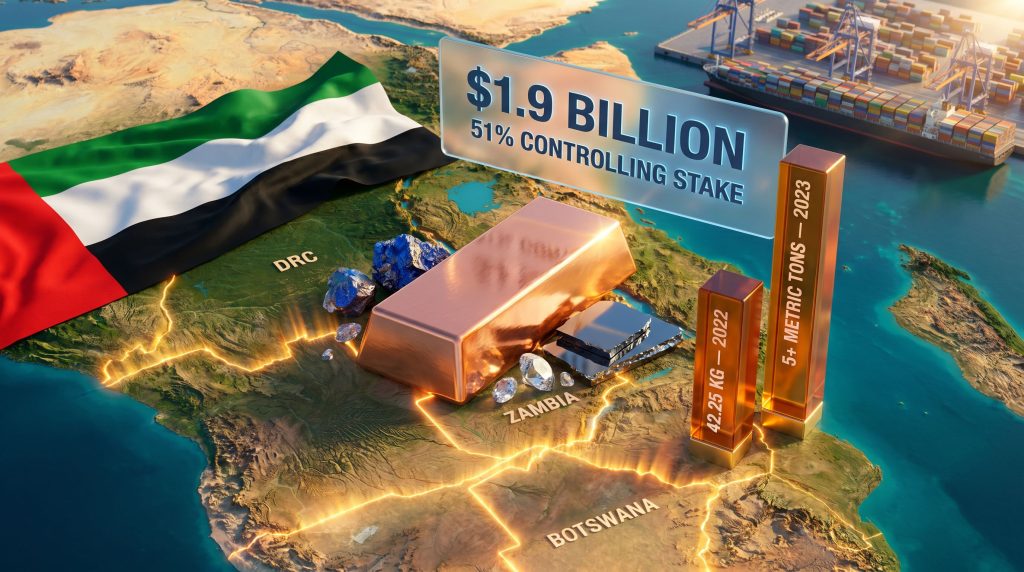
In December 2022, the DRC signed an agreement with Emirati company Primera to structure artisanal gold purchasing and export from South Kivu province. The results, measured purely by volume, were extraordinary: official artisanal gold exports climbed from 42.25 kilograms in 2022 to more than 5 metric tons in 2023, a growth rate exceeding 12,000% in a single year.
This figure requires careful interpretation. The dramatic increase did not reflect new gold deposits being discovered or miners suddenly becoming more productive. It reflected the formalisation of production that had previously exited the country through informal channels, often entirely unrecorded. The UAE, through Primera Gold, essentially converted invisible supply into visible supply, capturing flows that had been feeding smuggling networks.
A separate and larger agreement followed in 2023. Congolese state-owned enterprise Sakima signed a $1.9 billion contract with an Emirati counterpart covering four critical mineral mines producing tin, tantalum, and tungsten, the minerals collectively designated as the 3T group. The full terms of this agreement have not been made publicly available, which has drawn scrutiny from international transparency organisations focused on extractive sector governance.
Botswana's Diamond Dilemma and the UAE's Vertical Integration Opportunity
Why Botswana Cannot Afford to Wait for the Perfect Partner
Few economies on earth are as dependent on a single commodity as Botswana is on diamonds. The mineral accounts for approximately 80% of total export earnings and contributes nearly 25% of gross domestic product. De Beers sources roughly 70% of its global diamond production from Botswana, making the country's fiscal health and De Beers' commercial performance functionally inseparable.
The structural vulnerability of this dependency has been exposed in recent years by three simultaneous pressures:
- Falling rough diamond prices driven by oversupply and demand softness
- Weakening consumer demand from Chinese buyers, historically a primary growth market for diamond jewellery
- Accelerating competition from lab-grown synthetic diamonds, which have eroded the premium positioning of natural stones in mid-market segments
These combined forces contributed to a sovereign credit-rating downgrade by S&P Global in 2025, directly limiting Botswana's capacity to finance an expanded ownership stake in De Beers through conventional debt markets.
Botswana's President Duma Boko has been explicit in his pursuit of strategic financing partners. Discussions extended to Oman, Angola, and Namibia before the UAE and Oman emerged as the most credible candidates. Botswana currently holds a 15% equity stake in De Beers, and Anglo American's decision to divest its 85% holding creates a potentially generational window for the government to increase its ownership position, provided the financing architecture can be assembled.
The Dubai Diamond Connection: More Than a Coincidence
The UAE's potential involvement in Botswana's De Beers transaction is not simply a mining investment. It is a vertical integration play. Dubai is the world's leading diamond-trading hub, and Botswana's rough diamond production is integral to the supply pipeline that sustains that ecosystem.
For Abu Dhabi, financing Botswana's expanded De Beers stake would simultaneously secure upstream supply access and reinforce Dubai's downstream trading dominance. This is a rare convergence of sovereign wealth objectives: a single investment that strengthens both resource security and commercial infrastructure positioning.
The strategic logic connecting Botswana's diamond fields to Dubai's trading floors is one of the most underappreciated dimensions of the UAE African mining strategy. It transforms what appears to be a mining finance transaction into a supply chain integration exercise spanning the full value chain from geological extraction to retail market access.
The Logistics Dimension: How Ports Amplify Mining Investments
Controlling mineral assets is valuable. Controlling how those minerals move to market is potentially more valuable. The UAE has operationalised this principle through systematic investment in African port and transport infrastructure.
The European Council on Foreign Relations has documented UAE expansion across African logistics networks through entities including DP World and Abu Dhabi Ports. DP World operates terminals in Djibouti, Somaliland, Mozambique, Senegal, and Egypt, among other locations, creating an integrated export corridor that complements upstream mining investments.
This logistics layer transforms the UAE's position from that of a passive equity holder in mining assets to an active participant in supply chain architecture. A country that controls both the mine and the port through which ore is exported has structural pricing and routing leverage that pure mining investors do not possess. Consequently, the African mining finance trends increasingly reflect this infrastructure-bundled investment model.
Competing Powers: UAE vs. China vs. Saudi Arabia in African Mining
The UAE African mining strategy does not operate in a vacuum. It unfolds within an intensifying competition for African mineral access involving China, Saudi Arabia, and Western institutional capital. In addition, the surge in critical minerals demand is accelerating the pace at which all major players are staking their positions.
| Dimension | UAE | Saudi Arabia | China |
|---|---|---|---|
| Primary vehicle | State-linked commercial firms (IHC, IRH, DP World) | PIF-backed sovereign vehicles | State-owned enterprises and policy banks |
| Mineral focus | Copper, cobalt, gold, diamonds, 3T minerals | Phosphates, gold, base metals | Copper, cobalt, lithium, manganese |
| Infrastructure bundling | High (port and logistics integration) | Moderate | Very high (roads, railways, ports tied to concessions) |
| Transparency profile | Mixed, several deals undisclosed | Mixed | Frequently opaque |
| Geographic concentration | DRC, Zambia, Botswana, East Africa | East Africa, North Africa | Sub-Saharan Africa broadly |
Unlike Chinese state-backed investment, which has historically bundled large infrastructure packages with resource concession agreements, UAE capital tends to operate through commercially structured equity vehicles. This distinction can reduce debt-trap optics for African host governments, though it also typically means fewer associated infrastructure co-benefits for local communities.
The next major ASX story will hit our subscribers first
The Illicit Gold Contradiction: A Structural Problem Beneath the Formal Agreements
The most uncomfortable dimension of the UAE African mining strategy is the structural contradiction embedded within it. The same ecosystem that enables formalisation of mineral flows also sustains one of the world's largest illicit gold pipelines.
A 2024 study published by Swiss NGO SWISSAID estimated that up to 435 metric tons of African gold exited the continent through illicit channels in 2022 alone, with the UAE identified as the primary transit destination. Over the preceding decade, the UAE reportedly absorbed more than 2,500 metric tons of smuggled African gold, representing cumulative value exceeding $115 billion.
For African governments, these flows represent a direct fiscal haemorrhage. The lost royalties, export duties, and corporate taxes associated with those volumes could fund hospitals, schools, and infrastructure across multiple countries.
The contradiction is acute and must be named directly: the same country formalising artisanal gold exports in the DRC through structured commercial agreements is simultaneously the world's leading destination for informally traded African gold. Formalisation programmes that do not include enforceable traceability mechanisms risk legitimising supply chains without genuinely transforming the incentive structures that sustain illicit flows.
Governance Risks and What African Governments Should Be Demanding
The Natural Resource Governance Institute published analysis in September 2024 identifying a recurring pattern in Gulf sovereign wealth fund-backed mining investments: layered corporate structures that can obscure beneficial ownership, combined with contract terms that are not publicly disclosed. Furthermore, according to the Resource Governance Institute, producing countries need considerably stronger negotiating capacity to avoid systematic undervaluation of their mineral wealth.
The undisclosed terms of the $1.9 billion Sakima agreement in the DRC represent a concrete, documented example of this transparency deficit. African governments entering mineral partnerships with UAE-linked entities should be securing, as minimum conditions:
- Mandatory public disclosure of full contract terms, beneficial ownership structures, and revenue-sharing arrangements
- Enforceable mineral traceability commitments with independent verification, particularly for gold and 3T minerals
- Local beneficiation requirements that compel in-country processing rather than raw ore export
- Workforce development and skills transfer provisions embedded directly in concession agreements
- Independent third-party production auditing covering volumes, export values, and royalty calculations
- Sunset clauses and renegotiation provisions tied to commodity price movements to prevent value erosion over multi-decade contract periods
Key Statistics: The UAE's African Mining Footprint at a Glance
| Metric | Figure | Context |
|---|---|---|
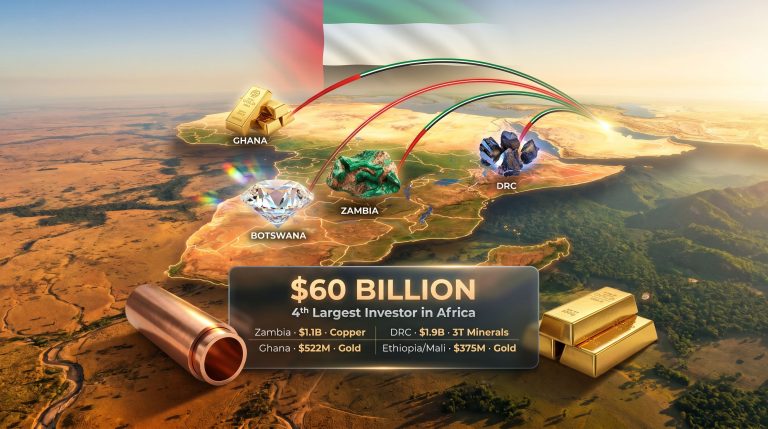
| UAE rank as African investor | 4th largest | Behind China, EU, and United States |
| Mopani Copper Mines stake acquired | 51% | IRH/IHC acquisition, March 2024 |
| Mopani legacy debt absorbed | ~$1.5 billion | Previously owed to Glencore |
| DRC artisanal gold export growth | 12,000%+ | 42.25 kg (2022) to 5+ metric tons (2023) |
| Sakima 3T minerals agreement value | $1.9 billion | Terms not publicly disclosed |
| Illicit African gold via UAE (decade to 2022) | 2,500+ metric tons | Valued at $115+ billion (SWISSAID, 2024) |
| Illicit African gold leaving continent annually (2022) | ~435 metric tons | Majority transiting through UAE |
| Botswana diamond share of total exports | ~80% | National economic dependency indicator |
| De Beers production sourced from Botswana | ~70% | Anglo American's 85% stake under divestment |
| Botswana's current De Beers ownership | 15% | Government seeking to increase via UAE financing |
Opportunity or Extraction? The Central Policy Question for African Governments
The binary framing of UAE investment as either developmental partnership or extractive exploitation misses the more important question: under what institutional conditions does incoming capital generate durable economic transformation rather than temporary liquidity relief?
Gulf capital provides real value in specific circumstances. It delivers immediate financing when multilateral lending is unavailable or conditioned on policy constraints that governments are unwilling to accept. It has demonstrably formalised previously invisible mineral flows, as the DRC artisanal gold data confirms. And UAE infrastructure investment through DP World and Abu Dhabi Ports creates genuine logistical value for both landlocked and coastal mineral exporters.
The structural risks are equally real. Opacity in deal terms limits accountability and creates conditions for systematic undervaluation of national assets over multi-decade concession periods. Without enforceable local processing requirements, even well-structured mining partnerships risk reinforcing the raw-material export dependency that has historically constrained African industrialisation. And the illicit gold contradiction represents a governance failure that formalisation agreements alone cannot resolve.
The central insight for policymakers is this: the question is not whether to engage with UAE capital. The fiscal need is genuine, and the strategic interest is mutual. The question is whether the institutional architecture surrounding each specific deal is robust enough to ensure that resource extraction translates into lasting economic development rather than a temporary liquidity event followed by long-term supply chain dependency.
Readers seeking ongoing coverage of African mining investment, governance, and economic policy developments can find related reporting and analysis through Ecofin Agency, which provides daily sector-focused coverage across the continent.
This article contains forward-looking analysis and references to ongoing negotiations. Outcomes related to Botswana's De Beers financing discussions, UAE investment commitments, and broader mineral partnership terms remain subject to change. Nothing in this article constitutes financial or investment advice.
Want to Capitalise on the Next Major Mineral Discovery Before the Broader Market?
Discovery Alert's proprietary Discovery IQ model delivers real-time alerts on significant ASX mineral discoveries, transforming complex geological and commodity data into actionable investment insights for both short-term traders and long-term investors. Explore how historic discoveries have generated substantial returns by visiting Discovery Alert's dedicated discoveries page, and begin your 14-day free trial today to position yourself ahead of the market.