June 9, 2026
The Gulf's Hard Asset Pivot: Why UAE Mining Investments in Africa Are Reshaping Global Resource Power
Sovereign wealth has always chased scarcity. For most of the twentieth century, that scarcity was oil, and the Gulf states sat atop it. Today, a different scarcity is driving capital allocation decisions across the Arab world: the metals and minerals that make batteries charge, turbines spin, and electric motors run. Africa holds a disproportionate share of those reserves, and the UAE has moved with speed and scale to position itself at the centre of that supply chain.
Understanding the full scope of UAE mining investments in Africa requires looking beyond individual transactions and examining the integrated architecture of extraction, trading, and logistics that Abu Dhabi has been quietly constructing across the continent.
When big ASX news breaks, our subscribers know first
Why Gulf Capital Is Flowing Into African Mineral Assets
The UAE's domestic geology is not its friend. With negligible in-country mineral reserves of strategic importance, Abu Dhabi cannot rely on home-ground resources to participate in the energy transition minerals supply chain. This structural deficit has consequently become a powerful driver of overseas acquisition activity.
According to the Arab Gulf States Institute, this dynamic is not unique to the UAE. Saudi Arabia and Qatar are pursuing comparable strategies, using sovereign capital to build exposure to hard commodities as a hedge against the long-term erosion of hydrocarbon revenues. What distinguishes the UAE, however, is the sophistication and integration of its approach.
Rather than simply buying mining stakes, Abu Dhabi has constructed a vertically integrated model that connects upstream extraction to commodity trading infrastructure and export logistics. Dubai already functions as the world's largest diamond-trading hub and a major node in global gold flows. The port networks operated by DP World and Abu Dhabi Ports span dozens of African coastal and inland corridors, providing the physical infrastructure to move extracted commodities to market efficiently.
The minerals in focus are not random selections. Copper, cobalt, lithium, graphite, and the 3T group (tin, tantalum, and tungsten) are all classified as critical inputs for battery manufacturing and grid-scale renewable energy infrastructure. The critical minerals demand surge means African deposits represent a globally significant share of reserves across several of these categories, making the continent structurally indispensable to any credible energy transition supply chain.
The Scale of UAE Mining Investments in Africa: A Country-by-Country View
Zambia: Copper and the Mopani Acquisition
The Mopani Copper Mines transaction stands as one of the most strategically significant UAE mining investments in Africa to date. In November 2023, Zambian authorities selected International Resources Holding (IRH), a company linked to the UAE's International Holding Company, to acquire assets at Mopani, one of Africa's most consequential copper operations.
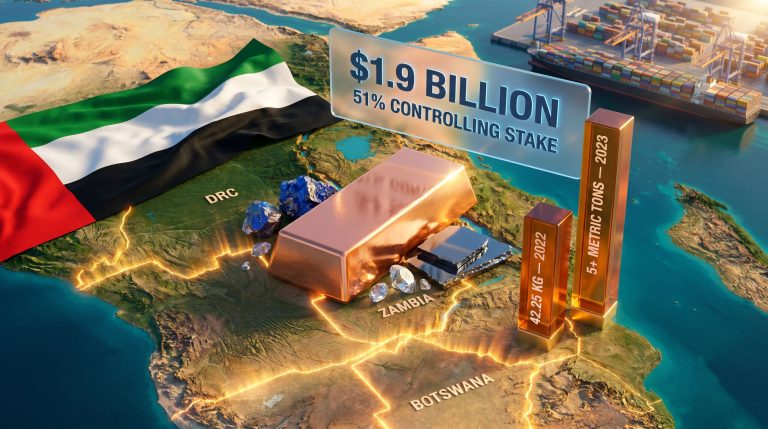
The deal closed in March 2024 with IRH securing a 51% controlling stake for approximately $1.1 billion, while the Zambian state retained a 49% ownership position. The transaction arrived at a critical juncture: Mopani carried roughly $1.5 billion in legacy debt to Glencore and had been accumulating operational losses. IRH committed more than $300 million over three years to double production capacity, and output increases were being reported through 2025.
The Mopani deal illustrates a recurring pattern in UAE Africa strategy: entering at moments of genuine fiscal stress, when asset owners are motivated sellers and negotiating leverage tilts toward the incoming capital provider. For Zambia, the arrangement provided necessary liquidity to revive a strategically important asset. The co-ownership structure, with the state retaining a near-majority stake, offered a template that other African governments have since studied closely. Furthermore, African mining finance trends suggest this model is becoming increasingly common across the continent.
DRC: Gold Formalisation and the 3T Minerals Contract
The Democratic Republic of Congo has become one of the most active arenas for UAE mining investments in Africa. In December 2022, Kinshasa signed an agreement with Emirati company Primera, establishing Primera Gold to purchase and export artisanal gold from South Kivu province.
The results were numerically striking. Official artisanal gold exports climbed from just 42.25 kilograms in 2022 to more than 5 metric tons in 2023, an increase exceeding 12,000% in a single year. The programme was explicitly designed to capture production that had previously been lost to cross-border smuggling networks.
A separate and considerably larger transaction followed in 2023: a $1.9 billion contract between Congolese state-owned company Sakima and an Emirati partner to develop four critical mineral mines covering tin, tantalum, and tungsten. The full terms of this contract have not been publicly disclosed, a fact that has drawn scrutiny from governance analysts and civil society organisations. According to reporting by the New York Times, the scale and opacity of such arrangements are attracting increasing international attention.
Botswana: Diamonds and the De Beers Succession Question
Botswana's current situation encapsulates both the opportunity and the vulnerability that define African engagement with UAE capital. Diamonds account for approximately 80% of Botswana's total exports and nearly one-quarter of national GDP. De Beers, which sources roughly 70% of its global production from Botswana, is now subject to a major ownership transition as Anglo American prepares to divest its 85% holding.
Botswana holds a 15% stake in De Beers and has expressed intent to expand that position significantly. President Duma Boko opened negotiations with the UAE as a potential financing partner, alongside Oman, Angola, and Namibia. According to Bloomberg's reporting on those discussions, the UAE and Oman emerged as the most strategically significant potential partners.
The pressure behind Botswana's search for external capital is real. Falling diamond prices, weakening Chinese consumer demand, and growing competition from laboratory-grown synthetic stones have strained the country's fiscal position, contributing to a sovereign credit-rating downgrade by S&P Global. This is precisely the type of financially pressured environment in which UAE sovereign capital has historically shown willingness to engage.
Ethiopia, Mali, and Ghana: Expanding the Gold Footprint
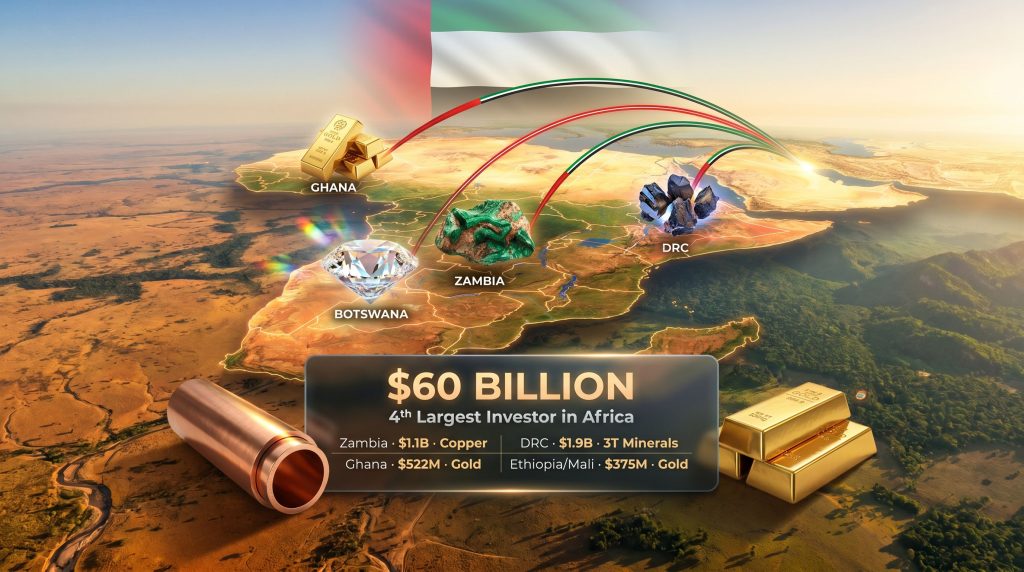
In 2025, Ambrosia Investment Holding, a UAE-linked entity, acquired a 50% stake in Allied Gold's operations across Ethiopia and Mali, accompanied by a commitment of $375 million in working capital. This transaction extended UAE mining exposure into both West and East African gold belts simultaneously, signalling an intentional geographic diversification beyond the southern and central African operations that had defined earlier deal activity.
In Ghana, Emiral Mining expanded its West African presence through a stake in Asante Gold, supporting a $522 million expansion of the Bibiani and Chirano gold mines. Ghana's established regulatory framework and long track record as a gold-producing jurisdiction made it a lower-risk entry point for capital seeking scale in West Africa.
UAE Mining Deal Summary: Key African Transactions
| Country | Asset / Operation | UAE Entity | Deal Value | Mineral | Year |
|---|---|---|---|---|---|
| Zambia | Mopani Copper Mines (51%) | International Resources Holding | ~$1.1 billion | Copper | 2023-2024 |
| DRC | Sakima 3T Mineral Mines | Emirati partner (undisclosed) | $1.9 billion | Tin, Tantalum, Tungsten | 2023 |
| DRC | Primera Gold (artisanal gold) | Primera | Undisclosed | Gold | 2022 |
| Ethiopia / Mali | Allied Gold operations (50%) | Ambrosia Investment Holding | $375M working capital | Gold | 2025 |
| Ghana | Asante Gold (Bibiani & Chirano) | Emiral Mining | $522 million expansion | Gold | 2024-2025 |
| Botswana | De Beers stake expansion | UAE sovereign partner (TBC) | TBC | Diamonds | 2025-2026 |
| Angola | Iron ore JVs + Luanda port | UAE-linked entities | Undisclosed | Iron Ore | Ongoing |
The Illicit Gold Problem: A Structural Tension at the Heart of UAE-Africa Relations
Any honest analysis of UAE mining investments in Africa must contend with a deeply uncomfortable parallel reality. Swiss NGO SWISSAID published findings in 2024 estimating that up to 435 metric tons of African gold departed the continent through illicit channels in 2022 alone, with the majority of that volume transiting through the UAE.
Over the preceding decade, the UAE reportedly absorbed more than 2,500 metric tons of smuggled African gold with an estimated value exceeding $115 billion, according to SWISSAID's research.
These flows represent an enormous and ongoing drain on African government tax revenues, dwarfing many of the formal investment commitments being celebrated as development partnerships. Dubai's structural role as a major hub for informal gold trading creates a fundamental tension with the UAE's simultaneous positioning as a responsible mining investment partner. The Guardian has, for instance, highlighted concerns around the broader implications of the UAE's growing role across the continent.
The DRC's Primera Gold initiative was designed in part to address this problem by formalising artisanal gold flows. However, governance analysts have pointed out that formalisation programmes and parallel illicit channels are not mutually exclusive. Without robust, independently verified traceability mechanisms, formalisation can increase the legitimacy of some flows while leaving smuggling infrastructure intact.
This dual dynamic is not simply an ethical concern. It has direct implications for how African governments should structure any partnership with UAE-linked entities in the gold sector, and it is attracting increasing scrutiny from international anti-money laundering bodies that monitor Dubai's commodity trading ecosystem.
Governance Risks and Transparency Deficits
Beyond the gold smuggling question, several specific governance concerns attach to UAE mining investments in Africa:
- The $1.9 billion Sakima contract covering DRC's 3T minerals has not been publicly disclosed in full, preventing independent assessment of whether terms reflect fair market value for national assets.
- In a September 2024 analysis, the Natural Resource Governance Institute identified opacity and structural complexity as recurring features of Gulf sovereign wealth fund-backed mining transactions, noting that African governments need sophisticated negotiating capacity to protect national interests.
- Sovereign wealth fund structures and multi-layered holding company arrangements can obscure ultimate beneficial ownership, complicating accountability for both host governments and civil society monitoring organisations.
- UAE capital frequently enters at moments of acute fiscal stress, as demonstrated by Mopani's debt burden, Botswana's credit downgrade, and Zambia's production shortfall. Financial urgency can consequently compress negotiating timelines and reduce the leverage available to host government teams.
A less commonly discussed dynamic involves the mineral grade and asset quality dimension of these deals. When distressed assets change hands under time pressure, the acquiring party typically benefits from access to geological data and resource estimates that the vendor may not have had the capacity to independently verify or market competitively. In the context of copper assets like Mopani, where ore grades decline with depth and capital-intensive shaft deepening is required to access higher-grade zones, the long-term value embedded in the asset may substantially exceed what near-term production metrics suggest.
The next major ASX story will hit our subscribers first
How African Governments Can Strengthen Their Negotiating Position
The central question facing African policymakers is not whether to accept UAE investment. Gulf capital provides genuine liquidity at moments when Western institutional investors and multilateral development lenders may be unavailable, too slow, or attached to conditionality frameworks that are politically difficult to navigate. The strategic question is under what governance architecture that capital operates.
Several practical approaches can shift the balance of outcomes in Africa's favour:
- Mandate full public disclosure of contract terms, beneficial ownership structures, and revenue-sharing arrangements before deal closure, rather than after.
- Use competing interest as leverage by engaging multiple potential partners simultaneously to generate competitive tension and extract binding downstream commitments, particularly around local mineral processing and value-addition requirements.
- Require independently verified gold traceability as a non-negotiable structural condition of any Emirati-backed artisanal gold formalisation programme.
- Adopt co-ownership models with defined production targets and joint oversight mechanisms, using Zambia's Mopani structure as a baseline template rather than an exceptional case.
- Benchmark deal terms systematically against comparable transactions across jurisdictions, building shared negotiating frameworks through regional bodies such as the African Union and the African Minerals Development Centre.
Comparing Gulf State Approaches to African Mining
| Dimension | UAE | Saudi Arabia | Qatar |
|---|---|---|---|
| Primary vehicle | Sovereign wealth funds + state holding companies | PIF-led direct investment | QIA-led financial stakes |
| Mineral focus | Copper, gold, diamonds, 3T minerals | Lithium, rare earths, gold | Diversified commodities |
| Logistics integration | High (DP World, AD Ports) | Moderate | Lower |
| Transparency record | Mixed (several undisclosed contracts) | Improving | Limited public data |
| African FDI stock | $60+ billion (leading GCC) | Growing rapidly | Smaller, targeted |
The UAE's competitive advantage within this Gulf peer group lies not in capital scale alone, but in logistics depth. The broader geopolitical mining landscape reveals how DP World and Abu Dhabi Ports investments across African port and transport corridors give the UAE structural influence over commodity flows that extends well beyond what ownership stakes in individual mines would suggest. Control of the export pathway is, in many respects, as strategically valuable as control of the pit.
Emerging Trends to Watch in UAE-Africa Mining Relations
Several developments will likely define how UAE mining investments in Africa evolve over the coming years:
- The Botswana-De Beers transaction could set a precedent for Gulf-financed African state buyouts of legacy Western mining stakes, a model that other mineral-rich governments are watching closely.
- Growing pressure from African civil society and international NGOs is likely to result in new disclosure requirements for foreign-backed mining contracts, particularly in the DRC and other high-scrutiny jurisdictions.
- Expanding UAE port and logistics infrastructure into East and West African mineral corridors will intensify as battery metal export volumes accelerate, particularly for copper and cobalt moving toward Asian processing hubs.
- The Allied Gold transactions in Ethiopia and Mali signal an intentional push into the Sahel and Horn of Africa regions, extending the geographic footprint of UAE mining interests into territories where Western institutional capital has been reluctant to operate.
- International scrutiny of Dubai's gold trading ecosystem from anti-money laundering enforcement bodies could reshape the narrative around UAE formalisation programmes in African gold markets, forcing greater transparency commitments as a condition of maintaining trade relationships.
The fundamental dynamic underlying all of these trends is a multipolar competition for African mineral supply chains that is accelerating rather than stabilising. Furthermore, the role of mining private equity alongside sovereign wealth funds is adding yet another layer of complexity to how these deals are structured and financed. China built its position over two decades of patient infrastructure financing. Western investors are now attempting to re-engage after years of hesitation. Gulf states, led by the UAE, are moving with the speed and flexibility that sovereign capital enables.
For African governments, this competitive environment represents genuine leverage, provided they develop the institutional capacity to use it. The minerals beneath their soil are not renewable. The window to negotiate the terms on which those minerals enter the global economy will not remain open indefinitely.
This article is intended for informational purposes only and does not constitute financial or investment advice. All figures, transaction details, and institutional assessments referenced are drawn from publicly available sources and should be independently verified before being relied upon for any investment or policy decision.
Want To Track The Next Major Mineral Discovery Before The Market Moves?
Discovery Alert's proprietary Discovery IQ model delivers real-time alerts on significant ASX mineral discoveries — instantly translating complex resource data into actionable investment insights for both short-term traders and long-term investors. Explore historic discoveries and the returns they generated, then begin your 14-day free trial at Discovery Alert to position yourself ahead of the market.