May 22, 2026
Understanding the Fundamentals of Underground Excavation Integrity
Underground mining operations face complex engineering challenges that extend far beyond simple excavation. The intricate relationship between geological conditions, structural mechanics, and operational safety creates a multifaceted environment where stope stability in mining becomes paramount to successful resource extraction. Modern mining engineering recognises that excavation integrity depends on sophisticated interactions between rock mass behaviour, stress redistribution patterns, and geometric design principles.
The foundation of stable underground excavations rests on comprehensive understanding of how rock masses respond to stress changes during mining activities. When natural equilibrium conditions are disturbed through excavation, the surrounding rock mass must accommodate new stress distributions whilst maintaining structural integrity. This fundamental principle drives every aspect of underground mine design, from initial planning phases through operational execution.
Advanced engineering approaches now integrate multiple assessment frameworks to predict and manage excavation behaviour. These methodologies combine empirical observations with numerical modelling capabilities, creating robust analysis tools that account for site-specific geological conditions and operational requirements. Furthermore, modern mining innovation trends continue to shape how engineers approach stability challenges in underground excavations.
When big ASX news breaks, our subscribers know first
How Does Excavation Geometry Influence Underground Stability?
Stress Distribution Patterns in Different Excavation Shapes
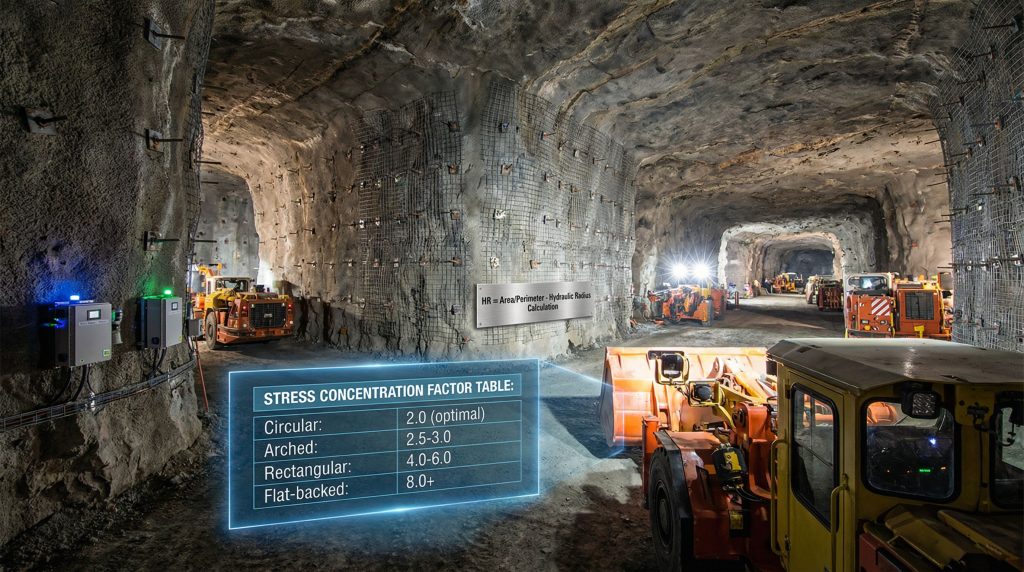
The geometric configuration of underground excavations fundamentally controls stress concentration patterns within surrounding rock masses. Research in mining geomechanics has established clear relationships between excavation profiles and their corresponding stress concentration factors, directly influencing stope stability in mining operations.
| Excavation Profile | Stress Concentration Factor | Stability Rating | Practical Application |
|---|---|---|---|
| Circular | 2.0 (optimal) | Excellent | Vertical shafts, some drives |
| Arched | 2.5-3.0 | Very Good | Development headings, access tunnels |
| Rectangular | 4.0-6.0 | Moderate | Standard mining stopes |
| Flat-backed | 8.0+ | Poor | Avoided where possible |
Engineering analysis demonstrates that circular excavations provide the most efficient stress redistribution, making them inherently stable under most geological conditions. However, practical mining constraints often prevent implementation of fully circular profiles in production areas. As documented in geotechnical design literature, arched configurations represent an effective compromise between stress management and constructability requirements.
The progression from circular to rectangular geometries shows exponential increases in stress concentration factors. This relationship explains why traditional flat-backed excavations frequently experience stability problems, particularly in stressed ground conditions or weak rock masses.
Wall Orientation and Gravitational Loading Effects
The orientation of excavation walls relative to gravitational forces creates predictable stability patterns that influence design decisions across all underground mining operations. Vertical surfaces experience minimal gravitational loading perpendicular to their face, whilst horizontal surfaces bear maximum gravitational stress.
Key Angular Relationships:
• 90° (vertical): Maximum stability under gravitational loading
• 60-80°: Reduced stability but often acceptable with support
• 30-45°: Significant gravitational stress concentration
• 0-15° (near-horizontal): Maximum instability without support
Field observations consistently demonstrate that excavation performance improves as wall angles approach vertical orientations. This principle applies particularly to footwall excavations, which often exhibit superior stability characteristics due to their favourable orientation relative to gravitational forces.
The relationship between wall angle and stability becomes especially critical in large-scale stoping operations where gravitational forces can induce significant stress concentrations along low-angle surfaces. Engineering design must balance ore recovery objectives with stability requirements, often leading to compromises in excavation geometry.
What Engineering Methods Quantify Stope Stability Performance?
Hydraulic Radius Calculations and Applications
The hydraulic radius methodology provides a fundamental geometric assessment tool for stope stability in mining applications. Calculated as the ratio of excavation cross-sectional area to perimeter, hydraulic radius offers a simplified approach to comparative stability assessment across different excavation geometries.
However, contemporary engineering practice recognises limitations in purely hydraulic radius-based approaches. Modern stability assessment focuses on optimising individual dimensional parameters rather than simply minimising hydraulic radius values. This approach acknowledges that excavation performance depends on complex interactions between multiple geometric factors.
Advanced Geometric Optimisation Considerations:
• Height-to-width ratios for stress redistribution
• Strike length optimisation for regional stability
• Span limitations based on rock mass characteristics
• Sequential extraction planning for load management
Research indicates that stope performance tends to improve with increased height and strike length dimensions, reflecting more stable stress redistribution patterns at larger scales. This observation challenges traditional approaches that emphasised hydraulic radius minimisation without considering dimensional optimisation opportunities.
Multi-Parameter Assessment Frameworks
Contemporary stope stability in mining assessment integrates multiple analytical approaches that extend beyond geometric considerations. These frameworks combine empirical classification systems with advanced numerical modelling capabilities to provide comprehensive stability predictions. In addition, modern approaches incorporate 3D geological modelling to enhance spatial understanding of rock mass characteristics.
Empirical Classification Systems:
• Rock mass quality indices incorporating discontinuity characteristics
• Stress-adjusted stability charts for site-specific conditions
• Time-dependent stability projections accounting for excavation ageing
• Site-specific correlation databases linking design parameters to performance outcomes
Numerical Modelling Capabilities:
• Three-dimensional stress analysis incorporating complex geological structures
• Sequential excavation simulation predicting progressive stability changes
• Discrete fracture network modelling for structurally-controlled failures
• Time-dependent deformation prediction accounting for rock mass deterioration
These integrated approaches enable engineers to account for site-specific geological conditions whilst maintaining standardised assessment methodologies. The combination of empirical and numerical techniques provides validation mechanisms that improve prediction reliability.
How Do Rock Mass Properties Control Excavation Behaviour?
Structural Geology Impact Assessment
Rock mass discontinuities exert dominant control over excavation stability through their influence on stress distribution and failure mechanisms. Understanding these relationships forms the foundation of effective stope stability in mining design.
| Rock Mass Parameter | Stability Influence | Measurement Method | Design Implication |
|---|---|---|---|
| Joint Frequency | High | Scanline surveys | Span limitations |
| Joint Orientation | Critical | Stereonet analysis | Wall angle selection |
| Joint Condition | Moderate | Surface roughness testing | Support requirements |
| Intact Rock Strength | Variable | Laboratory testing | Overall feasibility |
Joint frequency measurements directly correlate with maximum stable spans in unsupported excavations. High joint frequencies reduce effective rock mass strength and increase susceptibility to gravity-driven failures. Systematic mapping programmes provide essential data for establishing span limitations and support requirements.
Joint orientation relationships determine potential failure modes and influence excavation geometry selection. Kinematic analysis using stereonet techniques identifies critical orientations that could lead to wedge failures, planar sliding, or toppling mechanisms. This analysis directly influences wall angle selection and support system design.
Surface condition assessments of discontinuities provide insight into available shear strength along potential failure surfaces. Rough, tight discontinuities offer significantly higher resistance to sliding compared to smooth, altered surfaces. These characteristics directly influence support system selection and installation density requirements.
Weathering and Alteration Effects
Weathered rock masses exhibit significantly different mechanical behaviour compared to fresh rock conditions. These changes have profound implications for stope stability operations, particularly in near-surface environments or areas with extensive hydrothermal alteration. Furthermore, the integration of mineralogy and mining economics considerations helps optimise extraction strategies in these challenging conditions.
Primary Weathering Impacts:
• Reduced cohesion in weathered zones leading to lower overall strength
• Increased permeability and water sensitivity creating time-dependent behaviour
• Variable strength characteristics within single excavations complicating design
• Progressive deterioration over operational timeframes requiring monitoring
Engineering assessment must account for spatial variability in weathering intensity and its implications for excavation performance. Transition zones between fresh and weathered rock often exhibit particularly complex behaviour that challenges traditional stability assessment methods.
Alteration mineral assemblages can create specific stability challenges. Clay minerals reduce friction angles and increase water sensitivity, whilst certain alteration products may exhibit time-dependent strength degradation when exposed to atmospheric conditions.
What Are the Economic Implications of Stability Design Decisions?
Dilution Control and Ore Recovery Optimisation
Stability failures directly impact mining economics through dilution and ore loss mechanisms that can significantly affect project viability. Understanding these relationships enables optimisation of stope design for maximum economic benefit. Additionally, implementing data‐driven mining operations enhances decision-making capabilities in stability management.
Dilution Categories and Economic Impact:
• Planned Dilution: Designed waste inclusion for stability typically ranges from 5-15% of extracted tonnage
• Unplanned Dilution: Overbreak from instability events can exceed 50% in poor ground conditions
• Ore Loss: Inaccessible resources due to stability constraints reduce overall recovery
• Production Delays: Rehabilitation and re-support activities interrupt production schedules
Economic modelling demonstrates that modest investments in stability enhancement often generate substantial returns through dilution reduction and improved ore recovery. The relationship between stability investment and economic return follows predictable patterns that enable optimisation of design approaches.
Cost-Benefit Analysis Framework
Comprehensive economic assessment of stability measures requires systematic evaluation of investment categories and their corresponding benefits. This analysis framework enables informed decision-making regarding stability enhancement strategies.
Stability Investment Categories:
• Primary design optimisation through geological modelling and engineering analysis
• Active support systems including rock bolts, mesh, and cable bolt installations
• Passive monitoring systems providing instrumentation and real-time assessment
• Emergency response capabilities encompassing rescue equipment and evacuation procedures
Return on investment calculations demonstrate that proactive stability measures consistently outperform reactive approaches. Early investment in comprehensive stability assessment and design optimisation typically generates the highest economic returns through prevention of costly failures and production disruptions.
How Do Modern Technologies Enhance Stability Assessment?
Real-Time Monitoring Integration
Advanced monitoring technologies have revolutionised stope assessment by providing continuous performance feedback and early warning capabilities. These systems enable proactive management approaches that prevent failures rather than simply responding to them. Moreover, AI in drilling and blasting operations supports enhanced stability through optimised excavation techniques.
Monitoring Technology Applications:
• Microseismic event detection and location for stress-induced failure prediction
• Convergence measurement using laser scanning for deformation tracking
• Stress change monitoring via pressure cells for load redistribution assessment
• Ground-penetrating radar for void detection and structural mapping
Integration of multiple monitoring technologies provides comprehensive assessment capabilities that extend beyond individual system limitations. Data fusion approaches combine information from different monitoring modalities to improve prediction accuracy and reduce false alarm rates.
Real-time monitoring enables adaptive management strategies where excavation procedures and support installation can be modified based on observed performance. This approach optimises both safety and productivity by enabling informed decision-making during excavation development.
Predictive Modelling Capabilities
Machine learning applications in stability assessment represent a significant advancement in prediction capabilities. These technologies process complex datasets to identify patterns and relationships that traditional analysis methods might overlook.
AI-Enhanced Assessment Applications:
• Pattern recognition in monitoring data for failure prediction
• Algorithm-based failure prediction incorporating multiple data streams
• Optimisation of support installation timing based on performance predictions
• Integration of diverse data sources for enhanced accuracy in stability assessment
Predictive modelling enables proactive management by identifying potential stability issues before they manifest as observable problems. This capability allows mining operations to implement preventive measures whilst maintaining production schedules.
The next major ASX story will hit our subscribers first
What Support Systems Address Different Stability Challenges?
Systematic Support Design Principles
Effective support system design requires matching support characteristics to specific stability challenges encountered in mining applications. Different failure mechanisms demand different support responses to achieve optimal performance.
| Stability Challenge | Primary Support | Secondary Support | Monitoring Requirement |
|---|---|---|---|
| Gravity-driven failure | Rock bolts, mesh | Cable bolts | Convergence measurement |
| Stress-induced failure | Yielding support | Backfill | Microseismic monitoring |
| Structurally-controlled failure | Targeted bolting | Shotcrete | Joint movement tracking |
| Time-dependent deterioration | Corrosion-resistant systems | Maintenance access | Regular inspection protocols |
Support system effectiveness depends on proper matching between support characteristics and expected loading conditions. Rigid support systems perform well under static loading but may fail catastrophically under dynamic conditions. Yielding support systems accommodate deformation whilst maintaining load-carrying capacity.
Innovative Support Technologies
Emerging support technologies address specific stability challenges through advanced materials and intelligent system design. These innovations enhance stability through improved performance under challenging conditions, as documented in comprehensive stope design research.
Advanced Support System Categories:
• Dynamic Support Systems: Energy-absorbing bolts for seismic ground conditions
• Smart Monitoring Integration: Wireless sensor networks for remote performance assessment
• Adaptive Support Systems: Load-responsive systems adjusting to changing ground conditions
• Integrated Design Approaches: Combined support and ventilation systems optimising space utilisation
Innovation in support technology focuses on improving system reliability whilst reducing installation complexity and maintenance requirements. Smart support systems provide real-time performance feedback that enables optimisation of support layouts and installation procedures.
How Does Sequential Excavation Affect Regional Stability?
Stress Redistribution During Mining Progression
The sequence of excavation development significantly influences overall stability through progressive stress redistribution effects. Each new excavation alters the stress field around existing openings, potentially improving or degrading their stability performance.
Sequential planning requires comprehensive understanding of stress interaction effects between adjacent excavations. Numerical modelling provides insight into these complex relationships and enables optimisation of extraction sequences for improved stability performance.
Sequential Planning Considerations:
• Pillar design and extraction sequencing for optimal load distribution
• Stress concentration management between adjacent excavations
• Regional support system coordination across multiple excavation areas
• Emergency access maintenance throughout progressive extraction phases
Effective sequential planning balances immediate stability requirements with long-term operational objectives. This approach requires integration of geotechnical assessment with mine planning and production scheduling to achieve optimal outcomes.
Long-term Stability Management
Sustainable mining operations require long-term stability planning that addresses evolving ground conditions throughout mine life. Stope assessment must consider time-dependent changes in rock mass behaviour and operational requirements.
Long-term Stability Factors:
• Progressive deterioration of temporary excavations requiring monitoring and maintenance
• Changing groundwater conditions affecting rock mass behaviour
• Seismic activity from regional extraction influencing stability conditions
• Legacy infrastructure maintenance requirements for continued access
Long-term planning enables proactive management of stability challenges whilst maintaining operational flexibility. This approach reduces costs associated with emergency repairs and unplanned production disruptions.
What Quality Assurance Measures Ensure Stability Performance?
Field Verification Protocols
Systematic quality assurance protocols ensure that stability design intentions translate into actual field performance. These verification processes identify deviations from design parameters and enable corrective actions before stability problems develop.
Quality Assurance Components:
• As-built surveying to verify design compliance and dimensional accuracy
• Support installation inspection and testing for proper implementation
• Regular stability assessment updates incorporating operational experience
• Performance monitoring against design predictions for validation
Quality assurance processes must be integrated into operational procedures to ensure consistent implementation across all excavation activities. Regular auditing of quality assurance procedures maintains system effectiveness and identifies improvement opportunities.
Continuous Improvement Processes
Learning from operational experience drives ongoing improvement in methodologies. Systematic analysis of performance data enables refinement of design approaches and enhancement of prediction capabilities.
Improvement Process Elements:
• Failure analysis and root cause investigation for understanding mechanisms
• Design methodology refinement based on performance feedback
• Support system performance evaluation for optimisation opportunities
• Integration of new technologies and analytical techniques
Continuous improvement requires systematic documentation of design decisions, performance outcomes, and lessons learned. This information forms the foundation for enhanced design methodologies and improved prediction capabilities.
Disclaimer: This article presents general engineering principles and industry practices related to underground excavation stability. Specific applications require detailed site assessment by qualified professionals. Stability design decisions should always incorporate comprehensive geotechnical investigation and site-specific analysis. Investment in mining operations involves significant risks, and readers should seek professional advice before making financial decisions.
Looking to Capitalise on Underground Mining Innovation Opportunities?
Discovery Alert's proprietary Discovery IQ model delivers real-time notifications on significant ASX mineral discoveries, instantly empowering subscribers to identify actionable opportunities in advanced mining operations ahead of the broader market. Explore how major mineral discoveries can lead to substantial returns by visiting Discovery Alert's dedicated discoveries page, showcasing historic examples of exceptional outcomes, then begin your 14-day free trial today to position yourself ahead of the market.